Strategic Initiatives
12254 stories
·
45 followers

What is the Spanish right's 'national priority' policy for Spaniards? // Spain's centre-right PP has made a regional pact with far-right Vox that establishes a 'national priority' to put Spaniards first for benefits and state aid. The clause creates legal debate and perhaps even a view to future immigration policy on a national level.

1 Share
  • Policy Objective: Regional governing pacts in Spain are incorporating a "national priority" framework to ensure public resources, such as social housing and aid, are allocated first to individuals with verified, long-standing connections to the territory.
  • Residency Requirements: Specific provisions in the Extremadura agreement mandate minimum residency thresholds—ten years for social home purchases and five years for social rentals—to qualify for prioritized access to public resources.
  • Rationalization: Proponents of the policy argue that current systems unfairly discriminate against Spanish citizens, necessitating reforms to prioritize the needs of taxpayers and residents with established roots.
  • Legislative Targets: The implementation of these priorities involves seeking amendments to Spain's Organic Law 4/2000, which currently mandates equal access to social benefits for foreign residents.
  • Legal Distinctions: While contributory benefits like pensions and unemployment remain protected by current laws against national-origin discrimination, non-contributory social programs may legally allow for residency-based criteria.
  • Political Significance: The re-emergence of cooperation between the Popular Party and Vox in regional governments signals a potential shift toward a more restrictive national immigration agenda should such a coalition form following future general elections.

At a time when immigration is dominating public debate in Spain, the country's right-wing parties have remade regional pacts on the basis of a 'national priority' policy that puts Spaniards before foreigners.

The idea, which essentially prioritises Spaniards over foreigners for state aid, has caused controversy with left-wing parties and the Catholic church.

This comes after a deal in Extremadura in which Spain’s centre-right opposition Popular Party (PP) has entered into a regional pact with the far-right Vox months following regional elections. It comes just two years after policy divergence over immigration collapsed similar deals in five regions.

READ ALSO: Which foreigners pay the most into Spain's social security system?

The idea is as simple as it is controversial: to give priority to Spanish citizens over foreigners, including European Union citizens, in areas such as social benefits, social housing and certain public services. 

However, Vox's definition of who qualifies as Spanish seems not to be a legal one — that is, those with Spanish nationality — but rather an ethnic one that relies on conceptions of bloodline. 

This involves having two Spanish parents, something many of Vox's frontline politicians themselves don't even have.

This stance has clashed with some factions within the PP and comes as immigration has been front and centre of Spanish debate in recent years, especially following the government's programme to regularise the legal status of over 500,000 undocumented migrants that has gained international headlines.

Put simply, for the PP, this connection is about rewarding a citizen’s ties to a region regardless of nationality. For the far-right, however, it means prioritising Spaniards over immigrants in access to public services.

READ ALSO: Why do many figureheads of Spain's far-right Vox have foreign surnames?

Advertisement

What is the 'national priority'?

According to the text, where prioridad nacional appears six times, it is the "priority assignment of public resources to those who maintain a real, lasting and verifiable link to the territory".

Vox leader, Santiago Abascal, summed up the underlying motivations when speaking with the Spanish media recently. Spaniards, he said, are currently being "discriminated against’" in access to benefits and housing, adding that "that is what is illegal".

The party’s national spokesperson, José Antonio Fúster, has argued that "Spaniards first in benefits, housing and services".

Looking at the Extramadura deal, Point 6 of the agreement states: "A system for accessing social housing and social rent will be established, based on the principle of national priority and in accordance with current legislation, which ensures that public resources are allocated as a priority to those who have a genuine, long-standing and verifiable connection to the region.’

This connection, it adds, is based on being registered as a resident in Extremadura and they will require a minimum of 10 years for buying a home and 5 years for renting one.

It also mentions that other criteria will be assessed, such as employment status or “the presence of first-degree relatives” living in the region.

This principle of “national priority” also appears in Chapter 7 and applies to “access to all public aid, grants and benefits”.

Crucially, the text, which makes no mention of foreigners explicitly, adds that to achieve these objectives, “a call will be made for the amendment of Organic Law 4/2000”, that is, a reform to Spain's Immigration Act. 

Advertisement

Is it legal?

We're not entirely sure yet. The details are still quite vague.

According to Article 14 of Spain's Immigration Law: “Foreign residents are entitled to social services and benefits… on the same terms as Spanish nationals".

However, it may depend on what exactly the authorities in Extremadura try to do. According to legal sources consulted by Euronews, difference in treatment between nationals and non-nationals is not automatically illegal. 

The key lies notably between contributory and non-contributory benefits.

Take contributory pensions or unemployment benefits, for example, with which you cannot discriminate on the basis of nationality. Anyone who has paid contributions has entitlement, regardless of whether they are Spanish, a citizen of the European Union or a non-EU national.

On the other hand, in the case of certain social benefits, Member States do have the right to impose conditions such as length of residence, roots in the country or financial circumstances. 

Advertisement

What does this mean for politics?

Legal or not, realistic or not, the politics of this measure are clear and could provide some insight into immigration policy on a national level in the near future.

If the polls are correct, the Spanish right will win the next general election, slated for sometime in 2027. However, the PP are likely to need Vox in order to get a governable majority.

The concessions made by the PP in Extremadura, therefore, take on extra weight. That the two parties are making deals again could likely mean something similar happens on a national level next year.

If the polls are right and that is to happen, Spain would surely see a markedly different immigration policy under a PP-Vox coalition than under the current Sánchez government, one of the few in Europe making a pro-migration argument.

Read the whole story
bogorad
51 minutes ago
reply
Barcelona, Catalonia, Spain
Share this story
Delete

Power Play | RealClearDefense

1 Share

LLM (google/gemini-3.1-flash-lite-preview-20260303) summary:

  • Strategic Realignment: the author describes a transition away from a globalized rules-based order toward a state-centric model of national interest.
  • Containment Objective: the primary motivation for current geopolitical shifts is presented as a deliberate effort to block the long-term expansion of chinese influence.
  • Provocation As Policy: aggressive diplomatic maneuvers and economic tariffs are characterized as intentional tools to force action from reluctant international allies.
  • Economic Statecraft: the state is increasingly moving to direct domestic production and resource control as a response to perceived industrial and defense vulnerabilities.
  • Regional Hegemony: the administration is actively consolidating control over western hemisphere assets to prevent rival powers from securing critical strategic footholds.
  • Deterrence Theory: the strategy relies on creating prohibitive costs for adversaries to discourage future global conflicts through a show of brute force.
  • Economic Risks: significant concerns exist regarding whether the nation can sustain debt-fueled military and industrial spending without destabilizing the broader market.
  • High Stakes Execution: the entire vision rests upon competent execution of a massive, risky pivot that leaves no room for moderate or hesitant policy solutions.

How Trump Is Running the Most Aggressive Geopolitical Play in a Generation—and Why It Has to Be This Way

From 1973 to 1977 the National Hockey League was the wild west, and Bob “Gasser” Gassoff—a 5’10”, 190-pound wrecking ball who skated for the St. Louis Blues—was one of the best enforcers in the game. His job was not to score. It was to protect the players who did. High-stick, slash, board or manhandle a Blues skill player and Gasser would drop the gloves and answer the bell, over and over, until somebody turtled or a referee had the stones to break it up. He skated to the penalty box bloodied and sometimes missing his jersey, then flashed a trademark toothless grin that thrilled Blues fans and infuriated every opponent in the building.

Gassoff loved to fight. But he loved winning more. He never worried about being liked. He worried about winning. Sound familiar?

Fast forward to 2026. The United States is engaged in titanic—and very risky—battles of its own, not on a rink but across the global stage. The liberal rules-based order that governed international behavior for the better part of seven decades is over. Not struggling. Not fraying at the edges. Over. The country is tired of policing the world while receiving debt and ingratitude in return. The majority voted for change, and the Trump administration has delivered it with a ferocity that has stunned allies and adversaries alike.

The north star is America First: put American interests—especially national security—ahead of the globalist commitments that hollowed out the middle class, offshored the industrial base, and left the Pentagon dependent on a rival power for critical supply chains. The 2026 National Defense Strategy puts it plainly: “Out with utopian idealism; in with hardnosed realism."

What looks like chaos—the tariffs, the strikes, the ultimatums, the Greenland threats, the trolling of Canada—is not chaos. It is a deliberate, historically grounded power play aimed at a single strategic objective: containing China’s rise before the window to do so closes permanently.

The Rulebook Got Shredded

Brent Johnson of Santiago Capital offers the clearest summary: Trump has done more to dismantle the rules-based order in 12 months than the BRICS nations did in 12 years. He didn’t just bend the rules. He dropped his gloves and hit the referee. But Johnson is equally insistent on something most observers miss: the system was already dying. The pendulum had been swinging toward globalization for decades, and COVID rang the bell at the top. It is now swinging back hard and would have done so regardless of who won in 2024. Trump is a uniquely blunt instrument for an era that demands one—not the cause of the disruption but its most forceful expression.

Michael Every, global strategist at Rabobank, frames what has replaced the old order. The world has shifted from economic policy to economic statecraft. Economic policy asks: what is inflation, what is the deficit, how do we hit a 2% growth target? Economic statecraft asks a more fundamental question: what is GDP for? Once you start answering that, every move the Trump administration has made snaps into focus—not random, but in service of a clearly defined national interest.

Victor Davis Hanson of the Hoover Institution calls Trump’s approach “Jacksonian preemptive deterrence." It is neither isolationism nor empire-building. It is a focused strategy to weaken adversaries and strengthen friends before a larger confrontation—one nobody wants but everyone is preparing for—has to be fought. The Obama and Biden administrations projected weakness and paid for it: four major theater conflicts, from Crimea in 2014 through the full invasion of Ukraine in 2022 and the Middle East theater war of 2024–25. Anemic deterrence invites aggression. Trump’s approach is designed to make the cost of testing America so prohibitive that adversaries think twice.

Locking Down the Backyard First

In hockey, before you launch a power play you control your own zone. You don’t scramble to clear your crease while trying to set up a scoring chance at the other end. You lock it down at home first.

Venezuela. Cuba. The Panama Canal. The cartel designations. The deportations. The “51st state” pressure on Canada. The Greenland campaign. The January 2026 removal of Nicolás Maduro—accomplished in less than 48 hours. To most observers these look like random provocations. They are neither random nor unrelated. They are all aimed at the same target: China. While America spent the 2000s consumed by Iraq and Afghanistan, Beijing was methodically rewriting its relationship with Latin America—one infrastructure loan, one port deal, one oil-for-credit arrangement at a time. By 2024, China had become the dominant trading partner for South America’s largest economies and had signed Belt and Road agreements with more than twenty Latin American nations. Nobody in Washington had a serious plan to stop it.

Johnson is direct on Venezuela: it was never going to be allowed to keep its oil fields—the largest reserves in the Western Hemisphere—in Chinese hands indefinitely. The only question was when. The answer turned out to be January 2026. This was not about stealing oil. It was about denying China a strategic asset in America’s own backyard. The same logic governs the Panama Canal—built by America, given away for a dollar under Carter, and now strategically reclaimed after Chinese companies moved aggressively to control it. The NSS calls the framework the Trump Corollary to the Monroe Doctrine. The strategy is two words: Enlist and Expand.

Hanson does not mince words on the fentanyl front: 75,000 Americans die every year, much of it deliberately laced into other substances. The precursor chemicals come from China. They flow through Mexican cartels. Designating those cartels as Foreign Terrorist Organizations and going after them with military tools is not cruelty. It is triage on a mass casualty event—and it simultaneously squeezes Chinese influence out of the Americas by severing a critical revenue stream.

It Was Always About China

Johnson states it plainly: even when it isn’t about China, it is still about China. The number that should stop every American cold: in 2000, China manufactured 6 percent of the world’s goods. On its current trajectory, by 2030 that share reaches 45 percent. Extended further, there is a point at which China makes effectively everything—at which point it can do whatever it wants, because the rest of the world cannot function without it. America has a closing window to reverse this trajectory.

Hanson dissects the old bipartisan fantasy with surgical precision. For decades, both Republican and Democratic administrations operated on the same assumption: the more American money invested in China, the more a prosperous Chinese middle class would demand freedom, and China would gradually liberalize. This was catastrophically wrong. Those trade dollars funded the largest peacetime military buildup in modern history. American consumers made China rich. China used that wealth to build a military capable of challenging American power on every front. The NSS calls the old trade relationship “free but not fair," and the results are now impossible to ignore.

Every frames the strategic response through economic history. What Trump is doing is not radical departure—it is a return to American roots. Alexander Hamilton built American industry behind tariff walls. The post-war era of open markets was the exception, not the rule. When it stopped serving American interests—when it hollowed out the industrial base and handed China the supply chains that underpin American military power—the model had to change. The tariffs are not primarily an economic instrument. They are a weapon: forcing American allies to stop trading with China on terms that sustain Beijing’s industrial and military expansion.

Why Trump Is Hitting the Allies—and Why It's Working

Sometimes you take a penalty on purpose. A strategic foul slows the other team’s momentum and accepts the two minutes because the disruption is worth the cost. This is the logic behind Trump’s treatment of allies—the part of the strategy that confuses even supporters and enrages critics.

Why alienate the very partners you need to build a coalition against China? Because Trump uses predictable opposition as a mechanism. European and Canadian elites have a reliable reaction function: they reflexively oppose anything he proposes. So rather than ask them politely—which has never worked—he provokes them into doing what he needs while they believe they are resisting him.

The proof is in the results. During his first term, Trump pleaded with European NATO members to increase defense spending. Defense budgets barely moved. Then he threatened to pull out of NATO entirely. The response was dramatic: Germany hit 2% of GDP for the first time in decades, Poland is building one of the largest armies in Europe, and NATO members collectively committed to 5% in total defense and security spending—a number that would have been considered fantasy five years ago. He did not persuade them. He provoked them.

Elbridge Colby, now Under Secretary of Defense for Policy, laid out the underlying logic in The Strategy of Denial. Preventing Chinese regional dominance in Asia is the non-negotiable core American interest. But the United States cannot concentrate forces in the Pacific while simultaneously babysitting Europe and maintaining commitments around the globe. The math only works if allies handle their own regions—Europe handles Russia, Asia-Pacific allies handle their piece of the Chinese containment line, and America pivots to the decisive theater when needed. Either allies step up or Trump creates conditions in which the cost of inaction exceeds the cost of action.

The Power Play: Risks and Rewards

Power plays fail. More often than people remember. The penalty killer breaks free, catches the defense napping, and buries a shorthanded goal. Everything described here could go wrong, and an honest assessment requires saying so.

Johnson identifies the most dangerous near-term threat: the bond market. The U.S. government will not stop spending—no administration ever does—but if interest rates spike hard enough to make refinancing America’s debt load unmanageable, the entire strategic apparatus collapses. You cannot fund a military renaissance, an industrial revival, and a campaign against China if Treasury yields are blowing out and borrowing costs are crushing the economy.

Every raises a more structural risk—what he calls the Gorbachev parallel. Trump is attempting a reverse transformation of the American economy: shifting it from financialization and consumption toward production, industry, and military capacity. Gorbachev attempted something analogous in the 1980s—introducing market mechanisms into the Soviet command economy to reform it from within. The result was catastrophic collapse. The system could not be reformed piecemeal. Pull one leg of the table and the whole thing falls over. Trump faces a version of the same problem: he needs enough state direction to rebuild American manufacturing without destroying the market dynamism that makes America innovative. The margin is narrow. The state directing capital in the name of necessity rarely gives that power back.

The risks abroad are equally real: a miscalculation over Taiwan; a hot war in the Middle East that draws in Russia; a fracturing of the allied coalition that leaves America genuinely isolated rather than strategically freed. And there is the domestic risk few want to say aloud: all of this requires competent execution. Big plays require big talent.

But if it works—even partially—the rewards are historic. American energy dominance becomes real and lasting, fueling the AI race that will define the 21st century’s commanding heights. Re-industrialization brings blue-collar jobs home and rebuilds the defense industrial base. China gets contained without a shooting war. The alliance that looked like it was fraying emerges more durable because everyone is finally pulling their share. Hanson’s bottom line: it’s not Fortress America in isolation. It’s Fortress America better equipped to help its friends, punish its enemies, and remain the dominant power in the world.

Conclusion

The thesis of this piece is not that Trump’s power play will succeed. It is that the play is real, coherent, and historically grounded in ways the daily news cycle obscures. Beneath the provocations and the bluster, there is a strategy—aimed at preventing China from achieving the kind of dominance that would make American power irrelevant for a generation. Whether it succeeds depends on factors no analyst can predict: the resilience of American institutions, the competence of execution, the choices of adversaries, and the tolerance of Americans for the short-term pain that any serious power play requires.

Bob Gassoff died in a motorcycle accident in 1977. He was 24. He never saw the Stanley Cup. He never got to find out whether all those fights, all that blood, and all those penalty minutes added up to the championship everyone in St. Louis was convinced he would help deliver. That is the nature of power plays. You commit to them fully or not at all. You put the extra man on the ice, you turn the game in your favor, and then you either bury it or you don’t. There is no halfway. No hedging. No playing it safe.

What we are watching in real time is the most consequential power play attempted by any nation in living memory. America—battered, indebted, politically fractured, and tired of subsidizing a world that kept taking and rarely gave back—has pulled the extra man off the bench and sent him onto the ice. Whether it ends with Gasser skating off bloodied and grinning with the game-winner on the board, or face-down on the ice after a shorthanded goal breaks the wrong way, we will know soon enough. The clock is running. The gloves are already off.


Christopher J. Little is a writer and essayist based in St. Louis. “Power Play” is his first work of geopolitical analysis.

Support RealClear, Independent Journalism

Carl Cannon, RCP Executive Editor
“Information wants to be free!” was a rallying cry at the dawn of the Internet Age. The paradox is that information also “wants to be expensive.”

At RealClearPolitics, we provide news and information spanning the ideological spectrum—without a paywall. That’s the “free” part.

But producing quality journalism means paying reporters, editors, aggregators, tech team, and the analysts who curate RCP’s renowned polling averages. That’s the expensive part.

If you value independent news and seeing a diversity of viewpoints, please consider making a tax-deductible donation to RealClear Media Fund. Every dollar you donate is an investment in an informed public discourse and holding government and other key institutions accountable. Your support helps us put First Amendment theory into real-world practice.

Sincerely,

Carl Cannon
Executive Editor
RealClearPolitics

Read the whole story
bogorad
1 hour ago
reply
Barcelona, Catalonia, Spain
Share this story
Delete

The end of sex? How human reproduction could soon change forever | BBC Science Focus Magazine

1 Comment

LLM (google/gemini-3.1-flash-lite-preview-20260303) summary:

  • Reproductive Disassociation: technological progress aims to sever the historical link between sexual activity and the creation of offspring.
  • Gametic Engineering: laboratory manipulation of skin cells into artificial eggs and sperm intends to bypass biological fertility limitations.
  • Unibaby Conception: individual genetic material could theoretically be used to produce children without the traditional requirement of a partner.
  • Multiplex Parenting: speculative assembly of human embryos using genetic contributions from large groups of multiple individuals.
  • Genetic Modification: the crispr toolset allows for invasive alterations to embryonic dna with permanent consequences for future generations.
  • Designer Fetalism: technical capabilities for embryo editing raise inevitable alarms regarding the manufacture of enhanced human traits.
  • Synthetic Gestation: ongoing development of artificial wombs promises to liberate the reproductive process from female biological vessels.
  • Ethics Deficit: regulatory and moral consensus lags behind the reckless pursuit of harvesting human embryos for experimental purposes.

Over the past decade, I have made some bold predictions about the future of sex. One that’s been easy is that people will still be having sex for years to come, but for different reasons: they simply won’t do it so much to make babies.

That’s not to say that making babies will become obsolete, but, rather, that technology will change the ways we do it. There could be a much safer and easier way to reproduce – and sex as we know it could end.

Until about a century ago, humans always created embryos and babies in the same old, largely random way – through sex. Then some started using artificial insemination and, 45 years ago, in vitro fertilisation. Important as these technologies have been, they still involve human eggs and sperm.

Thanks to stem cell technologies, though, that will shift.

The step change will be in vitro gametogenesis (IVG) – turning skin cells into induced pluripotent stem cells, then turning those into eggs and sperm. IVG is tremendously exciting to millions of couples, but it does raise some tricky questions.

For example, if we could make eggs from skin cells, 90-year-olds could become genetic parents. So could nine-year-olds, miscarried foetuses or people who have been dead for years, but whose cells were frozen.

Also consider this: what if we could make sperm from women’s skin cells, or eggs from men’s? It could soon be a reality. In 2023, Japanese scientists announced that they had made eggs from a male mouse’s skin cells and, using ‘normal’ mouse sperm, had produced mouse pups.

To take this idea further, what if we made both eggs and sperm from the same person and used them to make embryos?

Your ‘unibaby’ wouldn’t be a clone, but closer to you than your siblings. An even more radical idea called ‘multiplex parenting’ could involve making embryos from four people that would then be used to make eggs and sperm.

Turn that fertilised egg into a baby and you’ve got a child with roughly equal genetic contributions from four parents – or eight, or sixteen, or more.

Developing technology

Another technology that could end reproduction as we know it is the power to modify an embryo’s DNA. Targeted editing of particular sequences in a cell’s DNA has become possible thanks to a revolutionary tool, invented in 2012, targeting CRISPR (Clustered Regularly Interspaced Short Palindromic Repeats) DNA sequences (below).

In November 2018, Chinese scientist He Jiankui announced the birth of two girls whose embryos he had ‘CRISPRed’ earlier that year. Unfortunately, he did this work in secret, in ways that violated both human research ethics and Chinese law.

A Chinese court sentenced him to three years in prison, and the court of international opinion condemned him as a renegade. (Those first two babies are now over five years old, but China has released no information about their health or genetic makeup.)

Colorful 3d Illustration of a in-vitro fertilization of an egg cell.The debate around genetically engineering embryos for specific traits – so-called 'designer babies' – is intensifying as science progresses - Photo credit: Getty

When you edit DNA in an early embryo, you edit the DNA in what will become all of its cells – including its eggs and sperm. You therefore make a change that can be passed on to that embryo’s descendants indefinitely.

The most plausible use of this DNA-editing technology is to prevent diseases or disabling conditions in children. The most frightening, though implausible, use is to use it to create ‘super babies’ who would not only have greater abilities, but would also pass them on to their offspring.

Some think that we should never be allowed to change the DNA of our descendants, potentially forever; others think that we shouldn’t use it now, because it’s not proven safe or effective.

Read more:

Another technology that could make sex for reproduction further redundant is the development of artificial wombs. Over 90 years ago, in Brave New World, Aldous Huxley predicted ‘hatcheries’ in which human foetuses would develop in bottles.

In 2017, researchers reported keeping neonatal lambs born a week or two early alive in fluid-filled plastic bags. More recently, the US Food and Drug Administration held a public meeting to consider whether, when and how to run trials with such artificial wombs on babies.

These devices are, in effect, early incubators. They might push back viability for premature infants a week or two, from (at best) about 22 weeks of pregnancy to nearer 20, but that baby would still need to have spent four and a half months developing inside a woman.

This advance could be wonderful for premature infants and their parents, but would not make much difference for most of us.

What about a ‘true’ artificial uterus – one that could take a six- or seven-day embryo and help it develop over nine months into a healthy newborn? That would remove not only the sex from making babies, but pregnancy as well. Some might welcome it. Others would, no doubt, be concerned.

All this might not be implausible in the far future. A major area of long-term research today is using stem cells to grow human organs. The focus is on vital organs for transplants – kidneys, livers, hearts – but if they can be grown, why not a uterus?

Concept illustration of a fetus development in an artificial gestational sac.Science may soon make it possible to grow a foetus entirely outside the womb – but should it? - Photo credit: Getty

Imagine that organ, grown from a woman’s stem cells, hooked up to a machine that would provide blood, sugar, oxygen and all the necessary hormones, as well as waste treatment – then add in an embryo. Such a ‘womb in a box’ could, in theory at least, take the place of a womb in a woman.

But should it? Our children and grandchildren will likely need to make that decision.

This is an amazing time to be involved in medicine and biology. Our knowledge is expanding astonishingly. Our ability to make good use of that knowledge is growing more slowly, but steadily. Our understanding of the consequences of using new technologies – and our agreement on what limits, if any, should be placed on it – are growing more slowly still.

Making babies artificially is not an exception, though it is special in one important way. I am able to consent to an experimental procedure, agreeing to the risks in return for potential benefits to myself or to science. Babies can’t consent; nor can embryos.

That doesn’t mean that we shouldn’t ever use new technologies in reproduction, but it does mean that we should be especially careful to test the technologies to make sure that they are safe and effective – for the babies.

We need to emphasise their welfare first, then the broader effects on our societies.

Read more:

Read the whole story
bogorad
2 hours ago
reply
forget the sex, the rest is mind-blowing.
Barcelona, Catalonia, Spain
Share this story
Delete

The world’s most complex machine - Works in Progress Magazine

1 Share

LLM (google/gemini-3.1-flash-lite-preview-20260303) summary:

  • Technological Evolution: modern transistors have shrunk exponentially, enabling vast computing power increases compared to early guidance systems through microscopic switching capabilities.
  • Monopolistic Dominance: the global semiconductor supply chain fixates on a single dutch firm that controls the only machines capable of printing high density transistor patterns.
  • Resource Intensive Machinery: these massive lithography scanners require thousands of components and complex mirror arrangements to project light at extreme ultraviolet wavelengths.
  • Corporate Bureaucracy: failing initially as a philips spin-off, the enterprise survived only through state-backed interference and a desperate pivot to off-the-shelf component assembly.
  • Coerced Strategic Alliances: the firm manipulated its way into american research partnerships, utilizing foreign capital to socialize the immense financial risks of unproven technologies.
  • Public Private Schemes: massive injections of government-linked funding and consumer-side subsidies created an artificial market landscape that stifled legitimate competition from established rivals.
  • Tacit Knowledge Hoarding: technical superiority is shielded not just by patents, but by an insular culture of institutional memory that prevents external entities from reverse-engineering the system.
  • Precarious Market Standing: despite being deemed an indispensable european giant, the company remains tethered to volatile geopolitical interests and the endless, costly pursuit of scaling limits.

The phones we carry around in our pockets have two million times more memory and are thousands of times faster than the room-sized computers that guided the Apollo mission to the Moon. This incredible shrinking act has been driven by our ability to make transistors smaller and smaller.

Each transistor is a microscopic switch that can alternate between a one and a zero, the basic language of all computing. Billions are packed onto tiny silicon chips called semiconductors. The more transistors that fit onto a chip, the more logic and memory circuits it holds, and the more it can do. 
Get the print magazine

Subscribe for $100 to receive six beautiful issues per year.

Subscribe

Advanced semiconductors are, arguably, the most important technology in the world. Over the last five years, they have even emerged as a geopolitical flashpoint between the US and China. But for all this rivalry, any country or company that hopes to manufacture semiconductors is dependent on a single firm: ASML. Dubbed a relatively obscure Dutch companyby the BBC in 2020, ASML makes the only machines in the world capable of stenciling the transistors onto chips with the precision necessary to fit billions on a 30-centimeter wafer.

These machines are roughly the size of double-decker buses. To ship one requires 40 freight containers, three cargo planes, and 20 trucks. They are the world’s most complex objects. Each contains over one hundred thousand components, all of which have to be perfectly calibrated for the machine to produce light consistently at the right wavelength.
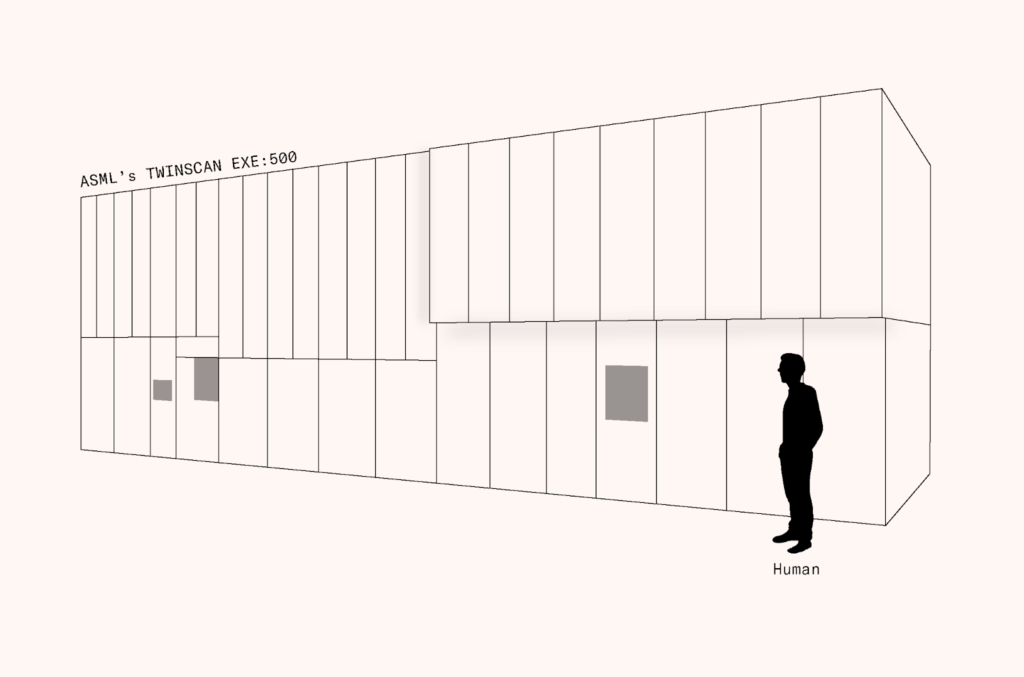
While ASML is now the sole supplier of these machines, and will be for some time to come, it started out as a laggard in the chipmaking industry. Overtaking its competition required many things rarely associated with European companies: close collaboration with the American government, selling large stakes to foreign competitors, and a huge gamble on an unproven technology. 

Let there be light

The key to ASML’s success is a technology called photolithography (sometimes just called lithography). The technique involves transferring a pattern onto a semiconductor wafer by exposing it to light. In the 1950s, the first chipmakers had tried to draw these patterns by hand, but anything that physically touches the wafer scratches it, dirties it, or warps the pattern. Scientists working independently for Bell Labs and the US military realized that they could use light to print identical patterns without making physical contact with the wafer.

To make chips, engineers start with a thin wafer of semiconductor material, usually silicon. This wafer is coated with a chemical called photoresist, which reacts when exposed to light. In photolithography, light is projected through a detailed pattern onto the photoresist-coated wafer, softening the exposed areas. The wafer is washed to remove any softened areas, revealing the silicon underneath. It is then moved to an etching machine that blasts it with charged chlorine or bromine gas, carving the desired pattern into the exposed silicon. These features are later filled with metal, such as tungsten and copper, to connect the transistor to power. These etched layers then combine into an intricate network of transistors. 
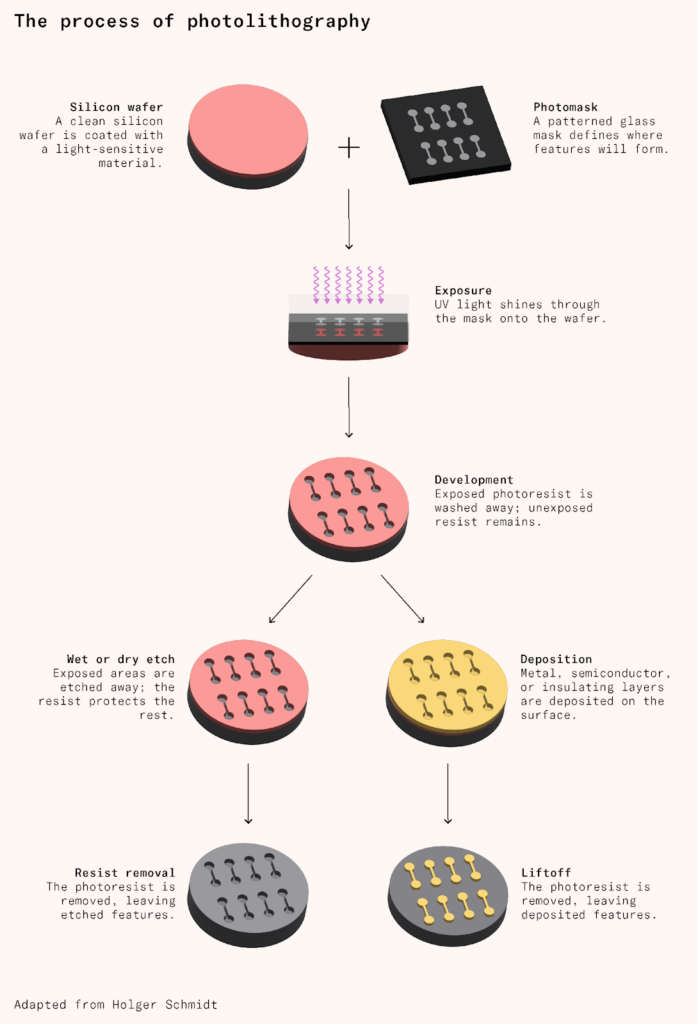
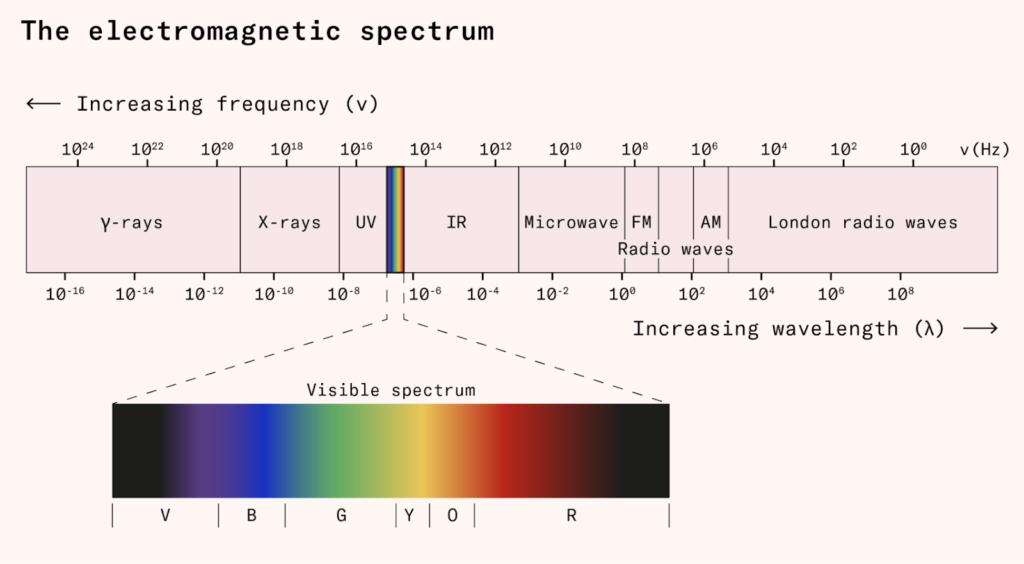
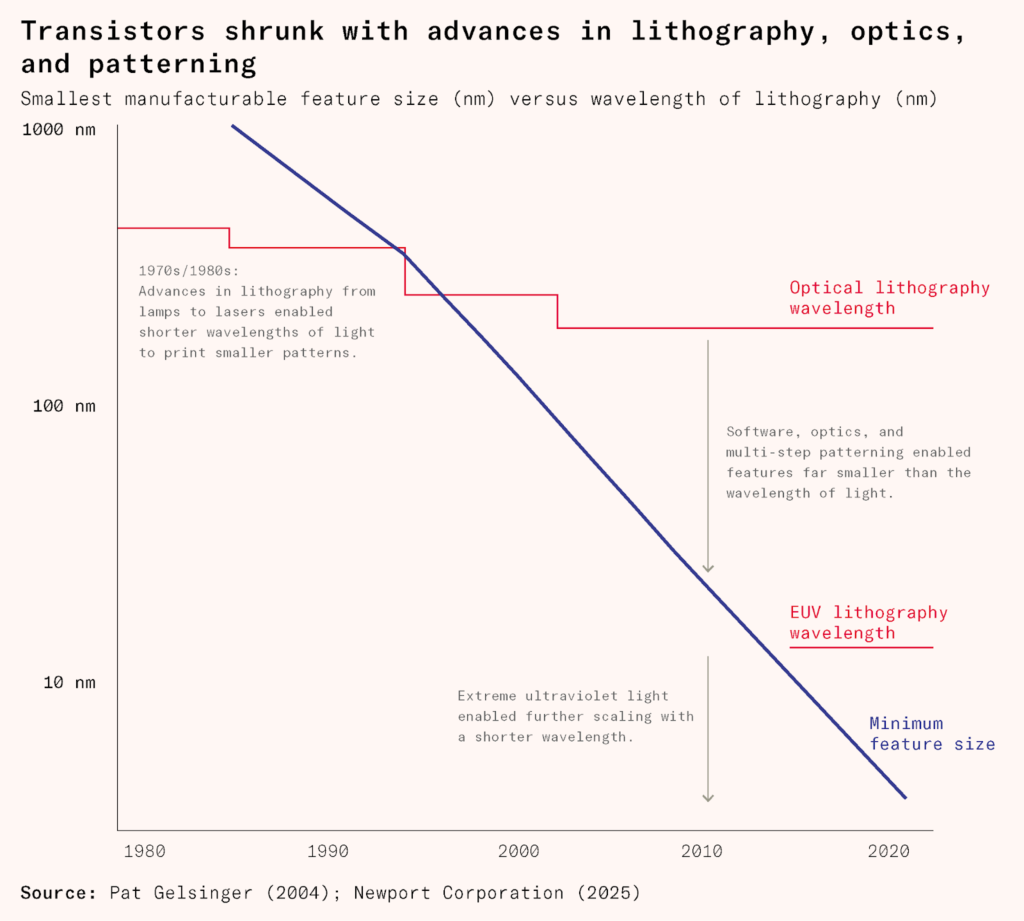
Over time, the semiconductor manufacturing ecosystem has developed increasingly sophisticated etching using ever smaller wavelengths of light. Smaller wavelengths diffract less, allowing the light to travel in straighter lines and print sharper, tinier details without blurring. These allow for more precise pattern projections that, in turn, allow smaller and more densely packed transistors. 

Early lithography relied on mercury vapor lamps that were similar to streetlights, while more modern machines rely on lasers created using argon and fluorine gases. By 2010, such lasers made it possible to create a 22-nanometer feature through multiple exposures using a 193-nanometer wavelength.

The most advanced version of this technology, extreme ultraviolet lithography, is used to make the very smallest chips. The smallest in 2025 were marketed as three nanometers, roughly 25,000 times thinner than a human hair. 

To make them, a droplet of liquid tin is released into a chamber and hit with a single pulse of light, which melts and flattens it. As the droplet continues to fall, a second, more powerful pulse vaporizes the tin, creating an extremely hot plasma that emits light at the narrow wavelengths needed for extreme ultraviolet lithography. The light beam is then concentrated by reflecting it across a series of slightly concave mirrors so flawless that, if scaled to the size of Germany, their imperfections would be measured in millimeters. Engineers need to use mirrors, rather than the glass lenses used in standard lithography, as almost all solid materials absorb light at such short wavelengths.

The light eventually hits the mask, which contains the pattern to be printed on the chip. As the pattern on the mask is usually several times larger than what is wanted on the chip, the light is then reflected by a second system of mirrors. 
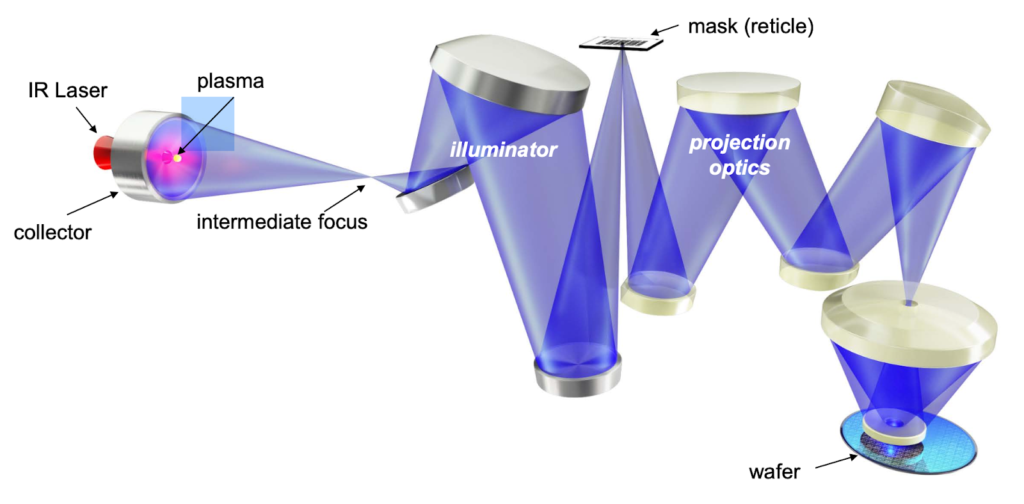
Path of light through an extreme ultraviolet lithography scanner.
Image
ASML.

After the light reflects from the mask, it carries the pattern as a bundle of rays spreading out from each point. The next mirrors tip these rays inward so that, instead of spreading widely, they reunite over a shorter distance. When the rays from each point come together sooner, the picture they form is physically smaller. By repeating this with several carefully shaped mirrors, engineers shrink the pattern by a fixed amount while keeping it in focus. After being shrunk four times, it hits the wafer.

The great shrinking act

Longer wavelengths act like a blunt chisel, suitable for rough shaping, but they struggle to capture finer details. The longer light waves are larger relative to the tiny features on the reticle that they must reflect from. When a wave meets something smaller than itself, it naturally spreads and bends around its edges instead of casting a sharp shadow. To create the same details, the blunt chisel needs to go over the same spot a number of times (creating blurrier edges). Lithography had to take wavelengths all the way to the extreme ultraviolet range to achieve the high resolution patterning needed for cutting-edge process nodes.

Wavelengths as low as 13.5 nanometers can achieve more precise patterns in a single exposure. In fact, extreme ultraviolet lithography can combine three or four photolithography patterning cycles into a single one on a seven-nanometer node. Without EUV, producing five-nanometer nodes might require as many as one hundred different steps. 

Extreme ultraviolet lithography was able to produce more accurate patterns on wafers than older techniques even if they were used multiple times.

Today, ASML dominates the overall market for lithography and has an effective monopoly in extreme ultraviolet lithography. Its EUV machines sell for more than $120 million. With a market capitalization of over $400 billion, ASML is one of Europe’s most valuable companies. But it wasn’t always like this.

Origins

ASML started off life within Philips, the Dutch consumer electronics giant. During the 1970s, Philips had roughly 20 percent of the global electronics market and was a major chipmaker. In this era, lithography machines used wavelengths of over 400 nanometers to pattern 1,000-nanometer features. The industry struggled to shrink features without losing accuracy or letting dust and flaws creep in. Philips began to work on its own prototype, drawing on its expertise in optics and precision mechanics. By the early 1980s, the project was running into trouble. The company was looking to cut costs and engineers estimated that they would need over $280 million in today’s money to finish the machine’s development and production.

In 1984, Philips spun out Advanced Semiconductor Materials Lithography (which later dropped the full name in favor of its acronym) as a joint venture with ASM International, a Dutch conglomerate that sold equipment to the semiconductor industry. The business originally struggled. It had no market share and no brand recognition. Its first product, the PAS 2000, was a commercial failure. The machine used oil pressure, like that in power steering, to move the table that held the wafer during exposure, rather than electric motors. This made it smooth and precise, but it was prone to leaking. At the first conference ASML attended, one industry executive told them: ‘The race has already been run. There’s no room for you here.’ ASML switched back to electric motors.

The company took an unusual approach from the outset. While Japanese giants Nikon and Canon were vertically integrated, ASML outsourced key components like optics and motors so that it could focus on assembling and optimizing the final machine. Given this outsourcing, it made sense for ASML to embrace a modular design with clearly defined subsystems. This approach was mocked in European manufacturing circles. German engineers warned ASML’s leadership that they were ‘asking for trouble’ and would ‘lose all control’ if they didn’t make critical components themselves. But ASML had no choice: it lacked the capital, expertise, and time to build these subsystems from scratch.

By 1988, ASML was on the verge of collapse. ASM International had already pulled out, and Philips considered shutting it down. It was saved by a single Philips board member, Gerd Lorenz, who was particularly worried about Europe’s growing dependence on Asia for strategic technology. Lorenz argued that Europe needed a stake in chip manufacturing. This was enough to convince Philips to give ASML more time, but didn’t fix its fundamental problem: it was still an inferior supplier with no competitive edge.

ASML used the time it was given to develop the PAS 5500, released in 1991 and the company’s first commercial breakout. While Nikon’s contemporary photolithography system was more precise, ASML’s modular design meant that machines could be fixed quickly on site. This reduced downtime and, by making it easy to replace parts when they broke, it was possible to extend the machine’s life. This was a key factor that led John Kelly, IBM’s director of semiconductor R&D, to push IBM to order the PAS 5500 over the Japanese machines. ASML had gone global. 

The first breakthroughs

ASML’s success depended on two projects in the late 1990s and 2000s that gave it a huge advantage in research and development. The first was a public-private partnership, started in 1997, called the Extreme Ultraviolet Limited Liability Company. The Extreme Ultraviolet Limited Liability Company began life as a rescue mission. Before 1997, basic semiconductor research was carried out in a small handful of research labs, all dependent on government grants.

The original program for EUV research was a ‘virtual national lab’ that combined Lawrence Livermore National Laboratory, Sandia National Laboratories, and the Lawrence Berkeley National Laboratory. Each covered a different component: Livermore focused on mirrors and optics, Sandia on the light source and systems engineering, and Berkeley on advanced equipment for testing. But in 1996, Department of Energy budget cuts had placed the virtual national lab program on the chopping block. 

Intel, then the undisputed world leader in microprocessors, was keen to preserve the work and spearheaded the creation of the Extreme Ultraviolet Limited Liability Company, the largest public-private partnership of its kind in the history of the US Department of Energy. During its six-year life, the company invested over $270 million into extreme ultraviolet lithography development, funded by the sale of shares to member companies, giving them a right of first refusal to purchase the photolithography tools being produced.

The company initially restricted membership to American firms. ASML, along with its main Japanese rivals, Canon and Nikon, was initially barred from membership.

The only established semiconductor equipment manufacturer to join the partnership from the beginning was Silicon Valley Group, which had a market share of just 5 percent to ASML’s 20 percent. Fearing the danger of being reliant on such a small manufacturer, the rest of the companies involved concluded that it would be better to open up to foreign firms, rather than risk ceding the entire market.

ASML was allowed to participate so long as it committed to establish a research center in the US and source 55 percent of components for the systems sold in the US from American suppliers. In practice, this commitment was never enforced. Its Japanese competitors were never allowed to join, due to widespread fear in the US of Japanese competition.

The program built up a vast base of intellectual property and process knowledge. These types of public-private partnerships typically grant the participating companies a non-exclusive license to use the intellectual property generated, but in this case the companies in partnership got complete ownership.

In 2001, ASML acquired Silicon Valley Group after it ran into cash flow difficulties, making ASML the sole surviving equipment manufacturer in the partnership. When the consortium produced the first full-scale extreme ultraviolet lithography prototype – the Engineering Test Stand – ASML stood alone at the vanguard of lithography. This was the first demonstration that 13.5-nanometer light could print dense features on a chip.

By the time the Engineering Test Stand was built, the program had already proved that it was possible to generate extreme ultraviolet light reliably, which let engineers start building mirrors and lenses that could be used in real production tools. To solve outstanding questions, such as how to boost the throughput of their machines or increase the power of their light sources in production settings, ASML needed to test its machines in environments close to the real world. But no chipmakers were willing to shoulder a project so large and risky at such an early stage.

The second project essential to ASML’s success was the Belgium-based Interuniversity Microelectronics Centre (IMEC), a research organization that collects machines from different companies and allows researchers to test them in semi-real environments while protecting the companies’ intellectual property. 

As potential customers began to consider different options for next generation lithography technologies, ASML used IMEC to promote its extreme ultraviolet lithography prototype. Topping ASML’s target list was TSMC, which today is the world’s largest semiconductor foundry. Founded in 1987, TSMC’s history had been intertwined with ASML’s since its birth: Philips, ASML’s former parent, owned a 27.5 percent stake in it. Seeing ASML’s machinery exhibited at IMEC was what led TSMC to partner with ASML in EUV development. 

By contrast, Canon and Nikon were tight-lipped about their research and made little effort to cooperate with outside companies. While this theoretically allowed them to maintain greater control over their work, and capture more of the value chain, it also made them solely responsible for simultaneously solving a bewildering array of fundamental physics problems, while assuming all the financial risk of doing so.
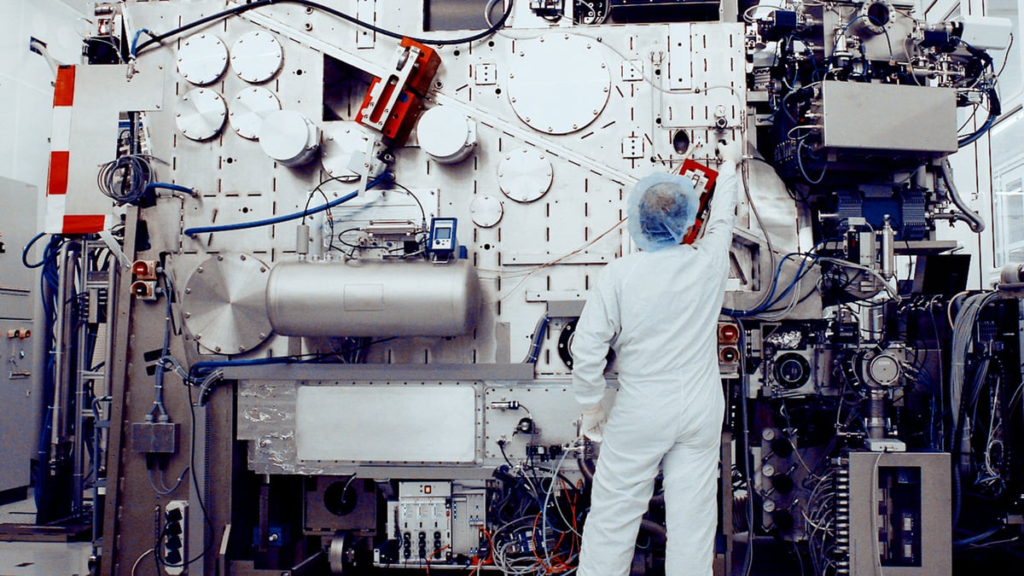
ASML’s prototype extreme ultraviolet lithography system.
Image
ASML.

Since almost all of the parts in ASML’s machines are made by other companies, it has become master of a sprawling supply chain of over five thousand companies. It has diversified its suppliers over the years in a very deliberate way: 80 percent of its spending goes to companies across Europe and the Middle East (notably not the US, despite prior agreements), which reduces the risk of potential export restrictions, tariffs, and other geopolitical risks that may face critical suppliers based in the US or Asia. It also aims for its suppliers to make no more than 25 percent of their revenue from ASML, to force them not to become overreliant on the volatile semiconductor market. 

While most of its components come from a large number of small suppliers, ASML has formed deep bonds with its biggest suppliers. It acquired a 24.9 percent stake in optics manufacturer Zeiss. Peter Leibinger, vice chairman of laser manufacturer Trumpf, has said that ASML and Trumpf are a ‘virtually merged company’

Winning the war

Extreme ultraviolet lithography would not become a successful commercial technology until 2018, over 20 years after the creation of the Extreme Ultraviolet Limited Liability Company and 34 years after IMEC was founded. In the meantime, it was consuming more and more resources. By 2015, ASML was spending more than $1 billion a year on R&D, more than double its 2010 total. According to some estimates, by 2014, the industry had collectively invested over $20 billion in extreme ultraviolet lithography, with no guarantee of any return.

ASML was able to continue pouring money into this black hole partly because it had already beaten its competitors. By 2010, it had two thirds of the overall lithography market and was the dominant supplier for the rapidly growing smartphone market, with deep ties to Intel, Samsung, and TSMC. It had secured this position by winning the decisive technical battle of the 2000s. 

At the start of the millennium, the entire semiconductor industry hit a physical wall. Circuits had been getting steadily smaller for decades by simply switching to shorter wavelengths, but the standard 193-nanometer light (roughly one five-hundredth of the thickness of a human hair) was too blunt to draw smaller circuits. 

Nikon tried to solve this by developing a new light source with a smaller wavelength of 157 nanometers. But this shorter wavelength light was absorbed and distorted by standard glass, forcing Nikon to build lenses out of calcium fluoride, a rare, brittle crystal that was expensive to polish and prone to cracking under heat. The industry poured hundreds of millions of dollars into this ‘dry’ lithography path, only to find the manufacturing challenges insurmountable. 

ASML’s partnerships helped it avoid this dead end. TSMC researcher Burn Lin had advised them to switch to a technology called immersion lithography. ASML continued to use 193-nanometer light but placed a layer of water between the lens and the silicon wafer. Just as a straw appears bent and magnified when placed in a glass of water, the water in the machine bent the light waves, sharpening the focus and allowing smaller circuits to be printed without needing new lenses.

ASML compounded this advantage by introducing a revolutionary machine architecture called TWINSCAN. In older machines, the light source would sit idle while the machine stopped to measure the surface of the silicon wafer to ensure it was flat. ASML replaced this with a dual-stage system: a massive machine with two tables would measure one wafer in the background while another was being printed simultaneously. This eliminated the dead time in the manufacturing process, allowing chipmakers to produce significantly more chips per hour. By the time Nikon abandoned its 157-nanometer project in 2005, ASML had become the industry standard, with 53.2 percent of the market.

ASML’s machines were so much better than the competition that it could charge nearly twice as much for them: $55 million versus $30 million for the comparable Nikon device.

But even this was not enough. While ASML was beginning to ship prototype EUV machines to IMEC from 2006 onwards, they were so slow and prone to breaking down that they were commercially useless. In 2012, ASML, still reeling from the global financial crisis, was struggling to continue financing its EUV efforts.

In a drastic move – part desperate attempt to keep the company’s research efforts afloat and part strategic bet to win the EUV market once and for all – the ASML leadership launched a co-investment program that sold 23 percent of the company to its three largest customers: Intel, TSMC and Samsung. 

The funding also allowed ASML to complete a $2.5 billion acquisition of one of its suppliers, Cymer, which produces lithography light sources. The acquisition allowed ASML to invest in Cymer’s R&D efforts to perfect its soft X-ray light source, which involved hitting fast-moving droplets of tin with such force that they lost electrons, but precisely enough that this did not shed so much debris that it coated the mirrors. They accomplished this by moving from a single pulse to two separate laser pulses: the pre-pulse would shape the droplet and the main pulse would generate the plasma. This improved efficiency and stability. 

ASML’s close partnership with TSMC proved especially critical. In 2014, TSMC launched its first chip for Apple, which was now its largest customer and was putting pressure on the chipmaker to produce higher performance chips than its existing machinery was capable of. It had become urgent for ASML to complete a commercial EUV machine. 

The two companies worked so closely together that Anthony Yen, the Division Director at TSMC responsible for overseeing EUV development, described them as ‘one team’. ASML and TSMC engineers on the ground worked tirelessly, troubleshooting and iterating until they had reached the necessary throughput: 500 wafers a day for a month. 

During this period, the joint team redesigned both the tin-droplet generator and the way the laser hit each droplet. The new setup produced droplets that were about half the original size while still yielding the same ultraviolet energy. Smaller droplets throw off far less debris when vaporized, which slows the rate at which tin builds up on the collector mirror. Because the mirror degrades more slowly, it needs fewer replacements, keeping the machine up and running for longer stretches.

The partnership was a win for ASML, as it was able to work through some of its key engineering and commercialization challenges. It also helped TSMC become an early adopter of the most cutting-edge technology. By 2019, TSMC was ramping up mass production of its seven-nanometer process and the first phones with EUV chips were being sold by the end of the year.
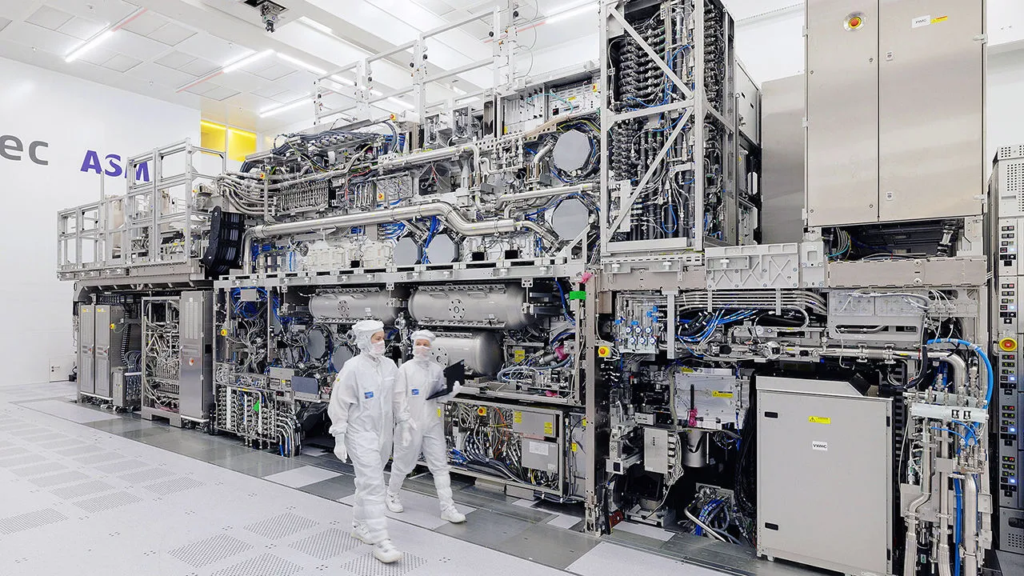
ASML’s most advanced extreme ultraviolet lithography scanner, the TWINSCAN EXE:5000.
Image
ASML.

Meanwhile, competitor firms like Nikon, which had never believed as strongly in extreme ultraviolet lithography, effectively gave up. In its 2013 annual report, Nikon noted that its own EUV progress had not proceeded as planned, and it was not mentioned in an annual report again. With ASML pulling ahead on R&D and locking up key customer demand, and with competitors struggling to justify their own R&D spending in the wake of the financial crisis, ASML became the last company standing in the race to commercialize the technology.

The importance of tacit knowledge

Early on, ASML cultivated a culture that was more risk tolerant than other players in the industry. It promoted high-potential talent early and had a track record of retaining key employees for decades. Much of this is a product of its challenging early years. ASML needed the talent of its younger generation to save the company, so it was more willing to promote and empower them quickly.

For example, Martin Van Den Brink joined ASML in 1984. Within 18 months, aged 29, he became one of two people promoted to lead the development of one of the company’s early flagship projects. He carried on working at ASML for his entire career, serving as president and chief technical officer until his retirement in 2024. This practice was far less common among ASML’s Japanese rivals, who were more hierarchical and tended to reward seniority over performance. 

Retaining the best workers is especially crucial in an area like photolithography, where a huge amount of tacit knowledge is used to assemble its machines. An ASML engineer once told He Rongming, the founder of Shanghai Micro Electronics Equipment, one of China’s top ASML competitors, that the company wouldn’t be able to replicate ASML’s products even if it had the blueprints. He suggested that ASML’s products reflected ‘decades, if not centuries’ of knowledge and experience. ASML’s Chinese competitors have systematically attempted to hire former ASML engineers, and there is at least one documented case of a former ASML employee unlawfully handing over proprietary information. But none of this appears to have narrowed the gap.

A European giant 

ASML is a rare example of a European tech giant. Its success was the result of transatlantic cooperation, not continental parochialism. Had the company not joined a program funded by US chipmakers, Canon and Nikon would likely still dominate a less advanced lithography industry. 

Cooperation with other companies was just as important. While vertical integration gave Nikon and Canon total control, it capped their innovation at the limits of their internal resources. In a system exceeding one hundred thousand components, that ceiling proved fatal. ASML’s modular approach allowed it to import cutting-edge physics by acquiring Cymer and investing in Zeiss, while distributing the risk to customers like Intel and TSMC. This strategy created a collective engine that outspent and outpaced every rival attempting to shoulder the burden alone.

This took a great deal of courage. ASML sank billions of dollars into the development and commercialization of EUV technology, with no guarantee that it would ever work. As late as the 2010s, many semiconductor experts doubted that the technology could be successfully commercialized. Now it is the most important technology in the world. 

But ASML, and by extension the continent, cannot stand still. As ASML enjoys its place as an indispensable pillar in one of the world’s most important industries, others are working to create a new paradigm in chip technology. Moore’s Law probably doesn’t end here, and in a matter of years, five nanometers won’t be small enough.

Read the whole story
bogorad
2 hours ago
reply
Barcelona, Catalonia, Spain
Share this story
Delete

Musk Vies to Turn X Into Super App With Banking Tool Near Launch - Bloomberg

1 Share

LLM (google/gemini-3.1-flash-lite-preview-20260303) summary:

  • Grandiose Vision: the project attempts to mimic monopolistic chinese super apps to force users into a single digital ecosystem.
  • Dubious Incentives: current claims of inflated interest rates and cashback perks appear to be temporary bait for a suspicious user base.
  • Chronic Indiscipline: historical data suggests the billionaire regularly manufactures optimistic timelines that repeatedly collapse under reality.
  • Regulatory Friction: the platform currently lacks mandatory licenses in several states due to legitimate concerns regarding consumer safety and corporate governance.
  • Infrastructure Deficits: the service lacks basic transactional necessities such as verified one-click purchasing which remain absent from the ecosystem.
  • Control Mechanisms: creators are being forced onto the proprietary platform to ensure a captive and coerced initial user population.
  • Opaque Operations: fundamental details regarding long-term pricing and functional viability remain entirely undisclosed to the public.
  • Systemic Distrust: state regulators and public officials have formally questioned whether a platform with a history of safety liquidation should handle sensitive financial assets.

More than three years after acquiring Twitter, Elon Musk says he’s nearing his long-stated goal of turning it into an “everything app” with a new financial services tool that he pledged to launch for the public this month.

X Money, a banking and payments platform built inside the social network now known as X, is expected to make its early public access debut imminently, based on the timeframe offered by Musk last month. Early users testing the service have touted competitive perks, including 3% cash back on eligible purchases and a 6% interest rate on cash savings — the latter of which is roughly 15 times the national average.

Musk’s new product is also expected to offer free peer-to-peer transfers, a metal Visa debit card personalized with a user’s X handle, and an AI concierge built by Musk’s xAI startup that tracks spending and sorts through past transactions, according to reports from users with early access.

Musk, who first rose to prominence in Silicon Valley by co-founding PayPal Holdings Inc., sees payments as crucial to creating a so-called super app similar to social products that have flourished in China. WeChat, for example, lets users hail a ride, book a flight and pay off their credit card. As Musk told employees in February, “We want it to be such that, if you want to, you could live your life on the X app.”

If it works, X Money would sit at the intersection of social media and finance in a way no American product has attempted at this scale. However, the super-app model has yet to take off in the US. Several key details about Musk’s payments project also remain unclear, including pricing, the full set of features and the date when it will be widely available.

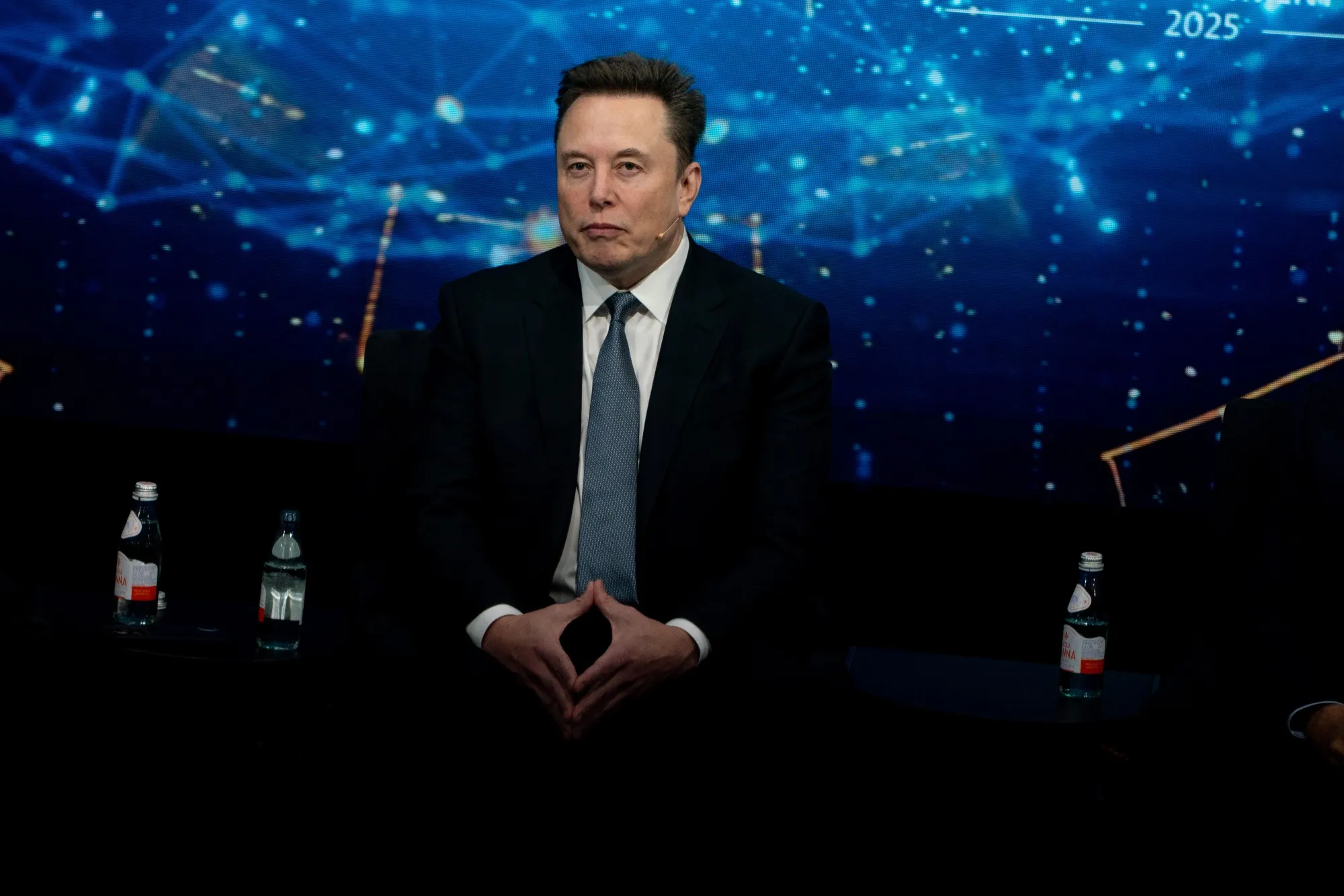
Elon Musk Photographer: Stefani Reynolds/Bloomberg

Musk is known for making bold promises and missing his own deadlines. In this case, he’s contending with regulatory headaches and delays: X Money still lacks payment licenses in several states including New York, where lawmakers have questioned whether the billionaire should be trusted with people’s money.

The customer rewards remain to be seen, too. Though X Money’s potential 6% savings rate would exceed rival consumer finance services from SoFi Technologies Inc., Block Inc. and LendingClub Corp., Musk’s company has not said whether that rate is permanent or promotional. A spokesperson for X did not respond to requests for comment.

Richard Crone, the founder of Crone Consulting LLC and an industry watcher who has tracked the payments sector for years, is skeptical of X Money’s prospects.

“He promised this vision more than two years ago, and he said they’d have it within a year,” Crone said. “This may be a day late and a dollar short.”

Missing features and deadlines

Musk does have advantages few fintech founders can claim: a platform with 600 million monthly users; a captive base of content creators already being paid through X; and his own history helping to build a pioneering payments service.

Creators who currently receive payments from X for engagement will be switched from Stripe to X Money as their payment platform, according to early users — a move that guarantees an initial base of active accounts.

Some have already been testing X Money to send payments to one another through the app’s chat feature or directly through their profiles, according to early participants in the rollout. It’s unclear what would happen to a user’s X Money account if their X profile gets banned or suspended.

While peer-to-peer payments are a popular feature for everyday use, it’s usually a loss leader for businesses that facilitate them, said Harshita Rawat, a senior research analyst at Bernstein Institutional Services LLC. The real prize comes when you can convince people to do the rest of their banking on a platform, including credit purchases and loans.

“Becoming the primary bank account is hard,” Rawat said. “I’m not saying it cannot be done, but I think you need to figure out an angle for that.”

Some payments industry veterans see a more basic problem: X still lacks the infrastructure to make buying things on the platform frictionless, a prerequisite for any app that wants to handle real commerce.

“He doesn’t have a one-click buy, and he needs that or e-commerce on his site will lag,” Crone said.

X Money touts features that could include a 6% interest rate on cash savings and 3% cash back on eligible purchases. Photographer: Brent Lewin/Bloomberg

Musk’s timeline for the project has also slipped repeatedly due to regulatory hurdles. Operating a payments platform in the US requires licenses from all 50 states, and Musk underestimated the process. During a 2023 all-hands meeting, he predicted X would secure the necessary approvals “in the next few months.” X currently holds licenses in 44 states, according to its website, and likely won’t be able to operate in states where it hasn’t obtained a license.

In a letter last year, then-New York state senator Brad Hoylman-Sigal and assembly member Micah Lasher called for the state’s Department of Financial Services to deny Musk’s application. They cited his “pattern of reckless conduct, in both business and government, that has put consumers at risk,” including Musk’s role in dismantling the Consumer Financial Protection Bureau while leading the Department of Government Efficiency.

Documents and emails obtained by Bloomberg through public records requests show that state regulators have also required detailed explanations of X’s business model and security features, with lawyers for the company sometimes fielding multiple rounds of follow-up questions. In at least one case, regulators expressed concern about Musk’s early track record with X, where he slashed much of the staff including many working on safety initiatives.

A payments regulator in Texas sought feedback from other states while reviewing the company’s application in June 2024, saying he had “a few concerns” with X’s application, according to the emails. Specifically, the regulator wanted to discuss “Mr. Musk’s troubled history with the SEC,” as well as the “financial condition of X Payments LLC’s parent company, X Corp.”

The request led to a multi-state conference call in the summer of 2024, according to emails and a person familiar with the discussion. Texas approved X’s application three months later.

Earlier in April, Senator Elizabeth Warren of Massachusetts — a frequent Musk critic — sent a letter to Musk raising questions about X Money’s yield economics and its banking arrangements, as well as broader concerns about its impact on the financial system.

“Your failure to operate X in a safe and responsible manner does not breed confidence in your ability to safely expand into consumer finance,” she said. X is still awaiting a payments license in Massachusetts.

Read the whole story
bogorad
2 hours ago
reply
Barcelona, Catalonia, Spain
Share this story
Delete

Don’t Bet on Unions. Competition is a Better Cure

1 Share

LLM (google/gemini-3.1-flash-lite-preview-20260303) summary:

  • Political Grandstanding: the mayor promotes ineffective collective bargaining schemes to consolidate power while ignoring economic reality
  • Economic Obsolescence: organized labor artificially inflates wages without increasing productivity leading to stagnant growth
  • Corporate Illusion: belief that businesses absorb all costs is a naive misunderstanding of market mechanics and price pass-through
  • Job Destruction: monopolistic labor practices historically correlate with the decline of key industries and manufacturing employment
  • Exclusionary Tactics: current systems prioritize existing members at the expense of new workers seeking employment opportunities
  • Cost Burden: higher wage mandates inevitably manifest as increased prices damaging the purchasing power of the average consumer
  • Market Flexibility: competitive labor environments provide greater long-term job security through investment and business formation
  • Rational Reform: true economic prosperity requires competitive tax policies and deregulation rather than bureaucratic union expansion

Courtesy Michael M. Santiago/Getty Images

On Sunday, New York City Mayor Zohran Mamdani spoke at a rally for the launch of Union Now, a new organization aimed at expanding organized labor’s reach. It’s the latest in a series of early pro-union moves by the mayor, including joining a nurses’ strike picket line and pushing to unionize tenants.

Mamdani’s approach is misguided. Competition, not unionization, is the surer path to improving conditions for both workers and tenants. In fact, more unions will mainly accomplish one “goal”: consolidating political support for policies that ultimately make the affordability crisis worse.

It is well established that labor unions—which secure exclusive bargaining rights over workers’ terms of employment—can raise wages for their members relative to what they would otherwise have been paid. But unless matched by increases in productivity, the gains amount to rent seeking, extracting benefits without greater output. A 2025 National Bureau of Economic Research study, for example, found that most of the wage gap between unionized and nonunionized workers reflect unions’ ability to extract more rents for workers, rather than underlying productivity differences.

Who bears these costs? At Sunday’s rally, Sara Nelson, president of the Association of Flight Attendants-CWA, suggested they fall largely on management and corporate profits. “Too often, the boss has all the power to starve workers during a fight,” she said. “Union Now will work with unions directly to ensure workers have the means to win.”

In reality, the burden is often more diffuse. In highly competitive industries, where firms have limited ability to pass on higher labor costs, those higher costs might indeed take the form of lower profits. A 2011 study estimates that, if the entire economy were unionized, profits would fall by 20 percent.

But that is not necessarily a win for workers. Lower expected profits tend to reduce investment, slow business formation, and push jobs to places where compensation more closely reflects productivity (or offshores them entirely). A 2025 Mercatus Center study of the Rust Belt echoes this pattern, finding that “[u]nions wielding monopoly privileges and fueling strikes and labor conflicts were responsible for 55 percent of the region’s decline in US manufacturing employment.”

For poorer workers, the effect is especially pronounced. Unions’ use of coercive power to extract higher wages for existing workers comes at the expense of outsiders who might otherwise have worked for less. The result is higher unemployment and fewer opportunities. Empirical data show that private-sector job growth in right-to-work states has been far more robust than in non-right-to-work states.

Then there’s the other side of the equation: since only a portion of union-driven cost increases comes out of profits, much of the rest is borne by consumers in the form of higher prices. And since most people are both workers and consumers, higher wages are often offset by higher prices.

A more promising approach is to encourage competition. Moving away from New York’s union-dominated labor markets—through policies like right-to-work laws, which eliminate mandatory union membership—aligns wages more closely with productivity and expands opportunities for workers. Just as important, it lowers costs for consumers by reducing the upward pressure on prices.

The benefits show up in investment and job creation. States with more flexible labor markets tend to attract more business investment, which in turn drives employment growth. The job security unions provide—making it harder to dismiss workers—is real for those inside the system. But a more dynamic labor market offers a different kind of security: the ability to find new opportunities quickly, often on terms that exceed standardized union contracts.

Right-to-work laws aren’t the only path forward for New York, though they would be a step in the right direction. The state ranks last on the Tax Foundation’s Competitiveness Index, and the group’s 2026 report outlines several ways to improve that standing. Fully repealing New York’s capital stock tax, allowing full expensing of investments in machinery and equipment, and cutting corporate taxes are just a few sensible measures the state could adopt to expand investment and give workers more options.

While unions fall short as an economic solution to New York’s affordability crisis, they have nonetheless proven effective as a political force. That helps explain Mamdani’s emphasis on expanding them. But for New Yorkers concerned with rising costs, the priority should be on policies that increase competition, attract investment, and expand opportunity rather than on merely redistributing a shrinking pie.

Share

Read the whole story
bogorad
3 hours ago
reply
Barcelona, Catalonia, Spain
Share this story
Delete
Next Page of Stories