Strategic Initiatives
12252 stories
·
45 followers

The end of sex? How human reproduction could soon change forever | BBC Science Focus Magazine

1 Comment

LLM (google/gemini-3.1-flash-lite-preview-20260303) summary:

  • Reproductive Disassociation: technological progress aims to sever the historical link between sexual activity and the creation of offspring.
  • Gametic Engineering: laboratory manipulation of skin cells into artificial eggs and sperm intends to bypass biological fertility limitations.
  • Unibaby Conception: individual genetic material could theoretically be used to produce children without the traditional requirement of a partner.
  • Multiplex Parenting: speculative assembly of human embryos using genetic contributions from large groups of multiple individuals.
  • Genetic Modification: the crispr toolset allows for invasive alterations to embryonic dna with permanent consequences for future generations.
  • Designer Fetalism: technical capabilities for embryo editing raise inevitable alarms regarding the manufacture of enhanced human traits.
  • Synthetic Gestation: ongoing development of artificial wombs promises to liberate the reproductive process from female biological vessels.
  • Ethics Deficit: regulatory and moral consensus lags behind the reckless pursuit of harvesting human embryos for experimental purposes.

Over the past decade, I have made some bold predictions about the future of sex. One that’s been easy is that people will still be having sex for years to come, but for different reasons: they simply won’t do it so much to make babies.

That’s not to say that making babies will become obsolete, but, rather, that technology will change the ways we do it. There could be a much safer and easier way to reproduce – and sex as we know it could end.

Until about a century ago, humans always created embryos and babies in the same old, largely random way – through sex. Then some started using artificial insemination and, 45 years ago, in vitro fertilisation. Important as these technologies have been, they still involve human eggs and sperm.

Thanks to stem cell technologies, though, that will shift.

The step change will be in vitro gametogenesis (IVG) – turning skin cells into induced pluripotent stem cells, then turning those into eggs and sperm. IVG is tremendously exciting to millions of couples, but it does raise some tricky questions.

For example, if we could make eggs from skin cells, 90-year-olds could become genetic parents. So could nine-year-olds, miscarried foetuses or people who have been dead for years, but whose cells were frozen.

Also consider this: what if we could make sperm from women’s skin cells, or eggs from men’s? It could soon be a reality. In 2023, Japanese scientists announced that they had made eggs from a male mouse’s skin cells and, using ‘normal’ mouse sperm, had produced mouse pups.

To take this idea further, what if we made both eggs and sperm from the same person and used them to make embryos?

Your ‘unibaby’ wouldn’t be a clone, but closer to you than your siblings. An even more radical idea called ‘multiplex parenting’ could involve making embryos from four people that would then be used to make eggs and sperm.

Turn that fertilised egg into a baby and you’ve got a child with roughly equal genetic contributions from four parents – or eight, or sixteen, or more.

Developing technology

Another technology that could end reproduction as we know it is the power to modify an embryo’s DNA. Targeted editing of particular sequences in a cell’s DNA has become possible thanks to a revolutionary tool, invented in 2012, targeting CRISPR (Clustered Regularly Interspaced Short Palindromic Repeats) DNA sequences (below).

In November 2018, Chinese scientist He Jiankui announced the birth of two girls whose embryos he had ‘CRISPRed’ earlier that year. Unfortunately, he did this work in secret, in ways that violated both human research ethics and Chinese law.

A Chinese court sentenced him to three years in prison, and the court of international opinion condemned him as a renegade. (Those first two babies are now over five years old, but China has released no information about their health or genetic makeup.)

Colorful 3d Illustration of a in-vitro fertilization of an egg cell.The debate around genetically engineering embryos for specific traits – so-called 'designer babies' – is intensifying as science progresses - Photo credit: Getty

When you edit DNA in an early embryo, you edit the DNA in what will become all of its cells – including its eggs and sperm. You therefore make a change that can be passed on to that embryo’s descendants indefinitely.

The most plausible use of this DNA-editing technology is to prevent diseases or disabling conditions in children. The most frightening, though implausible, use is to use it to create ‘super babies’ who would not only have greater abilities, but would also pass them on to their offspring.

Some think that we should never be allowed to change the DNA of our descendants, potentially forever; others think that we shouldn’t use it now, because it’s not proven safe or effective.

Read more:

Another technology that could make sex for reproduction further redundant is the development of artificial wombs. Over 90 years ago, in Brave New World, Aldous Huxley predicted ‘hatcheries’ in which human foetuses would develop in bottles.

In 2017, researchers reported keeping neonatal lambs born a week or two early alive in fluid-filled plastic bags. More recently, the US Food and Drug Administration held a public meeting to consider whether, when and how to run trials with such artificial wombs on babies.

These devices are, in effect, early incubators. They might push back viability for premature infants a week or two, from (at best) about 22 weeks of pregnancy to nearer 20, but that baby would still need to have spent four and a half months developing inside a woman.

This advance could be wonderful for premature infants and their parents, but would not make much difference for most of us.

What about a ‘true’ artificial uterus – one that could take a six- or seven-day embryo and help it develop over nine months into a healthy newborn? That would remove not only the sex from making babies, but pregnancy as well. Some might welcome it. Others would, no doubt, be concerned.

All this might not be implausible in the far future. A major area of long-term research today is using stem cells to grow human organs. The focus is on vital organs for transplants – kidneys, livers, hearts – but if they can be grown, why not a uterus?

Concept illustration of a fetus development in an artificial gestational sac.Science may soon make it possible to grow a foetus entirely outside the womb – but should it? - Photo credit: Getty

Imagine that organ, grown from a woman’s stem cells, hooked up to a machine that would provide blood, sugar, oxygen and all the necessary hormones, as well as waste treatment – then add in an embryo. Such a ‘womb in a box’ could, in theory at least, take the place of a womb in a woman.

But should it? Our children and grandchildren will likely need to make that decision.

This is an amazing time to be involved in medicine and biology. Our knowledge is expanding astonishingly. Our ability to make good use of that knowledge is growing more slowly, but steadily. Our understanding of the consequences of using new technologies – and our agreement on what limits, if any, should be placed on it – are growing more slowly still.

Making babies artificially is not an exception, though it is special in one important way. I am able to consent to an experimental procedure, agreeing to the risks in return for potential benefits to myself or to science. Babies can’t consent; nor can embryos.

That doesn’t mean that we shouldn’t ever use new technologies in reproduction, but it does mean that we should be especially careful to test the technologies to make sure that they are safe and effective – for the babies.

We need to emphasise their welfare first, then the broader effects on our societies.

Read more:

Read the whole story
bogorad
1 hour ago
reply
forget the sex, the rest is mind-blowing.
Barcelona, Catalonia, Spain
Share this story
Delete

The world’s most complex machine - Works in Progress Magazine

1 Share

LLM (google/gemini-3.1-flash-lite-preview-20260303) summary:

  • Technological Evolution: modern transistors have shrunk exponentially, enabling vast computing power increases compared to early guidance systems through microscopic switching capabilities.
  • Monopolistic Dominance: the global semiconductor supply chain fixates on a single dutch firm that controls the only machines capable of printing high density transistor patterns.
  • Resource Intensive Machinery: these massive lithography scanners require thousands of components and complex mirror arrangements to project light at extreme ultraviolet wavelengths.
  • Corporate Bureaucracy: failing initially as a philips spin-off, the enterprise survived only through state-backed interference and a desperate pivot to off-the-shelf component assembly.
  • Coerced Strategic Alliances: the firm manipulated its way into american research partnerships, utilizing foreign capital to socialize the immense financial risks of unproven technologies.
  • Public Private Schemes: massive injections of government-linked funding and consumer-side subsidies created an artificial market landscape that stifled legitimate competition from established rivals.
  • Tacit Knowledge Hoarding: technical superiority is shielded not just by patents, but by an insular culture of institutional memory that prevents external entities from reverse-engineering the system.
  • Precarious Market Standing: despite being deemed an indispensable european giant, the company remains tethered to volatile geopolitical interests and the endless, costly pursuit of scaling limits.

The phones we carry around in our pockets have two million times more memory and are thousands of times faster than the room-sized computers that guided the Apollo mission to the Moon. This incredible shrinking act has been driven by our ability to make transistors smaller and smaller.

Each transistor is a microscopic switch that can alternate between a one and a zero, the basic language of all computing. Billions are packed onto tiny silicon chips called semiconductors. The more transistors that fit onto a chip, the more logic and memory circuits it holds, and the more it can do. 
Get the print magazine

Subscribe for $100 to receive six beautiful issues per year.

Subscribe

Advanced semiconductors are, arguably, the most important technology in the world. Over the last five years, they have even emerged as a geopolitical flashpoint between the US and China. But for all this rivalry, any country or company that hopes to manufacture semiconductors is dependent on a single firm: ASML. Dubbed a relatively obscure Dutch companyby the BBC in 2020, ASML makes the only machines in the world capable of stenciling the transistors onto chips with the precision necessary to fit billions on a 30-centimeter wafer.

These machines are roughly the size of double-decker buses. To ship one requires 40 freight containers, three cargo planes, and 20 trucks. They are the world’s most complex objects. Each contains over one hundred thousand components, all of which have to be perfectly calibrated for the machine to produce light consistently at the right wavelength.
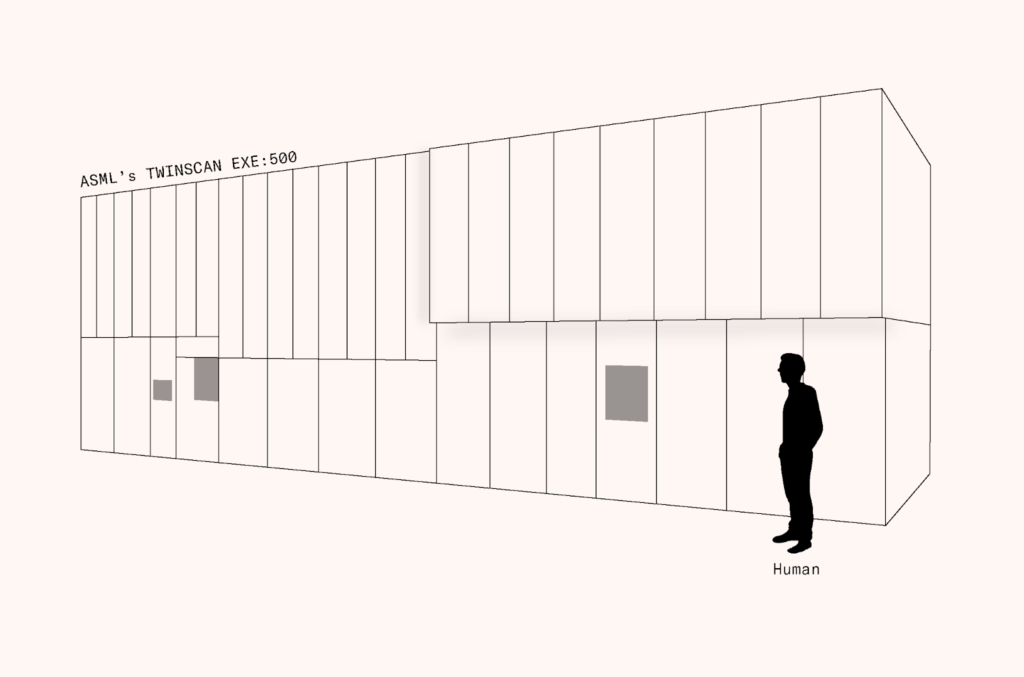
While ASML is now the sole supplier of these machines, and will be for some time to come, it started out as a laggard in the chipmaking industry. Overtaking its competition required many things rarely associated with European companies: close collaboration with the American government, selling large stakes to foreign competitors, and a huge gamble on an unproven technology. 

Let there be light

The key to ASML’s success is a technology called photolithography (sometimes just called lithography). The technique involves transferring a pattern onto a semiconductor wafer by exposing it to light. In the 1950s, the first chipmakers had tried to draw these patterns by hand, but anything that physically touches the wafer scratches it, dirties it, or warps the pattern. Scientists working independently for Bell Labs and the US military realized that they could use light to print identical patterns without making physical contact with the wafer.

To make chips, engineers start with a thin wafer of semiconductor material, usually silicon. This wafer is coated with a chemical called photoresist, which reacts when exposed to light. In photolithography, light is projected through a detailed pattern onto the photoresist-coated wafer, softening the exposed areas. The wafer is washed to remove any softened areas, revealing the silicon underneath. It is then moved to an etching machine that blasts it with charged chlorine or bromine gas, carving the desired pattern into the exposed silicon. These features are later filled with metal, such as tungsten and copper, to connect the transistor to power. These etched layers then combine into an intricate network of transistors. 
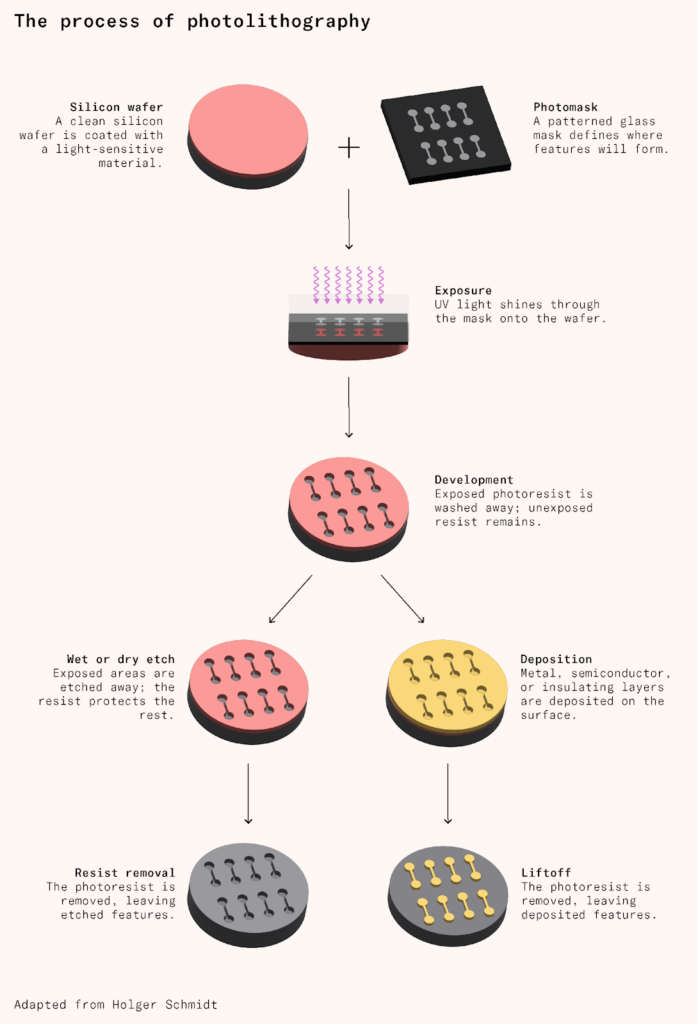
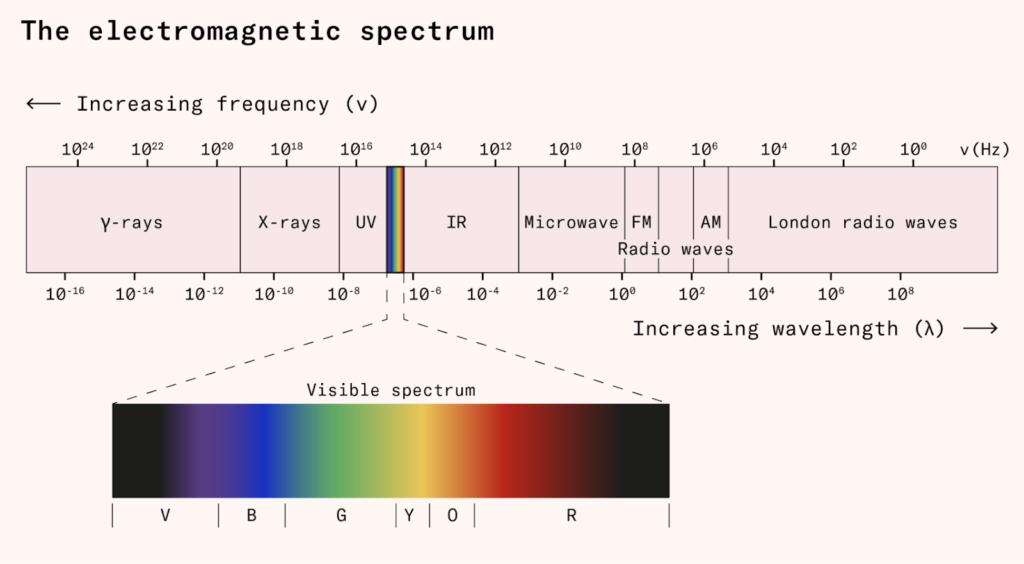
Over time, the semiconductor manufacturing ecosystem has developed increasingly sophisticated etching using ever smaller wavelengths of light. Smaller wavelengths diffract less, allowing the light to travel in straighter lines and print sharper, tinier details without blurring. These allow for more precise pattern projections that, in turn, allow smaller and more densely packed transistors. 

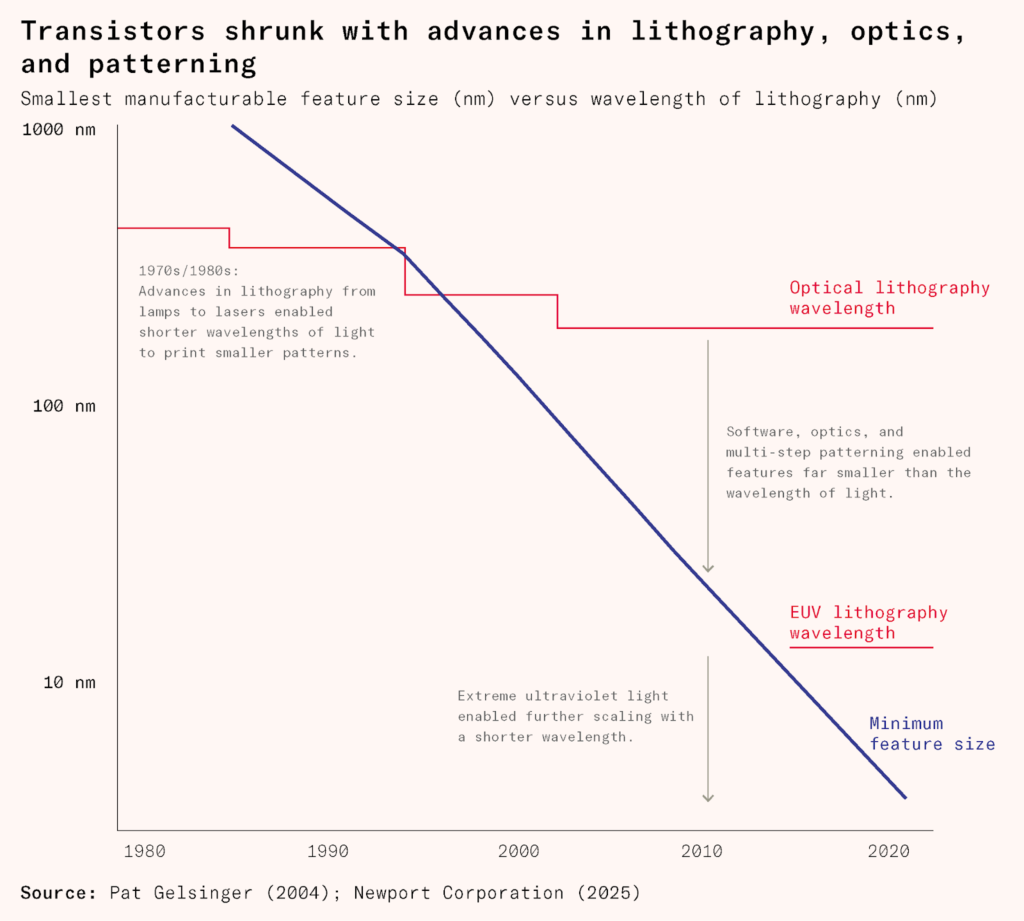
Early lithography relied on mercury vapor lamps that were similar to streetlights, while more modern machines rely on lasers created using argon and fluorine gases. By 2010, such lasers made it possible to create a 22-nanometer feature through multiple exposures using a 193-nanometer wavelength.

The most advanced version of this technology, extreme ultraviolet lithography, is used to make the very smallest chips. The smallest in 2025 were marketed as three nanometers, roughly 25,000 times thinner than a human hair. 

To make them, a droplet of liquid tin is released into a chamber and hit with a single pulse of light, which melts and flattens it. As the droplet continues to fall, a second, more powerful pulse vaporizes the tin, creating an extremely hot plasma that emits light at the narrow wavelengths needed for extreme ultraviolet lithography. The light beam is then concentrated by reflecting it across a series of slightly concave mirrors so flawless that, if scaled to the size of Germany, their imperfections would be measured in millimeters. Engineers need to use mirrors, rather than the glass lenses used in standard lithography, as almost all solid materials absorb light at such short wavelengths.

The light eventually hits the mask, which contains the pattern to be printed on the chip. As the pattern on the mask is usually several times larger than what is wanted on the chip, the light is then reflected by a second system of mirrors. 
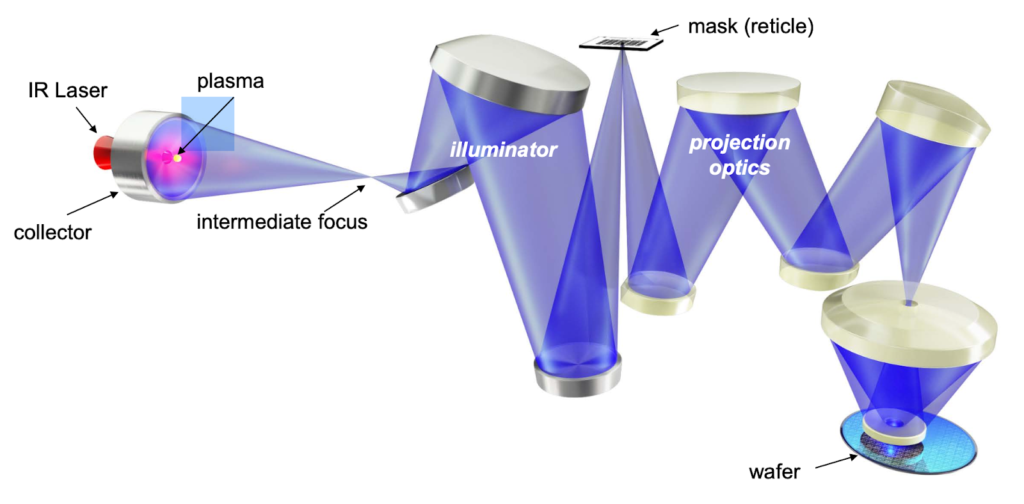
Path of light through an extreme ultraviolet lithography scanner.
Image
ASML.

After the light reflects from the mask, it carries the pattern as a bundle of rays spreading out from each point. The next mirrors tip these rays inward so that, instead of spreading widely, they reunite over a shorter distance. When the rays from each point come together sooner, the picture they form is physically smaller. By repeating this with several carefully shaped mirrors, engineers shrink the pattern by a fixed amount while keeping it in focus. After being shrunk four times, it hits the wafer.

The great shrinking act

Longer wavelengths act like a blunt chisel, suitable for rough shaping, but they struggle to capture finer details. The longer light waves are larger relative to the tiny features on the reticle that they must reflect from. When a wave meets something smaller than itself, it naturally spreads and bends around its edges instead of casting a sharp shadow. To create the same details, the blunt chisel needs to go over the same spot a number of times (creating blurrier edges). Lithography had to take wavelengths all the way to the extreme ultraviolet range to achieve the high resolution patterning needed for cutting-edge process nodes.

Wavelengths as low as 13.5 nanometers can achieve more precise patterns in a single exposure. In fact, extreme ultraviolet lithography can combine three or four photolithography patterning cycles into a single one on a seven-nanometer node. Without EUV, producing five-nanometer nodes might require as many as one hundred different steps. 

Extreme ultraviolet lithography was able to produce more accurate patterns on wafers than older techniques even if they were used multiple times.

Today, ASML dominates the overall market for lithography and has an effective monopoly in extreme ultraviolet lithography. Its EUV machines sell for more than $120 million. With a market capitalization of over $400 billion, ASML is one of Europe’s most valuable companies. But it wasn’t always like this.

Origins

ASML started off life within Philips, the Dutch consumer electronics giant. During the 1970s, Philips had roughly 20 percent of the global electronics market and was a major chipmaker. In this era, lithography machines used wavelengths of over 400 nanometers to pattern 1,000-nanometer features. The industry struggled to shrink features without losing accuracy or letting dust and flaws creep in. Philips began to work on its own prototype, drawing on its expertise in optics and precision mechanics. By the early 1980s, the project was running into trouble. The company was looking to cut costs and engineers estimated that they would need over $280 million in today’s money to finish the machine’s development and production.

In 1984, Philips spun out Advanced Semiconductor Materials Lithography (which later dropped the full name in favor of its acronym) as a joint venture with ASM International, a Dutch conglomerate that sold equipment to the semiconductor industry. The business originally struggled. It had no market share and no brand recognition. Its first product, the PAS 2000, was a commercial failure. The machine used oil pressure, like that in power steering, to move the table that held the wafer during exposure, rather than electric motors. This made it smooth and precise, but it was prone to leaking. At the first conference ASML attended, one industry executive told them: ‘The race has already been run. There’s no room for you here.’ ASML switched back to electric motors.

The company took an unusual approach from the outset. While Japanese giants Nikon and Canon were vertically integrated, ASML outsourced key components like optics and motors so that it could focus on assembling and optimizing the final machine. Given this outsourcing, it made sense for ASML to embrace a modular design with clearly defined subsystems. This approach was mocked in European manufacturing circles. German engineers warned ASML’s leadership that they were ‘asking for trouble’ and would ‘lose all control’ if they didn’t make critical components themselves. But ASML had no choice: it lacked the capital, expertise, and time to build these subsystems from scratch.

By 1988, ASML was on the verge of collapse. ASM International had already pulled out, and Philips considered shutting it down. It was saved by a single Philips board member, Gerd Lorenz, who was particularly worried about Europe’s growing dependence on Asia for strategic technology. Lorenz argued that Europe needed a stake in chip manufacturing. This was enough to convince Philips to give ASML more time, but didn’t fix its fundamental problem: it was still an inferior supplier with no competitive edge.

ASML used the time it was given to develop the PAS 5500, released in 1991 and the company’s first commercial breakout. While Nikon’s contemporary photolithography system was more precise, ASML’s modular design meant that machines could be fixed quickly on site. This reduced downtime and, by making it easy to replace parts when they broke, it was possible to extend the machine’s life. This was a key factor that led John Kelly, IBM’s director of semiconductor R&D, to push IBM to order the PAS 5500 over the Japanese machines. ASML had gone global. 

The first breakthroughs

ASML’s success depended on two projects in the late 1990s and 2000s that gave it a huge advantage in research and development. The first was a public-private partnership, started in 1997, called the Extreme Ultraviolet Limited Liability Company. The Extreme Ultraviolet Limited Liability Company began life as a rescue mission. Before 1997, basic semiconductor research was carried out in a small handful of research labs, all dependent on government grants.

The original program for EUV research was a ‘virtual national lab’ that combined Lawrence Livermore National Laboratory, Sandia National Laboratories, and the Lawrence Berkeley National Laboratory. Each covered a different component: Livermore focused on mirrors and optics, Sandia on the light source and systems engineering, and Berkeley on advanced equipment for testing. But in 1996, Department of Energy budget cuts had placed the virtual national lab program on the chopping block. 

Intel, then the undisputed world leader in microprocessors, was keen to preserve the work and spearheaded the creation of the Extreme Ultraviolet Limited Liability Company, the largest public-private partnership of its kind in the history of the US Department of Energy. During its six-year life, the company invested over $270 million into extreme ultraviolet lithography development, funded by the sale of shares to member companies, giving them a right of first refusal to purchase the photolithography tools being produced.

The company initially restricted membership to American firms. ASML, along with its main Japanese rivals, Canon and Nikon, was initially barred from membership.

The only established semiconductor equipment manufacturer to join the partnership from the beginning was Silicon Valley Group, which had a market share of just 5 percent to ASML’s 20 percent. Fearing the danger of being reliant on such a small manufacturer, the rest of the companies involved concluded that it would be better to open up to foreign firms, rather than risk ceding the entire market.

ASML was allowed to participate so long as it committed to establish a research center in the US and source 55 percent of components for the systems sold in the US from American suppliers. In practice, this commitment was never enforced. Its Japanese competitors were never allowed to join, due to widespread fear in the US of Japanese competition.

The program built up a vast base of intellectual property and process knowledge. These types of public-private partnerships typically grant the participating companies a non-exclusive license to use the intellectual property generated, but in this case the companies in partnership got complete ownership.

In 2001, ASML acquired Silicon Valley Group after it ran into cash flow difficulties, making ASML the sole surviving equipment manufacturer in the partnership. When the consortium produced the first full-scale extreme ultraviolet lithography prototype – the Engineering Test Stand – ASML stood alone at the vanguard of lithography. This was the first demonstration that 13.5-nanometer light could print dense features on a chip.

By the time the Engineering Test Stand was built, the program had already proved that it was possible to generate extreme ultraviolet light reliably, which let engineers start building mirrors and lenses that could be used in real production tools. To solve outstanding questions, such as how to boost the throughput of their machines or increase the power of their light sources in production settings, ASML needed to test its machines in environments close to the real world. But no chipmakers were willing to shoulder a project so large and risky at such an early stage.

The second project essential to ASML’s success was the Belgium-based Interuniversity Microelectronics Centre (IMEC), a research organization that collects machines from different companies and allows researchers to test them in semi-real environments while protecting the companies’ intellectual property. 

As potential customers began to consider different options for next generation lithography technologies, ASML used IMEC to promote its extreme ultraviolet lithography prototype. Topping ASML’s target list was TSMC, which today is the world’s largest semiconductor foundry. Founded in 1987, TSMC’s history had been intertwined with ASML’s since its birth: Philips, ASML’s former parent, owned a 27.5 percent stake in it. Seeing ASML’s machinery exhibited at IMEC was what led TSMC to partner with ASML in EUV development. 

By contrast, Canon and Nikon were tight-lipped about their research and made little effort to cooperate with outside companies. While this theoretically allowed them to maintain greater control over their work, and capture more of the value chain, it also made them solely responsible for simultaneously solving a bewildering array of fundamental physics problems, while assuming all the financial risk of doing so.
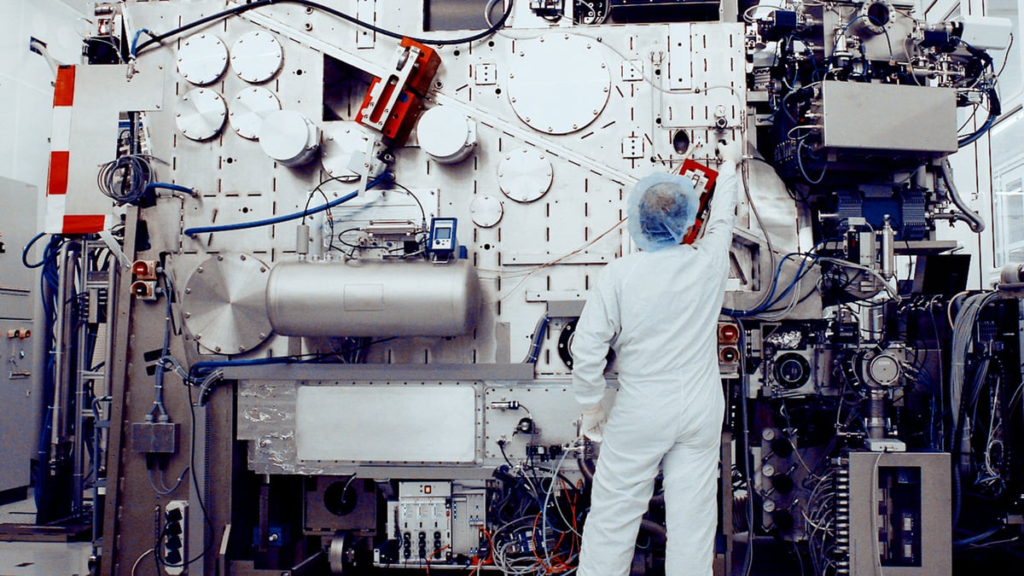
ASML’s prototype extreme ultraviolet lithography system.
Image
ASML.

Since almost all of the parts in ASML’s machines are made by other companies, it has become master of a sprawling supply chain of over five thousand companies. It has diversified its suppliers over the years in a very deliberate way: 80 percent of its spending goes to companies across Europe and the Middle East (notably not the US, despite prior agreements), which reduces the risk of potential export restrictions, tariffs, and other geopolitical risks that may face critical suppliers based in the US or Asia. It also aims for its suppliers to make no more than 25 percent of their revenue from ASML, to force them not to become overreliant on the volatile semiconductor market. 

While most of its components come from a large number of small suppliers, ASML has formed deep bonds with its biggest suppliers. It acquired a 24.9 percent stake in optics manufacturer Zeiss. Peter Leibinger, vice chairman of laser manufacturer Trumpf, has said that ASML and Trumpf are a ‘virtually merged company’

Winning the war

Extreme ultraviolet lithography would not become a successful commercial technology until 2018, over 20 years after the creation of the Extreme Ultraviolet Limited Liability Company and 34 years after IMEC was founded. In the meantime, it was consuming more and more resources. By 2015, ASML was spending more than $1 billion a year on R&D, more than double its 2010 total. According to some estimates, by 2014, the industry had collectively invested over $20 billion in extreme ultraviolet lithography, with no guarantee of any return.

ASML was able to continue pouring money into this black hole partly because it had already beaten its competitors. By 2010, it had two thirds of the overall lithography market and was the dominant supplier for the rapidly growing smartphone market, with deep ties to Intel, Samsung, and TSMC. It had secured this position by winning the decisive technical battle of the 2000s. 

At the start of the millennium, the entire semiconductor industry hit a physical wall. Circuits had been getting steadily smaller for decades by simply switching to shorter wavelengths, but the standard 193-nanometer light (roughly one five-hundredth of the thickness of a human hair) was too blunt to draw smaller circuits. 

Nikon tried to solve this by developing a new light source with a smaller wavelength of 157 nanometers. But this shorter wavelength light was absorbed and distorted by standard glass, forcing Nikon to build lenses out of calcium fluoride, a rare, brittle crystal that was expensive to polish and prone to cracking under heat. The industry poured hundreds of millions of dollars into this ‘dry’ lithography path, only to find the manufacturing challenges insurmountable. 

ASML’s partnerships helped it avoid this dead end. TSMC researcher Burn Lin had advised them to switch to a technology called immersion lithography. ASML continued to use 193-nanometer light but placed a layer of water between the lens and the silicon wafer. Just as a straw appears bent and magnified when placed in a glass of water, the water in the machine bent the light waves, sharpening the focus and allowing smaller circuits to be printed without needing new lenses.

ASML compounded this advantage by introducing a revolutionary machine architecture called TWINSCAN. In older machines, the light source would sit idle while the machine stopped to measure the surface of the silicon wafer to ensure it was flat. ASML replaced this with a dual-stage system: a massive machine with two tables would measure one wafer in the background while another was being printed simultaneously. This eliminated the dead time in the manufacturing process, allowing chipmakers to produce significantly more chips per hour. By the time Nikon abandoned its 157-nanometer project in 2005, ASML had become the industry standard, with 53.2 percent of the market.

ASML’s machines were so much better than the competition that it could charge nearly twice as much for them: $55 million versus $30 million for the comparable Nikon device.

But even this was not enough. While ASML was beginning to ship prototype EUV machines to IMEC from 2006 onwards, they were so slow and prone to breaking down that they were commercially useless. In 2012, ASML, still reeling from the global financial crisis, was struggling to continue financing its EUV efforts.

In a drastic move – part desperate attempt to keep the company’s research efforts afloat and part strategic bet to win the EUV market once and for all – the ASML leadership launched a co-investment program that sold 23 percent of the company to its three largest customers: Intel, TSMC and Samsung. 

The funding also allowed ASML to complete a $2.5 billion acquisition of one of its suppliers, Cymer, which produces lithography light sources. The acquisition allowed ASML to invest in Cymer’s R&D efforts to perfect its soft X-ray light source, which involved hitting fast-moving droplets of tin with such force that they lost electrons, but precisely enough that this did not shed so much debris that it coated the mirrors. They accomplished this by moving from a single pulse to two separate laser pulses: the pre-pulse would shape the droplet and the main pulse would generate the plasma. This improved efficiency and stability. 

ASML’s close partnership with TSMC proved especially critical. In 2014, TSMC launched its first chip for Apple, which was now its largest customer and was putting pressure on the chipmaker to produce higher performance chips than its existing machinery was capable of. It had become urgent for ASML to complete a commercial EUV machine. 

The two companies worked so closely together that Anthony Yen, the Division Director at TSMC responsible for overseeing EUV development, described them as ‘one team’. ASML and TSMC engineers on the ground worked tirelessly, troubleshooting and iterating until they had reached the necessary throughput: 500 wafers a day for a month. 

During this period, the joint team redesigned both the tin-droplet generator and the way the laser hit each droplet. The new setup produced droplets that were about half the original size while still yielding the same ultraviolet energy. Smaller droplets throw off far less debris when vaporized, which slows the rate at which tin builds up on the collector mirror. Because the mirror degrades more slowly, it needs fewer replacements, keeping the machine up and running for longer stretches.

The partnership was a win for ASML, as it was able to work through some of its key engineering and commercialization challenges. It also helped TSMC become an early adopter of the most cutting-edge technology. By 2019, TSMC was ramping up mass production of its seven-nanometer process and the first phones with EUV chips were being sold by the end of the year.
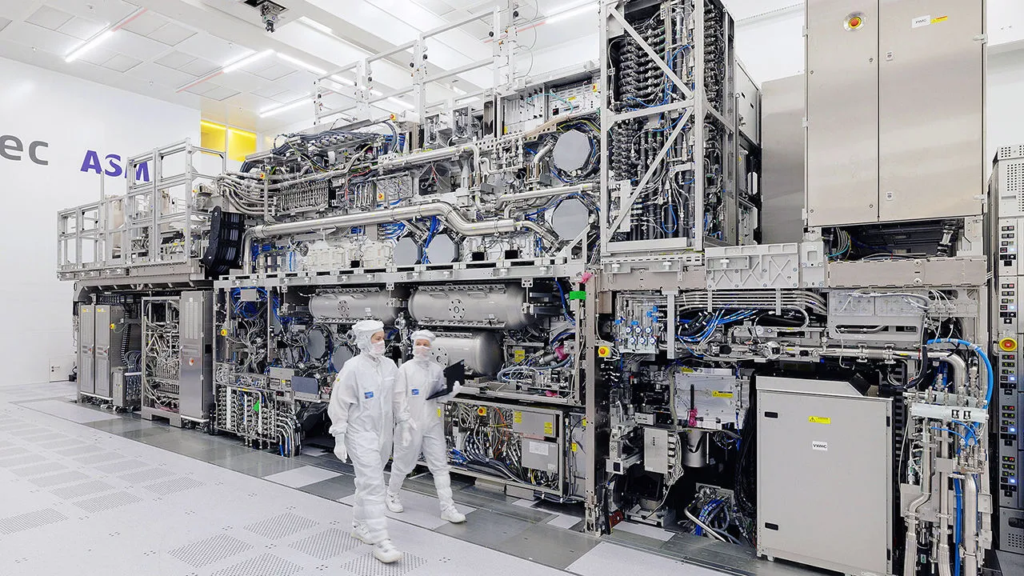
ASML’s most advanced extreme ultraviolet lithography scanner, the TWINSCAN EXE:5000.
Image
ASML.

Meanwhile, competitor firms like Nikon, which had never believed as strongly in extreme ultraviolet lithography, effectively gave up. In its 2013 annual report, Nikon noted that its own EUV progress had not proceeded as planned, and it was not mentioned in an annual report again. With ASML pulling ahead on R&D and locking up key customer demand, and with competitors struggling to justify their own R&D spending in the wake of the financial crisis, ASML became the last company standing in the race to commercialize the technology.

The importance of tacit knowledge

Early on, ASML cultivated a culture that was more risk tolerant than other players in the industry. It promoted high-potential talent early and had a track record of retaining key employees for decades. Much of this is a product of its challenging early years. ASML needed the talent of its younger generation to save the company, so it was more willing to promote and empower them quickly.

For example, Martin Van Den Brink joined ASML in 1984. Within 18 months, aged 29, he became one of two people promoted to lead the development of one of the company’s early flagship projects. He carried on working at ASML for his entire career, serving as president and chief technical officer until his retirement in 2024. This practice was far less common among ASML’s Japanese rivals, who were more hierarchical and tended to reward seniority over performance. 

Retaining the best workers is especially crucial in an area like photolithography, where a huge amount of tacit knowledge is used to assemble its machines. An ASML engineer once told He Rongming, the founder of Shanghai Micro Electronics Equipment, one of China’s top ASML competitors, that the company wouldn’t be able to replicate ASML’s products even if it had the blueprints. He suggested that ASML’s products reflected ‘decades, if not centuries’ of knowledge and experience. ASML’s Chinese competitors have systematically attempted to hire former ASML engineers, and there is at least one documented case of a former ASML employee unlawfully handing over proprietary information. But none of this appears to have narrowed the gap.

A European giant 

ASML is a rare example of a European tech giant. Its success was the result of transatlantic cooperation, not continental parochialism. Had the company not joined a program funded by US chipmakers, Canon and Nikon would likely still dominate a less advanced lithography industry. 

Cooperation with other companies was just as important. While vertical integration gave Nikon and Canon total control, it capped their innovation at the limits of their internal resources. In a system exceeding one hundred thousand components, that ceiling proved fatal. ASML’s modular approach allowed it to import cutting-edge physics by acquiring Cymer and investing in Zeiss, while distributing the risk to customers like Intel and TSMC. This strategy created a collective engine that outspent and outpaced every rival attempting to shoulder the burden alone.

This took a great deal of courage. ASML sank billions of dollars into the development and commercialization of EUV technology, with no guarantee that it would ever work. As late as the 2010s, many semiconductor experts doubted that the technology could be successfully commercialized. Now it is the most important technology in the world. 

But ASML, and by extension the continent, cannot stand still. As ASML enjoys its place as an indispensable pillar in one of the world’s most important industries, others are working to create a new paradigm in chip technology. Moore’s Law probably doesn’t end here, and in a matter of years, five nanometers won’t be small enough.

Read the whole story
bogorad
1 hour ago
reply
Barcelona, Catalonia, Spain
Share this story
Delete

Musk Vies to Turn X Into Super App With Banking Tool Near Launch - Bloomberg

1 Share

LLM (google/gemini-3.1-flash-lite-preview-20260303) summary:

  • Grandiose Vision: the project attempts to mimic monopolistic chinese super apps to force users into a single digital ecosystem.
  • Dubious Incentives: current claims of inflated interest rates and cashback perks appear to be temporary bait for a suspicious user base.
  • Chronic Indiscipline: historical data suggests the billionaire regularly manufactures optimistic timelines that repeatedly collapse under reality.
  • Regulatory Friction: the platform currently lacks mandatory licenses in several states due to legitimate concerns regarding consumer safety and corporate governance.
  • Infrastructure Deficits: the service lacks basic transactional necessities such as verified one-click purchasing which remain absent from the ecosystem.
  • Control Mechanisms: creators are being forced onto the proprietary platform to ensure a captive and coerced initial user population.
  • Opaque Operations: fundamental details regarding long-term pricing and functional viability remain entirely undisclosed to the public.
  • Systemic Distrust: state regulators and public officials have formally questioned whether a platform with a history of safety liquidation should handle sensitive financial assets.

More than three years after acquiring Twitter, Elon Musk says he’s nearing his long-stated goal of turning it into an “everything app” with a new financial services tool that he pledged to launch for the public this month.

X Money, a banking and payments platform built inside the social network now known as X, is expected to make its early public access debut imminently, based on the timeframe offered by Musk last month. Early users testing the service have touted competitive perks, including 3% cash back on eligible purchases and a 6% interest rate on cash savings — the latter of which is roughly 15 times the national average.

Musk’s new product is also expected to offer free peer-to-peer transfers, a metal Visa debit card personalized with a user’s X handle, and an AI concierge built by Musk’s xAI startup that tracks spending and sorts through past transactions, according to reports from users with early access.

Musk, who first rose to prominence in Silicon Valley by co-founding PayPal Holdings Inc., sees payments as crucial to creating a so-called super app similar to social products that have flourished in China. WeChat, for example, lets users hail a ride, book a flight and pay off their credit card. As Musk told employees in February, “We want it to be such that, if you want to, you could live your life on the X app.”

If it works, X Money would sit at the intersection of social media and finance in a way no American product has attempted at this scale. However, the super-app model has yet to take off in the US. Several key details about Musk’s payments project also remain unclear, including pricing, the full set of features and the date when it will be widely available.

Elon Musk Photographer: Stefani Reynolds/Bloomberg

Musk is known for making bold promises and missing his own deadlines. In this case, he’s contending with regulatory headaches and delays: X Money still lacks payment licenses in several states including New York, where lawmakers have questioned whether the billionaire should be trusted with people’s money.

The customer rewards remain to be seen, too. Though X Money’s potential 6% savings rate would exceed rival consumer finance services from SoFi Technologies Inc., Block Inc. and LendingClub Corp., Musk’s company has not said whether that rate is permanent or promotional. A spokesperson for X did not respond to requests for comment.

Richard Crone, the founder of Crone Consulting LLC and an industry watcher who has tracked the payments sector for years, is skeptical of X Money’s prospects.

“He promised this vision more than two years ago, and he said they’d have it within a year,” Crone said. “This may be a day late and a dollar short.”

Missing features and deadlines

Musk does have advantages few fintech founders can claim: a platform with 600 million monthly users; a captive base of content creators already being paid through X; and his own history helping to build a pioneering payments service.

Creators who currently receive payments from X for engagement will be switched from Stripe to X Money as their payment platform, according to early users — a move that guarantees an initial base of active accounts.

Some have already been testing X Money to send payments to one another through the app’s chat feature or directly through their profiles, according to early participants in the rollout. It’s unclear what would happen to a user’s X Money account if their X profile gets banned or suspended.

While peer-to-peer payments are a popular feature for everyday use, it’s usually a loss leader for businesses that facilitate them, said Harshita Rawat, a senior research analyst at Bernstein Institutional Services LLC. The real prize comes when you can convince people to do the rest of their banking on a platform, including credit purchases and loans.

“Becoming the primary bank account is hard,” Rawat said. “I’m not saying it cannot be done, but I think you need to figure out an angle for that.”

Some payments industry veterans see a more basic problem: X still lacks the infrastructure to make buying things on the platform frictionless, a prerequisite for any app that wants to handle real commerce.

“He doesn’t have a one-click buy, and he needs that or e-commerce on his site will lag,” Crone said.

X Money touts features that could include a 6% interest rate on cash savings and 3% cash back on eligible purchases. Photographer: Brent Lewin/Bloomberg

Musk’s timeline for the project has also slipped repeatedly due to regulatory hurdles. Operating a payments platform in the US requires licenses from all 50 states, and Musk underestimated the process. During a 2023 all-hands meeting, he predicted X would secure the necessary approvals “in the next few months.” X currently holds licenses in 44 states, according to its website, and likely won’t be able to operate in states where it hasn’t obtained a license.

In a letter last year, then-New York state senator Brad Hoylman-Sigal and assembly member Micah Lasher called for the state’s Department of Financial Services to deny Musk’s application. They cited his “pattern of reckless conduct, in both business and government, that has put consumers at risk,” including Musk’s role in dismantling the Consumer Financial Protection Bureau while leading the Department of Government Efficiency.

Documents and emails obtained by Bloomberg through public records requests show that state regulators have also required detailed explanations of X’s business model and security features, with lawyers for the company sometimes fielding multiple rounds of follow-up questions. In at least one case, regulators expressed concern about Musk’s early track record with X, where he slashed much of the staff including many working on safety initiatives.

A payments regulator in Texas sought feedback from other states while reviewing the company’s application in June 2024, saying he had “a few concerns” with X’s application, according to the emails. Specifically, the regulator wanted to discuss “Mr. Musk’s troubled history with the SEC,” as well as the “financial condition of X Payments LLC’s parent company, X Corp.”

The request led to a multi-state conference call in the summer of 2024, according to emails and a person familiar with the discussion. Texas approved X’s application three months later.

Earlier in April, Senator Elizabeth Warren of Massachusetts — a frequent Musk critic — sent a letter to Musk raising questions about X Money’s yield economics and its banking arrangements, as well as broader concerns about its impact on the financial system.

“Your failure to operate X in a safe and responsible manner does not breed confidence in your ability to safely expand into consumer finance,” she said. X is still awaiting a payments license in Massachusetts.

Read the whole story
bogorad
1 hour ago
reply
Barcelona, Catalonia, Spain
Share this story
Delete

Don’t Bet on Unions. Competition is a Better Cure

1 Share

LLM (google/gemini-3.1-flash-lite-preview-20260303) summary:

  • Political Grandstanding: the mayor promotes ineffective collective bargaining schemes to consolidate power while ignoring economic reality
  • Economic Obsolescence: organized labor artificially inflates wages without increasing productivity leading to stagnant growth
  • Corporate Illusion: belief that businesses absorb all costs is a naive misunderstanding of market mechanics and price pass-through
  • Job Destruction: monopolistic labor practices historically correlate with the decline of key industries and manufacturing employment
  • Exclusionary Tactics: current systems prioritize existing members at the expense of new workers seeking employment opportunities
  • Cost Burden: higher wage mandates inevitably manifest as increased prices damaging the purchasing power of the average consumer
  • Market Flexibility: competitive labor environments provide greater long-term job security through investment and business formation
  • Rational Reform: true economic prosperity requires competitive tax policies and deregulation rather than bureaucratic union expansion

Courtesy Michael M. Santiago/Getty Images

On Sunday, New York City Mayor Zohran Mamdani spoke at a rally for the launch of Union Now, a new organization aimed at expanding organized labor’s reach. It’s the latest in a series of early pro-union moves by the mayor, including joining a nurses’ strike picket line and pushing to unionize tenants.

Mamdani’s approach is misguided. Competition, not unionization, is the surer path to improving conditions for both workers and tenants. In fact, more unions will mainly accomplish one “goal”: consolidating political support for policies that ultimately make the affordability crisis worse.

It is well established that labor unions—which secure exclusive bargaining rights over workers’ terms of employment—can raise wages for their members relative to what they would otherwise have been paid. But unless matched by increases in productivity, the gains amount to rent seeking, extracting benefits without greater output. A 2025 National Bureau of Economic Research study, for example, found that most of the wage gap between unionized and nonunionized workers reflect unions’ ability to extract more rents for workers, rather than underlying productivity differences.

Who bears these costs? At Sunday’s rally, Sara Nelson, president of the Association of Flight Attendants-CWA, suggested they fall largely on management and corporate profits. “Too often, the boss has all the power to starve workers during a fight,” she said. “Union Now will work with unions directly to ensure workers have the means to win.”

In reality, the burden is often more diffuse. In highly competitive industries, where firms have limited ability to pass on higher labor costs, those higher costs might indeed take the form of lower profits. A 2011 study estimates that, if the entire economy were unionized, profits would fall by 20 percent.

But that is not necessarily a win for workers. Lower expected profits tend to reduce investment, slow business formation, and push jobs to places where compensation more closely reflects productivity (or offshores them entirely). A 2025 Mercatus Center study of the Rust Belt echoes this pattern, finding that “[u]nions wielding monopoly privileges and fueling strikes and labor conflicts were responsible for 55 percent of the region’s decline in US manufacturing employment.”

For poorer workers, the effect is especially pronounced. Unions’ use of coercive power to extract higher wages for existing workers comes at the expense of outsiders who might otherwise have worked for less. The result is higher unemployment and fewer opportunities. Empirical data show that private-sector job growth in right-to-work states has been far more robust than in non-right-to-work states.

Then there’s the other side of the equation: since only a portion of union-driven cost increases comes out of profits, much of the rest is borne by consumers in the form of higher prices. And since most people are both workers and consumers, higher wages are often offset by higher prices.

A more promising approach is to encourage competition. Moving away from New York’s union-dominated labor markets—through policies like right-to-work laws, which eliminate mandatory union membership—aligns wages more closely with productivity and expands opportunities for workers. Just as important, it lowers costs for consumers by reducing the upward pressure on prices.

The benefits show up in investment and job creation. States with more flexible labor markets tend to attract more business investment, which in turn drives employment growth. The job security unions provide—making it harder to dismiss workers—is real for those inside the system. But a more dynamic labor market offers a different kind of security: the ability to find new opportunities quickly, often on terms that exceed standardized union contracts.

Right-to-work laws aren’t the only path forward for New York, though they would be a step in the right direction. The state ranks last on the Tax Foundation’s Competitiveness Index, and the group’s 2026 report outlines several ways to improve that standing. Fully repealing New York’s capital stock tax, allowing full expensing of investments in machinery and equipment, and cutting corporate taxes are just a few sensible measures the state could adopt to expand investment and give workers more options.

While unions fall short as an economic solution to New York’s affordability crisis, they have nonetheless proven effective as a political force. That helps explain Mamdani’s emphasis on expanding them. But for New Yorkers concerned with rising costs, the priority should be on policies that increase competition, attract investment, and expand opportunity rather than on merely redistributing a shrinking pie.

Share

Read the whole story
bogorad
2 hours ago
reply
Barcelona, Catalonia, Spain
Share this story
Delete

Scientists Identify The Most Dangerous Time in Life to Gain Weight : ScienceAlert

1 Share

LLM (google/gemini-3.1-flash-lite-preview-20260303) summary:

  • Statistical Correlation Claims: early weight gain is vaguely associated with higher mortality risks compared to later life weight gain.
  • Arbitrary Age Groupings: the researchers focused on obesity onset between ages 17 and 29 to manufacture their alarming 70 percent mortality statistic.
  • Reliance On Datasets: the study utilizes secondhand records from 600,000 individuals rather than conducting rigorous direct physical interventions.
  • Obsolete Metric Dependency: the findings rely heavily on bmis, a notoriously imprecise tool that fails to differentiate between fat and muscle.
  • Speculative Biological Mechanisms: the researchers guess that theoretical wear and tear or internal stress might explain why some people die earlier than others.
  • Convenient Omissions: factors like diet and exercise were ignored, leaving the study to make broad assumptions without accounting for basic lifestyle choices.
  • Predictable Bureaucratic Narrative: the authors inevitably push for more political intervention to regulate public weight rather than trusting individual agency.
  • Admission Of Uncertainty: the lead researcher concedes the numerical risk figures are not accurate and advises against taking these statistics too seriously.

A new study suggests it's not just gaining weight that affects our health over a lifetime, but also when we put on the pounds, with weight gain during early adulthood more strongly associated with mortality risk.

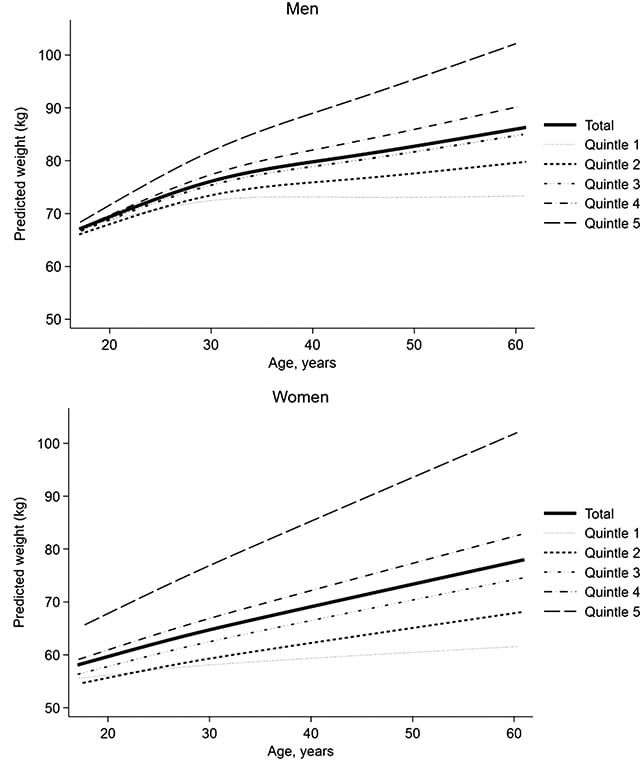
Participants who first developed obesity between the ages of 17 and 29 were around 70 percent more likely to die of any cause during the follow-up period, compared with those who hadn't developed obesity by the age of 60.

Led by a team from Lund University in Sweden, the study was designed to track weight over time rather than relying on a single snapshot. Information on more than 600,000 people was obtained from an existing dataset, including only those with at least three recorded weight measurements between ages 17 and 60.

While the study doesn't show that the early weight gain was specifically responsible for the deaths, rather than any other factor, we know that obesity is linked with a host of health problems.

"The most consistent finding is that weight gain at a younger age is linked to a higher risk of premature death later in life, compared with people who gain less weight," says epidemiologist Tanja Stocks, from Lund University.

According to the researchers, it's possible that spending more years living with the biological stress of being overweight, with the body under more pressure and at a greater risk of wear and tear than normal, is a reason for the earlier deaths statistic.

The team tracked overall mortality and deaths linked to numerous obesity-related conditions, including cardiovascular diseases, several kinds of cancer, and type 2 diabetes.

Subscribe to ScienceAlert's free fact-checked newsletter

Obesity onset was defined as the first time that a recorded body mass index (BMI) reached 30 or higher. BMI was standard practice at the time the weight measurements were taken, but definitions of obesity are evolving.

In addition to the primary finding about weight gain in early adulthood, several other associations are worth noting. As expected, those who gained the most weight across any and all ages were more likely to die during the study period.

Cardiovascular diseases, including heart attacks and stroke, accounted for the largest share of these associations.

"Our findings of higher all-cause and cardiovascular disease mortality associated with early weight gain and obesity onset suggest that the duration of obesity, rather than weight gain in late adulthood, may be the key factor underlying risk," the researchers write in their published paper.

"Long-term exposure to insulin resistance, inflammation, and hypercoagulation due to adipocytokines released from adipose tissue likely contribute to these risks."

Deaths from type 2 diabetes and certain cancers were also linked to obesity, but a few causes of death – including bladder cancer in men and stomach cancer in women – showed no connection, statistically.

There were differences between men and women, too.

For cancer in women, the increased risk of premature death linked to obesity was roughly the same regardless of when the weight gain occurred. This suggests another factor is more significant here than elsewhere – perhaps hormonal changes related to menopause.

Age chartsMale and female weight gain was tracked over the course of adult lifetimes. (Le et al., eClinicalMedicine, 2026)

"If our findings among women reflect what happens during menopause, the question is which came first: the chicken or the egg?" says epidemiologist Huyen Le, from Lund University.

"It may be that hormonal changes affect weight and the age and duration over which these changes occur – and that weight simply reflects what's happening in the body."

There are limitations to mention here. Exercise and diet weren't accounted for and may well have played a role in the mortality rates observed by the researchers – we know they're also crucial to overall health.

Adding data on these factors could be an option for future study, the study authors note, as could examining fat distribution, which newer definitions of obesity do, and distinguishing between fat and muscle mass.

But with so many participants involved and weight tracked over several years for each one, the researchers suggest these are important findings for public health: that preventing obesity should be done as early in life as possible.

Related: Study Links 2 Simple Eating Habits to Lasting Lower Weight

To put the mortality risk discovered here into numbers: if 10 out of every 1,000 participants without early obesity died over the follow-up period, about 17 in 1,000 died among the group who developed early obesity.

"We shouldn't get too hung up on exact risk figures," says Stocks. "They are rarely entirely accurate, as they are influenced, for example, by the factors taken into account in the study and the accuracy with which both risk factors and outcomes have been measured."

"However, it's important to recognize the patterns, and this study sends an important message to decision-makers and politicians."

The research has been published in eClinicalMedicine.

Read the whole story
bogorad
2 hours ago
reply
Barcelona, Catalonia, Spain
Share this story
Delete

China Bans Meta’s Acquisition of Manus on National Security Grounds - WSJ

1 Share

LLM (google/gemini-3.1-flash-lite-preview-20260303) summary:

  • Regulation Order: china national development and reform commission mandates the reversal of the meta acquisition of manus ai.
  • Security Grounds: government officials cite national security concerns as the primary justification for banning the technology deal.
  • Startup Origin: the ai firm was initially developed by engineers at a chinese entity known as beijing butterfly effect technology.
  • Operational Relocation: the startup moved the majority of its staff to singapore following venture capital investment prior to the meta purchase.
  • Corporate Acquisition: meta completed the acquisition process in late december before facing immediate regulatory scrutiny in january.
  • Executive Restrictions: national authorities prevented manus cofounders residing in beijing from leaving the country during the investigative process.
  • Policy Objectives: regulatory intervention aims to suppress business departures and strictly control the export of domestic artificial intelligence assets.
  • Ongoing Dispute: affected parties anticipate further resolution processes while working to address the status of remaining domestic business operations.


A laptop screen displaying the Manus AI logo and "The general AI agent" text.Manus has developed an AI agent that can carry out tasks such as writing in-depth research reports. Raul Ariano/Bloomberg News

China has ordered that Meta Platforms’ META 2.41%increase; green up pointing triangle $2.5 billion acquisition of artificial-intelligence startup Manus be unwound.

China’s National Development and Reform Commission, which has the authority to review foreign investments, said Monday that it has banned the acquisition and ordered it to be rescinded on national security grounds.

“The transaction complied fully with applicable law,” a Meta representative said in an email statement. “We anticipate an appropriate resolution to the inquiry.”

Manus has developed an AI agent that can carry out sophisticated tasks such as writing in-depth research reports and preparing presentation slides. Early versions of Manus were created by engineers at Beijing Butterfly Effect Technology, which was founded in China in 2022. 

Last year, a Singapore-based entity, also called Butterfly Effect, took over the operations of the AI agent product in markets outside China. Manus later relocated most of its China-based employees to Singapore after receiving investment from a California-based venture-capital firm.

Then, in late December, Meta acquired Manus. Days later, Chinese authorities announced a review of the deal in January, saying that cross-border acquisitions and the export of technology must comply with the law. 

Last month, Chinese officials called the two co-founders of Manus—Xiao Hong and Ji Yichao—in to discuss the deal in Beijing. The executives, who currently work for Meta, were later told not to leave the country during the investigation, The Wall Street Journal has reported. Many of Manus’s top executives are Chinese nationals.

According to Chinese law, any foreign investments that may carry a national-security risk may be subject to review by the authorities. Chinese authorities believe they have the power to demand that the deal be unwound because Beijing Butterfly Effect Technology remains a Chinese company.

After the acquisition, Meta said that there would be no continuing Chinese ownership interest in Manus and that the startup would discontinue its China-based services and operations. Manus was working to close Beijing Butterfly Effect Technology, but hasn’t yet done so.

The series of events that culminated in Meta’s purchase of China-originated technology has angered Chinese regulators. They are worried that the steps Manus took would spur other Chinese companies to follow suit and move out of China without Beijing’s approval. 

The inquiry into the Manus sale reflected Beijing’s broader attempts to protect the country’s AI know-how at a time when the U.S. and China are locked in an intensifying technology race. Both countries have tightened export controls, restricted the exchange of tech professionals and curbed cross-border investment.

Manus and Xiao didn’t immediately respond to requests for comment. Ji couldn’t be reached for comment.

Copyright ©2026 Dow Jones & Company, Inc. All Rights Reserved. 87990cbe856818d5eddac44c7b1cdeb8

Raffaele Huang is a reporter for The Wall Street Journal in Singapore, covering Asia’s technology companies. Previously, he mainly focused on corporate news in the automotive and technology sector in Beijing.


Up Next


Videos

Read the whole story
bogorad
5 hours ago
reply
Barcelona, Catalonia, Spain
Share this story
Delete
Next Page of Stories