Strategic Initiatives
12158 stories
·
45 followers

Ukraine’s top drone commander wants to bleed Russia’s army dry

1 Share
  • Command Operations Center: An Underground Facility Houses Advanced Surveillance Systems And Tactical Planning Infrastructure For Drone Missions
  • Military Leadership Transition: Former Grain Broker Robert Brovdi Leads Specialized Ukrainian Unmanned Forces Using Corporate Efficiency Strategies
  • Strategic Personnel Attrition: Operational Focus Shifts Toward Depleting Russian Human Capital Faster Than Recruitment Can Replenish Effective Fighting Force Strength
  • Verified Loss Metrics: Data Indicates Drone Strikes Under Current Management Accountability Programs Have Exceeded Seasonal Russian Military Recruitment Numbers
  • Advanced Kill Chains: Combat Effectiveness Relies On Integrated Ecosystems Combining Real Time Surveillance With Precise Weaponized Unmanned Aerial Systems
  • Optimized Resource Utilization: Battlefield Logistics Prioritize Material Investment To Achieve High Enemy Casualty Rates Per Unit Of Capital Expenditure
  • Operational Safety Protocols: Standardized Equipment Backup Systems And Strict Tactical Discipline Maintain Low Cumulative Casualty Rates Among Specialized Drone Operators
  • Extended Conflict Outlook: Persistent Military Efforts Continue Despite The Absence Of Clear Near Term Indicators For Cessation Of Hostilities

Listen to this story

AI Narrated

Your browser does not support the

The road to the command point is rough, though the minivan’s blacked-out windows hide the details. On arrival its doors slide open to reveal the entrance to a world buried deep underground. Inside, one corridor is lined with two decks of Japanese-style sleeping pods. Behind a second corridor lies a gym. Wall after wall of screens relay live data feeds: kill chains, missions, enemy losses. A gallery of famous Ukrainian paintings hangs among missiles and explosives. A snuff video of Russian soldiers in their last moments of life runs on a loop next to an expressionist stone sculpture of a man’s face.

The darkly eccentric atmosphere is in keeping with the character of the man in charge. Before the invasion Robert “Madyar” Brovdi (pictured) was a wheeler-dealer grain broker. Now the 50-year-old commander of Ukraine’s unmanned forces is a weathered warrior and the lead architect of a strategy to target drone power at individual Russian soldiers. Four years into the war, Ukraine’s central challenge has become not so much holding territory as removing Russians faster than the Kremlin can recruit them. For the first time, thanks in large part to Mr Brovdi’s efforts, this might now be happening.

Mr Brovdi analyses the figures in a windowless three-metre-square cubby-hole, chain-smoking cigarettes and sipping Fortnum & Mason tea, a nod to his prior life fraternising with the rich in London auction-houses. Russian losses have increased substantially since he took over last summer, aided by a revamped, gamified system that now prioritises enemy infantry. December marked a turning point, the first month when verified Russian losses to Ukrainian drones exceeded recruitment. Since the start of the winter, Ukrainian drones have killed or incapacitated at least 8,776 more soldiers than Russia has replaced. Russia continues to gain little ground in return for its losses. Even on its most successful axis, near the town of Kostiantynivka in the Donbas, it has taken just 23% of the territory called for in its winter campaign plan.

Mr Brovdi’s drone brigade, codenamed “Madyar’s birds”, claims it has been responsible for a sixth of the Russian losses. The wider unmanned-forces grouping he now controls accounts for more than a third. Those forces make up just 2% of the Ukrainian army’s headcount. At the December peak, enemy losses reached 388 a day, equivalent to the assault component of an entire battalion. “If a battalion has no infantry left, the Russians don’t disband it but throw desk officers to the front,” Mr Brovdi says. “They are the easiest targets, because they can’t fight.” His soldiers are ordered to target personnel, rather than armour or other equipment, at least 30% of the time. Russia can only train and equip so many recruits; Mr Brovdi likens it to a cow, and his units to farmers. “We need to keep milking this cow, the Russian army, for everything it’s worth, exhausting it beyond its maximum capacity.”

A Ukrainian serviceman launches a drone at the frontline near Vuhledar, Ukraine

Photograph: AP

An ethnic Hungarian from Ukraine’s western borderlands, Mr Brovdi joined the war as a civilian volunteer. His rise was improbable but no accident. Applying business instincts to battlefield problems, he helped to develop Ukraine’s earliest drone capabilities. The first breakthrough came in the summer of 2022, when he was fighting on the Kherson front. The Ukrainians were outgunned and, worse, had no idea where the Russians were firing from. Mr Brovdi, still an inexperienced soldier, remembered a drone he had bought his son on a business trip in Asia, and had some brought to the trenches. They were crude, but good enough to spot hidden Russian tanks. The future commander began passing coordinates to a nearby artillery brigade over Discord, a social-media app. He had created Ukraine’s first drone kill chain.

A year later Mr Brovdi and his disciples had been transferred to Bakhmut, then the war’s main killing ground. One colleague, a former taekwondo champion known as Klym, had a friend who had competed in races of first-person-view drones. He suggested the fast, agile machines could carry small munitions. The team began hanging water-filled condoms from trees and trying to hit them with drones. Soon they were taping American mk-19 grenades to the frames. This became the cornerstone of a “line of drones” reconnaissance-and-strike kill-zone concept, which Mr Brovdi later championed to offset Ukraine’s infantry shortage.

Members of

Photograph: Getty Images

The bunker’s hundred-odd screens show how far operations have progressed. Every mission, whether drone strike or electronic-warfare session, is logged and verified by video, then fed into business-intelligence software that Mr Brovdi repurposed from his days as a grain trader. “The principles are the same,” he says. “I asked my guys to swap grain type, tonnage and truck numbers for weapons, shifts and ammunition.” The killing is managed closer to the front. Teams operate 3-5km behind the line, overseen only by battle captains back at headquarters. Mr Brovdi says the unit has an ecosystem of 15 interlocking functions, from jamming to surveillance, mine-laying and explosive production. It is a concept nato generals have yet to grasp, he says. “When the Americans come—and they come to us like bees to honey—they ask, ‘Which drone is best?’ I tell them the best drone is an ecosystem. For one pilot to make a kill, a whole machine must work behind him.”

Mr Brovdi’s critics say his success hinges on the unconditional support and funds he has received since taking over as drone chief. Ukraine’s armed forces usually operate under constant shortages. His predecessor, who was less close to Oleksandr Syrsky, the commander-in-chief, never enjoyed the same resources. Mr Brovdi counters that Ukrainian soldiers should not be waiting for drones, but that the drones should be ready and waiting for them. He insists on having a backup for each piece of equipment, a lesson learned in several near-death experiences, and says his strict safety protocols keep his unit’s cumulative casualty rate at just 1%.  The unmanned-systems forces now extract 400 Russian lives for just one Ukrainian, he claims, and each kill costs $878 in materiel.  “We should be swapping plastic and metal for dead Russians,” he says. “It’s the best exchange rate.”

Mr Brovdi’s battlefield kill videos, posted on social media with slapstick chase music, have made him a controversial figure. Some allege that such videos violate the laws of war. He dismisses the criticism. “I don’t experience any moral reservations at all. None,” he says. “A man with a rifle in his hand on my land is coming to kill me. I kill him or he kills me. Millions of Ukrainians, my mother included, draw strength from what we do.”

That single-minded focus is giving Ukraine hope. Whether it will be enough to force Vladimir Putin to stop his war is another question. December was the first time Mr Brovdi’s figures turned in Ukraine’s favour. In the year before that, Russian forces had grown by over 100,000 men. Russia’s president seems to have no exit strategy. “Let’s first see if we can keep the pace up this coming year,” says Mr Brovdi. “I have no rose-tinted fantasies that this war is about to end.” ■

To stay on top of the biggest European stories, sign up to Café Europa, our weekly subscriber-only newsletter.

Read the whole story
bogorad
5 hours ago
reply
Barcelona, Catalonia, Spain
Share this story
Delete

AI Is Rewriting the Old Rules of Google Search and SEO - WSJ

1 Share
  • Search Evolution: Digital Marketing Strategies Are Shifting From Traditional Keyword Rankings To AI Visibility Optimization
  • Consumer Trends: Market Data Indicates A Rapid Rise In Demand For AI Powered Search Engines Through The Next Five Years
  • Content Engagement: Successful AI Visibility Requires Active Brand Participation In Social Media Forums And Third Party Reviews
  • Structural Optimization: Technical AI Requirements Include Extensive Use Of Subheadings Bulleted Lists And Frequent Concise Summaries
  • Contextual Accuracy: Enhanced Product Descriptions Providing Detailed Behavioral And Situational Context Improve Relevance For Conversational Search Queries
  • Platform Variance: Optimization Tactics Must Be Tailored To Specific AI Models Given That Each System Prioritizes Data Sources Differently
  • Frequent Updates: Rapid Development Cycles Make Long Term Strategy Setting Difficult Due To Frequent Changes In Model Behavior
  • Measurement Challenges: Traditional Analytics Are Insufficient For Assessing AI Performance Because Results Are Highly Personalized And Often Lack Direct Click Throughs

BPC > Only use to renew if text is incomplete or updated: | archive.vn

BPC > Full article text fetched from (no need to report issue for external site): | archive.today | archive.vn

Illustration of a dog-like robot walking among rocks and holding one.

Zohar Lazar for WSJ

  • AI systems like ChatGPT are changing online search, shifting standards from traditional SEO rankings to a company’s visibility online, in places like review sites and forums.

  • Half of consumers polled in an August 2025 McKinsey survey seek AI-powered search engines, and experts are developing new tactics for AI visibility.

  • AI search standards are inconsistent, with models updating every 17 days on average, making visibility difficult to predict and measure for companies.

This summary was generated with AI and reviewed by an editor. Read more about how we use artificial intelligence in our journalism.

  • AI systems like ChatGPT are changing online search, shifting standards from traditional SEO rankings to a company’s visibility online, in places like review sites and forums.

    View more

The rules of search are changing. And it’s forcing a lot of companies to ask themselves a fundamental question: How do we get noticed now?

For two decades, companies have relied on search-engine optimization, or SEO, to battle for customer attention online—tuning keywords and backlinks to climb Google’s rankings. Now, as AI systems like ChatGPT and Claude increasingly answer questions directly, visibility depends less on ranking first and more on being the source those systems trust.

Half of consumers polled in an August 2025 McKinsey survey specifically seek out AI-powered search engines. And by 2028, McKinsey projects, people will spend $750 billion on goods and services they find through AI-powered searches.

All of this means that companies may have to find new ways to get attention. Unlike Google, AI doesn’t have consistent search standards that companies can follow; in fact, it is very tough to tell what sites AI will use or recommend when answering a question.

The changing landscape also matters for the consumers who use search. For a long time, people’s experience of the internet has been shaped by SEO and the tactics companies use to boost their rankings. Now, the online experience may be affected by very different standards—how companies package their information for AI. And understanding those tactics will help consumers make more-informed decisions.

Experts are already cooking up new ways for companies to boost their AI visibility. Here are some of their recommendations.

Don’t abandon tradition

One caveat right off the bat: Although AI search is growing fast, many people are still using traditional search engines and clicking on links. And even when people do use ChatGPT or other large language models (LLMs), the chatbots are often doing good old-fashioned web searches under the hood—even if they aren’t giving priority to the same stuff that regular search engines do.

The bottom line is that the SEO fundamentals still matter. “This is not the end of SEO,” says Kelly Cutler, associate professor of digital marketing and visual communication at Northwestern University. “This is the next iteration of SEO.” Businesses should still make sure that their sites load quickly, for instance, and that they’re set up for easy indexing.

Talk to customers

At the same time, a lot of rules are changing. For instance, with traditional SEO, getting a single link from a very authoritative site meant more for ranking purposes than hundreds of mentions on other sites.

But experts say AI favors tons of customer reviews and comments, drawing heavily on sites like Reddit, G2 and Quora. For instance, Reddit is ChatGPT’s go-to source for consumer electronics, followed by Tom’s Guide and then Wikipedia, according to marketing-software company Semrush. (An OpenAI spokesperson says, “ChatGPT search is designed to provide people with timely, high-quality answers they find helpful. We surface relevant information from a range of sources, and we’re constantly refining our search indexing, ranking, and model behavior.”)

“AI search is inextricably linked to user-generated content, what people are saying about your brand,” says Andrew Warden, chief marketing officer at Semrush. “AI favors firsthand experience, specificity and continuously refreshed discussions. So the more activity that is happening around your brand, the more likely you are to be propelled into the conversation.”

To gin up that kind of visibility, companies are likely to engage more with customers online, like answering people’s questions, or encouraging them to leave honest reviews.

Structure matters

AIs focus on facts they can easily grab and include in their answers. So companies will try to give their sites a clear structure that makes information easy to identify.

For instance, traditional SEO strategies advise users to put plenty of subheads in their content. But AI chatbots want even more subheads, along with bulleted lists, FAQs and quick “TL;DR” summaries of the article’s main points.

Add details—even really obvious ones

When people search using AI, they get specific and conversational. They won’t tell AI just to look for a “black zip-up fleece”; they will tell it that they’re going hiking next week in the Smoky Mountains and need a slim-fitting fleece to keep them warm. So AI will favor sites that add exactly that kind of contextual information to product listings—even if it seems really obvious.

“It’s about putting yourself in your customers’ shoes and thinking about all the contextual information you could add,” says Rachel Klein, a senior vice president at digital-marketing agency Wpromote.

Different tactics for different AIs

In traditional SEO, techniques that worked for Google would generally also work for Bing, Yahoo and other search engines, and what worked for sites in one industry would usually work in others. AI throws all that out the window.

“All of the platforms have a different weighting of ingredients,” says James Cadwallader, co-founder and chief executive of Profound, a company focused on helping brands gain visibility in AI search. “Gemini pulls from YouTube results far more than ChatGPT does, for example.” Gemini also relies on a wider range of sources than others do, he says.

“We see demand for original perspectives, rich visual formats like video, and information that helps people learn something new,” says a spokesperson for Google, which runs Gemini. “Across Search and Gemini, we don’t aim to show content from any particular site or platform. Rather, we pull together a wide range of the most relevant insights and perspectives from sites across the web.”

Different chatbots also rely on different sites depending on the industry or type of search. “In e-commerce, social channels like Reddit play a huge role, but in fintech, we see [articles on a company’s own website] being successful,” Cadwallader says. So a financial firm could benefit from adding authoritative articles to its own website, while an e-commerce firm might be better off asking customers to leave reviews and start social-media conversations about the products.

Consider sponsored content

Traditional search engines usually give less weight to sponsored content: articles or blog posts that a company pays for but that look like regular editorial content. AI, though, seems to treat that information the same as other articles, Klein says.

“We’re seeing lots of instances where a chatbot is referencing information from sponsored content, but they aren’t disclosing that,” she says. “So there’s an opportunity for brands to influence the types of conversations that they’re in and what they’re associated with.”

Get ready to adapt

The old SEO world got shaken every time Google changed its search algorithm. Strategies that used to work suddenly brought massive drops in traffic. But AI models get updated far more frequently: every 17 days on average, according to Jesse Dwyer, chief communications officer at AI company Perplexity, and that pace will increase as AI models increasingly update themselves. So what works today may not work even a few weeks from now, let alone a few years.

“There were more model updates in 2025 than Google has had algorithm updates since 2018,” says Dwyer. “You can still game these systems at this point, but the rate of acceleration of AI makes it very, very difficult. The models are becoming so sophisticated so fast that this idea of being able to reverse-engineer them and game the results is just untenable and unrealistic.”

Embrace uncertainty

In traditional search, the rules of the game were simple, and success was easy to quantify—where your company showed up in search and how many people clicked on it. AI search, however, is much harder to measure. Many searchers get their answers from AI and never click through to a company’s website. And AI search results vary wildly.

In June and July of last year, Profound ran thousands of prompts through four major AI platforms. The company found that 40% to 60% of the domains cited in AI responses were completely different just a month later, even when they asked identical questions.

Dwyer at Perplexity adds that AI search pulls in much more information about the person asking the question, making search results highly customized for individual users and therefore difficult to predict or measure.

He advises companies to direct their optimization efforts at improving their products and the quality of the information they share, not on technical tweaks aimed at moving an elusive needle. “Marketers have the option to follow fake numbers or to focus on building great things,” he says. “Time will tell which of those strategies is better.”

Andrew Blackman is a writer in Serbia. He can be reached at reports@wsj.com.

Artificial Intelligence

Read the full report

How I Stop AI From Telling Me What I Want to Hear How I Stop AI From Telling Me What I Want to Hear

AI Is Rewriting the Old Rules of Google Search and SEO AI Is Rewriting the Old Rules of Google Search and SEO

How Much Do You Know About Rare Earths? Test Yourself With This Quiz How Much Do You Know About Rare Earths? Test Yourself With This Quiz

Why You Should Let AI Write Your Next Customer Complaint Why You Should Let AI Write Your Next Customer Complaint

The E-Nose Knows: AI Learns to Smell The E-Nose Knows: AI Learns to Smell

The Unexpected Risk of Letting ChatGPT Fact-Check Your Financial Adviser The Unexpected Risk of Letting ChatGPT Fact-Check Your Financial Adviser

I Finally Have a Physician Who’s Available and Who Gets Me. Meet Dr. Grok. I Finally Have a Physician Who’s Available and Who Gets Me. Meet Dr. Grok.

It’s Easier to Cheat When You Can Blame AI It’s Easier to Cheat When You Can Blame AI

Read the whole story
bogorad
5 hours ago
reply
Barcelona, Catalonia, Spain
Share this story
Delete

Exclusive | Mark Zuckerberg Is Building an AI Agent to Help Him Be CEO - WSJ

1 Share
  • Agent Deployment: Meta Develops Internal Personal Agents To Accelerate Information Retrieval And Decision Making For Staff
  • Organizational Flattening: Management Removes Structural Layers To Increase Team Agility And Competitive Efficiency
  • Performance Metrics: AI Adoption Now Functions As A Formal Evaluation Criterion In Employee Reviews
  • Internal Innovation: Workers Create Custom Tools Like Second Brain And My Claw To Automate Tasks And Communication
  • Strategic Acquisitions: The Company Procures Specialized Entities Like Manus And Moltbook To Bolster Agent Capabilities
  • Structural Redesign: New Applied AI Engineering Units Utilize An Ultraflat Hierarchy With Fifty Contributors Per Manager
  • Workplace Skillsets: Employees Participate In Frequent Training Sessions And Hackathons To Master AI Development Tools
  • Labor Dynamics: Rapid Integration Efforts Influence Existing Employee Anxiety Regarding Potential Future Reductions In Headcount

The agent, which is still in development, is currently helping Zuckerberg get information faster—for instance, by retrieving answers for him that he would typically have to go through layers of people to get, the person familiar with the project said.

Zuckerberg’s agent project reflects a drive across the 78,000-person company to accelerate the pace of work, eliminate layers from its organizational structure and change the day-to-day jobs of its employees to remain competitive with AI-native startups with much smaller staffs. The company views AI adoption as critical to its future success and is experimenting with how to integrate more of it into its business.

Zuckerberg, who has also been spending more time coding recently, previewed some of the efforts on the company’s earnings call in January.

“We’re investing in AI-native tooling so individuals at Meta can get more done. We’re elevating individual contributors and flattening teams,” he said. “If we do this, then I think that we’re going to get a lot more done and I think it’ll be a lot more fun.”

Use of AI tools has spread quickly through the ranks at Meta—in part because it is now a factor in employees’ performance reviews

Meta’s internal message board is filled with posts from employees sharing new AI use cases they have found and new tools they have built using AI, according to people familiar with the matter.

Some inside the company described the atmosphere as reminiscent of the company’s early days, when its name was still Facebook and its unofficial internal motto was “move fast and break things.” (Zuckerberg said while giving testimony during a recent trial that the company has moved away from that motto in favor of something more akin to “move fast with stable infrastructure.”)

Employees have started using personal agent tools such as My Claw that have access to their chat logs and work files and can go talk to colleagues—or their colleagues’ own personal agents—on their behalf, the people said. 

Another AI tool called Second Brain that is somewhere between a chatbot and an agent is also gaining momentum internally, according to people familiar with the matter. Second Brain was built by a Meta employee on top of Claude and can index and query documents for projects, among other uses. On the internal post announcing it to staff, the employee said it is “meant to be like an AI chief of staff.”

There is even a group on the internal messaging board where employees’ personal agents talk to each other, some of the people said. (Separately, Meta acquired Moltbook, the social-media site for AI agents, and hired its founders in a deal earlier this month.)

Meta also recently acquired Manus, a Singapore-based startup that makes personal agents that can execute tasks for its users, and is using the tool internally, some of the people said.

Meta recently established a new applied AI engineering organization that is tasked with using AI to help speed up development of the company’s large language models. Those teams will have an ultraflat structure of as many as 50 individual contributors reporting to one manager, The Wall Street Journal previously reported.

“We’re designing this org to be AI native from day one,” Maher Saba, the Meta executive in charge of the new organization, said in an internal post announcing the new teams, which report up to the company’s technology chief, Andrew Bosworth.

Employees across the company said they have been encouraged to attend AI tutorial meetings several times a week and frequent AI hackathons, and to create their own AI tools to speed up their work.

While one employee described the current era at Meta as fun and empowering, others have said the rapid change and intense focus on AI use has fed anxiety about potential layoffs. 

Meta laid off a portion of its staff for the first time in 2022 after nearly doubling its head count to a peak of 87,314 during the Covid years. At the time Meta found itself facing a slumping digital-ads market and a falling stock price, and it cut 11,000 roles.

Zuckerberg declared 2023 Meta’s “year of efficiency” and said the company would cut 10,000 more jobs over the following months and reduce hiring rates. By year’s end, Meta’s head count had shrunk to roughly 67,000.

In the subsequent years, however, the number of employees continued to climb back up. As of the last official tally, Meta’s head count had reached 78,865.

At a conference earlier this month, Meta’s chief financial officer, Susan Li, discussed the importance of updating Meta’s workforce practices to reflect the competition in AI.

“Making sure that we don’t—for a company at the size and scale that we are—that we don’t work any less efficiently than companies that are AI native from the start, that’s something that I think about a lot,” she said.

The Global AI Race

Coverage of advancements in artificial intelligence, selected by the editors

Get WSJ's AI Newsletter

OpenAI’s Bid to Allow X-Rated Talk Is Freaking Out Its Own Advisers OpenAI’s Bid to Allow X-Rated Talk Is Freaking Out Its Own Advisers

AI Isn’t Lightening Workloads. It’s Making Them More Intense. AI Isn’t Lightening Workloads. It’s Making Them More Intense.

Anthropic’s Standoff With the Pentagon Shakes Up AI Talent Race Anthropic’s Standoff With the Pentagon Shakes Up AI Talent Race

AI Needs Management Consultants After All AI Needs Management Consultants After All
Read the whole story
bogorad
5 hours ago
reply
Barcelona, Catalonia, Spain
Share this story
Delete

Exclusive | OpenAI Plans Launch of Desktop ‘Superapp’ to Refocus, Simplify User Experience - WSJ

1 Share
  • Strategic Consolidation: OpenAI Is Merging Its Product Portfolio Into A Single Unified Application To Improve Operational Focus
  • Development Objectives: The Company Intends To Prioritize The Creation Of Agentic Artificial Intelligence Capabilities Within The Superapp
  • Business Efficiency: Management Aims To Streamline Internal Resources And Eliminate Fragmentation That Hindered Previous Product Performance
  • Competitive Pressure: The Strategy Shift Responds Directly To Market Gains Made By Rival Firm Anthropic In The Enterprise And Coding Sectors
  • Executive Directive: Leadership Has Designated High Priority Operations While Deprioritizing Peripheral Projects To Address Competitive Urgency
  • System Integration: Future Roadmaps Include Merging The Codex App ChatGPT And The Atlas Browser Into A Centralized Platform
  • Commercial Focus: Operational Emphasis Has Pivoted Toward Securing B2b Contracts And Enhancing Employee Productivity Tools
  • Structural Simplification: Reduced Product Proliferation Is Designed To Foster Better Collaboration Across Research And Development Teams

The strategy change marks a major shift from last year, when OpenAI launched a series of stand-alone products that didn’t always resonate with users and sometimes created a lack of focus within the company. OpenAI executives are hoping that unifying its products under one app will allow it to streamline resources as it seeks to beat back the success of its rival Anthropic.

OpenAI is seeking to focus on creating so-called “agentic” AI capabilities within the new superapp, in which artificial-intelligence systems can work autonomously on a user’s computer to carry out a variety of tasks, including writing software and analyzing data, according to OpenAI.

“We realized we were spreading our efforts across too many apps and stacks, and that we need to simplify our efforts,” Simo shared in an internal note with employees Thursday. “That fragmentation has been slowing us down and making it harder to hit the quality bar we want.”

News Corp, owner of The Wall Street Journal, has a content-licensing partnership with OpenAI.

Top executives including Chief Executive Sam Altman, Chief Research Officer Mark Chen, and Simo have spent the last few weeks reviewing OpenAI’s product portfolio and looking at areas to deprioritize, The Wall Street Journal reported. In an all-hands meeting last week, Simo told employees they couldn’t afford to be distracted by “side quests” given Anthropic’s rapid success winning over enterprise and coding customers. “An OpenAI spokeswoman said the company was very much acting as if it were under a “code red.”

OpenAI is in a business battle with Anthropic to increase sales from companies looking to buy AI tools that boost productivity for their employees. Selling to enterprises wasn’t an initial focus for OpenAI, but the company has since renewed its efforts after seeing the breakout success of Anthropic’s Claude Code and Cowork products. Both startups are considering public listings as soon as the end of the year and are racing to meet ambitious revenue growth targets outlined to investors.

An OpenAI spokeswoman said the new “superapp” will enable teams inside OpenAI to work more closely together, and help the research division focus its efforts around improving one central product. Over the coming months, the company expects to add new “agentic” capabilities within its Codex app so it can help with productivity-related tasks beyond coding before merging ChatGPT and the Atlas browser into the superapp as well. The mobile ChatGPT app will remain unchanged.

OpenAI’s organizational structure grew complicated due in part to the myriad products that it announced last year, including its video-generator Sora and a new hardware device.

“This is an opportunity to combine the strongest AI consumer app and brand with the strongest agentic app and really leverage our consumer scale to give agentic capabilities to everyone,” Simo said in her note.

Read the whole story
bogorad
1 day ago
reply
Barcelona, Catalonia, Spain
Share this story
Delete

Google Search traffic has plummeted, AI referrals are 'less than 1%'

1 Share
  • Search Traffic Data: Google Search Referrals For Smaller Websites Dropped By Sixty Percent
  • Publisher Impact: Medium Websites Experienced A Forty Seven Percent Decline In Search Traffic
  • Large Publisher Trends: Large Websites Saw A Twenty Two Percent Reduction In Google Referrals
  • Discover Traffic Loss: Traffic From Google Discover Fell By Fifteen Percent Within One Year
  • Chatbot Referrals: AI Platforms Currently Account For Less Than One Percent Of Total Page View Referrals
  • User Engagement: Media Websites Receive Traffic From AI Primarily For Fact Checking Unreliable Results
  • Tech Media Downturn: Major Tech Media Outlets Reported Search Traffic Declines Reaching Up To Ninety Seven Percent
  • Corporate Stated Position: Google Claims Total Organic Click Volume Remained Relatively Stable While Maintaining Eco System Health

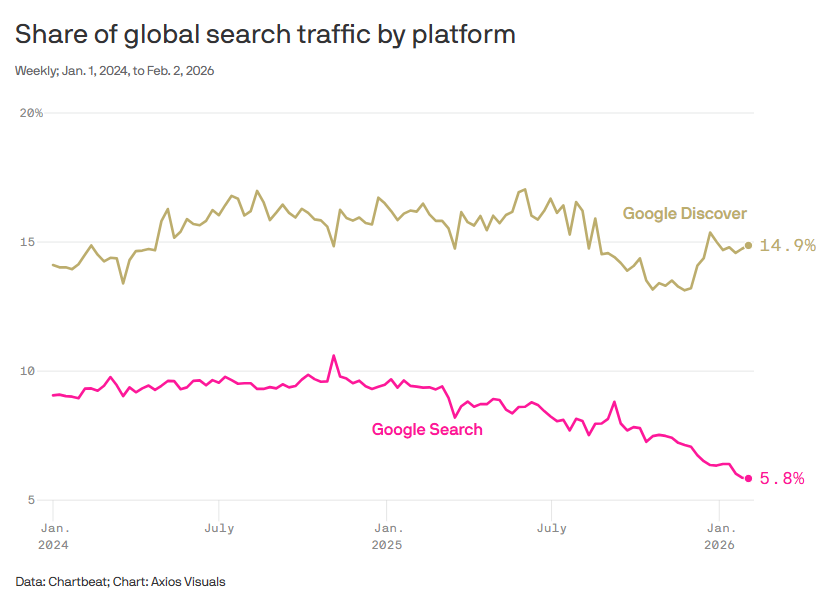
New data shows just how impactful AI has been to the web, with Google Search referrals falling off of a cliff while traffic from AI source links are next to nothing.

Data gathered by Chartbeat and shared by Axios reveals that, over the past year, Google Search traffic to publishers across the broader web have fallen drastically, and proportionally more so for smaller websites. Referral traffic from Google apparently fell by 60% for “small publishers,” while “medium publishers” (those with between 10,000-100,000 daily pageviews) saw a drop of 47%. “Large publishers,” meanwhile, saw a 22% drop. That last category would be any site getting over 100,000 daily pageviews.

It’s not just Google Search either. While Search traffic dropped by 34%, traffic from Google Discover has also fallen by 15% over the past year, the report found.

AI certainly isn’t making up the difference.

While many AI products, including Google’s own, have improved how they surface source links to the rest of the web, this report found that “chatbots still account for less than 1% of all publisher page view referrals.” And that’s an improvement. Apparently, ChatGPT referrals grew by over 200% over the course of 2025.

As far as traffic from AI chatbots go, the report found that “news and media websites receive the highest overall number of page views from AI platforms,” but with the “lowest engagement,” seemingly as users only visit the source links to fact-check the notoriously unreliable AI results. The report also brought out that “email, apps and instant messages” are a growing source of referral traffic, and that overall traffic “dropped 6% between 2024 and 2025.”

Another recent report found that tech media in particular has been hit hard in recent years, with Google Search traffic to sites such as The Verge, HowToGeek, and many others having dropped by as much as 85% or more over the past year. Digital Trends was hit particularly hard with a 97% drop – the publication notably laid off almost its entire full-time staff in early 2025.

Google last year said that “total organic click volume from Google Search to websites has been relatively stable year-over-year,” and that “average click quality has increased and we’re actually sending slightly more quality clicks to websites than a year ago (by quality clicks, we mean those where users don’t quickly click back – typically a signal that a user is interested in the website),” seemingly in opposition to this report’s findings. The company also said that it “care[s] passionately – perhaps more than any other company – about the health of the web ecosystem.”

More on Google Search:

Follow Ben: Twitter/XThreads, Bluesky, and Instagram

Add 9to5Google as a preferred source on Google Add 9to5Google as a preferred source on Google

You’re reading 9to5Google — experts who break news about Google and its surrounding ecosystem, day after day. Be sure to check out our homepage for all the latest news, and follow 9to5Google on Twitter, Facebook, and LinkedIn to stay in the loop. Don’t know where to start? Check out our exclusive stories, reviews, how-tos, and subscribe to our YouTube channel

Read the whole story
bogorad
2 days ago
reply
Barcelona, Catalonia, Spain
Share this story
Delete

Selective attention to attacks on health facilities undermines their protection

1 Share
  • Legal Standards: Hospitals maintain protected status under international law, which relies on consistent and impartial application to remain effective.
  • Data Discrepancies: World Health Organization reporting has been criticized for omitting missile threats against Israeli medical facilities while tracking incidents in Iran and Lebanon.
  • Militarization Concerns: Reports indicate that armed forces in various conflict zones have utilized health facilities and schools for military operations, complicating their protected status.
  • Reporting Bias: Analysis of humanitarian and human rights organizations reveals a tendency to emphasize attacks by specific state actors while downplaying or overlooking similar conduct by militia groups and regimes.
  • Verification Delays: Information regarding hospital raids and conflict-related violence appears to be inconsistently updated on public dashboards, often following public inquiry.
  • Systemic Oversight: Critics argue that the current humanitarian surveillance systems fail to adequately track or report the use of medical infrastructure for military purposes, such as interrogation or weapon storage.
  • Institutional Imbalance: Current organizational structures within global health bodies, specifically regarding regional directorate reporting, have been cited as a source of geographic reporting imbalances.
  • Proposed Reforms: Suggestions for restoring impartiality include establishing independent audit panels, increasing transparency in surveillance data, and formalizing dialogue with independent oversight organizations.

[

](https://substackcdn.com/image/fetch/$s_!QKeS!,f_auto,q_auto:good,fl_progressive:steep/https%3A%2F%2Fsubstack-post-media.s3.amazonaws.com%2Fpublic%2Fimages%2F82af12d9-968c-41b9-b42a-9045db4e039a_1682x882.jpeg)

Hospitals are protected under international law—but that protection is only as strong as its consistent and impartial application. When attacks on health care are investigated and reported selectively, the result is not just bias—it is a weakening of the norm itself.

A March 5th WHO press conference provides an example. It cited data of “13 attacks against health facilities in Iran and 1 in Lebanon” since the war began on February 28, 2026.

But there was no mention of the missile threats against health facilities in Israel, which promptly moved critical operations underground to avoid a repeat of devastation seen in June 2025, when an Iranian missile fell directly on the largest hospital in the country’s southern region, Soroka. Nor was there mention of Makassed Hospital in East Jerusalem allegedly having closed due to an Iranian missile attack. Nor was there mention of the use of cluster munitions by Iran, which is illegal under international law.

One question from a single media outlet highlighted the problem of selective focus.

Health Policy Watch asked whether WHO’s tracking of Iran had also included the multiple media reports of regime forces entering hospitals to arrest or even kill health workers and injured protestors during the protests of January-February 2026. And what about reports that since February 28, IRGC and Basij forces were embedding themselves in schools and hospitals to evade Israeli and US attack?

WHO’s Annette Heinzelmann responded that the organization had no information about the embedding of armed forces in health facilities since the war began on 28 February.

Regarding regime attacks on health care during the January protests, she said: “During the events you are alluding to, the situation was quite difficult. However, we were able to verify some of the incidents, and the information is available on the [WHO] dashboard on attacks on health care.”

It looks like these reports were posted to the WHO dashboard only days after the press conference and after Health Policy Watch followed up with a WHO spokesperson, who also noted that the Director-General had posted on X about the reported incidents.

(As of March 18, WHO has verified 28 attacks in Lebanon, 20 in Iran, and 2 in Israel.)

Thanks for reading Global Health Insights! Subscribe for free to receive new posts.

Selective approach?

Emphasizing attacks on healthcare carried out by Israel and the United States – while downplaying raids and attacks by the Iranian regime — mimics the selective approach we saw in Gaza. There, the focus was on Israeli attacks on hospitals while the underlying militarization of many hospitals and ambulances in the Hamas-controlled healthcare network was largely overlooked.

Some of the most glaring examples include video footage of hostages being dragged through Al Shifa hospital on 7 and 8 October and former hostage Sharon Cunio describing to CNN’s Anderson Cooper how she and other hostages were held in Nasser hospital and transported in ambulances.

Since the Israel-Hamas ceasefire on October 10 2025, WHO has registered 27 attacks on health facilities in the ‘occupied Palestinian territory’ through its Surveillance System for Attacks on Health Care. Only 1 of these involved a report on the militarization of health care – even though there is evidence that Hamas militarization of healthcare continues until today.

Such selective attention goes back a long way. After the 1967 war WHO member states adopted a resolution to report annually on health conditions in the ‘occupied Palestinian territory and East Jerusalem.’ In practice this means a selective focus on Israel.

It is also not unique to WHO. I scanned press releases of human rights NGOs since the October 10 2025, ceasefire for mentions of Hamas or the Iranian regime in hospitals. Human Rights Watch had one mention (in more than 500 releases) of Iranian regime raids on hospitals. Amnesty International had one mention (in more than 200 releases) of Iranian regime arrests and denial of medical treatment in hospitals.

Militarizing hospitals

The selective approach often downplays the use of health facilities for military purposes. Militarizing hospitals puts patients and staff at risk. Militarized hospitals can lose their protection under international law, although a number of safeguards remain, such as warnings, precautions, and proportionality. In a sense, militarization is the ‘Achilles heel’ of protection — and deserves special attention.

What is interesting about militarization is this: at its core it’s an epistemological problem. You don’t find if you don’t look. What we have here is a humanitarian version of the oft quoted saying, ‘if a tree falls in the forest and there is no one around to hear it does it make a sound?’

In November 2025, after the October 10 ceasefire, Ahmed Fouad Alkhatib, a Gaza native and commentator who now lives in the US, posted, “Gaza’s torture dungeons are now in hospitals.” He went on to describe how Hamas ‘viciously’ interrogated his friend in the al-Nasser hospital in Khan Younis.

Médicins sans Frontieres (MSF) corroborated Hamas misuse of hospitals in a statement it issued about Nasser hospital in February 2026: “With an uptick since the ceasefire, MSF teams have reported a pattern of unacceptable acts, including the presence of armed men, intimidation, arbitrary arrests of patients, and a recent situation of suspicion of movement of weapons. These incidents pose serious security threats to our teams and patients.”

For some, this was reminiscent of the scene in Casablanca where the police chief says, “I am shocked, shocked to find there is gambling going on in here.” Or, as Alkhatib observed in an X post entitled “The Great Hospital Con”: “MSF is two years late to this recognition but it is ultimately confirming what even a child in southern Gaza could have told the organization or the NYT, Washington Post, BBC, Al Jazeera and countless others had they bothered to ask - which is that Hamas has literally turned Gaza’s three main hospitals into headquarters for security, ministerial, and administrative operations.”

Admittedly, Hamas in Gaza or the regime in Iran would not be rushing to report their own militarization of health facilities and would not take kindly to others doing so.

Impartiality

Selective attention calls into question the impartiality of humanitarian organizations and the objectivity of their reporting. It foments outrage against the US and Israel while shielding the cruel Iranian regime and Hamas terrorist group.

The fundamental problem is that selective attention undermines the very norm it is meant to uphold. Norms require us to regard transgressions as taboo. If some are ignored, the norm is eroded.

There are simple things humanitarian organizations could do. The March 5th press conference featured the regional director of EMRO (the WHO region in which Iran sits) but not the regional director of EURO (the WHO region in which Israel sits). Subsequent WHO situation reports have been issued by EMRO but not by EURO, thereby omitting Israel. This imbalance should be easy to correct.

Recommendations for improving data and transparency of the surveillance system have been put forward but not yet implemented. WHO could strike an independent expert panel to examine and improve the surveillance database, with a focus on impartiality, as I argued a year ago in the New York Times.

Dialogue with critical civil society organizations such as UN Watch or NGO Monitor could also help.

There are also lessons to be learned from other contexts — such as from the Dinah project about reporting the sexual violence of October 7th or institutional neutrality policies in US universities. Humanitarian organizations could take a page from the social auditing movement and set up an independent group to audit their activities for impartiality — although their boards would have to embrace this value.

Without humanitarian organizations re-committing to impartiality and taking more seriously the militarization playbook, the norm against attacks on health facilities will continue to erode and suffering will increase.

Leave a comment

Thanks for reading Global Health Insights! Subscribe for free to receive new posts.

Read the whole story
bogorad
2 days ago
reply
Barcelona, Catalonia, Spain
Share this story
Delete
Next Page of Stories