Strategic Initiatives
12106 stories
·
45 followers

What does Putin really want? | Responsible Statecraft

1 Share
  • Protracted Conflict: The war in Ukraine is entering its fifth year with both sides maintaining high endurance despite significant losses in personnel, equipment, and international reputation.
  • Military Stasis: Neither Russia nor Ukraine has achieved a definitive military breakthrough, and while Russian casualties currently exceed recruitment rates, neither political system appears to be near collapse.
  • Russian Objectives: Putin consistently seeks a neutral, non-nuclear, and demilitarized Ukraine, alongside the non-negotiable retention of Crimea and the four annexed regions of Donetsk, Lugansk, Kherson, and Zaporizhzhia.
  • Political Control: Beyond territorial acquisition, a primary Russian goal remains the installation of a receptive government in Kyiv that prevents the deployment of NATO infrastructure and maintains ties to the Russian cultural sphere.
  • Security Dilemmas: Experts suggest that Western security guarantees may lack long-term credibility, leaving Ukraine’s own military capacity as the primary guarantor of its future sovereignty.
  • Negotiation Models: Potential paths to cessation include establishing a Korean War-style demarcation zone or utilizing frameworks like the Kashmir dispute to manage conflicting territorial claims.
  • Strategic Buffer: A core element of Russian grand strategy is the prevention of Ukrainian NATO membership to maintain a permanent buffer zone between Russia and the Western military alliance.
  • International Order: The conflict highlights a shift from a rules-based international system toward a multipolar world defined by spheres of influence, imperial ambitions, and great power competition.

This article is part of our special series recognizing the four-year anniversary of the Ukraine War

The Russian invasion of Ukraine is entering its fifth year. We know from history that warring states are capable of enduring far longer than anyone imagined possible, despite unrecoverable losses in men and materiel, national treasure and morale, or international prestige.

And as battles over piles of rubble grind on, the war’s causes, so front of mind at the outset, may recede from public consciousness. Arguments over causes and origins seem less important than the need to prevail or survive, to pull something worthwhile from ruin.

After four years of nearly ceaseless combat, Russia has not conquered all of the Donbas. Minuscule territorial gains have come at such a cost that losses now exceed recruitment. Neither side has achieved a military breakthrough, and neither appears on the brink of military or political collapse.

Moreover, important questions that emerged in the early months of this endless war of attrition remain difficult to answer. Thus, the two sides aren’t mired only at the front lines in eastern Ukraine. There’s been little substantial movement around the obstacles to a durable peace.

I asked several experts to comment on how Russia’s autocrat defines victory — what are Putin’s aims? Also, whether Ukrainian President Volodymyr Zelenskyy should drop his opposition to ceding national territory, what Ukraine might receive in return for such a concession, and the consequences for the “rules-based order.”

Nicolai Petro, political scientist at the University of Rhode Island and Senior Washington Fellow at the Institute for Peace and Diplomacy

Putin’s peace terms have been consistent since the outbreak of the war. They are: 1) a neutral and non-nuclear Ukraine that is not part of any military alliance; 2) a demilitarized Ukraine; 3) a denazified Ukraine. Russian control over Crimea, Donetsk, Lugansk, Kherson, and Zaporizhzhia is non-negotiable for Russia, though this need not be formally recognized by Ukraine, so long as it withdraws its troops from these regions.

Each side — Ukraine, Russia, America, and Europe — will try to spin the final agreement to their own domestic political advantage. For Russia, complete victory would be achieving all three objectives. Anything short of that will be spun as a partial (but still worthwhile) victory by Russia, and as a defeat of Russia by the West.

In any negotiation worthy of the name, acceptable terms are decided by the interlocutors. The involvement of third parties only complicates direct negotiations. Also, since territorial exchanges after wars are commonplace, I see no consequences for international law or any “rules-based order.” Any territorial changes are simply made part of the new order.

Sergey Radchenko, historian at the Johns Hopkins School of Advanced International Studies and author of “To Run The World.”

There are two issues here that lead to dramatically different interpretations of what Putin is after. One is that Putin is basically interested in the Donbas, and if the Ukrainians abandon the territory, then the war will end in some sort of a ceasefire. But there’s another interpretation. That is, Putin wants not just the territory but political control of Ukraine itself. In this sense, until he actually reaches that point, he will not end the war.

Or you might think about this from Putin’s perspective. He has a fixation with territory because he sees control over Ukraine as part of Russia’s self-image as a great empire. He’s trying to restore Russian greatness. This is where there is no agreement as to what Putin’s goals are.

Ukrainians have put too much faith in a promise of Western security guarantees. The West has not been willing to put boots on the ground to fight the Russians. And to imagine it’ll be willing to do that in the future is folly. I don’t see the United States guaranteeing anything at all, although Trump has been talking about NATO Article 5-style guarantees. I find it hard to believe it would be credible.

So, what can actually guarantee Ukraine’s security? The answer is Ukraine’s own military. In the Istanbul talks back in 2022, the sticking point was what kind of army would Ukraine be allowed to have post-conflict. The Russians have been trying to restrict it because they know that is the real guarantee of Ukraine’s security.

Dr. Sumantra Maitra, Senior Fellow, Center for Renewing America

Vladimir Putin miscalculated Ukrainian resolve when he started the conflict, but now that he is in, he wants two things. One, to keep Ukraine out of NATO. That aim is a permanent aim of Russian grand strategy, to have a buffer between NATO and Russia. For that cause, he is willing to continue the conflict, as he enjoys superiority in numbers, and he knows that NATO won't directly join the war against Russia. His second aim is to have a grand bargain with the U.S. and have a disunited European continent. He is willing not to escalate the conflict to devastating proportions, because he wants to keep a negotiation option open.

The Russian way of war didn't quite serve the aims of Putin, as the Russian army is not capable of good combined arms ops against Ukraine, and the Russian economy is clashing against the overwhelming might of European countries and the US. That being said, he can continue his little random gains as he has superior numbers, and Ukrainians suffer from desertions and low manpower. If this continues, we might end up in a World War One scenario of rapid Ukrainian lines collapsing.

Ukraine should at least consider the current boundaries as the international line of demarcation. Both sides should decide on a day of cessation of fighting, and then pull troops back five miles essentially creating a demarcation zone similar to the Korean War. Then negotiations can continue. The American side should threaten to walk away if that doesn't happen.

The rules-based order was never orderly, nor rules based, and we are now back in a world of imperialism, spheres, conquests, and great powers. That is a result of structural realities, such as multipolarity, relative power gap between powers, tech advancement and offense dominated battlespace, and surplus elites having no jobs, fueling populism.

Nikolas Gvosdev, Senior fellow for national security at the Foreign Policy Research Institute

Ever since the 2004 Orange Revolution, Putin has been consistent in what he "wants" from Ukraine: a government in Kyiv that is receptive to Russian interests. These include a Ukraine that does not deploy NATO infrastructure or personnel on its territory, does not compromise Russia's power projection capabilities into the Black Sea and the larger Mediterranean area, that does not obstruct Russia's ability to reach larger global markets, and most importantly, a Ukraine that does not put up barriers to separate itself from a larger Russian world space.

What has changed over the years are the tactics, from support for Viktor Yanukovych and backing political forces inside Ukraine, to seizing Crimea and attempting to impose a constitutional settlement on Ukraine, to resorting to large-scale armed conflict. Since 2022, Russian methods have changed, from attempting an effective coup d'etat, to trying to hive off southeastern Ukraine, to now engaging in a war of attrition in the hopes that Ukraine will accept a settlement in order to preserve the rest of the country. But he will define victory as meeting these overall conditions. Many rounds of negotiations have made it clear that Ukraine is not ready to acquiesce to this entire program.

The inconsistent enforcement of the "rules" has already exposed the hollowness of the concept. What I often hear from "Global South" interlocutors is that much of the rest of the world is already used to a divergence between de jure claims and de facto realities. One thing I've seen in the negotiating process is an effort to find a fig leaf to paper over the gap. At one point, there was a proposal for Ukraine to "sell" Crimea to Russia; now we have ideas about demilitarized, special-economic zones as a way to reconcile irreconcilable Russian and Ukrainian claims. In this regard, how India and Pakistan continue to manage the Kashmir challenge may provide useful guidance.

Read the whole story
bogorad
2 hours ago
reply
Barcelona, Catalonia, Spain
Share this story
Delete

Supreme Court’s Tariff Ruling Doesn’t Reverse Economic Damage - Bloomberg

1 Share
  • Judicial Ruling: The Supreme Court invalidated various presidential tariffs in a 6-3 decision, ruling the International Emergency Economic Powers Act does not authorize such trade regulations.
  • Policy Persistence: The administration intends to bypass the ruling by implementing a new 15% global tariff under Section 122 of the 1974 Trade Act.
  • Legal Uncertainty: Ongoing litigation remains regarding the legality of using alternative executive authorities and the potential for repeated emergency declarations.
  • Refund Dispute: Lower courts must now determine the administration of approximately $170 billion in potential refunds for duties previously collected under the invalidated regime.
  • Fiscal Impact: The loss of over $250 billion in annual tariff revenue creates a significant budgetary gap, as national deficits currently exceed 5% of gross domestic product.
  • Economic Risks: The abrupt removal of expected trade revenue combined with potential new levies presents a substantial fiscal shock to the domestic economy.
  • Institutional Conflict: Continued judicial resistance to executive trade policies may lead to increased friction between the White House and the Supreme Court.
  • Proposed Recovery: Restoration of stability requires orderly spending discipline, bipartisan deficit targets, and the pursuit of formal trade agreements with international partners.

Opinion

|Editorial Board

February 23, 2026 at 11:00 AM UTC

By The Editorial Board

The Editorial Board publishes the views of the editors across a range of national and global affairs.

There’s no telling what he’ll do next.

Photographer: Mandel Ngan/AFP/Getty Images

[Contact us:

Provide news feedback or report an error

](https://archive.is/o/FV3TT/https://www.bloomberg.com/help/question/submit-feedback-news-coverage/)

[Site feedback:

Take our Survey

](https://archive.is/o/FV3TT/https://bmedia.iad1.qualtrics.com/jfe/form/SV_0xQ0jMsQ7QLRlj0?slug=2026-02-23/supreme-court-s-tariff-ruling-doesn-t-reverse-economic-damage)

On the merits, the Supreme Court’s decision last week to invalidate much of the president’s global tariff regime is to be welcomed. Yet the court’s judgment, sound as it might be on constitutional grounds, can’t by itself undo the damage that America’s turn to protectionism has already caused — nor prevent worse to come.

Avoiding further harm will be entirely up to the administration and Congress. Unless they choose to put stability first, things could quickly spiral toward a crisis.

By a 6-3 margin, the court found that the president had exceeded his authority when imposing a blizzard of high tariffs last year. It ruled that the law the administration had invoked, the International Emergency Economic Powers Act, didn’t explicitly authorize such measures when conferring the power to “regulate” trade. Other crucial questions were left unresolved, however, not least whether the White House can replace the tariffs using other legal tools or if it can keep on declaring so-called emergencies to justify expansive executive action.

Plans to replace the duties are already underway. In response to the ruling, the president said that he’ll impose a new global 15% tariff under Section 122 of the 1974 Trade Act and start investigations with a view to imposing more levies using different authorities. This leaves the outlook no clearer than before. In particular, firms that have paid the now-illegal tariffs will seek redress. Whether refunds will be granted and how they’d be administered has been sent back to lower courts — with some $170 billion of government revenue at stake.

Whatever the result of this further litigation, the government’s fiscal calculations — which were already dubious, to put it generously — have now been torn up. Budget deficits, currently well above 5% of gross domestic product, were likely to keep growing despite more than $250 billion a year in expected future tariff revenue. Cutting off that income creates an enormous gap, and even the most expansive use of alternative authorities is unlikely to bridge it. In other words, the economy faces a new and potentially massive fiscal shock.

As if all this weren’t worrying enough, there’s yet another danger as the administration ponders this stinging defeat. If the president’s effort to reimpose tariffs by other means meets with further resistance from the court — an open possibility given the narrowness of last week’s ruling — he might turn his anger on the justices, in much the same way he has tried to intimidate the Federal Reserve. In that event, the court could be drawn into a struggle over who’s in charge. The government’s setback on tariffs might become a fiscal emergency (real, not imagined), an economic body blow and a constitutional crisis all in one.

Get the Singapore Edition newsletter in your inbox.

Get the Singapore Edition newsletter in your inbox.

Get the Singapore Edition newsletter in your inbox.

Go beyond the headlines with insights into one of Asia's most dynamic economies. Delivered weekly.

Go beyond the headlines with insights into one of Asia's most dynamic economies. Delivered weekly.

Go beyond the headlines with insights into one of Asia's most dynamic economies. Delivered weekly.

By continuing, I agree to the Privacy Policy and Terms of Service.

It’s vital that wiser heads prevail. The administration should, at the very least, soften its approach to trade, seeking new agreements with trading partners and dispensing with any further tariff threats. It should work with Congress to start restoring fiscal control with orderly spending discipline, broad-based increases in revenue, and a workable, bipartisan target for future deficits. And it should struggle to contain its fury over a Supreme Court that just shot down its signature policy.

Just now, such advice might sound like asking for the moon. Before dismissing it, consider the alternative.

More From Bloomberg Opinion:

​​​​​Want more Bloomberg Opinion? OPIN here . Or you can subscribe to our daily newsletter.

—Editors: Clive Crook (ccrook5@bloomberg.net), Timothy Lavin (tlavin1@bloomberg.net).

To contact the senior editor responsible for Bloomberg Opinion’s editorials: Timothy L. O'Brien at tlobrien@bloomberg.net

The Editorial Board publishes the views of the editors across a range of national and global affairs.

Members: Timothy L. O'Brien (senior executive editor), Timothy Lavin (managing editor), Frank Barry, Clive Crook, Nisid Hajari , Christine Harper, Therese Raphael, Rachel Rosenthal and Mark Whitehouse.

[Contact us:

Provide news feedback or report an error

](https://archive.is/o/FV3TT/https://www.bloomberg.com/help/question/submit-feedback-news-coverage/)

[Site feedback:

Take our Survey

](https://archive.is/o/FV3TT/https://bmedia.iad1.qualtrics.com/jfe/form/SV_0xQ0jMsQ7QLRlj0?slug=2026-02-23/supreme-court-s-tariff-ruling-doesn-t-reverse-economic-damage)

[

Before it's here, it's on the Bloomberg Terminal

LEARN MORE

](https://archive.is/o/FV3TT/https://www.bloomberg.com/professional/solution/bloomberg-terminal-learn-more/)

More From Bloomberg

[

Operations At The Port Of Los Angeles

Bessent Says Tariff Refund Would Be ‘Ultimate Corporate Welfare’

](https://archive.is/o/FV3TT/https://www.bloomberg.com/news/articles/2026-02-20/bessent-says-tariff-revenue-to-be-virtually-unchanged-in-2026)[

US Eastern Ports Prepare To Close With Labor Talks Stalled

Tariff Ruling Kicks Off Fight Over $170 Billion in Refunds

](https://archive.is/o/FV3TT/https://www.bloomberg.com/news/articles/2026-02-20/tariff-ruling-kicks-off-messy-fight-over-170-billion-in-refunds)[

Trump's Global Tariffs Struck Down By US Supreme Court

The Supreme Court’s Ruling on Tariffs Marks a Turning Point

](https://archive.is/o/FV3TT/https://www.bloomberg.com/opinion/articles/2026-02-20/supreme-court-s-tariffs-ruling-finally-holds-trump-accountable)[

China, India Among Winners After US Court Blocked Trump Tariffs

](https://archive.is/o/FV3TT/https://www.bloomberg.com/news/articles/2026-02-23/china-india-among-winners-after-us-court-blocked-trump-tariffs)[

Banco Master CEO Arrested As Brazil Regulator To Liquidate Firm

Brazil’s Top Court Allows Police to Deepen Master Probe

](https://archive.is/o/FV3TT/https://www.bloomberg.com/news/articles/2026-02-20/brazil-s-top-court-allows-police-to-deepen-banco-master-probe)

Top Reads

[

Trump's Global Tariffs Struck Down By US Supreme Court

Trump Charts New Trade Path After Supreme Court Blocks Key Tariff Hammer

by Shawn Donnan and Laura Curtis

](https://archive.is/o/FV3TT/https://www.bloomberg.com/news/features/2026-02-20/how-trump-will-change-us-trade-policy-after-supreme-court-ruling)[

Blue Owl Anxiety Rattles the $1.8 Trillion Private Credit Market

by Silas Brown, Olivia Fishlow, Davide Scigliuzzo and Leonard Kehnscherper

](https://archive.is/o/FV3TT/https://www.bloomberg.com/news/features/2026-02-22/blue-owl-redemptions-halt-intensifies-private-credit-fears)[

25th August 2024 - Leeds, UK: Fred Again headlines the closing night of Leeds Festival 2024

The Dance Floor Is Disappearing In a Sea of Phones

by Tiffany Ap

](https://archive.is/o/FV3TT/https://www.bloomberg.com/news/features/2026-02-20/a-boom-in-electronic-dance-music-is-changing-club-culture)[

PURSUITS_WEB_Qiddiya City

Six Flags. Formula One. Aquarabia. Saudi Arabia Bets $32 Billion On Fun

by Christine Burke

](https://archive.is/o/FV3TT/https://www.bloomberg.com/news/features/2026-02-20/f1-six-flags-saudi-arabia-bets-32-billion-on-entertainment-hub)

HomeBTV+Market DataOpinionAudioOriginalsMagazineEvents

News

MarketsEconomicsTechnologyPoliticsGreenCryptoAI

Work & Life

WealthPursuitsBusinessweekCityLabSportsEqualityManagement & Work

Market Data

StocksCommoditiesRates & BondsCurrenciesFuturesSectorsEconomic Calendar

Explore

NewslettersExplainersPointed News QuizAlphadots GameThe Big TakeGraphicsSubmit a TipAbout Us

Terms of ServiceTrademarksPrivacy Policy

CareersAdvertise

Ad Choices

Help©2026 Bloomberg L.P. All Rights Reserved.

Read the whole story
bogorad
2 hours ago
reply
Barcelona, Catalonia, Spain
Share this story
Delete

What's the Point of a Space Station Around the Moon? | RealClearScience

1 Share
  • Lunar Infrastructure: The Lunar Gateway is a planned modular space station designed to orbit the Moon as a central component of the NASA-led Artemis programme.
  • Mission Objectives: The outpost serves as a staging point for crewed and robotic missions, a laboratory for scientific research, and a testing environment for Mars-bound technologies.
  • Global Collaboration: This multinational project involves the Canadian Space Agency, European Space Agency, Japan Aerospace Exploration Agency, and the Mohammed Bin Rashid Space Centre.
  • Strategic Competition: The station functions as a diplomatic counterweight to the International Lunar Research Station, a rival lunar surface project pursued by China and Russia.
  • Economic Uncertainty: The programme faces significant challenges regarding rising costs, potential US funding cuts, and executive-level proposals for cancellation in the 2026 budget.
  • Hardware Status: Significant hardware components, including habitation and propulsion modules from international and commercial partners, have already been manufactured and delivered for testing.
  • Diplomatic Risks: Withdrawal from the project could erode United States influence in global partnerships and undermine international trust in long-term deep space cooperation.
  • Alternative Outcomes: Potential cancellation necessitates strategies to repurpose existing hardware or allows for leadership shifts, such as the European Space Agency continuing the project independently.

What's the Point of a Space Station Around the Moon?

submit to reddit

By Berna Akcali Gur
February 23, 2026

NASA

X

Story Stream

recent articles

The Lunar Gateway is planned space station that will orbit the Moon. It is part of the Nasa‑led Artemis programme. Artemis aims to return humans to the Moon, establishing a sustainable presence there for scientific and commercial purposes, and eventually reach Mars.

However, the modular space station now faces delays, cost concerns and potential US funding cuts. This raises a fundamental question: is an orbiting space station necessary to achieve lunar objectives, including scientific ones?

The president’s proposed 2026 budget for Nasa sought to cancel Gateway. Ultimately, push back from within the Senate led to continued funding for the lunar outpost. But debate continues among policymakers as to its value and necessity within the Artemis programme.

Cancelling Gateway would also raise deeper questions about the future of US commitment to international cooperation within Artemis. It would therefore risk eroding US influence over global partnerships that will define the future of deep space exploration.

Gateway was designed to support these ambitions by acting as a staging point for crewed and robotic missions (such as lunar rovers), as a platform for scientific research and as a testbed for technologies crucial to landing humans on Mars.

It is a multinational endeavour. Nasa is joined by four international partners, the Canadian Space Agency, the European Space Agency (Esa), the Japan Aerospace Exploration Agency and the United Arab Emirates’ Mohammed Bin Rashid Space Centre.

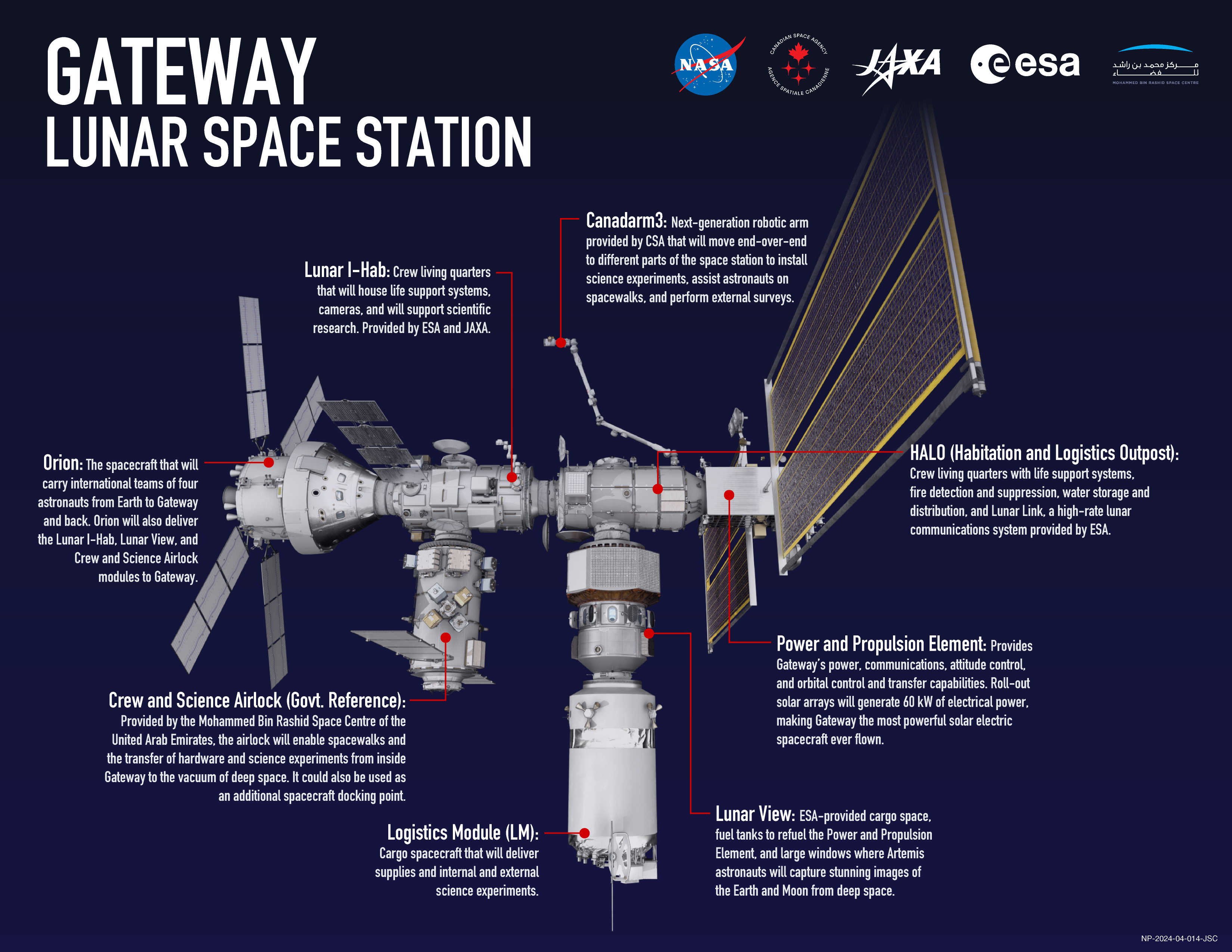
Schematic of the Lunar Gateway.

The Lunar Gateway. Nasa

Most components contributed by these partners have already been produced and delivered to the US for integration and testing. But the project has been beset by rising costs and persistent debates over its value.

If cancelled, the US abandonment of the most multinational component of the Artemis programme, at a time when trust in such alliances is under unprecedented strain, could be far reaching.

It will be assembled module by module, with each partner contributing components and with the possibility of additional partners joining over time.

Strategic aims

Gateway reflects a broader strategic aim of Artemis, to pursue lunar exploration through partnerships with industry and other nations, helping spread the financial cost – rather than as a sole US venture. This is particularly important amid intensifying competition – primarily with China.

China and Russia are pursuing their own multinational lunar project, a surface base called the International Lunar Research Station. Gateway could act as an important counterweight, helping reinforce US leadership at the Moon.

In its quarter-century of operation, the ISS has hosted more than 290 people from 26 countries, alongside its five international partners, including Russia. More than 4,000 experiments have been conducted in this unique laboratory.

In 2030, the ISS is due to be succeeded by separate private and national space stations in low Earth orbit. As such, Lunar Gateway could repeat the strategic, stabilising role among different nations that the ISS has played for decades.

However, it is essential to examine carefully whether Gateway’s strategic value is truly matched by its operational and financial feasibility.

It could be argued that the rest of the Artemis programme is not dependant on the lunar space station, making its rationales increasingly difficult to defend.

Some critics focus on technical issues, others say the Gateway’s original purpose has faded, while others argue that lunar missions can proceed without an orbital outpost.

Sustainable exploration

Supporters counter that the Lunar Gateway offers a critical platform for testing technology in deep space, enabling sustainable lunar exploration, fostering international cooperation and laying the groundwork for a long term human presence and economy at the Moon. The debate now centres on whether there are more effective ways to achieve these goals.

Despite uncertainties, commercial and national partners remain dedicated to delivering their commitments. Esa is supplying the International Habitation Module (IHAB) alongside refuelling and communications systems. Canada is building Gateway’s robotic arm, Canadarm3, the UAE is producing an airlock module and Japan is contributing life support systems and habitation components.

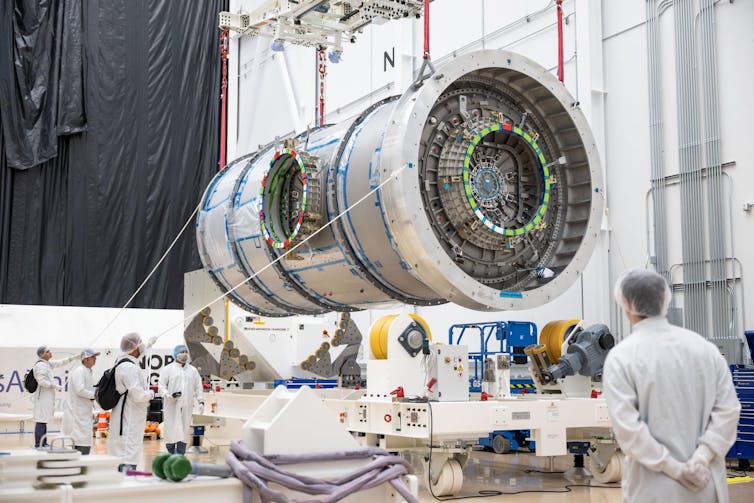
Gateway’s Halo module at a facility in Arizona operated by aerospace company Northrop Grumman. Nasa / Josh Valcarcel

US company Northrop Grumman is responsible for developing the Habitat and Logistics Outpost (Halo), and American firm Maxar is to build the power and propulsion element (PPE). A substantial portion of this hardware has already been delivered and is undergoing integration and testing.

If the Gateway project ends, the most responsible path forward to avoid discouraging future contributors to Artemis projects would be to establish a clear plan to repurpose the hardware for other missions.

Cancellation without such a strategy risks creating a vacuum that rival coalitions, could exploit. But it could also open the door to new alternatives, potentially including one led by Esa.

Esa has reaffirmed its commitment to Gateway even if the US ultimately reconsiders its own role. For emerging space nations, access to such an outpost would help develop their capabilities in exploration. That access translates directly into geopolitical influence.

Space endeavours are expensive, risky and often difficult to justify to the public. Yet sustainable exploration beyond Earth’s orbit will require a long-term, collaborative approach rather than a series of isolated missions.

If the Gateway no longer makes technical or operational sense for the US, its benefits could still be achieved through another project.

This could be located on the lunar surface, integrated into a Mars mission or could take an entirely new form. But if the US dismisses Gateway’s value as a long term outpost without ensuring that its broader benefits are preserved, it risks missing an opportunity that will shape its long term influence in international trust, leadership and the future shape of space cooperation.The Conversation

Berna Akcali Gur, Lecturer in Outer Space Law, Queen Mary University of London

This article is republished from The Conversation under a Creative Commons license. Read the original article.

Recommended Newsletters

Carl M. Cannon's Morning Note

headlines against the historic events

Science News

Featuring the latest science news

submit to reddit

Comment

Show comments Hide Comments

You must be logged in to comment.

RCS Account: Login Register

Read the whole story
bogorad
2 hours ago
reply
Barcelona, Catalonia, Spain
Share this story
Delete

Ladybird adopts Rust, with help from AI - Ladybird

1 Share
  • Language Migration: The Ladybird project is transitioning its codebase from C++ to Rust to utilize a more mature systems programming ecosystem and memory safety features.
  • Selection Rationale: Rust was chosen over Swift due to superior C++ interoperability, broader platform support, and an existing contributor base familiar with the language.
  • Pragmatic Compromise: Despite Rust's mismatch with the web platform's inheritance-heavy object model, it has been adopted as the most viable path forward for safety guarantees.
  • Initial Target: The migration began with LibJS, specifically the JavaScript lexer, parser, AST, and bytecode generator, due to their self-contained nature and test coverage.
  • Automated Translation: Low-level code porting was facilitated by AI tools under human direction, completing 25,000 lines of code in approximately two weeks.
  • Safety Verification: Performance and accuracy were validated through extensive test suites and lockstep testing, ensuring byte-for-byte identical output between the C++ and Rust pipelines.
  • Non Idiomatic Code: The current Rust implementation intentionally mimics C++ patterns and register allocation to maintain compatibility during the transition period.
  • Incremental Integration: The project will maintain a dual-language architecture, with the core team managing the gradual porting of subsystems while development continues in C++.

We’ve been searching for a memory-safe programming language to replace C++ in Ladybird for a while now. We previously explored Swift, but the C++ interop never quite got there, and platform support outside the Apple ecosystem was limited. Rust is a different story. The ecosystem is far more mature for systems programming, and many of our contributors already know the language. Going forward, we are rewriting parts of Ladybird in Rust.

Why Rust?

When we originally evaluated Rust back in 2024, we rejected it because it’s not great at C++ style OOP. The web platform object model inherits a lot of 1990s OOP flavor, with garbage collection, deep inheritance hierarchies, and so on. Rust’s ownership model is not a natural fit for that.

But after another year of treading water, it’s time to make the pragmatic choice. Rust has the ecosystem and the safety guarantees we need. Both Firefox and Chromium have already begun introducing Rust into their codebases, and we think it’s the right choice for Ladybird too.

Porting LibJS

Our first target was LibJS , Ladybird’s JavaScript engine. The lexer, parser, AST, and bytecode generator are relatively self-contained and have extensive test coverage through test262, which made them a natural starting point.

I used Claude Code and Codex for the translation. This was human-directed, not autonomous code generation. I decided what to port, in what order, and what the Rust code should look like. It was hundreds of small prompts, steering the agents where things needed to go. After the initial translation, I ran multiple passes of adversarial review, asking different models to analyze the code for mistakes and bad patterns.

Results

The requirement from the start was byte-for-byte identical output from both pipelines. The result was about 25,000 lines of Rust, and the entire port took about two weeks. The same work would have taken me multiple months to do by hand. We’ve verified that every AST produced by the Rust parser is identical to the C++ one, and all bytecode generated by the Rust compiler is identical to the C++ compiler’s output. Zero regressions across the board:

Test suite

Tests

Regressions

test262

52,898

0

Ladybird regression tests

12,461

0

No performance regressions on any of the JS benchmarks we track either.

Beyond the test suites, I’ve done extensive testing by browsing the web in a lockstep mode where both the C++ and Rust pipelines run simultaneously, verifying that output is identical for every piece of JavaScript that flows through them.

If you look at the code, you’ll notice it has a strong “translated from C++” vibe. That’s because it is translated from C++. The top priority for this first pass is compatibility with our C++ pipeline. The Rust code intentionally mimics things like the C++ register allocation patterns so that the two compilers produce identical bytecode. Correctness is a close second. We know the result isn’t idiomatic Rust, and there’s a lot that can be simplified once we’re comfortable retiring the C++ pipeline. That cleanup will come in time.

What’s next

This is not becoming the main focus of the project. We will continue developing the engine in C++, and porting subsystems to Rust will be a sidetrack that runs for a long time. New Rust code will coexist with existing C++ through well-defined interop boundaries.

We want to be deliberate about which parts get ported and in what order, so the porting effort is managed by the core team. Please coordinate with us before starting any porting work so nobody wastes their time on something we can’t merge.

I know this will be a controversial move, but I believe it’s the right decision for Ladybird’s future. :^)

Andreas Kling

Founder & President

Read the whole story
bogorad
3 hours ago
reply
Barcelona, Catalonia, Spain
Share this story
Delete

Donald Trump’s ‘Board of Peace’ explores stablecoin for Gaza

1 Share
  • Stablecoin Economic Initiative: Officials are exploring a dollar-pegged cryptocurrency to facilitate digital transactions and revitalize the economy in Gaza.
  • Administrative Oversight: The project is led by the Board of Peace in coordination with the National Committee for the Administration of Gaza and the Office of the High Representative.
  • Electronic Payment Infrastructure: Plans involve creating a secure digital backbone to support financial services, e-learning, and healthcare while allowing for user control over data.
  • Asset Pegging Strategy: The proposed digital currency would be tied to the US dollar rather than acting as a sovereign Palestinian currency.
  • Physical Currency Challenges: The initiative addresses the severe shortage of Israeli shekels and the destruction of banking infrastructure caused by ongoing conflict.
  • Financial Control Objectives: Transitioning to digital payments aims to reduce the circulation of physical cash to prevent its acquisition by Hamas.
  • Connectivity Improvements: Implementation requires upgrading Gaza's existing 2G network to high-speed access to ensure the functionality of digital platforms.
  • Economic Linkage Concerns: Internal discussions include potential risks regarding the economic separation of Gaza from the West Bank if the system lacks central oversight.

Officials working with Donald Trump’s “Board of Peace” are exploring setting up a stablecoin for Gaza as part of efforts to reshape the devastated Palestinian enclave’s economy, according to five people familiar with the discussions.

The talks around introducing a stablecoin — a type of cryptocurrency whose value is pegged to a mainstream currency, such as the US dollar — are at a preliminary stage, and many details of how one could be introduced in Gaza remain to be determined.

But officials have discussed the idea as part of their plan for the future of the enclave, where economic activity collapsed during Israel’s two-year war with Hamas and the traditional banking and payments system has been severely impaired.

A person familiar with the project said the stablecoin was expected to be tied to the US dollar, with the hope that Gulf Arab and Palestinian companies with expertise in the field of digital currencies will help spearhead the effort. 

“This will not be a ‘Gaza Coin’ or a new Palestinian currency, but a means to allow Gazans to transact digitally,” the person said.

Work on the idea is being led by Liran Tancman, an Israeli tech entrepreneur and former reservist who is now working as an unpaid adviser to Trump’s “Board of Peace”, the US-led body tasked with rebuilding Gaza, according to two people familiar with the matter.

Others involved in the project include officials from the strip’s new Palestinian technocratic government, the 14-member National Committee for the Administration of Gaza (NCAG), as well as the Office of the High Representative led by former UN envoy Nickolay Mladenov. Both bodies work under the “Board of Peace”.

According to the person familiar with the project, the “Board of Peace” and NCAG will decide on the stablecoin’s regulatory framework and access, although “nothing definitive” has yet been finalised.

Speaking at a meeting of the “Board of Peace” in Washington last week, Tancman said the NCAG was working on building “a secure digital backbone, an open platform enabling e-payments, financial services, e-learning, and healthcare with user control over data”, but did not elaborate.

“The Board of Peace, NCAG, and the Office of the High Representative for Gaza are looking into all options that will jump start the Gazan economy,” a Trump administration official said. The US has previously pushed for the broader use of dollar-backed stablecoins.

The Palestine Monetary Authority serves as the central bank for both the occupied West Bank and Gaza. But it does not have the power to issue its own currency, and the formal currency in the Palestinian territories is Israel’s shekel. While dollar transactions take place in Gaza, they are limited in comparison to those done in shekels.

Since the start of the war between Israel and Hamas in 2023, however, access to physical shekels in Gaza has been severely limited as cash machines have been destroyed or closed, and Israel has blocked deliveries of new cash to the strip. 

This has left traders and brokers in control of the increasingly limited supply of hard currency, with many charging exorbitant fees to disburse it.

It has also pushed an increasing number of Gazans to use electronic payment systems.

A hand holds a partially burned Israeli 100 shekel banknote amid rubble and debris from destroyed buildings.

Access to physical Israeli shekels in Gaza has been severely limited by the war © Ahmad Salem/Bloomberg

Another person familiar with the talks over introducing a stablecoin — in which transactions are anonymous but traceable — said the idea behind the initiative was to “dry Gaza from cash so Hamas can’t generate any”.

The person familiar with the project argued that increasing the scope of digital transactions would allow commerce to continue without being beholden to the whims of the Israeli government.

However, other people familiar with the discussions expressed concerns that a stablecoin could potentially also be used to further detach the economies of Gaza and the West Bank, both of which Palestinians seek as part of a future state, particularly if a Gaza-only stablecoin were not under the control of the PMA.

“It will be much more difficult [to maintain economic links between Gaza and the West Bank] if they have no means of easy payment between the two, so that Gaza would be almost like a self-contained economy,” said one. “That would be a concern.”

The person familiar with the project disputed this. “No one is trying to divide Gaza from the West Bank,” the person said. “It’s only meant to allow Palestinians to transact digitally.”

Another potential complication of relying on a stablecoin would be the fact that Gaza suffers from frequent power cuts and Israel has long limited Gazans to using slow 2G network technology.

In his comments at the “Board of Peace” last week, Tancman said that Gaza’s 2G network “will be upgraded with free high-speed access to essential services” by July.

Additional reporting by James Politi in Washington

Read the whole story
bogorad
3 hours ago
reply
Barcelona, Catalonia, Spain
Share this story
Delete

Ira Bodnar on X: "Claude just killed our startup" / X

1 Share
  • Obsolescence Of Ad Management: General-purpose AI models and agents are integrating connectors for advertising platforms, rendering niche automation tools for ad management redundant.
  • Persistence Of Data Ownership: Customer Relationship Management systems and large-scale lead databases remain secure as AI lacks independent data storage and massive proprietary contact harvesting capabilities.
  • Decay Of Outreach Infrastructure: Automation of outreach and the underlying infrastructure, such as domain setup, are expected to be fully absorbed by AI agents.
  • Survival Of Enterprise Workflows: Complex enterprise systems, including Customer Data Platforms and high-volume creative production for large brands, are insulated from immediate AI disruption.
  • Shift To Model Context Protocol: The Model Context Protocol is emerging as a dominant platform where AI selects specific tools for users, mirroring the early impact of the mobile app store.
  • Rise Of Agentic Commerce: Procurement is shifting toward AI-to-AI transactions where agents prioritize technical specifications and value over brand recognition or traditional sales tactics.
  • Saturation Of Synthetic Content: Social media platforms face a projected influx of AI-generated content and bot activity, making organic human attention increasingly difficult to capture.
  • Value Of Human Intangibles: As technical execution becomes commoditized, market advantages shift toward human-centric qualities such as brand storytelling, taste, and high-volume experimentation.

I woke up today and Claude killed my startup. We got several hundred paying clients in 2 months, was growing like crazy. One Claude/Manus feature and our close rate dropped from 70% to 20%. Claude just made our entire product category obsolete.

We built an AI agent that automates ad management for you. Like, you can give it access to all your Google and Meta accounts and it will manage it for you. Pretty cool. Customers loved it.

Claude and Manus both released connectors for Meta Ads. Claude still can't make changes in ad accounts — it can only do analysis, and it has no access to Google Ads. But give it a few months, and it will. So building here feels pointless.

Like, every marketer will have Claude Cowork, ask "launch me a million-dollar ad campaign. make no mistakes" and go go go.

But what's next?

We need to think about the overall future of the GTM stack.

Here are the big GTM categories today:

  1. Own data — CRMs will be fine. Claude can't store your customer data.

  2. Lead databases — Clay, Apollo, RB2B will be fine. Claude can't collect 1B phone numbers and emails.

  3. Outreach automation — dead soon. You'll be able to tell Claude "Spam all YC founders offering my SaaS" and it'll just do it.

  4. Outreach infra — also dead. Agents will soon buy domains and set up outreach automation on their own.

  5. Niche tools — server-side tracking and similar will survive.

  6. Creatives — mostly dead. In a few months Meta and Google will generate them inside ad accounts. There will be some players who do top-tier large volume creatives for huge advertisers, but for small businesses it'll be inside Google/Meta.

  7. Enterprise complex workflows — like CDPs, customer engagement for huge brands. They are safe and will be doing exceedingly well. And waiting for more cool players in the space.

What's coming for marketing and distribution

AI made building free and distribution harder than ever. Everyone ships now. Good luck getting anyone to notice. Current GTM tech is pre-agentic era — it's not up to speed with where things are going. It can't sell to agents. But I'm a huge believer in the future of this space.

When building is free, distribution becomes everything — and that means more money, attention and energy will flow here than ever.

A few predictions:

  • MCP is the new App Store. Claude picks a tool via MCP. No marketplace, no comparison — the AI picks one tool and the user never sees alternatives. This is the iPhone App Store in July 2008.

  • Ads inside LLMs are the next trillion-dollar channel. Someone will build the ad network that connects thousands of chatbots the way Google connected websites. That company will be generational.

  • Agentic commerce is coming. AI agents don't pay extra for brand. They compare specs, read reviews, pick the best value. Every category races toward commodity pricing.

  • AI-to-AI sales will break enterprise playbooks. AI agents will read docs, compare specs, analyze pricing. They don't watch demos or get charmed.

  • Social: completely botted and hijacked. The best GTM people know how to work the algorithms and get billions of views for free. It's a volume game once you figure out how to create decent, engaging content. Very soon — if not already — 98% of TikTok and Instagram will be fake AI content boosted by bots to go viral.

  • Brand is more important than ever. It's almost impossible to replicate with AI. Last moat for selling to humans: story, trust, taste.

  • The gap between good and bad marketers will explode. Anyone can generate AI slop for ~$0. It doesn't work. Taste, viral instincts, and storytelling are your alpha.

  • Marketing is still a volume game. Try every channel, scale what works, do 10,000x of it. The tools die, but the hustle doesn't. We need human hustlers who can test everything and scale it.

What we're going to do next as a team

Our current business will be fine anyway. We knew what was coming and started actively pivoting a few weeks ago. Now we also build complex workflows for huge ad agencies managing 100s of accounts — like some of our clients manage 600 accounts with 6 people. Pretty insane.

We also sell AI-native ad agency services to SMBs because we know how to sell to small gas stations in Texas type of businesses, and they love how our AI and humans genuinely care about them.

But I definitely want to think more about the future of distribution in the post-Claude era and what cool and great things we can build here. Stay tuned.

[

Image

](/irabukht/article/2025846968245948795/media/2025843484087975936)

Read the whole story
bogorad
8 hours ago
reply
Barcelona, Catalonia, Spain
Share this story
Delete
Next Page of Stories