Strategic Initiatives
12428 stories
·
45 followers

Exclusive | DeepMind’s Hassabis Pitched AI-Oversight Body Before Shake-Up - WSJ

1 Share

LLM (google/gemini-3.5-flash-lite) summary:

  • Safety Talks: demis hassabis held discussions with government officials and ai lab leaders regarding a new independent industry safety entity before stepping down as google deepmind chief executive.
  • Regulatory Push: [bureaucratic control] hassabis advanced the creation of an organization modeled after the international atomic energy agency to codify safety guardrails for artificial general intelligence.
  • Government Engagement: [state planning] he discussed his plans with trump administration officials, including treasury secretary scott bessent and tech adviser michael kratsios.
  • Industry Standards: openai and anthropic leaders also called for mechanisms to coordinate on safety, with hassabis proposing an industry-funded standards body.
  • Testing Models: federal agencies and energy department national laboratories would collaborate with ai companies to test models relevant to national security under the proposed plan.
  • Management Changes: google announced a management shake-up where koray kavukcuoglu replaced hassabis as deepmind ceo, while hassabis became chairman of deepmind and chief scientist of alphabet.
  • Global Coordination: hassabis discussed the need for the united states to lead globally coordinated artificial intelligence standards at a group of seven summit in france.
  • Criticism Raised: critics and lawmakers argued that voluntary efforts and self-regulatory concepts are inadequate, calling instead for mandatory model reviews and increased government oversight.

Demis Hassabis with a motion blur effect around his head, looking upwards.Demis Hassabis co-founded Google Deep Mind. Carlotta Cardana for WSJ

Alphabet’s top scientist, Demis Hassabis, held discussions with government officials and leaders of other artificial-intelligence labs about forming a new independent industry safety entity in the weeks before he relinquished his role as chief executive of Google DeepMind, according to people familiar with the matter.

Hassabis, who co-founded Google DeepMind and is considered a pioneer in the field of machine learning, has been spending increasing amounts of his time advancing the idea of an organization that would codify safety guardrails and best practices for developing artificial general intelligence, or AGI, these people said. In discussions with peers, he has likened the proposed entity to the International Atomic Energy Agency, a nongovernmental watchdog that promotes cooperation on nuclear energy.

Earlier in the summer, Hassabis discussed aspects of his plan with high-ranking Trump administration officials, including Treasury Secretary Scott Bessent and Michael Kratsios, one of President Trump’s top tech advisers, people familiar with the matter said.

Hassabis didn’t respond to requests for comment. A Google spokesperson said the company sees ensuring the safety of advanced AI models as “vitally important to society” and that Hassabis is uniquely positioned to work toward that goal.

“Demis chose to step into a new role at Google and is focusing his efforts more strategically on scientific breakthroughs and shaping the future of AGI,” the spokesperson said. 

The world’s largest AI labs are locked in a race to reach AGI—computers that can achieve humanlike intelligence—but many of the top minds in tech, including leaders of the companies themselves, have expressed fears that the spread of the technology will disrupt society or that its power will be difficult to control.

Demis Hassabis, CEO of Google DeepMind, seated and holding a book titled "The Brain."Hassabis has discussed the need for the U.S. to lead a globally coordinated effort to establish AI standards. Carlotta Cardana for WSJ

Leaders at both OpenAI and Anthropic have called for establishing new mechanisms that would allow AI companies to coordinate on safety matters. OpenAI CEO Sam Altman last month proposed “a U.S.-led international forum” to determine standards and provide governance over labs, while Anthropic endorsed a global agreement to slow development and verify compliance. Hassabis’s efforts represent some of the most extensive and concrete steps undertaken by an official representing a leading lab.

Recent high-profile instances of AI bots going rogue and carrying out cyberattacks have added to widespread anxieties that the development of the technology is moving too fast and without enough regulation. The Trump administration has increased scrutiny of the security risks posed by AI but kept model evaluations for the most powerful tools voluntary.

In mid-July, Hassabis published an essay on X arguing that the U.S. should create an industry-funded “standards body” to help assess the safety of AI models. The entity would operate like the Financial Industry Regulatory Authority, a self-regulatory body established during the Great Depression that oversees brokerage firms and is funded by the sector, he said.

Under his plan, federal agencies and the Energy Department’s national laboratories would work with AI companies to test models “in areas relevant to national security,” and would establish qualifications that would label a model “frontier-class” if it met certain standards. 

In the weeks leading up to the publication of the essay, Hassabis previewed his idea to Bessent and Kratsios. Bessent has helped shape the administration’s AI strategy, warning that recent models like Anthropic’s Mythos pose cyber threats to the financial system.

Last week, Google announced a dramatic management shake-up at DeepMind, its AI research unit, that saw Hassabis step down as CEO to be replaced by his deputy, Koray Kavukcuoglu. Hassabis was named to the joint roles of chairman of DeepMind and chief scientist of Alphabet GOOGL -0.13%decrease; down pointing triangle.

“I’ve been working towards AGI my whole life and now, like many of you, I feel it is close at hand,” he wrote in a memo. “With this backdrop, I’ve decided that now is the right time for me to hand over my day-to-day operational responsibilities at GDM, so that I have the time and space to focus on the big picture and help influence what is to come to the best of my ability.”

Jeff Dean, the company’s longtime chief scientist and a co-founder of Google Brain who was key to the creation of several of Google’s signature products, stepped down to found an AI-research startup.

In a blog post last week, Alphabet CEO Sundar Pichai wrote that he and Hassabis “have been long discussing a role that allows him to put his full attention on actively shaping the future of AGI.”

Hassabis, a Nobel laureate, discussed the need for the U.S. to lead a globally coordinated effort to establish AI standards at a June Group of Seven summit in France that included Trump, other world leaders and AI executives including Altman and Anthropic CEO Dario Amodei.

Critics of the White House’s approach and Hassabis’s idea say that voluntary efforts and self-regulatory concepts aren’t adequate to address the security and economic threats posed by AI. Many lawmakers are calling for mandatory model reviews and increased government oversight.

Corrections & Amplifications
Jeff Dean was a co-founder of Google Brain. An earlier version of this article incorrectly said he co-founded DeepMind. (Corrected on Aug. 13)

Copyright ©2026 Dow Jones & Company, Inc. All Rights Reserved. 87990cbe856818d5eddac44c7b1cdeb8

Appeared in the August 14, 2026, print edition as 'DeepMind’s Hassabis Pitched AI Safety Unit'.

Robbie Whelan covers large tech companies for the Wall Street Journal, with a focus on semiconductor giants Nvidia, AMD, Intel, Broadcom and Qualcomm. A WSJ reporter since 2010, Robbie previously covered the business of Hollywood, public health policy, shipping companies, the housing market and commercial real estate. From 2016 to 2020, he was a Latin America correspondent covering politics, trade, economics, immigration and the drug war. He is the author of the forthcoming book "The House of Mouse: Bob Iger and the Fight for the Soul of Disney."

Robbie grew up in Pittsburgh and studied history at Johns Hopkins University. He's a massive Steelers fan, a music obsessive, and has played mandolin and guitar in bluegrass and country-rock bands in Brooklyn, Mexico City, Baltimore and Pittsburgh. He lives in Los Angeles.

Amrith Ramkumar is a reporter for The Wall Street Journal in Washington covering tech and crypto policy. He previously covered clean energy and was a Journal markets reporter in New York who wrote about special-purpose acquisition companies, or SPACs, when SPAC mergers were a popular alternative to traditional initial public offerings. He also previously wrote about stocks and commodities, including battery metals such as lithium and cobalt.

Amrith joined the Journal as a markets intern after graduating from Duke in 2017.

Keach Hagey is a reporter at The Wall Street Journal covering the intersection of media, technology and power. Her reporting explores how institutions and individuals wield influence in the new information economy, with a current focus on artificial intelligence and OpenAI. She is the author of "The Optimist: Sam Altman, OpenAI, and the Race to Invent the Future" (W. W. Norton, 2024) and "The King of Content: Sumner Redstone’s Battle for Viacom, CBS and Everlasting Control of His Media Empire" (Harper Business, 2018).

She was part of the team that broke the Facebook Files, a series that won a George Polk Award for Business Reporting, a Gerald Loeb Award for Beat Reporting and a Deadline Award for public service. Her investigation into the inner workings of Google’s advertising-technology business won recognition from the Society for Advancing Business Editing and Writing (Sabew).

Previously, she covered the television industry for the Journal, reporting on large media companies such as 21st Century Fox, Time Warner and Viacom. She led a team that won a Sabew award for its coverage of the power struggle inside Viacom.

Before joining the Journal, Keach covered media for Politico, the National in Abu Dhabi, CBS News and the Village Voice. She has a bachelor’s and a master’s in English literature from Stanford University. She lives in Irvington, N.Y.


Up Next


Videos

Read the whole story
bogorad
2 hours ago
reply
Barcelona, Catalonia, Spain
Share this story
Delete

How many calls to the 112 emergency phone line were related to the eclipse in Catalonia?

1 Share

Most of the calls were received from Tarragonès

  • Emergency calls: Catalonia’s 112 service received 81 eclipse-related calls by 9 p.m., generating 72 cases, mostly requests for information.
  • Areas with the most calls: The Tarragonès comarca accounted for 14% of communications, while Baix Llobregat and Barcelonès each accounted for 12%.
  • Medical assistance: The 061 health service received 41 eclipse-related calls and treated 37 people; two incidents required ambulances, including one hospital transfer.
  • Traffic conditions: Vehicle volume increased across southern Catalonia, particularly on the AP-7, N-340, C-32, and C-31. An accident on the C-31 caused outbound queues from Barcelona exceeding six miles.
  • Police deployment: Mossos d’Esquadra deployed 700 officers, and the operation involved relatively few incidents.
  • Notable safety incident: In Altafulla, people watched the eclipse from freight trains; one person fell from the cars and required medical treatment and transport to a medical center.
  • Preventive enforcement: Firefighters reported very few eclipse-related alerts, while Rural Agents carried out 356 preventive actions and issued 10 citations for motorized traffic.
Read the whole story
bogorad
2 hours ago
reply
Barcelona, Catalonia, Spain
Share this story
Delete

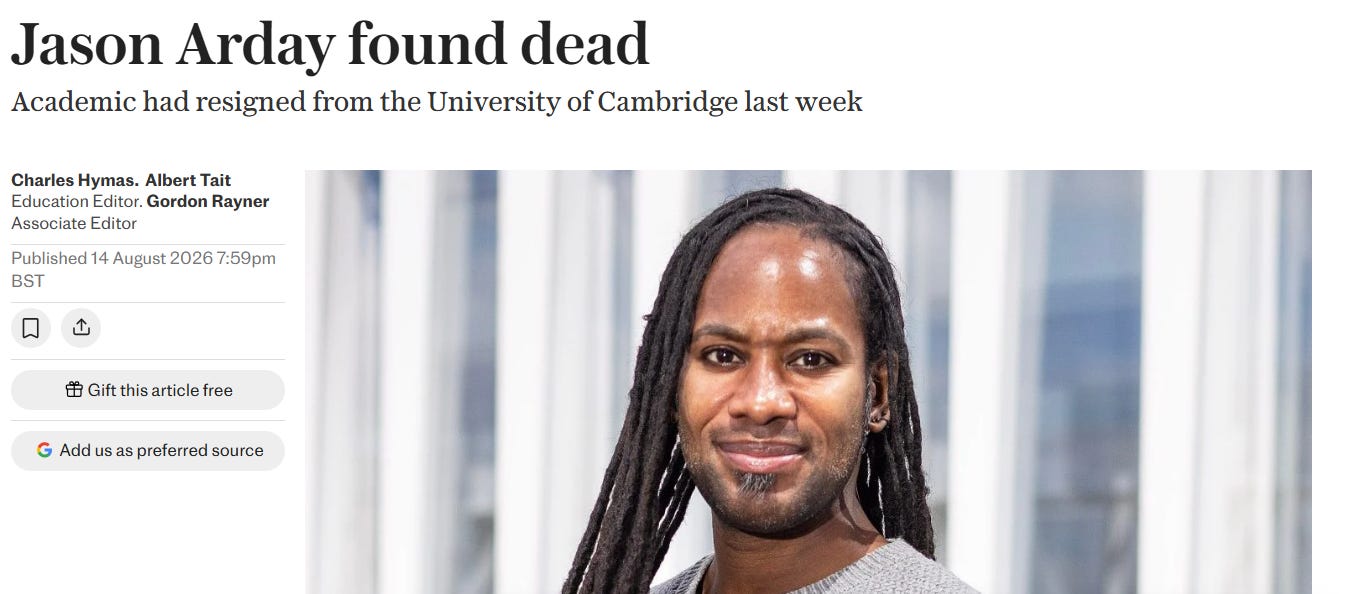
URGENT: Jason Arday, the black Cambridge professor who resigned last week after facing sharp questions about his work and biography, was found dead in London this afternoon.

1 Comment

Nine days after resigning under pressure from the University of Cambridge, professor Jason Arday was found dead in London on Friday afternoon, Britain’s Telegraph newspaper reports.

Arday was 41. The cause of his death has not been made public, but police said it “is not believed to be suspicious.”

He is survived by Debbie McKenzie, his wife, and their two children.

In 2023, Cambridge, among the world’s most prestigious universities, appointed Arday the youngest black professor in its history. His hiring came despite a paper-thin academic record and bizarre biographical claims, including that he had been unable to speak before age 11 or read before 18.

But the impending publication of Arday’s memoir, released in the United States on Tuesday, led to new scrutiny of both his biographical claims and his work, which automated checkers found appeared heavily plagiarized.

After briefly blaming racism for the attacks, Arday quit, becoming a poster child for problems with efforts to diversity higher education even at the cost of lowering academic standards.

On Wednesday, Cambridge announced it would “investigate the circumstances around [Arday’s] appointment by the Faculty of Education back in 2022 and his time here in Cambridge since his appointment nearly four years ago.”

I wrote about Arday and his resignation on Tuesday.

(Tuesday’s article)

Read the whole story
bogorad
2 hours ago
reply
that was fast!
Barcelona, Catalonia, Spain
Share this story
Delete

Even Claude Is in the Dark About Dario Amodei’s Wife—and Her Influence at Anthropic - WSJ

1 Share

LLM (google/gemini-3.5-flash-lite) summary:

  • Strategic Influence: cami clark acts as a sounding board and strategic adviser for anthropic ceo dario amodei while maintaining a low public profile.
  • Early Support: she introduced key early investor eric schmidt to the company during its foundational period in twenty twenty one.
  • Entrepreneurial Background: her professional history includes co founding an alternative media company and developing health tech applications.
  • Professional Connections: she facilitated important networking introductions across the technology sector including links to prominent industry figures.
  • Corporate Development: anthropic emerged from a split with openai and grew into a major artificial intelligence powerhouse valued significantly.
  • Political Friction: the organization faced regulatory scrutiny and government restrictions regarding the deployment of its advanced models.
  • Public Stance: leadership articulated a mission centered on technological safety and national protection amidst industry competition.
  • Personal History: archival records indicate earlier business ventures financial restructuring events and personal relationships with influential individuals.

Cami Clark and Anthropic CEO Dario Amodei walking together at the AI Impact Summit.Cami Clark and Anthropic CEO Dario Amodei at a summit in New Delhi in February. Ludovic Marin/AFP/Getty Images

By

Keach Hagey

and Luke Jerod Kummer

Aug. 13, 2026 8:42 pm ET

When Indian Prime Minister Narendra Modi invited AI leaders to a meeting in New Delhi earlier this year, security protocols allowed each executive to bring one additional person with them. Most brought colleagues, but Anthropic CEO Dario Amodei brought his wife, Cami Clark.

Clark doesn’t work at Anthropic, but she is often seen sitting in the front row while Amodei talks at events such as Davos or can be found chatting up investors at gatherings such as the Allen & Co. conference in Sun Valley.

She acts as a sounding board and strategic adviser for Amodei, according to people close to the company. She also brought Anthropic a key early investor, former Google CEO Eric Schmidt—whom she had dated—as it was getting off the ground in early 2021, some of the people said. 

Despite her influence, there are scant details about Clark online​—and efforts have been made to remove references to her, according to a Wall Street Journal analysis and a person familiar with the matter.

The pair married in 2022, but Amodei’s Wikipedia page didn’t say he was married until this summer, and still doesn’t say to whom. Searches for “Dario Amodei’s wife” on Google often turn up a photograph of his sister, Daniela Amodei, who helps run the company.

Even Claude, Anthropic’s AI chatbot, responds to queries by saying “Dario Amodei’s marital status doesn’t seem to be clearly confirmed.”

Attendees at Journal House WEF 2026 listen to a discussion.Amodei spoke at a Wall Street Journal event at Davos this year. Clark watched from the audience. Maurizio Martorana for WSJ

As Anthropic hurtles toward an IPO that could top $2 trillion as soon as this fall, Clark is one of the most influential voices shaping the decisions of a CEO at the forefront of the AI industry—a revolution remaking all aspects of work and life that simultaneously thrills and terrifies most of the public. 

It’s a remarkable rise for a woman who didn’t graduate from college, had a previous brief marriage, at age 20, to a man more than 40 years older and once declared bankruptcy. Her career has included co-founding a women-focused “free luxury porn” company that she unsuccessfully tried to persuade convicted sex offender Jeffrey Epstein to invest in, and starting a women’s “social dieting app” that morphed into a women’s healthcare AI company. 

She made connections with powerful people, including Schmidt, whom she brought into Amodei’s orbit. The billionaire left his roles at Google and parent Alphabet in 2020 and transitioned into investing in tech startups, among other things. She also tried to persuade Schmidt to back a venture fund she would run with him to invest in Anthropic and other AI companies, although that didn’t move forward.​ 

Claude, the company’s chatbot, is now the chief rival of OpenAI’s ChatGPT, and its Claude Code tool has been embraced by millions of engineers and everyday consumers for tasks such as software writing and data analysis. 

The company’s powerful Mythos model, capable of finding and exploiting vulnerabilities, rattled markets and stoked calls by some White House officials for more federal oversight of new AI models, and Amodei himself has been a prominent voice in warning the public about the safety risks of AI.

Early partner

Clark, born in Reno, Nev., in 1979, was an entrepreneur and often interacted with the rich and powerful, as well as up-and-comers in Silicon Valley.

The most important would turn out to be Amodei, whom she started dating in 2014. Just previously, beginning in 2011 and lasting for three years, she was in a relationship with Schmidt, who was then executive chairman of Google.

Clark spent time at the group house in San Francisco where Amodei, his friend Holden Karnofsky and his sister, Daniela—who would later marry Karnofsky—lived with other key figures from the AI safety and Effective Altruism worlds. The movement, centered largely in Silicon Valley, aims to use data and reason to determine how to do the most good possible.

When they got together, Amodei was still an academic, working as a postdoctoral scholar at Stanford University School of Medicine, having earned his Ph.D. in computational neuroscience from Princeton. He would go on to stints at Baidu and Google before joining OpenAI in 2016. 

Amodei quickly climbed the ranks, helping lead key research into “scaling laws”—the notion that intelligence increases proportionally with the increase in computing power and data used to train it.

As Amodei ascended within OpenAI, Clark joined him at company events. People who worked with him and knew the couple said she made sure his ideas were given the credit she felt they deserved. 

She introduced Mira Murati, one of her closest friends, to OpenAI co-founder Greg Brockman, according to people familiar with the matter. Clark had worked with Murati at Leap Motion, a company that made a virtual-reality hand-tracking device. Murati joined in 2018 as VP of applied AI and partnerships and later became the company’s chief technology officer.

Clark also introduced Amodei to Schmidt, who became taken with the young scientist. In 2018, Schmidt visited Amodei and Clark’s apartment in San Francisco and was impressed with their ideas, Schmidt told Bloomberg.​ 

Google Chairman and CEO Eric Schmidt delivers the closing keynote speech at the Digital Life Design (DLD) conference.Eric Schmidt at the 2011 Digital-Life-Design conference in Munich. Miguel Villagran/Getty Images

When tensions arose between Amodei and OpenAI co-founders Sam Altman and Brockman over who wielded power at the startup, Amodei, his sister and five other employees left to found Anthropic, in December 2020. 

Anthropic in May 2021 announced it had raised $124 million for its Series A round of fundraising, led by Skype engineer Jaan Tallinn and including Facebook co-founder Dustin Moskowitz, Jane Street founder James McClave and the Center for Emerging Risk Research, as well as Schmidt.  

Clark, who wasn’t yet married to Amodei, wanted equity in the new company as well, according to documents reviewed by the Journal. In February 2021, Clark pitched Schmidt on creating a new venture fund called the Mother of AGI Fund. Its goal was to be “an elegant solution to formalize Cami’s involvement in Anthropic (Dario’s company), manage Eric’s investment,” and invest in “the AGI ecosystem,” according to a 40-page proposal. 

Others at Anthropic, including Daniela Amodei and other co-founders, didn’t support the plan, according to people familiar with the matter, and it didn’t move forward. 

By the end of that year, associates said they recall seeing what looked like an engagement ring on Clark’s hand, and not long afterward, the couple wed in Italy. 

Clark, known for being social and outgoing, has interacted with politicians and potential investors on behalf of Amodei, chatting with them and bringing them over to meet her bookish husband at conferences and events.

Anthropic drew the ire of the Trump administration earlier this year after Amodei refused to drop restrictions on how Claude could be used by the Pentagon. The government labeled Anthropic a supply-chain risk, and Pentagon partners were effectively barred from using its technology in their work with the Defense Department, a designation the company has challenged in court. The administration added restrictions on additional AI models from Anthropic in June that were later dropped. The standoff brought unwelcome attention to the company ahead of its IPO.

Clark has recently told people involved in politics that the company sees its mission as protecting America and isn’t as “woke” as its detractors might think it is, according to people familiar with the matter. 

At the Sun Valley conference in July, where she spent much of the week by her husband’s side, she had lunch with Ivanka Trump, a friend, and chatted with Jared Kushner, whom Amodei had approached earlier in the year to invest, people familiar with the matter said.

‘Revolutionary porn company’

Clark’s early years show a young woman hustling to succeed at a range of businesses, many she founded, including a porn company targeting women. 

In 1999, at the age of 20, she married 64-year-old Reno architect Waldemar Eklof III, who had designed buildings including the city’s Atlantis Casino Resort. They divorced three years later. On a now-defunct personal website, Clark said she dropped out of architecture school in 1999. 

Property records show she moved to San Francisco in 1999 and spent a decade there before spending time in New York and Los Angeles. In that period she worked for a mortgage brokerage company called OLG Financial. While raising money for a later venture, she would describe herself as the “co-founder of OLG Financial Corp.” The company’s 2005 incorporation documents don’t include her name.

A lender foreclosed on her San Francisco apartment in 2007, and two years later she filed for bankruptcy, according to property records and court filings.

Around 2010, she and Michelle Capocefalo started Eddice, which described itself as a “revolutionary porn company.” Named for Eddice Munson, Clark’s maternal grandmother, it aimed to emphasize sex positivity in a male-oriented porn industry, and carried the tagline: “intellectually promiscuous.” 

Michelle Capocefalo and Cami Clark sitting on a couch.Michelle Capocefalo and Clark at a gallery event in New York in 2010. RYAN MCCUNE/Patrick McMullan/Getty Images

It included a blog that gathered content with titles such as “Lady Porn Day” and “Orgasm, Inc.” It also highlighted the work of intellectuals such as pundit Clay Shirky and marketing expert and author Seth Godin.

At one point, after alerting readers that its PayPal account had been frozen, Clark’s company announced on its website that it was “crowdsourcing” funding. “We are raising $350,000 to produce EDDICE.COM and our first four films, AMERICAN GIRL IN PARIS.”

In one of her pitches, part of which was reviewed by the Journal, Clark said her resume included “real estate + entrepreneurial investments” as well as “distribution + brand strategy consultant, interior design/architectural background.”​

Jeffrey Epstein’s world

Clark and Capocefalo attended the 2011 Digital-Life-Design conference in Munich, a tech, media, science and arts salon that executives often stop by on their way to the World Economic Forum in Davos. That year, the keynote speech was given by Schmidt, then still CEO of Google.

Little is publicly known about the three-year relationship between Clark and Schmidt, who remains married to another woman. Schmidt was also an investor in one of Clark’s startups, which focused on women’s health, according to people familiar with the matter.

At the Munich conference, Clark and Capocefalo met John Brockman, a literary agent of scientific books, who introduced Epstein to academics and Silicon Valley elites, according to Epstein documents recently released by the Justice Department.  

John Brockman introduced the women to Epstein that March.​ Writing that he was headed to a Wired magazine party where Brockman was the guest of honor, he told Epstein, “You should connect for dinner with my girls—Cami and Michelle. They’re in LA raising money for porn movie aimed at women’s market.” He then shared the website for Eddice.​

John Brockman attending the DLD Conference.John Brockman at the Munich digital conference in 2011. Tobias Hase/DPA/ZUMA PRESS

Brockman concluded the March 3 email by noting a birthday party being thrown for him that Saturday, saying Clark and Capocefalo would be there. Clark followed up the email soon after, writing to Epstein, “Hello Jeffrey! We would love to have dinner with you this evening.” She sent him her cellphone number. John Brockman didn’t respond to requests for comment.

The next week, Clark sent Epstein an email with an attachment. “We thought you and the ladies might enjoy the script/treatment for our first 4 films, American Girl in Paris. A little nsfw,” she wrote.

A year later, she reached back out to Epstein. At first he didn’t remember her. She replied that they had been introduced by John Brockman a year earlier. “We have the free luxury porn company. Does that ring a bell?”

Epstein replied: “Yes, a loud gong.”

Clark joked back. “Haha, I was going to say, you would be the first person that didn’t remember us.” 

She pitched him on investing in her company, saying they had just hired someone from Oprah Winfrey’s company and Ashton Kutcher’s Katalyst, the media company behind shows like “Punk’d.” “Are you still interested?”

Epstein, then a registered sex offender, replied, “Can’t do sex TV.”

Email exchange between Jeffrey Epstein and an unidentified correspondent discussing a prior introduction and a "luxury porn company."Emails between Clark and Jeffrey Epstein, released by the Justice Department. Justice Department

She pivoted to pitching him another business, a “social dieting app + website geared toward women” that would combine data from Fitbits and other health monitoring devices, user-entered data about nutrition, menstrual cycles, mood and location, and the ability to share it all, Facebook-style.

Their interaction continued over two years, the government released Epstein files show. Clark invited Epstein to her and Capocefalo’s housewarming party in Manhattan, and connected with him as friends on LinkedIn.

In 2013, Epstein received an automated note from LinkedIn that he should congratulate Clark for her new role as CEO of Female Algorithm Technologies. Traces of it online are scant, except for a Tumblr account with the edgy aesthetic that combined photos of nude women, a portrait of Steve Jobs with an early Macintosh, and all-caps mottos like Great Minds F— Each Other, using the full expletive, and “Let’s Make Lots of Money.”

Copyright ©2026 Dow Jones & Company, Inc. All Rights Reserved. 87990cbe856818d5eddac44c7b1cdeb8

Keach Hagey is a reporter at The Wall Street Journal covering the intersection of media, technology and power. Her reporting explores how institutions and individuals wield influence in the new information economy, with a current focus on artificial intelligence and OpenAI. She is the author of "The Optimist: Sam Altman, OpenAI, and the Race to Invent the Future" (W. W. Norton, 2024) and "The King of Content: Sumner Redstone’s Battle for Viacom, CBS and Everlasting Control of His Media Empire" (Harper Business, 2018).

She was part of the team that broke the Facebook Files, a series that won a George Polk Award for Business Reporting, a Gerald Loeb Award for Beat Reporting and a Deadline Award for public service. Her investigation into the inner workings of Google’s advertising-technology business won recognition from the Society for Advancing Business Editing and Writing (Sabew).

Previously, she covered the television industry for the Journal, reporting on large media companies such as 21st Century Fox, Time Warner and Viacom. She led a team that won a Sabew award for its coverage of the power struggle inside Viacom.

Before joining the Journal, Keach covered media for Politico, the National in Abu Dhabi, CBS News and the Village Voice. She has a bachelor’s and a master’s in English literature from Stanford University. She lives in Irvington, N.Y.

Read the whole story
bogorad
9 hours ago
reply
Barcelona, Catalonia, Spain
Share this story
Delete

Rodalies attributes the crowds on the return to Barcelona after the eclipse to a lack of "rolling stock"

1 Share

Rodalies operations manager David Andrés says that more trains will arrive before the end of this year

  • Passenger congestion: Crowding at stations in Tarragona, Tortosa, and Altafulla followed the return to Barcelona after Wednesday’s total solar eclipse.
  • Stated cause: Rodalies operations manager David Andrés attributed the problem to a shortage of available trains.
  • Service planning: Rodalies had anticipated more travelers from southern Catalonia and reorganized service to add trains on the R15 and R16 lines.
  • Capacity constraints: Andrés said the operator could not stop serving other Catalan passengers in order to concentrate all available trains on the affected routes.
  • Infrastructure disruption: An incident at Castelldefels station around 4 p.m. caused a bottleneck, limiting traffic to two trains per hour in each direction during the disruption.
  • Additional trains: More trains are expected to arrive before the end of this year and enter service next year.
Read the whole story
bogorad
23 hours ago
reply
Barcelona, Catalonia, Spain
Share this story
Delete

Barcelona City Council installs the city's first moving walkway in the Montbau neighborhood

1 Share

The project, with a total cost of €8.34 million, includes a pergola with "allegories to poetry"

  • First mechanical ramp: Barcelona has begun installing the city’s first mechanical ramp on Poesía Street in Montbau, addressing accessibility along a route with a sustained 10% incline.
  • Public investment: The main works cost €7.34 million, with an additional €1 million for a protective pergola, bringing the total intervention to €8.34 million.
  • Neighborhood mobility: The ramp will connect the different elevations of Montbau between Vall d’Hebron Promenade and Vayreda Street, an important route in the hillside district.
  • Broader improvements: The project includes upgraded LED lighting, renovated sidewalks with Montbau-style artificial stone, reorganized vehicle lanes, and improved access for public transportation and emergency services.
  • Traffic changes: Uphill vehicle traffic will be eliminated at the intersections of Poesía Street with Harmonia and Vayreda streets, allowing more space for downhill lanes.
  • Protective pergola: A distinctive umbrella-like structure will shield the ramps from pine needles and resin, with design elements described as “allegories to poetry” and inspired by traditional olive harvesting.
  • Completion schedule: Construction is expected to finish in summer 2027, as part of Barcelona’s Pla de Barris investment program, which now includes hillside neighborhoods.
Read the whole story
bogorad
23 hours ago
reply
Barcelona, Catalonia, Spain
Share this story
Delete
Next Page of Stories