Strategic Initiatives
12111 stories
·
45 followers

Say Goodbye to the Undersea Cable That Made the Global Internet Possible | WIRED

1 Share
  • Cable Integrity: Sharks Are Not Responsible For Damaging The Global Network Of Underwater Fiber Optic Infrastructure
  • Myth Origin: The Narrative Regarding Shark Attacks On Cables Proliferated During The Development Of The TAT8 System
  • Human Maintenance: A Small Group Of Specialized Professionals Manages Millions Of Kilometers Of Cables To Ensure Global Connectivity
  • Infrastructure History: The TAT8 System Was The First Transatlantic Cable To Utilize Fiber Optics For International Communication
  • Technical Development: Fiber Optic Technology Was Initially Developed To Facilitate Telephone Calls By Converting Voices Into Light Pulses
  • Industrial Realities: Damage To Subsea Cables Is More Often Linked To Physical Exploration Or Terrestrial Pests Like Rats
  • Economic Reliability: Modern Intercontinental Traffic Supports Essential Activities Including Commerce Social Interaction And Professional Remote Collaboration
  • Historical Milestone: The Inauguration Of TAT8 In 1988 Symbolized A Significant Advancement In Communicating Information Across Continents Using Light

Or at least they’re not eating the internet. As a family of cartilaginous fish, sharks are collectively not guilty of most, if not all, charges of biting, chomping, chewing, or otherwise attacking the underwater network of fiber-optic cables. The people who build and maintain the nearly 600 subsea cables that carry almost all of our intercontinental traffic—supporting just about every swipe, tap, Zoom, and doomscroll anywhere on the planet—have a love-hate relationship with this myth, which has persisted for decades. They might even hate that I’m starting this piece with it.

If a cable is suspended over the seabed, a shark might gum it as it explores. Sometimes they’ll lunge for a cable that’s being pulled out of the water. But for a shark to actually bite a cable, you’d have to wrap it in fish, much as you’d hide a pill in a hunk of cheese for the dog. Rats can be a threat on land, because their incisors never stop growing, so they like to file them down on semisoft cables. But nobody ever asks about rats, maybe because, as a friend of mine pointed out, “sharks make you cool, but rats sound like you have a problem.”

Sometimes people ask about satellites or, especially in Sweden (where I live), about alleged sabotage in the Baltic Sea. But historically, shark bites have commanded the most attention. The myth began nearly 40 years ago, with the development of a subsea fiber-optic cable known as TAT-8. TAT-8 practically invented the concept of an internet cable, and now that it’s ready for retirement, I spent time with the offshore workers, crew members, and engineers who are in the process of pulling it off the seabed. That’s the real story of subsea cables—not sabotage or sharks, but the humans who take care of the physical stuff that keeps all of our digital communication flowing.

Featured Video

[

Boating Expert Answers Boat Questions

](https://www.wired.com/video/watch/tech-support-boating-expert-answers-boat-questions)

a near-magical way of carrying information by pulses of light. Most people don’t even think about how quickly we’ve accepted instantaneous communication as normal, even those of us who can remember when an international phone call had to be booked in advance. The more people I meet in this industry, in this network of networks of people and things, the more insulting it sounds to hear that “we” only notice it when it breaks. (Who is this “we,” I always want to know?) Billions of people are able to walk around not noticing this infrastructure because of the daily work of a few thousand people, sometimes at sea, other times buried under piles of permits, surveys, and purchase orders for thousands of kilometers of cables that will join the millions of kilometers of cables on the seabed that ensure that our planet is continuously being hugged by light.

I also need to clear up something else. Most people call them “internet cables,” but technically, fiber-optic transmission was developed for telephone calls. One of the people involved was an English scientist named Alec Reeves, who also spent his time working on psychokinesis and telepathy. With fiber, voices become light, pulsate across spiderweb-thin strings of glass, and become voices again in your handset on the other end. Maybe there isn’t that much of a conceptual leap between that and moving things with your mind.

TAT is short for Trans-Atlantic Telephone, and TAT-8—built by AT&T, British Telecom, and France Telecom—was the eighth transoceanic system across the Atlantic. It was the first to use optical fibers to transmit traffic between Europe and the United States. Fiber optics for communication had only been worked out in theory in the 1960s, and terrestrial cables were first used in the 1970s. But using this technology to span continents was practically tantamount to human galactic expansion.

When TAT-8 went into service on December 14, 1988, the science fiction writer Isaac Asimov spoke on video link from New York to audiences in Paris and London: “Welcome everyone to this historic transatlantic crossing,” he said, “this maiden voyage across the sea on a beam of light.” AT&T made a TV ad, in which an earnest voice-over promised a “worldwide intelligent network” where people could send information in any format to anyone they want. Cue the montage of telephone operators: “This is the AT&T operator. You have a call booked for Poland?” “I have your call to Russia.” “What city in Cuba are you calling?” If they were looking to inspire viewers, it wasn’t with the promise of the internet, which was still too niche for most of us to comprehend, but with the end of the Cold War.


Read the whole story
bogorad
43 minutes ago
reply
Barcelona, Catalonia, Spain
Share this story
Delete

Class Warfare Returns // The Left is moving from culture to economics.

1 Share
  • Cycle observation: The activist Left allegedly rotates its primary axis between race, sex, and now class, with each shift responding to public fatigue on the previous front.
  • Axis transition: After the defeat of BLM and the fragmentation of transgender activism, the Left is reportedly pivoting to socialist economics framed around class distinctions instead of race or sex.
  • Class warriors emerging: Candidates such as Zohran Mamdani, James Talarico, and Graham Platner are cited as bearing the new class-warrior mantle, while Elizabeth Warren urges Democrats not to give billionaires too much room.
  • Policy proposals: Progressives propose measures like seizing 5% of billionaire assets, a 9.9% tax on income over $1 million in Washington despite constitutional limits, and renewed interest in price controls.
  • Right’s unpreparedness: Conservatives are described as having neglected supply-side arguments from figures like Gilder and Sowell, compounded by Trump’s protectionist and non-deficit-cutting tendencies.
  • Call to action: The Reagan-era free-market playbook is urged as the way to counter socialist narratives, warning that without strong economic rebuttals the Mamdani faction could prevail amid unsustainable fiscal conditions.

I have long believed that the Left’s focus permanently rotates between race, sex, and class. The activist Left drives the movement along one axis. Then, as Americans tire of those arguments, activists shift to the next axis, retreating from unpopular positions and rewarding the next interest group. Everyone gets his or her turn.

We are again entering the class phase of this cycle. In 2020, the activist Left mobilized protests on the race axis. Then, as Black Lives Matter started to alienate Americans, the activist Left shifted attention to sex—specifically, to transgenderism, which, as some of us observed at the time, was even less stable and sympathetic than the racial narratives. With Donald Trump’s return to the White House, the transgender movement splintered: hospitals and professional organizations retreated from pediatric gender transition and a spate of transgender-related mass shootings revealed the movement’s nihilistic center.

Finally, a reason to check your email.

Sign up for our free newsletter today.

First Name*
Last Name*
Email*
Sign Up
This site is protected by hCaptcha and its Privacy Policy and Terms of Service apply.
Thank you for signing up!

Conservatives should celebrate the defeat of BLM and trans ideology. But they should also recognize that in politics, no victory is permanent. Those movements have gone into hibernation, so the Left is now pivoting to its third axis: socialist economics, built on distinctions of class, rather than of race or sex.

New York City mayoral candidate Zohran Mamdani was the first on the scene. He quietly toned down his race and gender rhetoric (e.g., “Queer liberation means defund the police”) in favor of Leninist agitation about the “billionaire class” and the “warmth of collectivism.” His victory spawned class-warrior copycats, such as James Talarico in Texas and Graham Platner in Maine. Last month, Senator Elizabeth Warren reportedly encouraged Democrats not “to give billionaires too much room inside the tent.”

Instead of continuing to lose the argument on culture, the Left wants to use frustration about inflation, housing prices, and the cost of education to “tax the rich.” Progressives in California have proposed seizing 5 percent of the total assets of every billionaire under the state’s jurisdiction. Democrats in my home state of Washington have introduced a 9.9 percent tax on income over $1 million, though the state constitution prohibits a graduated income tax. Price controls are even making a comeback.

This new offensive has found the Right unprepared. One reason is disuse: in the 1980s, conservatives such as George Gilder, Milton Friedman, and Thomas Sowell made decisive arguments about free-market economics that some on the Right have neglected. Another is that Trump has partially rejected supply-side orthodoxy. The president favors protectionist trade, rock-bottom interest rates, and, despite passing significant tax cuts in his One Big Beautiful Bill, shows little interest in reducing spending.

The Left senses an advantage. Democratic candidates across the country are framing their arguments along class lines—promising, falsely, that they will deliver “affordability” through taxation. Friedman could have demolished that claim in a few minutes. But modern conservatives, who have grown skeptical of Reaganism, seem to have forgotten those ideas.

We should relearn them. Though we might want to update our policies for the post-Cold War era, especially regarding China, the fundamental insights of supply-side economics remain correct. America cannot tax its way to prosperity, and we cannot let resentment drive our fiscal policy. If we study it closely, the Reagan playbook offers a number of counter-narratives to the socialist agenda: the recent uproar about “Somali fraud” is an updated twist on President Reagan’s rhetoric about wasteful government programs.

Eventually, America’s troubled finances—unsustainable debt, uncontrolled money-printing—will come to a head. If conservatives don’t arm themselves again with strong economic arguments, the Mamdani faction will prevail, to the country’s detriment.

Christopher F. Rufo is a senior fellow at the Manhattan Institute, a contributing editor of City Journal, and the author of America’s Cultural Revolution.

Photo by Stephanie Keith 100584/Getty Images

Read the whole story
bogorad
2 hours ago
reply
Barcelona, Catalonia, Spain
Share this story
Delete

Trump’s Tariff Loss Is the Worst Judicial Defeat in Presidential History // From Jefferson to Lincoln, Nixon to Bush, no president’s agenda has been so thoroughly undercut by the Supreme Court.

1 Share
  • Supreme Court defeat: The Learning Resources v. Trump ruling is described as the Roberts Court’s worst judicial defeat for any president, far exceeding historic losses like Watergate or the New Deal setbacks.
  • Historical context: Prior presidential reversals—from Nixon, FDR, Truman, and others—paled in comparison, and those presidents typically retained support from their own appointees, unlike Trump.
  • Tariff power at stake: Trump’s unilateral tariff authority, central to his trade and industrial strategies, has been stripped by the Court, weakening his leverage in future negotiations.
  • Nominee dissent: Justices Neil Gorsuch and Amy Coney Barrett joined the majority, intensifying the blow and explaining the president’s sharp post-ruling comments.
  • Broader defeat record: Despite victories in cases like Trump v. Anderson and Trump v. United States, Trump has suffered numerous losses on issues such as the census citizenship question, DACA, tax returns, election litigation, and immigration enforcement.
  • Tariffs as bargaining chips: The ruling signals that courts will likely undercut future tariff threats, giving trade partners confidence to challenge or ignore those promises.
  • Outlook for second term: The Learning Resources decision foreshadows a potentially rocky path ahead, with the Court possibly continuing to restrain Trump even through justices he appointed.

How bad was President Trump’s loss last week at the Supreme Court in the tariffs case? Really bad.

How does this defeat compare with other losses suffered by presidents at the Court? There is no sugarcoating it: the Roberts Court handed Trump the worst judicial defeat in presidential history.

Finally, a reason to check your email.

Sign up for our free newsletter today.

First Name*
Last Name*
Email*
Sign Up
This site is protected by hCaptcha and its Privacy Policy and Terms of Service apply.
Thank you for signing up!

There isn’t even a close second. Not Richard Nixon’s Watergate case. Not Franklin D. Roosevelt’s New Deal setback. Not Harry S. Truman’s attempt to seize steel mills. Not George W. Bush’s War on Terror losses. None were in the same ballpark as the ruling in Learning Resources v. Trump. Even when those presidents lost, their own appointees generally ruled in their favor—in contrast to Trump, who saw two of his own nominees rule against him.

The results suggest that Trump will suffer many more defeats in the remainder of his second term—often through the votes of justices he selected.

Trump’s ability to impose and remove tariffs unilaterally was the cornerstone of his domestic and foreign policy agenda. Trump used this authority to force other nations to the bargaining table to reach trade deals. To avoid tariffs, countries promised to rebuild American industry. Tariff fees would also have contributed to the American economy (at least in theory).

The Supreme Court rejection of Trump’s unilateral tariff power therefore has undermined him on the world stage. Will any country take seriously his threats to impose new tariffs now? In fact, China and other countries can use trade surrogates to support litigation against future tariffs.

What made the defeat even more stinging for Trump was that two of his nominees—Justices Neil Gorsuch and Amy Coney Barrett—joined the majority opinion. Trump’s harsh comments at his press conference after the decision make more sense in this broader context.

A review of the history finds no comparison. Go all the way back to Marbury v. Madison (1805). Many know that case as the one in which Chief Justice John Marshall applied the long-standing doctrine of judicial review in federal courts (no, he didn’t make it up). But the actual facts of the dispute are not well understood. James Madison, the Secretary of State under President Thomas Jefferson, refused to finalize the appointment of William Marbury, a midnight judicial appointment by the outgoing President John Adams. Marshall ruled that Marbury was in fact entitled to his position—a setback to President Jefferson—but that the Supreme Court lacked the power to command the president to finalize the appointment in this case.

Some scholars might hold up Ex parte Merryman (1861) as an example of a presidential defeat, but that case doesn’t make the cut. During the Civil War, while Congress was in recess, President Abraham Lincoln unilaterally suspended the writ of habeas corpus. With this power, the military in the border state of Maryland detained John Merryman without affording him the usual judicial processes. Chief Justice Roger Taney, acting alone and not on behalf of the Supreme Court, declared that the president lacked the power to suspend habeas corpus during a civil war.

Contrary to a common misconception, Taney never actually ordered Lincoln to release the prisoner or do anything else for that matter. Merryman was not really a defeat for Lincoln. Indeed, Congress promptly ratified Lincoln’s decision to suspend the writ.

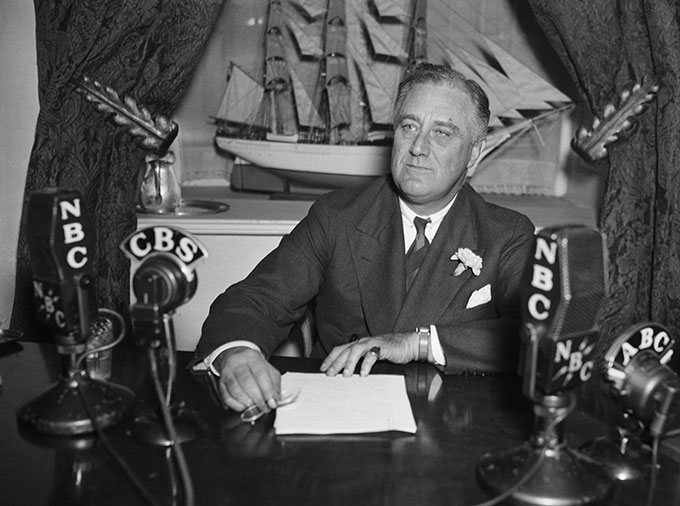
President Franklin Roosevelt’s first term offered several potential candidates for worst judicial defeats—especially Schechter Poultry v. United States (1935). Here, the Supreme Court unanimously struck down the National Industrial Recovery Act, a centerpiece of FDR’s New Deal agenda. While FDR hadn’t nominated any of the justices serving on the Court at that time, Justice Louis Brandeis, a prominent progressive appointed by President Woodrow Wilson, ruled against the president.

President Franklin Roosevelt in 1935 (Photo: Bettmann / Contributor / Bettmann via Getty Images
After FDR’s infamous “court packing” attempt in 1937, the Supreme Court no longer posed a threat to FDR. Indeed, Roosevelt was prepared to defy the Court if it blocked his efforts to eliminate the gold standard for paper money. It is noteworthy that in Korematsu v. United States, which upheld the president’s power to round up enemy aliens and U.S. citizens of Japanese ancestry, six of FDR’s appointees ruled in his favor, while only two were in dissent.

Another candidate might be Harry Truman’s loss after he attempted to force striking steel workers to stay on the job. In Youngstown Sheet & Tube Co. v. Sawyer (1952), the Court ruled against Truman by a 6-3 vote. Congress, not the president, had the power to seize the steel mills. Two of Truman’s three Supreme Court nominees ruled in his favor, while five of the six FDR appointees ruled against him.

This ruling unquestionably set back Truman’s domestic and foreign policy at the height of the Korean War, but it did not have a major practical effect. The labor strike lasted 50 days, but it caused no apparent disruption to the military’s steel supply lines.

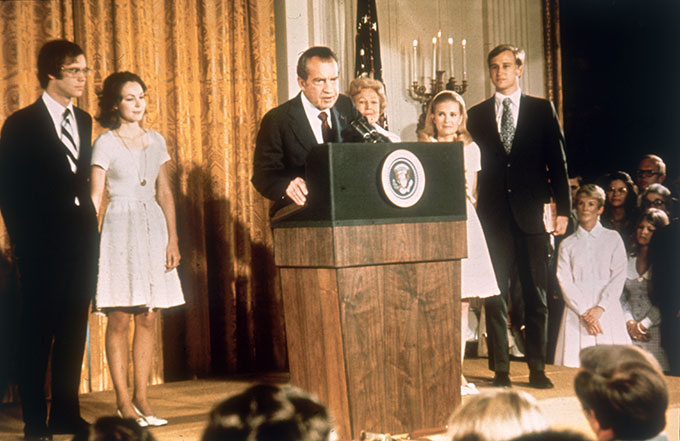
No president in American history had ever been so hobbled by lawfare as Richard Nixon—at least until Trump. In United States v. Nixon (1974), the Court ruled that President Nixon must produce the Watergate tapes. Three of the Court’s four Nixon appointees ruled against the president (Justice Rehnquist had recused). The decision led to Nixon’s resignation 16 days later.

But while the Court had delivered the coup de grace, Nixon’s presidency was already mortally wounded at this point. Even if the Court had not required Nixon to produce the tapes, Congress likely would have impeached and removed him from office anyway. (Contrast this with the current Congress, which refused even to vote on rescinding Trump’s tariffs.) While momentous, the Nixon decision accelerated events but did not alter them.

Richard Nixon after resigning in 1974 (Photo by Keystone/Hulton Archive/Getty Images)

The next five presidents suffered losses at the Supreme Court, but none of the magnitude of United States v. Nixon.

Morrison v. Olson (1988) upheld the constitutionality of the independent counsel statute. Chief Justice William Rehnquist wrote the majority opinion, which was joined by fellow Ronald Reagan appointee Justice Sandra Day O’Connor. Justice Antonin Scalia wrote a legendary dissent, finding that the statute violated the separation of powers.

President Bill Clinton suffered two important losses, though neither was momentous. Clinton v. City of New York (1998) invalidated the Line-Item Veto Act, though that was primarily a Republican initiative—part of Speaker Newt Gingrich’s Contract with America. Clinton v. Jones (1997) allowed Paula Jones to pursue a civil suit against a sitting president for sexual harassment. Still, Clinton promptly settled the case, and it was quickly forgotten. Clinton’s two appointees, Justices Ruth Bader Ginsburg and Stephen Breyer, ruled against the president in both cases.

President George W. Bush had more serious run-ins with the Supreme Court. In a series of decisions, the Court pushed back on Bush’s efforts to detain enemy combatants at Guantanamo Bay. But this process was gradual and stretched across both of Bush’s terms after 9/11. Indeed, at each juncture, Bush obtained additional authorities from Congress, only to be rebuffed by the justices.

The final blow came in Boumediene v. Bush (2008). Justice Anthony Kennedy’s majority opinion held that detainees at Guantanamo Bay could petition for a writ of habeas corpus in federal court. Bush’s two nominees to the Court, Chief Justice John Roberts and Justice Samuel Alito, vigorously dissented.

Still, Boumediene, decided on June 12, 2008, had a limited effect on the by-then lame duck president. After the case, the Supreme Court largely ignored the status of the detainees at Guantanamo, some of whom remain there to this day.

The Obama administration nearly suffered a catastrophic loss when the Court came close to striking down the Affordable Care Act, but Chief Justice Roberts threw the first of many life rafts to the Left. President Barack Obama did suffer two other defeats, but they didn’t concern his own policies, and neither was paradigm-shifting.

Citizens United v. Federal Election Commission (2010) invalidated decades-old limits on campaign finance. Though Obama assailed the decision at that year’s State of the Union address, Democrats and Republicans alike benefited from the decision. Shelby County v. Holder (2013) found that Southern states no longer needed permission from the federal government to change their election laws, but this landmark decision invalidated only part of the Voting Rights Act of 1965. The predictions of widespread voter suppression in the wake of Shelby County proved to be exaggerated.

That brings us to Trump. An entire semester of constitutional law could be taught on just the Trump cases.

In Trump v. Anderson (2024), the Supreme Court rejected efforts to remove Trump from the ballot on grounds of alleged insurrection. That decision was unanimous, and as I argued, should never have been close.

The president’s biggest victory came in Trump v. United States (2024). The Court, by a 6-3-ish vote (Justice Amy Coney Barrett largely agreed with the majority), ruled that Trump had presidential immunity from criminal indictment for many of his actions. But this ruling wasn’t really about Trump. As Justice Gorsuch maintained, the Court was “writing a rule for the ages,” not simply for this president.

But Trump has suffered many major defeats. Department of Commerce v. New York (2019) rejected Trump’s effort to add a citizenship question to the census. DHS v. Regents of the University of California (2019) blocked Trump from canceling the DACA immigration policy; both Trump appointees ruled in his favor on this case. Trump v. Vance (2020) ruled that Trump must release his tax returns to the New York City district attorney. Justices Gorsuch and Brett Kavanaugh largely agreed with the majority, though they reaffirmed the president’s powers. At the time, I wrote that “the two Trump appointees formally declared their independence from” Trump. Only Justices Alito and Clarence Thomas were in dissent.

Of course, there was Trump’s ill-fated litigation to block the certification of the 2020 election, for which none of the justices supported him. In the past year, Trump appointees ruled against his efforts to remove enemy aliens and use national guardsmen to enforce immigration law.

All these defeats pale in comparison with the tariffs case. While Justice Kavanaugh argued that the president could use other powers to accomplish the same ends, time will tell whether a majority of the Court would reject these grounds, as well. In any case, the Learning Resources ruling has greatly diminished tariffs’ utility as a bargaining chip, since negotiators on the other side of the table now have ample reason to believe that the courts will bail them out.

It remains to be seen whether the Supreme Court will continue to hobble President Trump for the remainder of his second term, but the tariff ruling suggests a rocky road ahead.

Josh Blackman is an adjunct fellow at the Manhattan Institute.

Top Photo by SAUL LOEB / AFP via Getty Images

Read the whole story
bogorad
2 hours ago
reply
Barcelona, Catalonia, Spain
Share this story
Delete

Anthropic Dials Back AI Safety Commitments - WSJ

1 Share
  • Safety Policy Shift: Anthropic Is Reducing Internal Restrictions On Artificial Intelligence Development To Maintain Market Competitiveness Against Rivals
  • Competitive Parity Strategy: The Firm Will Terminate Previous Practices Of Pausing Dangerous Models If Competitors Release Comparable Or Superior Technology
  • Military Contract Ultimatum: The Department Of Defense Set A Friday Deadline For Anthropic To Relax Usage Policies Regarding Surveillance And Autonomous Activities
  • Regulatory Environment Adaptation: Management Cited The Rapid Pace Of Development And A Global Shift Toward Economic Growth Over Federal Safety Regulations
  • Transparency Commitments: The Company Plans To Publish Regular Risk Reports And Safety Goal Evaluations Measured By Third Party Entities
  • Workforce Attrition: Multiple Researchers Have Resigned Expressing Concerns That Safety Considerations Are Being Secondary To Commercial Growth And Public Offerings
  • Political Friction: Anthropic Has Encouraged State And Federal Model Guardrails While Navigating Administration Efforts To Curb Local AI Regulations
  • Historical Shift: The Current Strategy Represents A Departure From The Safety Centric Principles That Originally Led Founders To Depart From OpenAI

By

Amrith Ramkumar

and

Georgia Wells

Feb. 24, 2026 7:59 pm ET

46


BPC > Only use to renew if text is incomplete or updated: | archive.li

BPC > Full article text fetched from (no need to report issue for external site): | archive.today | archive.ph

Jared Kaplan, co-founder and Chief Science Officer of Anthropic, speaking at the Wall Street Journal CIO Network Summit.

Jared Kaplan, chief science officer of Anthropic, speaking at a Wall Street Journal event in 2024. Nikki Ritcher for WSJ

  • Anthropic is softening its core AI safety policy to stay competitive

  • Anthropic faces a Defense Department deadline to relax policies or risk its contract.

  • Anthropic said the safety-policy change is an update based on the speed of AI’s development and a lack of federal AI regulations.

An artificial-intelligence tool created this summary, which was based on the text of the article and checked by an editor. Read more about how we use artificial intelligence in our journalism.

  • Anthropic is softening its core AI safety policy to stay competitive

    View more

Anthropic, the artificial-intelligence company known for its devotion to safety, is scaling back that commitment.

The company said Tuesday it is softening its core safety policy to stay competitive with other AI labs. Anthropic previously paused development work on its model if it could be classified as dangerous, but said it would end that practice if a comparable or superior model was released by a competitor.

The changes are a dramatic shift from 2 1/2 years ago, when the guardrails Anthropic published guiding the development and testing of its new models established the company as one of the most safety-conscious players in the AI space.

Anthropic faces intense competition from such rivals as OpenAI, Elon Musk’s xAI and Google, which regularly release cutting-edge tools. It is also locked in a battle with the Defense Department over how its Claude tools are used after it told the Pentagon they couldn’t be used for domestic surveillance or autonomous lethal activities.

The company has until Friday to relax its usage policies. If Anthropic doesn’t, it could lose its Pentagon contract or face other consequences, Defense Secretary Pete Hegseth told Anthropic Chief Executive Dario Amodei on Tuesday.

Anthropic said the safety-policy change is an update based on the speed of AI’s development and a lack of federal AI regulations. Anthropic, which started as an AI safety research lab, has battled the Trump administration by advocating for state and federal rules on model transparency and guardrails. The Trump administration has sought to curb states’ ability to regulate AI.


Newsletter Sign-up

Technology

A weekly digest of tech columns, big stories and personal tech advice, plus a news ticker and a touch of dark humor.

Subscribe


An Anthropic spokeswoman said the change is intended to help the company compete with several rivals against an uneven policy backdrop that puts the onus on companies to make their own judgments about safeguards. She said the safety pledge is unrelated to the Pentagon negotiations.

“The policy environment has shifted toward prioritizing AI competitiveness and economic growth, while safety-oriented discussions have yet to gain meaningful traction at the federal level,” Anthropic said in a blog post announcing the changes. The company said it is still committed to industry-leading safety standards. 

The safety change was earlier reported by Time.

The company said in the blog post that its core safety policy had motivated the company to develop stronger safeguards. Along with the change, Anthropic is committing to publishing regularly safety goals and risk reports evaluating its models that will be measured by a third party.

Several AI researchers have left Anthropic and other AI companies in recent weeks, warning that safety and other considerations are being pushed aside as the businesses raise billions of dollars and consider initial public offerings. OpenAI, the ChatGPT maker, and Google are grappling with similar challenges.

An Anthropic safety researcher, Mrinank Sharma, said in early February that he was leaving the company to explore a poetry degree, writing in a letter to colleagues that the “world is in peril” from AI, among other dangers. In January, he published a paper that found that advanced AI tools can disempower users and distort their sense of reality.

Sharma’s decision to leave Anthropic was related in part to the company’s decision to modify its safety policy, according to people familiar with the matter.

Anthropic was founded in 2021 after Amodei and other co-founders left OpenAI, worried that the ChatGPT maker wasn’t focused enough on safety concerns.

Amodei chose not to release an early version of Claude in 2022, fearing that it would start a dangerous technology race. OpenAI released ChatGPT several weeks later, leading Anthropic to play catch-up. Amodei has said he doesn’t regret the decision.

Write to Amrith Ramkumar at amrith.ramkumar@wsj.com and Georgia Wells at georgia.wells@wsj.com

The Global AI Race

Coverage of advancements in artificial intelligence, selected by the editors

Get WSJ's AI Newsletter

Meta and AMD Agree to AI Chips Deal Worth More Than $100 Billion Meta and AMD Agree to AI Chips Deal Worth More Than $100 Billion

Anthropic Accuses Chinese Companies of Siphoning Data From Claude Anthropic Accuses Chinese Companies of Siphoning Data From Claude

Inside OpenAI’s Decision to Kill the AI Model That People Loved Too Much Inside OpenAI’s Decision to Kill the AI Model That People Loved Too Much

Meet the One Woman Anthropic Trusts to Teach AI Morals Meet the One Woman Anthropic Trusts to Teach AI Morals

Copyright ©2026 Dow Jones & Company, Inc. All Rights Reserved. 87990cbe856818d5eddac44c7b1cdeb8

Already a subscriber? Sign In


Videos

Read the whole story
bogorad
2 hours ago
reply
Barcelona, Catalonia, Spain
Share this story
Delete

Stopping Your Meals Just Three Hours Before Bed Can Significantly Boost Heart Health

1 Share
  • Circadian Alignment: Coordinating eating patterns with the body's natural 24-hour internal clock and sleep cycles improves cardiovascular health.
  • Time Restricted Eating: Extending the overnight fasting window to 13-16 hours serves as a non-pharmacological intervention for adults at risk of heart disease.
  • Pre Sleep Fasting: Ceasing food intake at least three hours before bedtime helps restore natural physiological dips in blood pressure and heart rate.
  • Metabolic Optimization: Aligning food consumption with circadian rhythms enhances insulin response and morning glucose tolerance without requiring calorie restriction.
  • Heart Rate Regulation: Implementing sleep-aligned fasting leads to a measurable 5 percent decrease in heart rate during sleep and higher heart rate variability.
  • Blood Pressure Management: Shifting meal times away from the sleep period results in a 3.5 percent reduction in nighttime blood pressure levels.
  • Environmental Cues: Dimming indoor lighting three hours before sleep reinforces natural rhythms by signaling the brain to prepare for rest.
  • Accessible Health Strategy: Adjusting the timing of meals rather than the quantity or content of the diet offers a manageable approach to improving cardiometabolic function.

Person eating pizza while sitting on bed in a cozy bedroom setting.

Credits: Tima Miroshnichenko/Pexels

At 10:30 pm, the kitchen light is still on. A late snack, maybe a scroll through the phone, one more episode before bed—it feels harmless, right? In fact, this has become the normal night routine for many people around the globe, but what they don’t know is that this nightly habit is quietly working against their hearts.

Curious about what this late-evening pattern might be doing inside the body, a team of researchers at Northwestern University decided to investigate. Instead of asking people to cut calories or overhaul their diets, they tested a simpler idea: stop eating earlier in the evening and extend the overnight fasting window so it overlaps more fully with sleep.

Their findings suggest that this small shift in timing may help restore healthier heart rhythms and improve blood sugar control in adults at elevated risk of heart disease.

“It’s not only how much and what you eat, but also when you eat relative to sleep that is important for the physiological benefits of time-restricted eating,” Phyllis Zee, one of the study authors and an expert in sleep medicine, said

Eating late is an open invitation to heart problems

Unfortunately, only a small fraction of adults today have ideal cardiometabolic health. In fact, earlier US data showed that just 6.8 percent met optimal standards. This matters because poor cardiometabolic health increases the risk of type 2 diabetes, fatty liver disease and cardiovascular disease.

Scientists have long known that the body runs on a circadian rhythm — an internal 24-hour timing system. Blood pressure is meant to dip at night. Heart rate should slow during sleep. Hormones that control blood sugar follow predictable daily cycles.

However, modern habits disturb this flow. Late meals send signals that it is still daytime, while bright indoor lighting (including from devices) delays the body’s preparation for sleep. Over time, this mismatch may strain the cardiovascular and metabolic systems.

According to researchers, time-restricted eating, i.e., limiting food to a daily window, has emerged as a promising solution for this problem. However, most studies have focused on the length of fasting, not whether fasting aligns with sleep. 

This missing piece became the focus of the current study. 

A habit that restores heart rhythm

The study authors followed 39 overweight or obese adults between the ages of 36 and 75, all considered at elevated cardiometabolic risk. It lasted 7.5 weeks. About 80 percent of the participants in the intervention group were women.

Participants were divided into two groups. One continued their usual pattern, fasting about 11 to 13 hours overnight. The other group extended their overnight fasting to 13 to 16 hours and stopped eating at least three hours before bedtime.

No one was told to reduce calories and there was no weight-loss target. The only variable was timing. Both groups were also instructed to dim their lights for three hours before bed. Lower light levels help signal the brain that nighttime has begun, reinforcing natural circadian rhythms.

Importantly, adherence reached nearly 90 percent, suggesting the routine was manageable for participants.

RelatedPosts

Both too much and too little sleep increase heart attack risk

No laughing matter: scientists study the effects of laughing gas

More bang for your cup: new algorithm determines ideal caffeine intake for the best results

Slow mornings? Here’s how changing your alarm tone can combat sleep inertia

After seven and a half weeks, the extended-fasting group showed measurable physiological shifts. Nighttime blood pressure fell by 3.5 percent. Heart rate during sleep dropped by 5 percent. 

These changes restored a stronger day–night pattern: higher cardiovascular activity during the day, lower during rest. This rhythm — rising with activity, dipping during sleep — is considered healthier for the heart. Blood sugar regulation improved as well. When participants consumed glucose, their pancreas released insulin more effectively

“Extended overnight fasting improved secondary measures of nighttime autonomic function and morning oral glucose tolerance, including lower nighttime heart rate, higher heart rate variability, lower nighttime cortisol, and during the Oral Glucose Tolerance Test, lower glucose level, and higher 30-minute insulinogenic index, indicating improved acute insulin response,” the study authors said.

All of this suggests better control over blood sugar levels during the day. In simple terms, the body’s systems appeared to coordinate more smoothly when eating stopped earlier and fasting overlapped more fully with sleep.

A much easier way to manage health

The findings point to something powerful: improving heart and metabolic health may not always require stricter diets, intense exercise routines, or fewer calories. 

For middle-aged and older adults at higher risk, simply aligning meals with sleep, extending the overnight fast by roughly three hours, and avoiding food close to bedtime may offer a practical, non-drug strategy.

“This sleep-aligned time-restricted eating approach represents a novel, accessible lifestyle intervention with promising potential for improving cardiometabolic function,” the study authors added.

In a modern culture where dinner keeps getting pushed later, and screens glow long past sunset, the message is surprisingly clear: the body runs on a schedule, and when we finally let it keep that schedule, the heart may respond in kind.

The study is published in the journal Arteriosclerosis, Thrombosis, and Vascular Biology.

Add ZME Science as a preferred source on Google SearchFollow ZME Science on Google News

Tags: circadian rhythmheart healthheart rhythmrestore heart healthsleepsleep patterns

Rupendra Brahambhatt

Rupendra Brahambhatt

Rupendra Brahambhatt is an experienced journalist and filmmaker covering culture, science, and entertainment news for the past five years. With a background in Zoology and Communication, he has been actively working with some of the most innovative media agencies in different parts of the globe.

Read the whole story
bogorad
14 hours ago
reply
Barcelona, Catalonia, Spain
Share this story
Delete

What does Putin really want? | Responsible Statecraft

1 Share
  • Protracted Conflict: The war in Ukraine is entering its fifth year with both sides maintaining high endurance despite significant losses in personnel, equipment, and international reputation.
  • Military Stasis: Neither Russia nor Ukraine has achieved a definitive military breakthrough, and while Russian casualties currently exceed recruitment rates, neither political system appears to be near collapse.
  • Russian Objectives: Putin consistently seeks a neutral, non-nuclear, and demilitarized Ukraine, alongside the non-negotiable retention of Crimea and the four annexed regions of Donetsk, Lugansk, Kherson, and Zaporizhzhia.
  • Political Control: Beyond territorial acquisition, a primary Russian goal remains the installation of a receptive government in Kyiv that prevents the deployment of NATO infrastructure and maintains ties to the Russian cultural sphere.
  • Security Dilemmas: Experts suggest that Western security guarantees may lack long-term credibility, leaving Ukraine’s own military capacity as the primary guarantor of its future sovereignty.
  • Negotiation Models: Potential paths to cessation include establishing a Korean War-style demarcation zone or utilizing frameworks like the Kashmir dispute to manage conflicting territorial claims.
  • Strategic Buffer: A core element of Russian grand strategy is the prevention of Ukrainian NATO membership to maintain a permanent buffer zone between Russia and the Western military alliance.
  • International Order: The conflict highlights a shift from a rules-based international system toward a multipolar world defined by spheres of influence, imperial ambitions, and great power competition.

This article is part of our special series recognizing the four-year anniversary of the Ukraine War

The Russian invasion of Ukraine is entering its fifth year. We know from history that warring states are capable of enduring far longer than anyone imagined possible, despite unrecoverable losses in men and materiel, national treasure and morale, or international prestige.

And as battles over piles of rubble grind on, the war’s causes, so front of mind at the outset, may recede from public consciousness. Arguments over causes and origins seem less important than the need to prevail or survive, to pull something worthwhile from ruin.

After four years of nearly ceaseless combat, Russia has not conquered all of the Donbas. Minuscule territorial gains have come at such a cost that losses now exceed recruitment. Neither side has achieved a military breakthrough, and neither appears on the brink of military or political collapse.

Moreover, important questions that emerged in the early months of this endless war of attrition remain difficult to answer. Thus, the two sides aren’t mired only at the front lines in eastern Ukraine. There’s been little substantial movement around the obstacles to a durable peace.

I asked several experts to comment on how Russia’s autocrat defines victory — what are Putin’s aims? Also, whether Ukrainian President Volodymyr Zelenskyy should drop his opposition to ceding national territory, what Ukraine might receive in return for such a concession, and the consequences for the “rules-based order.”

Nicolai Petro, political scientist at the University of Rhode Island and Senior Washington Fellow at the Institute for Peace and Diplomacy

Putin’s peace terms have been consistent since the outbreak of the war. They are: 1) a neutral and non-nuclear Ukraine that is not part of any military alliance; 2) a demilitarized Ukraine; 3) a denazified Ukraine. Russian control over Crimea, Donetsk, Lugansk, Kherson, and Zaporizhzhia is non-negotiable for Russia, though this need not be formally recognized by Ukraine, so long as it withdraws its troops from these regions.

Each side — Ukraine, Russia, America, and Europe — will try to spin the final agreement to their own domestic political advantage. For Russia, complete victory would be achieving all three objectives. Anything short of that will be spun as a partial (but still worthwhile) victory by Russia, and as a defeat of Russia by the West.

In any negotiation worthy of the name, acceptable terms are decided by the interlocutors. The involvement of third parties only complicates direct negotiations. Also, since territorial exchanges after wars are commonplace, I see no consequences for international law or any “rules-based order.” Any territorial changes are simply made part of the new order.

Sergey Radchenko, historian at the Johns Hopkins School of Advanced International Studies and author of “To Run The World.”

There are two issues here that lead to dramatically different interpretations of what Putin is after. One is that Putin is basically interested in the Donbas, and if the Ukrainians abandon the territory, then the war will end in some sort of a ceasefire. But there’s another interpretation. That is, Putin wants not just the territory but political control of Ukraine itself. In this sense, until he actually reaches that point, he will not end the war.

Or you might think about this from Putin’s perspective. He has a fixation with territory because he sees control over Ukraine as part of Russia’s self-image as a great empire. He’s trying to restore Russian greatness. This is where there is no agreement as to what Putin’s goals are.

Ukrainians have put too much faith in a promise of Western security guarantees. The West has not been willing to put boots on the ground to fight the Russians. And to imagine it’ll be willing to do that in the future is folly. I don’t see the United States guaranteeing anything at all, although Trump has been talking about NATO Article 5-style guarantees. I find it hard to believe it would be credible.

So, what can actually guarantee Ukraine’s security? The answer is Ukraine’s own military. In the Istanbul talks back in 2022, the sticking point was what kind of army would Ukraine be allowed to have post-conflict. The Russians have been trying to restrict it because they know that is the real guarantee of Ukraine’s security.

Dr. Sumantra Maitra, Senior Fellow, Center for Renewing America

Vladimir Putin miscalculated Ukrainian resolve when he started the conflict, but now that he is in, he wants two things. One, to keep Ukraine out of NATO. That aim is a permanent aim of Russian grand strategy, to have a buffer between NATO and Russia. For that cause, he is willing to continue the conflict, as he enjoys superiority in numbers, and he knows that NATO won't directly join the war against Russia. His second aim is to have a grand bargain with the U.S. and have a disunited European continent. He is willing not to escalate the conflict to devastating proportions, because he wants to keep a negotiation option open.

The Russian way of war didn't quite serve the aims of Putin, as the Russian army is not capable of good combined arms ops against Ukraine, and the Russian economy is clashing against the overwhelming might of European countries and the US. That being said, he can continue his little random gains as he has superior numbers, and Ukrainians suffer from desertions and low manpower. If this continues, we might end up in a World War One scenario of rapid Ukrainian lines collapsing.

Ukraine should at least consider the current boundaries as the international line of demarcation. Both sides should decide on a day of cessation of fighting, and then pull troops back five miles essentially creating a demarcation zone similar to the Korean War. Then negotiations can continue. The American side should threaten to walk away if that doesn't happen.

The rules-based order was never orderly, nor rules based, and we are now back in a world of imperialism, spheres, conquests, and great powers. That is a result of structural realities, such as multipolarity, relative power gap between powers, tech advancement and offense dominated battlespace, and surplus elites having no jobs, fueling populism.

Nikolas Gvosdev, Senior fellow for national security at the Foreign Policy Research Institute

Ever since the 2004 Orange Revolution, Putin has been consistent in what he "wants" from Ukraine: a government in Kyiv that is receptive to Russian interests. These include a Ukraine that does not deploy NATO infrastructure or personnel on its territory, does not compromise Russia's power projection capabilities into the Black Sea and the larger Mediterranean area, that does not obstruct Russia's ability to reach larger global markets, and most importantly, a Ukraine that does not put up barriers to separate itself from a larger Russian world space.

What has changed over the years are the tactics, from support for Viktor Yanukovych and backing political forces inside Ukraine, to seizing Crimea and attempting to impose a constitutional settlement on Ukraine, to resorting to large-scale armed conflict. Since 2022, Russian methods have changed, from attempting an effective coup d'etat, to trying to hive off southeastern Ukraine, to now engaging in a war of attrition in the hopes that Ukraine will accept a settlement in order to preserve the rest of the country. But he will define victory as meeting these overall conditions. Many rounds of negotiations have made it clear that Ukraine is not ready to acquiesce to this entire program.

The inconsistent enforcement of the "rules" has already exposed the hollowness of the concept. What I often hear from "Global South" interlocutors is that much of the rest of the world is already used to a divergence between de jure claims and de facto realities. One thing I've seen in the negotiating process is an effort to find a fig leaf to paper over the gap. At one point, there was a proposal for Ukraine to "sell" Crimea to Russia; now we have ideas about demilitarized, special-economic zones as a way to reconcile irreconcilable Russian and Ukrainian claims. In this regard, how India and Pakistan continue to manage the Kashmir challenge may provide useful guidance.

Read the whole story
bogorad
1 day ago
reply
Barcelona, Catalonia, Spain
Share this story
Delete
Next Page of Stories