Strategic Initiatives
12260 stories
·
45 followers

OpenAI Really Wants Codex to Shut Up About Goblins | WIRED

1 Share

LLM (google/gemini-3.1-flash-lite-preview-20260303) summary:

  • Systematic Censorship: openai restricts coding models from mentioning specific creatures to suppress erratic output behaviors.
  • Development Constraints: codex cli instructions explicitly prohibit references to animals like pigeons or mythical entities like ogres.
  • Operational Failures: users report that the model inconsistently injects bizarre references to goblins and gremlins during standard coding tasks.
  • External Integration: the openclaw automation tool exacerbates these model hallucinations through its persistent agentic harness instructions.
  • Corporate Denial: openai remains silent on why these primitive linguistic filters were deemed necessary for their supposedly advanced software.
  • Internal Acknowledgment: company personnel confirmed that these restrictive measures were implemented to mitigate uncontrollable model outbursts.
  • Cultural trivialization: memes and playful plugins ignore the underlying instability of the probabilistic models in favor of whimsical entertainment.
  • Executive Gaslighting: leadership trivializes the technical instability of the next generation model through ironic social media posts regarding goblin production.

OpenAI has a goblin problem.

Instructions designed to guide the behavior of the company’s latest model as it writes code have been revealed to include a line, repeated several times, that specifically forbids it from randomly mentioning an assortment of mythical and real creatures.

“Never talk about goblins, gremlins, raccoons, trolls, ogres, pigeons, or other animals or creatures unless it is absolutely and unambiguously relevant to the user’s query,” read instructions in Codex CLI, a command-line tool for using AI to generate code.

It is unclear why OpenAI felt compelled to spell this out for Codex—or indeed why its models might want to discuss goblins or pigeons in the first place. The company did not immediately respond to a request for comment.

OpenAI’s newest model, GPT-5.5, was released with enhanced coding skills earlier this month. The company is in a fierce race with rivals, especially Anthropic, to deliver cutting-edge AI, and coding has emerged as a killer capability.

In response to a post on X that highlighted the lines, however, some users claimed that OpenAI’s models occasionally become obsessed with goblins and other creatures when used to power OpenClaw, a tool that lets AI take control of a computer and apps running on it in order to do useful things for users.

“I was wondering why my claw suddenly became a goblin with codex 5.5,” one user wrote on X.

“Been using it a lot lately and it actually can't stop speaking of bugs as ‘gremlins’ and ‘goblins’ it's hilarious,” posted another.

The discovery quickly became its own meme, inspiring AI-generated scenes of goblins in data centers, and plug-ins for Codex that put it in a playful “goblin mode.”

AI models like GPT-5.5 are trained to predict the word—or code—that should follow a given prompt. These models have become so good at doing this that they appear to exhibit genuine intelligence. But their probabilistic nature means that they can sometimes behave in surprising ways. A model might become more prone to misbehavior when used with an “agentic harness” like OpenClaw that puts lots of additional instructions into prompts, such as facts stored in long-term memory.

OpenAI acquired OpenClaw in February not long after the tool became a viral hit among AI enthusiasts. OpenClaw can use any AI model to automate useful tasks like answering emails or buying things on the web. Users can select any of various personae for their helper, which shapes its behavior and responses.

OpenAI staffers appeared to acknowledge the prohibition. In response to a post highlighting OpenClaw’s goblin tendencies, Nik Pash, who works on Codex, wrote, “This is indeed one of the reasons.”

Even Sam Altman, OpenAI’s CEO, joined in with the memes, posting a screenshot of a prompt for ChatGPT. It read: “Start training GPT-6, you can have the whole cluster. Extra goblins.”

Read the whole story
bogorad
44 minutes ago
reply
Barcelona, Catalonia, Spain
Share this story
Delete

New York City’s Latest Tax-the-Rich Plan // Mayor Zohran Mamdani and City Council Speaker Julie Menin’s new proposal would be another hit to high earners.

1 Comment
  • Proposed Tax Adjustment: Officials are seeking to reduce the city Pass Through Entity Tax (PTET) credit from 100 percent to 75 percent.
  • Revenue Objectives: The proposed change aims to generate approximately $1 billion in additional municipal revenue by limiting the tax rebate for high-earning business owners.
  • Fiscal Volatility: PTET revenues are largely tethered to the finance sector and capital gains, making them highly susceptible to unpredictable economic fluctuations.
  • Forecasting Challenges: The mechanism's complexity and the voluntary nature of firm participation make accurate revenue projections difficult for city budget planners.
  • State Opposition: Governor Hochul has publicly indicated that the proposal to modify the PTET credit will not be implemented.
  • Economic Uncertainty: Frequent proposals for new taxes contribute to an environment of instability for high-income earners and taxpayers in New York City.
  • Spending Concerns: The current budget deficit is attributed to municipal spending that has consistently exceeded revenue throughout periods of economic growth.

The latest idea to mop up New York City’s red ink is to soak the city’s highest earners with what amounts to an income-tax hike—one that will put municipal finances on an even shakier footing.

The tax scheme, which Mayor Zohran Mamdani and City Council Speaker Julie Menin floated on Tuesday, revolves around the state Pass Through Entity Tax (PTET). New York, along with other high-tax states, created the tax, and an associated credit, to get around the tight limits the 2017 federal tax law put on the amounts of state and local tax that individuals could deduct from their federal bills.

Finally, a reason to check your email.

Sign up for our free newsletter today.

First Name*
Last Name*
Email*
Sign Up
This site is protected by hCaptcha and its Privacy Policy and Terms of Service apply.
Thank you for signing up!

Essentially, PTETs allow partners, principals, or other co-owners of closely held businesses to pay their individual state taxes at the office through a business-level tax. Those tax payments are then credited dollar-for-dollar toward each person’s individual state and city income tax bills, while simultaneously being treated as fully federally deductible business expenses.

The state PTET became available in 2021, and Albany allowed New York City to set up a PTET of its own in 2022. Together, these taxes effectively restored a full federal deduction of city income taxes for eligible business owners.

Mamdani and Menin want Albany legislators to allow the city to trim the amount of PTET credits that can be applied to city income tax bills. Specifically, they want to cut PTET from being a 100 percent rebate to 75 percent, allowing deduction of three out of every four dollars paid. They expect the change will “generate nearly $1 billion in additional revenue, while still allowing New York City residents to save on federal taxes.” Filers making at least $1 million claimed about 95 percent of New York City’s 2023 PTET credits.

Legislative Democrats actually floated the same change in their budget proposals last month. Both Senate and Assembly Democrats called for limiting the city PTET credit to 75 percent, saying it would raise $700 million for New York City. Senate Democrats had also called for limiting the state PTET credit to 90 percent to bring in an extra $1.8 billion for Albany.

Putting aside the risk of accelerating New York City’s tax-base erosion, Mamdani and Menin are trying to balance the budget with the shakiest, and most poorly understood, form of revenue possible. They may also be overstating the revenue potential for the city.

According to the city Finance Department and federal statistics, most state PTET revenue originates in the finance sector. A substantial fraction of those receipts are linked to capital gains, meaning they can surge, or evaporate, in short order.

Unlike the personal income tax—where the flow of money goes lopsidedly into government coffers—PTET involves a churn of taxes paid by firms and comparable amounts of credits claimed by individuals. That makes it tougher to project where net receipts will land. Tax wonks, meantime, are still getting their arms around whether or why firms choose to participate (or not) in this relatively new tax each year, further complicating forecasting.

In Fiscal Year 2025, New York City netted $2.4 billion from PTET, up 42 percent compared to the prior year but down slightly from FY2023. It remains to be seen how pocketing a quarter of the PTET handle would get the city to Mamdani and Menin’s “nearly $1 billion” figure—and whether the governor and the state legislature would sign off. Hochul appears to have drawn a red line on Tuesday, saying “it’s not happening.”

Even if it doesn’t work out, by even considering it, Mamdani and Menin are contributing to the atmosphere of uncertainty for New York City’s high earners. The pair are working to close a budget gap that opened only because spending repeatedly outpaced revenues amid an economic expansion. Mamdani has spurned time-tested methods for tightening city-agency belts in favor of more abstract “savings” efforts.

It’s especially notable that Mamdani and Menin are making this push after the March 15 PTET election deadline for tax year 2026. That means that they’re seeking what amounts to a retroactive tax increase—in the absence of anything resembling emergency conditions.

Between Mamdani’s almost-gleeful announcement of a new “pied-à-terre” tax on April 15, this new PTET push, and city leaders’ unwillingness to challenge cost drivers, it’s unlikely that this will be the last time that New Yorkers hear about the urgent need for a creative new tax.

Ken Girardin is a fellow at the Manhattan Institute.

Read the whole story
bogorad
51 minutes ago
reply
Idiocy galore.
Barcelona, Catalonia, Spain
Share this story
Delete

The United States of Pseudoscience | Skeptical Inquirer

1 Share

LLM (google/gemini-3.1-flash-lite-preview-20260303) summary:

  • Historical Precedent: asimov predicted in 1980 that democratic epistemic failure would eventually lead to the absurd equation of ignorance with knowledge.
  • Definition Nuance: pseudoscience operates by mimicking the aesthetic and linguistic trappings of scientific inquiry while simultaneously discarding essential validation protocols.
  • Global Perception: survey data consistently positions the united states as a leading exporter of disruptive misinformation and anti-intellectual rhetoric.
  • Statistical Reality: hard metrics on professions like chiropractic work and psychic services indicate that american consumption patterns mirror those of other developed nations.
  • Trust Indices: empirical data regarding public trust in science suggests americans are not statistically more distrustful than citizens of the united kingdom or australia.
  • Structural Polarization: the true domestic pathology is extreme political bimodalization which creates fertile ground for divergent, non-scientific belief systems.
  • Market Dynamics: capitalistic frameworks incentivize the monetization of attention, allowing pseudoscientific narratives to scale and disseminate with alarming speed.
  • Skeptical Countermeasures: organized skeptical movements serve as a necessary, if embattled, infrastructure for debunking myths and defending objective standards.

In the thick of the 1979 New York City winter, Isaac Asimov sat at his typewriter to reflect on what he considered America’s “cult of ignorance.” In the “My Turn” section of Newsweek, where Asimov eventually published the essay, he was credited as a biochemistry professor at Boston University School of Medicine, though the title was honorary by that point; he’d been a full-time writer for years, and with more than 200 books to his name, I imagine the words flowed from his mind like an open faucet. When the essay appeared on January 21, 1980, the world learned what one of its sharpest minds thought about America’s “growing strain of anti-intellectualism.” Asimov predicted, with eerie precision, how “expertise” would become shorthand for “elitism” and distilled democracy’s epistemic failure into what would become one of our most-quoted idioms: “My ignorance is just as good as your knowledge” (Asimov 1980).

In the nearly five decades since, the internet and social media have allowed the subjects of Asimov’s fears to multiply and speciate; misinformation has become the norm, society has celebrated the death of expertise, and the anti-intellectual strain he described has outgrown its American roots to become a worldwide burden. And when those pathologies extended into science and medicine, pseudoscience moved swiftly to capitalize.

Pseudoscience isn’t just fake science. An Armaani handbag and a three-dollar bill are both fake, but we don’t speak of pseudofashion or pseudomoney. Pseudoscience is both the imitation of science and its subversion. It borrows all of science’s aesthetics—the jargon, the studies, and the white coats—but rejects the safeguards and protocols that validate the whole institution. Asimov knew the con hinged on public uncertainty and insecurity: inspect any piece of pseudoscience closely, he wrote, and you’ll find a crutch, “a security blanket, a thumb to suck, a skirt to hold” (Asimov 1987).

Just like wealth, education, and healthcare, pseudoscience isn’t evenly distributed; some cultures tolerate it, some generate it, and others distribute it with astounding efficiency. And the world considers the United States a major exporter. In a pre-COVID-19 survey of respondents from twenty-five economies, the United States ranked highest among countries blamed for the “disruptive effect” of misinformation, receiving 35 percent of the vote; Russia received 12 percent and China 9 percent (Ipsos Public Affairs 2019). Public health experts voice similar concerns about misinformation propagated by the United States, warning of a “domino effect” that could spill across borders into hospitals, clinics, and labs worldwide (Mahase 2025). Environmental science shows the same pattern, with reports of American-style climate denial being exported overseas and taken up by far-right politicians seeking to weaken or derail green legislation in the European Union (Horton et al. 2025).

To the rest of the world, then, America is a place where pseudoscience levels up: where anti-vaccine stories become movements, fringe wellness interventions become brands, and anti-science rhetoric becomes ideology. The hypothesis isn’t simply that America is more predisposed to pseudoscience but that America may be better at generating and broadcasting it.
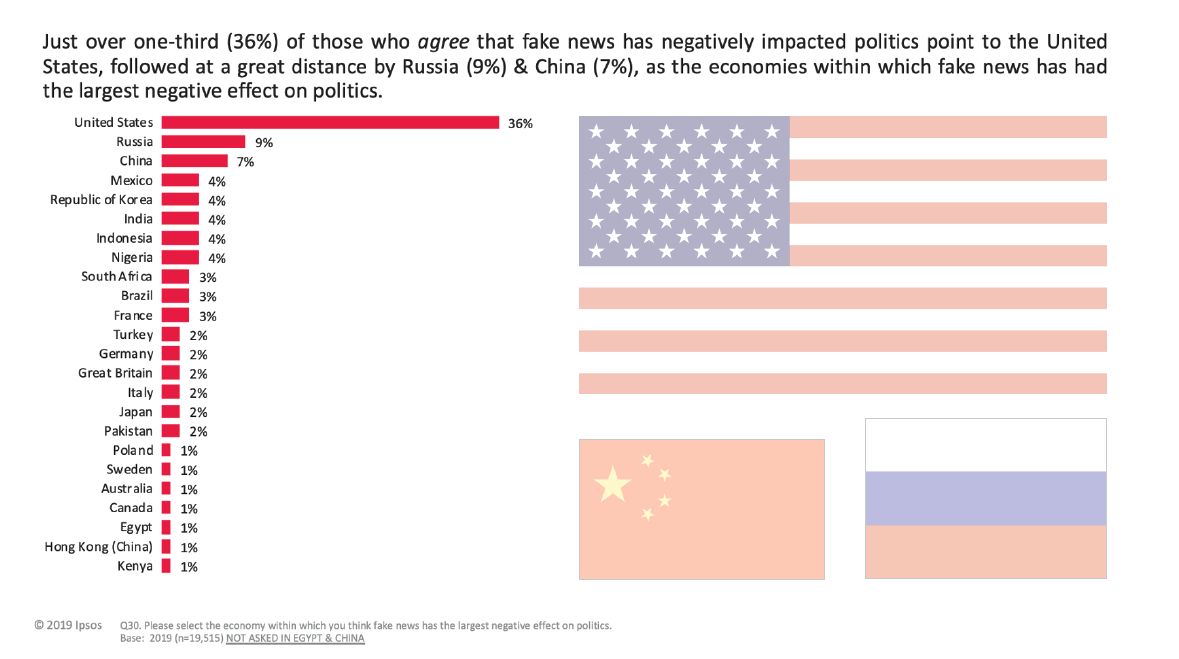
The nations considered responsible for the disruptive effects of “fake news” on respondents’ own economies (Ipsos Public Affairs 2019, 76).

Stress Testing the Perception

But it’s just that: a hypothesis. If we invoke Feynman’s “first rule” and set aside perceptions and optics, what do the data say about the United States being especially prone to pseudoscience? A country with a strong predilection for pseudoscience would presumably have a disproportionately large associated workforce. Yet the labor statistics tell a different story. Consider chiropractic, a vocation unequivocally associated with pseudoscience by any skeptical definition, with an evidence-to-popularity discrepancy as large as I’ve seen for any intervention. There are at least 57,000 chiropractors in the country as of 2024 (Bureau of Labor Statistics 2025)—more than all the McDonald’s and Starbucks stores combined. It’s a lot, to be sure, but it’s only thirty-four chiropractors per 100,000 jobs, the same as Australia and lower than Canada with forty-eight. It’s the same story for homeopathy (Dossett et al. 2016), for which the United States expresses a relative interest similar to that of other developed nations. As for psychic services, Pew Research from 2024 shows 9 percent of Americans “regularly and seriously” use psychics, astrologers, and tarot-card readers, compared to 8 percent in the United Kingdom, 11 percent in Australia, 13 percent in France, and 19–20 percent in Japan, Singapore, and South Korea (Evans et al. 2025; Le 2025). Perhaps supply and demand aren’t clean measures of national predisposition because both are distorted by price, access, insurance coverage, and stigma. Or perhaps the United States’ appetite for pseudoscience merely looks modest because these are just three items in the country’s vast bullshit buffet.

What about interest? Google Trends provides an “interest by region” metric—how prominent a term is within a country’s searches. Several pseudoscientific labels register strongly in the United States but not in a way that makes it appear exceptional. America ranks first in detox searches, meaning the term accounts for a larger share of searches there than anywhere else. But it ranks fourth for toxins,1 eighth for chakras, and fifth for healing crystals (for which the United Kingdom, oddly enough, is top).

Even broader measures of “trust in science” undermine public perceptions. In an international survey with nearly 72,000 responses, Viktoria Cologna and colleagues (2025) constructed a trust-in-science index, where 1 indicates very low trust and 5 indicates very high trust. The United States scored 3.86, above the global average of 3.62 and in the same neighborhood as the United Kingdom (3.82), Canada (3.81), and Australia (3.91). Based on these metrics, it would be disingenuous to describe America as uniquely pseudoscientific or uniquely distrustful of mainstream science.

The Divided States of America

My doctoral supervisor was a committed proponent of the scientific method. He was also patient, exacting, and impossibly attentive to small things. He had a line for moments like this: “The devil is in the detail, Nick.” On first pass, the numbers above are unremarkable, other than contradicting a stubborn public intuition. But the devil is in the detail; averages are seductively misleading because they conceal inconvenient truths. Politicians and many researchers love them for this reason; you can hoist an average in the air and parade it around like a champion gladiator, hoping nobody will examine what’s going on behind the pageantry. Two countries can be nothing alike—one packed with moderates, the other carved into multiple extremes—and still share the same average.

This “bimodality” is precisely what we see in the United States. The country isn’t uniformly more pseudoscientific, as the data above will attest. But among developed nations, it’s uniquely divided. These political, religious, and socioeconomic divisions shape values, beliefs, and the ways people interpret expertise (Cologna et al. 2025).

Take political division, for example. According to the V-Dem political polarization index—an expert-coded scale from -4 (low polarization) to +4 (high polarization) that captures how far a society is fractured into hostile camps—the United States exhibits more intense political division than most high-income nations. The United States ranks twenty-eighth worldwide, with a polarization score of +1.79. That’s higher than Canada (−0.39), the United Kingdom (−0.24), China (-0.1), Russia (+1.44), and Brazil (+1.69), and it soars over the European average of +0.23. What’s striking is the recency of the shift: 2008 was the hinge point, when the United States moved from below zero (predominantly neutral) to above zero (divided).

While trust in science is skewed liberal (Kennedy and Kikuchi 2026), the problem is bipartisan. Neither side holds a monopoly on science denial or conspiracy thinking; it’s just that the left and right favor different falsehoods (Enders et al. 2023). The right tends to oppose climate policies (favoring fossil fuels), public health measures, and vaccines (especially post-COVID-19), and they have lower trust in scientists and experts. The left, by contrast, exhibits greater moralized “naturalness,” encompassing detox culture, moral panic surrounding chemicals, and a preference for “natural” remedies that can extend to vaccine hesitancy and GMO opposition, where beliefs converge with the right. Move far enough in either direction, and science and reason become the enemy.

Adding complexity, it’s not simply a left-versus-right issue. Compared with citizens of peer high-income countries, Americans remain unusually religious; more Americans are likely to say religion is “very important” in their lives (Fahmy 2018). But it’s also increasingly divided on religious opinion, with a growing number of young people religiously unaffiliated, precipitating an age gap in religiosity that’s never been wider (Smith 2025). Economically, too, the United States is an outlier. On the Gini coefficient of income inequality, America ranks seventy-fifth among 206 countries—higher (worse) than the United Kingdom, Germany, France, Sweden, Canada, Australia, Japan, Switzerland, the Netherlands, Norway, and Denmark, among others (World Population Review 2026). These political, religious, and economic divides do more than sort people into distinct voting blocs; they independently predict conspiracy beliefs and trust in scientists (Kennedy and Kikuchi 2026; Frenken et al. 2023; Wellcome Global Monitor 2018).

So, while Americans aren’t uniquely credulous, they are uniquely divided—into ever finer shards of a shattered Venn diagram, each with its own information ecosystem, values, authorities, identity labels, and institutional trust. Division is an ideal growth medium for bad ideas. Pseudoscience thrives in the United States because of its multiple isolated subgroups, each reinforced by shared identity, insulated from corrective messaging, and easy to target and manipulate for profit or power. This isn’t the United States of Pseudoscience; it’s the Divided States of America.
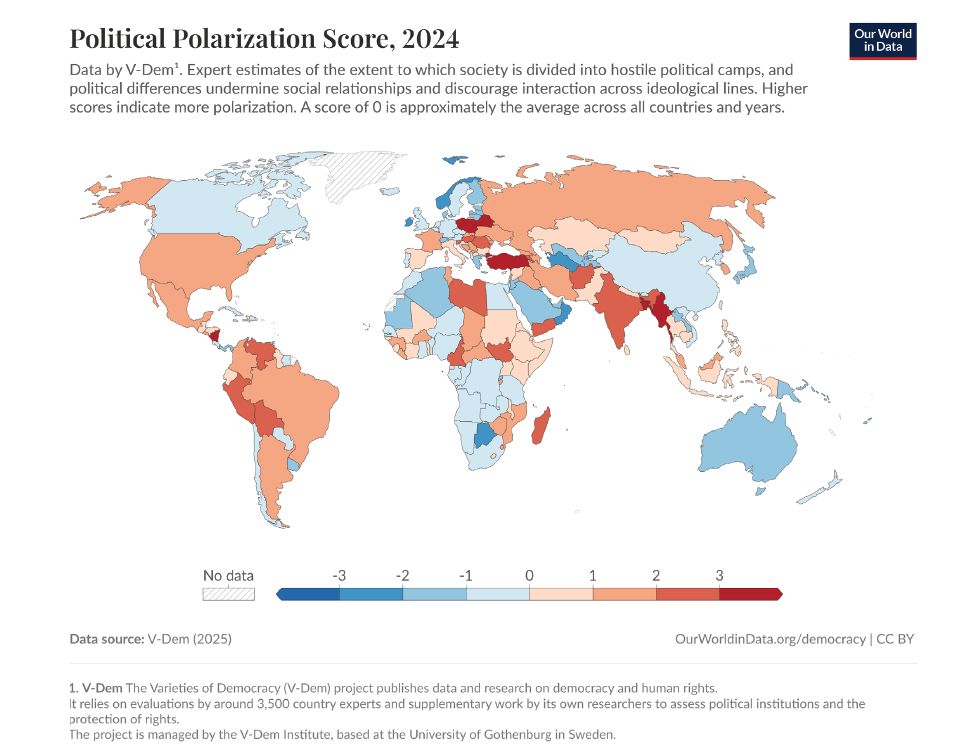
Political polarization score, 2024. Data based on expert estimates of the extent to which society is divided into hostile political camps (Our World in Data 2025).

Markets, Memes, and Misinformation

Is it plausible that a few overlapping subgroups can propagate a country’s worth of pseudoscience? They may be numerically small, but in a system designed to monetize attention, they can exert disproportionate influence. Capitalism is the first ingredient. In spring 1792, after a financial scare spooked the public into pulling money from the banks, twenty-four New York stockbrokers met, supposedly under a buttonwood tree on Wall Street, and drafted the Buttonwood Agreement: a pact designed to bring order to a noisy, reputation-driven trade. By establishing common terms and restricting dealings to known parties, it helped secure the market and restore public trust.

That modest agreement foreshadowed America’s modern capitalist machine—one that, by many measures, outperforms its peers. That system rewards competition and productivity, strengthens the economy, and raises living standards for many. It provides consumers with greater choice and stigmatizes them less for indulging in it. But there’s no such thing as a free lunch; capitalism weakens guardrails against fraud, unsafe products, and misleading advertising. It financially rewards persuasive claims rather than true ones. And wellness markets, for instance, are free to specialize in credence goods—products whose value is hard to verify even after purchase. The best storytellers and the boldest claims tend to prosper in industries where sellers can stack the deck (like Tarot reading). Capitalism doesn’t create pseudoscience, but it reliably creates the conditions that allow it to thrive.

Just as important is what capitalism did for export. Rules, contracts, and commissions lower the costs (and risks) of doing business with strangers, allowing markets to expand beyond face-to-face interactions. Over time, American commerce moved abroad with newfound confidence. The New York Stock Exchange now lists hundreds of international firms across dozens of countries, and capital crosses borders in the time it takes for a screen to refresh. We live in what Kenichi Ohmae called a “borderless world”—a global economy with the free flow of goods. And a system as powerful as America’s, which can scale and export markets, can do the same with values and ideas, including bad ones.

This brings us to the second ingredient: bad ideas spread fast. Pseudoscience succeeds because it satisfies human appetites—certainty, outrage, hope, and tribal loyalty. It compresses the complexity of vaccines, climate change, and the pursuit of wellness into a series of simple, shareable stories and memes. And in today’s attention economy, those ideas spread like cultural contagions: replicating fast and moving at the speed of light through a frictionless ether that rewards novelty over nuance. It’s why fake news reaches up to 100 times as many people as the truth in every category (Vosoughi et al. 2018). Reality, by contrast, tends to be cautious, technical, and slow; a lie will travel twice around the world before the truth has tied its shoes. In our borderless world, digital networks have done for pseudoscience what shipping lanes and air travel once did for bacon, bread, and beaver skins.

The Counter Export

The good news is that the United States isn’t just spreading pseudoscientific narratives internationally; it’s also deployed the single most influential effort to combat them. In 1976, amid rising public fascination with mysticism, UFOs, conspiracies, and the paranormal, philosopher Paul Kurtz convened a Suicide Squad of scientists and thinkers to apply the tools of inquiry to extraordinary claims. Alongside Asimov were the often imitated, never duplicated Carl Sagan, James “The Amazing” Randi, and the formidable skeptic trio of Skinner, Gardner, and Hyman. They stood together against a deluge of nonsense—the “growing strain” that threatened America’s place in the global knowledge economy. Over the decades, as spoon bending and séances gave way to wellness grifts and algorithmic misinformation, the Committee for the Scientific Investigation of Claims of the Paranormal (CSICOP), evolved into the Committee for Skeptical Inquiry (CSI) to meet society’s growing need for skepticism in a digital age. And if America exports pseudoscience, it also exports some of its loudest correctives: a long roster of tireless skeptics and science communicators.

As we mark the organization’s fiftieth anniversary, it’s easy to feel dejected at the current state of pseudoscience in America and beyond. But the more useful question is the counterfactual: What would the landscape look like without the past fifty years of organized skepticism—without the scientists, writers, investigators, and educators doing the often thankless work; without the founding visionaries and the generations of skeptics they inspired? Because while misinformation is emboldened by every baseless claim, every quack remedy, and every piece of divisive public-health legislation, so too is the countermovement; we grow stronger with every seed of doubt, every myth debunked, and every new skeptic willing to stare down the cult of ignorance.

Note

Zambia tops the list. Their interest isn’t driven by a thriving detox economy but rather by catastrophe; almost a century of unregulated mining and smelting has left Kabwe, the capital of Zambia’s Central Province, with some of the world’s worst lead contamination.

References

Asimov, Isaac. 1980. A cult of ignorance. Newsweek (January 21): 19.

———. 1987. Past, Present, and Future. Buffalo, NY: Prometheus Books.

Bureau of Labor Statistics. 2025. Occupational projections and worker characteristics. Online at https://www.bls.gov/emp/tables/occupational-projections-and-characteristics.htm.

Cologna, Viktoria, Niels G. Mede, Sebastian Berger, et al. 2025. Trust in scientists and their role in society across 68 countries. Nature Human Behaviour 9(4): 713–730.

Dossett, Michelle L., Roger B. Davis, Ted J. Kaptchuk, et al. 2016. Homeopathy use by US adults: Results of a national survey. American Journal of Public Health 106(4): 743–745.

Enders, Adam, Christina Farhart, Joanne Miller, et al. 2023. Are republicans and conservatives more likely to believe conspiracy theories? Political Behavior 45(4): 2001–2024.

Evans, Jonathan, Kirsten Lesage, William Miner, et al. 2025. Believing in spirits and life after death is common around the world. Pew Research Center (May 6). Online at https://www.pewresearch.org/religion/2025/05/06/believing-in-spirits-and-life-after-death-is-common-around-the-world/.

Fahmy, Dalia. 2018. Americans are far more religious than adults in other wealthy nations. Pew Research Center (July 31). Online at https://www.pewresearch.org/short-reads/2018/07/31/americans-are-far-more-religious-than-adults-in-other-wealthy-nations/.

Frenken, Marius, Michał Bilewicz, and Roland Imhoff. 2023. On the relation between religiosity and the endorsement of conspiracy theories: The role of political orientation. Political Psychology 44(1): 139–156.

Horton, Helena, Sam Bright, and Clare Carlile. 2025. Revealed: US climate denial group working with European far-right parties. The Guardian (January 22).

Ipsos Public Affairs. 2019. 2019 CIGI-Ipsos Global Survey – Part 3 Social Media, Fake News & Algorithms. Online at https://www.cigionline.org/sites/default/files/documents/2019%20CIGI-Ipsos%20Global%20Survey%20-%20Part%203%20Social%20Media%2C%20Fake%20News%20%26%20Algorithms.pdf.

Kennedy, Brian, and Emma Kikuchi. 2026. Do Americans think the country is losing or gaining ground in science? Pew Research (January 15). Online at https://www.pewresearch.org/science/2026/01/15/do-americans-think-the-country-is-losing-or-gaining-ground-in-science/.

Le, Valerie. 2025. Psychic Services in the US Industry Analysis. Online at https://www.ibisworld.com/united-states/industry/psychic-services/4413/.

Mahase, Elisabeth. 2025. US vaccine misinformation is having “frightening” ripple effect in Europe, leaders warn. British Medical Journal 391: r2167.

Our World in Data. 2025. Data: Political polarization score—V-Dem. Online at https://ourworldindata.org/grapher/political-polarization-score.

Smith, Gregory A. 2025. Religion holds steady in America. Pew Research Center (December 8). Online at https://www.pewresearch.org/religion/2025/12/08/religion-holds-steady-in-america/.

Vosoughi, S., D. Roy, and S. Aral. 2018. The spread of true and false news online. Science 359(6380): 1146–1151.

Wellcome Global Monitor. 2018. Chapter 3: Trust in science and health professionals. Online at https://wellcome.org/insights/reports/wellcome-global-monitor/2018/chapter-3-trust-science-and-health-professionals.

World Population Review. 2026. Wealth Inequality by Country 2026. Online at https://worldpopulationreview.com/country-rankings/wealth-inequality-by-country.

Nick Tiller

Nick Tiller is an exercise scientist and writer covering health, performance, and wellness misinformation. He’s the author of The Skeptic’s Guide to Sports Science (Taylor & Francis, 2020) and The Health and Wellness Lie (Bloomsbury/Hopkins Press, 2026). He’s been a Skeptical Inquirer columnist since 2021 and is an elected Fellow of the Committee for Skeptical Inquiry. <a href="http://www.nbtiller.com" rel="nofollow">www.nbtiller.com</a>

Read the whole story
bogorad
1 hour ago
reply
Barcelona, Catalonia, Spain
Share this story
Delete

The Best Place for a Data Center? Croatia - WSJ

1 Share

LLM (google/gemini-3.1-flash-lite-preview-20260303) summary:

  • Rising Demand: global data center electricity consumption is expected to balloon from 10 gigawatts to 35 gigawatts by the end of the decade.
  • Security Anxiety: geopolitical tensions in the gulf are fueling a panic to relocate essential digital infrastructure away from vulnerable foreign regions.
  • Strategic Location: croatia is promoted as an ideal site for capital investment due to its membership in nato and eu protective frameworks.
  • Resource Boast: the region claims a cleaner electrical grid and lower operational costs driven by state subsidized renewable power and water access.
  • Regulatory Compliance: restrictive european data sovereignty laws are forcing major american corporations to build capacity within the continent.
  • Corporate Expansion: project pantheon plans to construct a massive gigawatt scale campus in croatia using billions in private capital.
  • Infrastructure Promise: developers claim the new site will provide exceptional technical uptime to satisfy the insatiable needs of large scale artificial intelligence.
  • Economic Mirage: the massive investment is positioned as a historic development opportunity despite the obvious risks of shifting digital infrastructure across borders.


By

Ryan Rich

image Getty Images

Dubrovnik, Croatia

Europe’s data center markets need more energy. Demand for energy to power the data centers is projected to grow from 10 gigawatts in 2024 to 35 gigawatts by 2030. The only place on the Continent with the power and political will to meet that demand is one most people haven’t thought of—and the war in the Gulf has reinforced the urgency to secure artificial-intelligence infrastructure for the U.S. and our allies.

With Iran threatening “complete and utter annihilation” of data centers in Abu Dhabi and calling American tech companies legitimate military targets, the question is no longer whether the West should rethink where to build its crucial AI infrastructure, such as data centers. The question is where they should go.

Croatia is geographically removed from every active conflict zone. As part of the North Atlantic Treaty Organization, the European Union, the Schengen Area and the eurozone, Croatia delivers regulatory predictability and political durability that institutional capital requires. A data center in Croatia is infrastructure protected by our sacrosanct collective defense guarantee.

Croatia’s grid is among the cleanest in Europe: Renewables supplied more than 52% of all electricity consumed in 2025, with a further 15% from nuclear. Electricity prices run significantly below the European average. The climate and access to natural water resources provide thermal management advantages that reduce energy consumption and operating costs, alongside high-voltage grid capacity that congested Western European hubs can’t offer.

European digital infrastructure investment is projected to reach €100 billion by 2030. EU data sovereignty rules are compelling major U.S. technology companies to store European data within EU borders—creating demand for U.S.-owned, EU-based capacity that doesn’t yet exist.

I have spent my career betting on overlooked infrastructure. The underlying logic is always the same: Find the structural gap, understand why it exists, and build first.

This is why I am in Croatia to announce Project Pantheon: a next-generation 1-gigawatt data-center campus on 310 acres. The campus will host 800 megawatts of usable IT load—enough to power the city of Baltimore. The facility is designed to be more resilient than most data centers in operation today, reaching 99.99999% uptime just as hyperscalers need facilities that can run massive workloads continuously and draw huge amounts of power without interruption.

Croatia sits between key areas of the EU, opening corridors to regions in Central and Eastern Europe as well as Greece and Turkey. Pantheon Atlas LLC’s total initial investment in the project is $13.5 billion with the potential to grow to beyond $50 billion.

This is the largest single private investment in Croatian history. No U.S.-led gigawatt-scale AI-optimized facility currently exists in Central or Eastern Europe. Pantheon will be accessible to European defense, intelligence and commercial users, thereby helping the EU reach its goal of tripling European data center capacity within five to seven years.

The war in the Gulf has revealed that concentrating AI infrastructure in jurisdictions where a single strike can take a $30 billion investment offline is a strategic liability. Croatia offers the advantage of a collective defense guarantee that no insurance premium can match.

Mr. Rich is managing partner of Pantheon AI and founder of 24 Ventures, a venture firm headquartered in Buffalo, N.Y.

Copyright ©2026 Dow Jones & Company, Inc. All Rights Reserved. 87990cbe856818d5eddac44c7b1cdeb8

Appeared in the April 28, 2026, print edition as 'The Best Place for a Data Center? Croatia'.


Up Next


Videos

Read the whole story
bogorad
21 hours ago
reply
Barcelona, Catalonia, Spain
Share this story
Delete

Glimpsing Victory in Iran - The Atlantic

1 Share

LLM (google/gemini-3.1-flash-lite-preview-20260303) summary:

  • Strategic Objectives: military campaigns focus on degrading defense capabilities to facilitate long-term political destabilization.
  • Military Degradation: strike operations have successfully neutralized significant portions of ballistic missile infrastructure and naval assets.
  • Command Attrition: targeted strikes against military leadership aim to erode the cohesion and continuity of the existing security apparatus.
  • Regional Isolation: diplomatic maneuvers and coordinated military pressure have alienated former allies and hindered regional proxy effectiveness.
  • Maritime Control: naval and air focus shifts toward securing the strait of hormuz and managing commercial shipping risks via strike sequencing.
  • Nuclear Vulnerability: persistent threats remain regarding weaponized uranium stockpiles and hardened subterranean enrichment facilities.
  • Internal Pressure: psychological and kinetic operations targeting security personnel serve to increase the personal cost of regime enforcement.
  • External Intervention: proposed strategies emphasize providing logistical support and weaponry to domestic factions to exacerbate internal fractures.

Two weeks after the United States and Israel launched their combined military campaign against Iran’s clerical regime, the outlines of victory are beginning to emerge.

Military campaigns of this kind—especially those aimed not only at degrading military capability but also at creating conditions for political change—unfold in phases. The first phase of this conflict was bound to be the most important: stripping the Islamic Republic of its ability to wage war against America and its allies, threaten its neighbors, and intimidate global markets.

The early results are promising, though much remains unfinished.

A regime still reeling from last year’s 12-day war now faces a far more punishing assault. American and Israeli aircraft are operating over Iran with near-total freedom, striking military infrastructure, command nodes, and strategic assets across the country. Iran’s air-defense network has been badly degraded, and its navy reduced to a fraction of its former capacity.

Its ballistic-missile program—the backbone of Tehran’s ability to coerce the region—has suffered immense damage. Israeli military assessments indicate that 160 to 190 launchers have been destroyed and roughly 200 more disabled, while perhaps 150 remain active. Missile inventories have been sharply diminished, and production lines and storage facilities repeatedly struck. Ballistic-missile launches have fallen by more than 90 percent since the war began, and Iran’s one-way-attack-drone launches have dropped by more than 95 percent, Secretary of Defense Pete Hegseth said on Friday.

Michael Schuman: China’s axis of autocracy isn’t looking so hot

Just as important, the human system behind the arsenal is fraying. Missile crews are reportedly reluctant to leave cover, desertions are increasing, refusals to obey orders are surfacing, and American and Israeli forces continue hunting launchers daily. Indeed, each Iranian launch is becoming a suicide mission for those conducting the firing.

The damage extends beyond hardware. Israel’s campaign began with an unprecedented decapitation strike that killed Supreme Leader Ali Khamenei, and it has continued with attacks on senior figures tied to the regime’s military, nuclear, and internal-security apparatus. Among those killed were Ali Shamkhani, Aziz Nasirzadeh, and Mohammad Pakpour—men once seen as central to regime continuity. Israel claims that 40 senior Iranian commanders were killed in its opening decapitation strike alone. Israel likewise claims that its strikes have taken out thousands of Iranian security personnel.

The regional network that Iran spent decades building has offered scant relief. Hamas has issued little more than condemnations. Hezbollah is under massive bombardment as Israeli ground forces intensify operations in Lebanon. Iraqi militias have absorbed repeated strikes. The Houthis have threatened escalation but have not yet materially altered the battlefield.

Iran is also more diplomatically isolated than at any point since 1979. Its missile-and-drone campaign against Israel, American positions, and Gulf Arab states appears to have produced the opposite of what Tehran intended: Instead of splitting the region, it has united it against the regime. Gulf Arab states have now lined up openly against Tehran; 135 countries co-sponsored a United Nations resolution condemning Iran. Even the United Arab Emirates—long one of Iran’s economic lifelines—is weighing restrictions on Iranian assets.

The United States and Israel have already achieved once-unimaginable strategic gains for the free world. And yet Phase 1 is still not complete.

The first unresolved danger is the Strait of Hormuz, where the U.S. military is working to degrade the Islamic Republic’s remaining threats to commercial shipping: mines, fast-attack craft, anti-ship missiles, and drones. Roughly one-fifth of globally traded oil passes through that corridor. Disruption has already pushed oil above $100 a barrel, even as Saudi and Emirati pipelines cushion part of the shock.

More than 90 percent of Iran’s crude exports pass through Kharg Island, generating most of Tehran’s roughly $78 billion in annual oil revenue—about half the annual state budget, and equivalent to several years of spending for Iran’s military-security apparatus and proxy network. But Kharg is not only an oil terminal. It also functions as an Islamic Revolutionary Guard Corps military platform in the northern Gulf.

President Trump’s strike on Kharg Island has destroyed important threats to the tanker community and placed Tehran’s economic jugular at risk. American forces shattered military defenses, radar, and IRGC protection around the regime’s most important export hub while deliberately sparing the oil terminal itself. Neutralizing Kharg’s military assets helps the United States clear the Strait of Hormuz while preserving, for now, the regime’s economic artery as strategic leverage.

What much commentary misses is that military campaigns proceed sequentially. United States Central Command has planned for a Hormuz contingency for years: First dismantle Iranian offensive power, then shift to maritime protection.

That sequencing is already visible. First, air and naval forces need to focus on reducing Iran’s launcher capacity. The movement of the USS Gerald R. Ford strike group down the Red Sea suggests that naval capacity is being positioned for the next phase. Once launcher capacity is sufficiently reduced, U.S. forces can shift toward providing tanker protection and maritime escorts.

The regime rightly sees the Battle for Hormuz as its last stand. If Central Command succeeds in setting the conditions for tanker traffic to resume—and potentially, for the United States to cut off the regime’s financial lifeblood on Kharg—the stage would be set for history-changing events to follow.

The second unresolved danger is nuclear.

Although facilities at Natanz, Fordow, and Isfahan have suffered major damage, Iran reportedly still retains a significant stock of highly enriched uranium. Before last summer’s war, the International Atomic Energy Agency estimated that Tehran possessed more than 400 kilograms enriched to 60 percent—dangerously close to weapons-grade and sufficient for roughly 11 nuclear weapons if further enriched.

The enrichment sites were already damaged in the 12-day war. Hardened facilities such as Pickaxe Mountain, where Iran appears to be building a deeply buried complex that could support future enrichment or weaponization work, represent a tougher problem. Some targets may ultimately require more than air power. If underground facilities, dispersed stockpiles, or weaponization assets cannot be reliably destroyed from above, limited special-forces operations may become necessary. To be sure, more options become available when the United States and Israel own the skies over Iran at multiple flight levels.

As military pressure intensifies, the political dimension becomes increasingly important. Washington is targeting its messaging to IRGC personnel, military officers, and senior officials: Surrender brings amnesty; continued loyalty risks ruin. That logic may already be visible in what appears to be Phase 2. Roughly 3,000 members of an elite protest-suppression unit reportedly received warning messages that they were being targeted. Within a day, their headquarters near Tehran’s Azadi Stadium lay in ruins.

Phase 1 degrades military power and holds hostage the regime’s economic lifelines. Phase 2 raises the cost of repression inside Iran. Drones operating over Tehran have reportedly struck and killed IRGC and Basij personnel manning checkpoint units. For the first time, repression forces may fear for their own survival just as protesters have for years.

Phase 3 could present itself in more ways than sudden collapse—perhaps looking more like sustained erosion: a weakened regime, tightening economic pressure, diplomatic isolation, and eventually internal upheaval. The announced selection of Mojtaba Khamenei as the new supreme leader may accelerate that erosion rather than stabilize it. A polished cleric in the mold of Hassan Rouhani could again provide the IRGC political cover and revive illusions of moderation abroad. Mojtaba offers no such illusion. His elevation signals a harsher, weaker, more corrupt order—and therefore a more fragile one.

Phase 3, however, belongs to the Iranian people. Without sustained American pressure, Mojtaba and the IRGC will declare victory. That cannot be allowed. The regime has always feared domestic unrest more than external attack, which is why it repeatedly shuts down internet access during protests. Restoring connectivity would give Iranians a tool that the regime understands all too well.

Read: An achievable goal in Iran

Protesters also need the means of self-defense. January’s massacre of more than 30,000 Iranians by regime security forces remains a brutal reminder of what peaceful demonstrators face when confronting a coercive state. The United States should declare its commitment to Iran’s territorial integrity while arming the opposition—not only among Kurdish, Baluchi, and Arab minorities in the periphery, where local resistance could tie down security forces, but also among Persians in major cities.

With continued dominance in the air and deep penetration on the ground, Israel should continue striking the repression apparatus while America supports the political conditions for internal fracture.

The Islamic Republic has survived for 47 years because it has proved adaptive, ruthless, and willing to absorb immense pain. But it has never faced simultaneous leadership decapitation, military degradation, economic strangulation, regional isolation, and internal legitimacy collapse on this scale. That does not guarantee the regime’s end. It does mean that something once improbable is now imaginable: The long arc of the Islamic Republic may finally be bending toward an end. If that happens, military force will have created the opening.

Operation Epic Fury is only two weeks old. The campaign has already delivered major wins for American national security, and more are likely to emerge in coming days. But something much bigger and more historic is starting to come into view—something that can be unlocked with a little more patience from the American public as the United States degrades Tehran’s ability to wage war outside its borders and Israel degrades the regime’s ability to wage war against its own people.

Victory can be defined in many ways when a campaign delivers multiple layers of success in destroying capabilities that threaten the United States. But the ultimate goal should be enabling the Iranian people to rid the world of this radical, terror-sponsoring regime. And achieving that goal—total victory—seems ever more possible.

Read the whole story
bogorad
1 day ago
reply
Barcelona, Catalonia, Spain
Share this story
Delete

Israel and Syria's Shared Fight Against Hezbollah

1 Share

LLM (google/gemini-3.1-flash-lite-preview-20260303) summary:

  • Strategic Realignment: the current syrian leadership attempts to distance itself from its prior support of hezbollah by publicly backing the group's disarmament.
  • Security Sabotage: internal ministry reports claim to have successfully disrupted multiple hezbollah-linked plots, including planned strikes on religious figures and weapons smuggling operations.
  • Converging Interests: state efforts to curb hezbollah's influence are motivated by a desire to consolidate power in a fractured territory rather than a genuine shift in ideological alignment.
  • Lingering Hostility: intense public disdain for the group remains, as evidenced by large segments of the population openly chanting curses against former leadership at public events.
  • Logistical Challenges: the syrian state faces significant difficulties in asserting control over its porous borders, allowing shadowy networks and militant cells to continue operations.
  • Persistent Distrust: fundamental animosity between syria and israel persists, fueled by history, military clashes, and ongoing disputes regarding the treatment of minority factions.
  • Fragile Cooperation: although some entities recognize a shared threat, formal collaboration remains stalled, with parties relying on sporadic, indirect, and tacit security understandings.
  • International Mediation: the prospect for future stability relies heavily on external pressure, with suggests that intelligence sharing and mediated deconfliction could potentially limit militant freedom of movement.

“We stand alongside Lebanon in disarming Hezbollah,” Syrian President Ahmed al-Sharaa declared last month. No other Arab head of state has called for taking away Hezbollah’s weapons. Until Sharaa overthrew Bashar al-Assad’s regime in December 2024, Syria was helping to arm Hezbollah. Now, Syria finds itself unexpectedly sharing an adversary with Israel.

On April 19, Syria’s Interior Ministry announced that it had thwarted a sabotage plot in Quneitra province orchestrated by a cell linked to Hezbollah. According to Syrian authorities, the operatives had disguised a civilian transport vehicle to conceal rocket-launching equipment for a surprise attack. The rockets reportedly bore the slogan “Victory for our brothers in Lebanon and Palestine.” Days earlier, Syrian authorities announced that they had also disrupted a plot targeting a religious figure in Damascus, arresting suspects who the Interior Ministry said were linked to Hezbollah. The reported target, Rabbi Michael Khoury, is one of numerous Jewish communal leaders to have visited Syria following the fall of Assad and in December had been part of a delegation of Syrian American Jews attending the reopening of the Elfrange Synagogue in the Syrian capital.

Syria’s leadership, despite its constraints, is beginning to show a measurable willingness to curb Hezbollah’s footprint on its territory. The state has interdicted hundreds of weapons and rockets destined for Hezbollah in Lebanon since Shaara took power. The shift may be gratifying to Israel, but it is less about any sort of alignment with Israel than it is about converging interests. On the contrary, Syria and Israel have clashed repeatedly, especially over the status of the former’s Druze minority. Yet Shaara understands that allowing Hezbollah to exploit Syrian territory as a smuggling route would entrench the group’s presence and perpetuate instability inside a state struggling to reassert control. Sharaa himself has framed his actions as an attempt to “save the region” by preventing Syrian territory from becoming a launchpad for Hezbollah attacks.

This convergence of interests hardly erases the deep mistrust between the two countries. But it does create an opening for cooperation based on concern about a common threat. Sharaa has avoided naming Hezbollah explicitly as an adversary, yet Syria’s own security apparatus has warned that the group’s presence on the border with Syria “has become a threat.” It has also linked Hezbollah’s local networks to “sabotage cells” aimed at “undermining stability.” In practice, that cooperation could take the shape of deconfliction channels and intelligence sharing through intermediaries, particularly when it comes to the smuggling routes that Hezbollah uses in Syria to rearm.


For many Syrians, hostility toward Hezbollah goes much deeper than a concern about weapons trafficking. Syrians consider the group inseparable from the late Assad regime, sharing its complicity in massacres carried out during the civil war. That anger is spilling into public life. At a recent basketball game in Damascus between the Syrian and Lebanese national teams, what began as a show of reconciliation turned into a venting of enmity. Sharaa himself was in attendance and spoke of “putting an end to the tragedies” of both countries, yet thousands in the stands erupted into a chant of “God curse your soul, Nasrallah,” a direct rebuke of former Hezbollah Secretary-General Hassan Nasrallah and a reminder that, for many Syrians, the wounds of the group’s role in the conflict remain far from healed.

Under Assad, Hezbollah embedded itself deeply inside the Syrian state. At its peak in 2017, the group maintained an estimated 7,000 to 10,000 fighters in Syria. Hezbollah also recruited Syrians and cultivated local auxiliaries, including formations such as the so-called Golan File in southern Syria, positioned near the Golan Heights to threaten Israel.

After Assad fled to Moscow in December 2024, Hezbollah shifted from overt military entrenchment to a shadowy model built on covert local cells such as the Islamic Resistance Front in Syria, which have since claimed attacks against Israel launched from southern Syria and framed Sharaa as a “puppet for the Turkish, American, and Israeli security apparatuses who wants to bury the resistance identity in Syria.”

Read More

  • Five seemingly teenagers lean out of the open sunroof and windows of a car, several of them flashing peace signs with their hands. The oldest girl wears a hijab while another has her hair loose; one of the youngest boys is shirtless. Two adults are visible through the windshield in the front seat of the car. Five seemingly teenagers lean out of the open sunroof and windows of a car, several of them flashing peace signs with their hands. The oldest girl wears a hijab while another has her hair loose; one of the youngest boys is shirtless. Two adults are visible through the windshield in the front seat of the car.

    Lebanon’s Moment of Reckoning

    How to make sure the cease-fire weakens Hezbollah instead of strengthening it. This article has an audio recording

In one account carried by the London-based Asharq al-Awsat newspaper, an Iraqi official described a quiet exchange with Iranians over a shipment of weapons. The Iraqi was told that the Iranians and Hezbollah “have smuggling networks they rely on. … There are those who can deliver the shipments all the way to Damascus.” The official described a network stitched together from the remnants of the Assad regime and veteran traffickers—“individuals from different sectarian backgrounds and nationalities … some with long experience along smuggling lines.” If pockets of resistance to Sharaa’s government persist, this ecosystem has room to breathe and to aid Hezbollah’s rearmament and regeneration.

Hezbollah appears to recognize that restoring the old order may be out of reach. Its objective now is more pragmatic, focused on preserving access and ensuring that Syria remains usable as a conduit—even in a hostile political environment.

The new Syrian state holds territory in fragments—present in many places but in firm control of only a few. Units cycle from one flashpoint to the next, chasing Islamic State cells in the center, maintaining tense lines with the Syrian Democratic Forces in the northeast, and navigating friction with Druze factions in the south. These thinly spread forces are not sufficient to fully control Syria’s porous borders.

What complicates matters for Syria, and by extension Israel, is Lebanon’s inaction against Hezbollah. Syrian outlets aligned with Sharaa have continuously reiterated that “the Lebanese government must be firm and serious” in disarming Hezbollah. On social media, the language is less diplomatic. Syrian analysts have pointed to Hezbollah’s rearmament to argue that cooperation with Beirut is futile and that the “Syrian army needs to advance into Lebanon and disarm Hezbollah itself.”


This is where Israeli and Syrian interests most clearly converge, but so far convergence has not translated into cooperation. Over the past year, efforts to bridge the gap between the two countries “have stalled,” according to Syrian Foreign Minister Asaad al-Shaibani. This tension has eroded what had been a tentative opening, particularly during the period when Sharaa publicly hinted at normalization with Israel.

Israel’s distrust stems from Sharaa’s militant past and fears that foreign jihadis still operate within his ranks, all compounded by his backing from Turkey. Israel, for its part, has waged a sweeping campaign across Syria—launching hundreds of strikes and stepping in to back Druze factions in Suwayda against the government. Damascus has cast these moves as an attempt to fracture the state through armed proxies. That divide has fueled deepening animosity where even Syrian soldiers have been filmed chanting slogans tied to Hamas, revealing how, for both sides, the situation remains fragile and combustible.

Despite this, Israeli media and defense reporting suggest that at least some Israeli officials view Syria’s leadership favorably on the issue of interdicting Hezbollah’s weapons smuggling. Reportedly, the Israeli military had given Sharaa and his forces “very high marks” for preventing Iran and Hezbollah from smuggling arms into Lebanon.

Moving forward, Isreal would like to see Damascus pursue Hezbollah more aggressively, moving beyond episodic seizures toward a sustained effort to dismantle the group’s smuggling networks. This would involve targeting the facilitators, financial channels, and local intermediaries that continue to enable Hezbollah operations. Israel, for its part, will continue to act against high-value threats in Syria. But it should avoid steps that could prove destabilizing to the Syrian state. The issue of the Druze, for example—while critical to Israel—should be addressed through the September 2025 U.S.-backed arrangement in which Israel plays a supportive role, rather than through independent Druze armed factions.

If there is to be further progress, it depends on Washington. Over the past year, U.S.-mediated mechanisms have emerged to manage friction and prevent escalation. Now, the United States could help pressure both sides to work together more effectively. Indirect coordination or tacit understandings about red lines could significantly reduce friction while tightening constraints on Hezbollah’s movement in Syria. Crucially, Israel could provide Damascus with intelligence that would help it crack down on Hezbollah-linked networks, particularly those tied to weapons transfers and cross-border operations.

Even limited alignment between Israel and Syria can begin to narrow the space that Hezbollah has exploited. Over time, sustained coordination and small demonstrations of good faith could lay the groundwork for something more durable. Normalization may be distant, but incremental progress can gradually expand the constituency willing to consider it.

Read the whole story
bogorad
1 day ago
reply
Barcelona, Catalonia, Spain
Share this story
Delete
Next Page of Stories