Strategic Initiatives
12357 stories
·
45 followers

Supercluster

1 Share

LLM (google/gemini-3.1-flash-lite-20260507) summary:

  • Orbital Maneuvers: six russian satellites utilized fuel-intensive propulsion sequences to adjust their paths toward a finnish-operated imaging spacecraft.
  • Proximity Concerns: observation data indicates these russian assets achieved a distance as close as thirteen kilometers from a commercial target used for defense.
  • Strategic Intent: western analysts speculate these movements facilitate potential inspection, signal interference, or physical kinetic action against satellites supporting ukraine.
  • Resource Expenditure: the deliberate use of significant propellant for these orbital plane changes is described as behavior deviating from routine communication or reconnaissance missions.
  • Escalating Patterns: reliance on rendezvous and proximity operations represents an expansion of past russian military activity from geostationary orbits into low earth orbit.
  • Infrastructure Friction: official russian rhetoric has previously identified commercial western space assets as legitimate targets due to their function in supporting military operations.
  • Technological Parity: industry reports suggest russian military space capabilities currently match or exceed those of western powers, despite challenges in other domestic sectors.
  • Security Surveillance: experts advocate for incorporating onboard sensors into private satellites to mitigate reliance on ground-based tracking for threat detection.
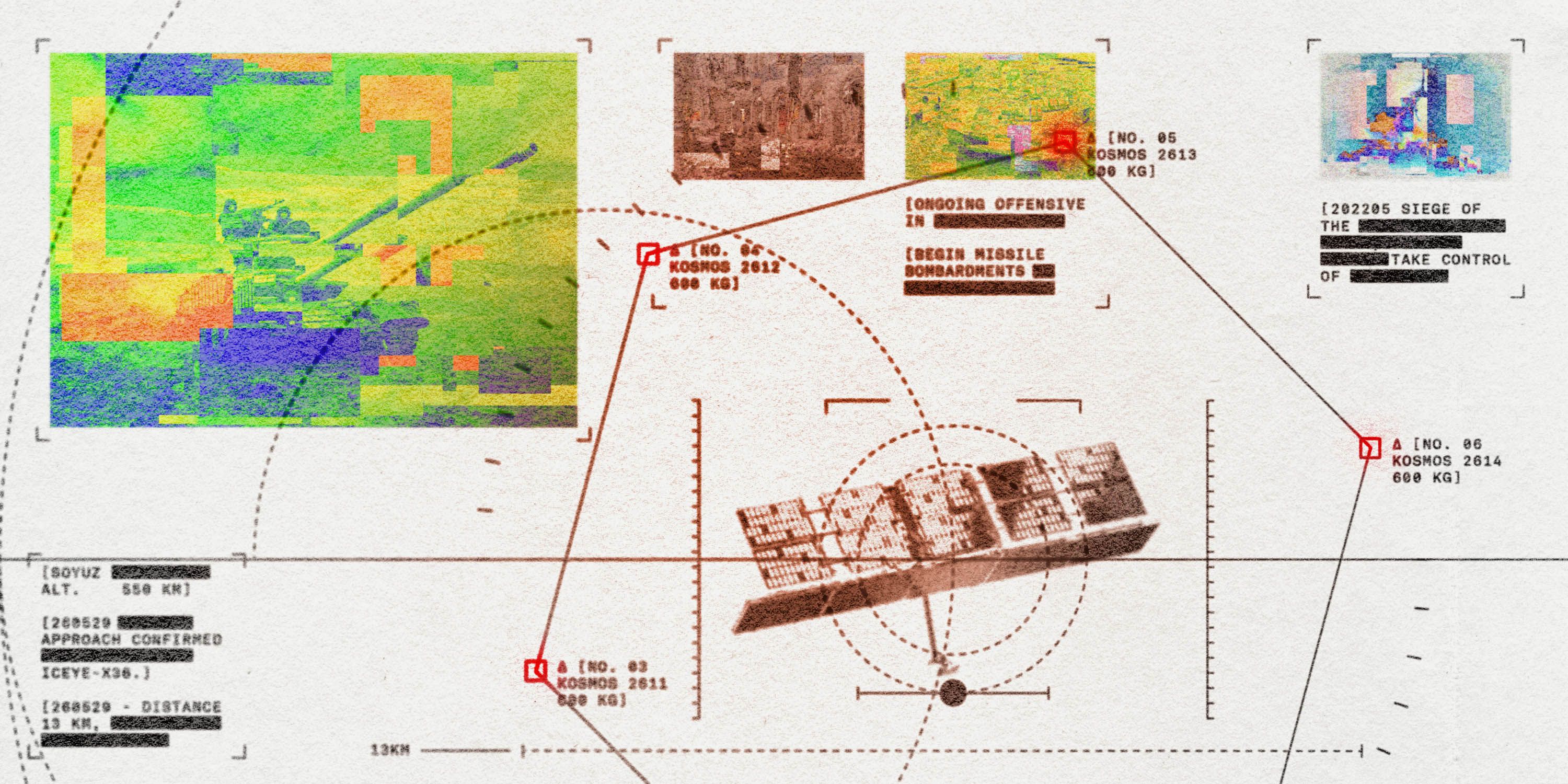
Six mysterious Russian satellites launched earlier this year have been creeping toward an observation spacecraft used by Ukraine.

Experts worry the complex maneuvers may be a prelude to an attempt to destroy the satellite or disrupt its operations.

Something about the way in which Russia placed into orbit a batch of its Kosmos satellites in late April of this year piqued Greg Gillinger’s interest. Gillinger, the Senior Vice President at space intelligence company Integrity ISR, thought it was strange when Russia used its Soyuz rocket to drop off the first of the satellites at an altitude of 550 kilometers, then dispatched the rest to a different orbital plane using the Volga space tug.

The satellites, numbered 2609 to 2614, weigh about 600 kilograms each. But that’s about as much as Western analysts know about them. For Gillinger, the effort Russia put into fine-tuning its orbits raises alarms.

The orbital plane is an imaginary disc tilted toward Earth’s equator, on which a satellite orbits. Changing orbital planes, once in space, is difficult and demands a lot of fuel, Gillinger said. The availability of fuel limits the useful lifetime of a satellite. Most operators perform fuel-hungry maneuvers with caution. Launching satellites with the intention to perform such maneuvers requires big fuel tanks, which reduce the usable payload mass a rocket can send into space.

Gillinger, who previously served as the chief of Intelligence, Surveillance, and Reconnaissance (ISR) at the Combined Space Operations Center of the U.S. Air Force, said that monitoring space launches is simply something he is in the habit of doing. In the weeks following the April Kosmos launch, he kept a close eye on data tracking the six satellites. This data was made available by the U.S. military.

It didn’t take long to confirm that the satellites had an unusual mission.

The original orbital plane the satellites were placed into was already very close to that of two satellites of the Finnish Earth-observing constellation ICEYE. By mid-May, several of the Kosmos satellites were firing their thrusters, burning precious fuel, to align even more closely with the ICEYE duo.
“My assumption is that you don’t do this by accident,” said Gillinger. “It requires an enormous amount of energy to change orbital inclination. It’s not typical to see reconnaissance satellites or communication satellites or other types of satellites do anything like this.”

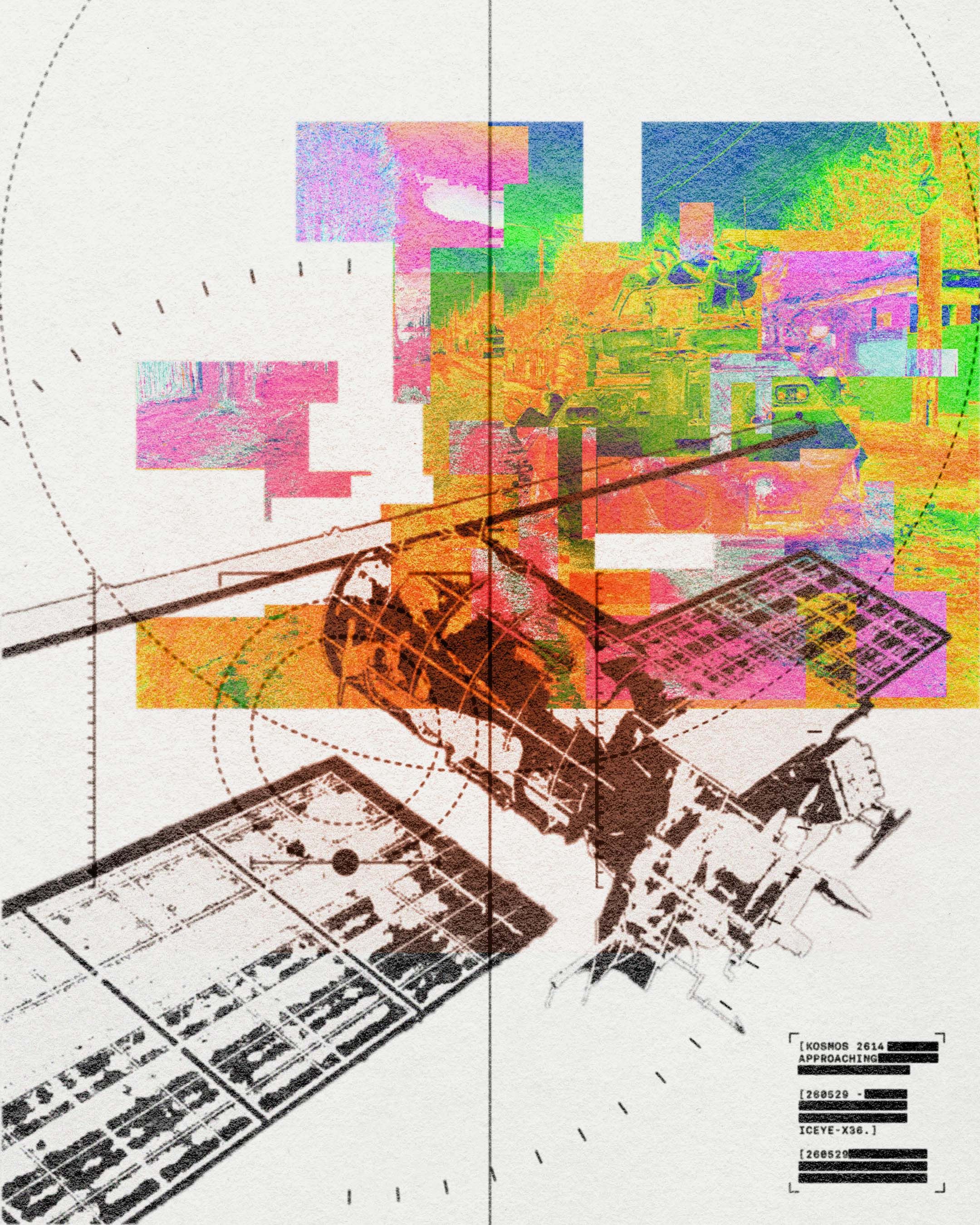
As they circle Earth, the Kosmos satellites now, thanks to this orbital alignment, regularly pass the ICEYE X36 satellite at a distance that causes concerns. On May 29th, Gillinger said, the distance between the Kosmos 2614 and ICEYE X36 shrank to only 13 kilometers.

Gillinger says that although the Russian sextet doesn’t “do anything dangerous or alarming” at the moment. The close approaches suggest that Russia may want to cause some harm to the ICEYE satellites or disrupt their operations.

“It’s a behavior we haven’t seen before,” Gillinger said. “It could be something as easy as an inspection mission. We don’t know. They might even want to interfere with the ICEYE satellite kinetically or non-kinetically.”

Kinetic interference refers to the use of physical force to destroy a target. In the space context, a kinetic attack could involve an intentional collision or the use of robotic grabbers to knock out a satellite. Non-kinetic interference could involve signal jamming or blinding the satellite’s sensors with laser light.

That Russia should be interested in ICEYE comes as no surprise to experts. The Finnish constellation is the world’s largest fitted with synthetic aperture radar instruments (SAR), which observe Earth’s surface through clouds and in the dark. Since the beginning of the war in Ukraine, ICEYE has been a key supporter of the Ukrainian defense effort. The embattled country even purchased priority access to the constellation’s images using money collected in a crowdfunding campaign.

“You have some curious in-orbit developments that aren’t normal, paired with a satellite that has been actively supporting Ukraine for years,” remarked Gillinger.

In fact, Russian officials have previously publicly expressed their discontent with Western satellite operators aiding Ukraine. In October 2022, about eight months after the invasion, Konstantin Vorontsov, the deputy director of the Russian foreign ministry’s department for non-proliferation and arms control, told the United Nations assembly that such “quasi-civilian infrastructure may become a legitimate target for retaliation.” He also described the role of commercial satellites in the defense effort as “an extremely dangerous trend.”

ICEYE declined to comment on the situation.

Space situational awareness software company COMSPOC confirmed its experts, too, had observed the close approach between Kosmos 2614 and ICEYE-X36 on May 29. Although they estimated the distance of the closest approach at 43 kilometers.

“What makes this maneuver particularly noteworthy is that the deployment pattern and subsequent orbit plane changes are highly unusual,” a COMSPOC spokesperson told Supercluster in an email.

The company said it would continue observing the situation.

Victoria Samson, the Chief Director for Space Security and Stability at the Secure World Foundation, said that although the Kosmos satellites are not the first Russian spacecraft to sneak up on Western spacecraft in orbit, the incident is a step-up from earlier Russian threats.
“This type of RPO (rendezvous and proximity operations) is not unusual for Russia,” Samson told Supercluster in an email. “Their Luch and Luch 2 satellites have gotten co-planar [orbiting in the same plane] with numerous US intelligence satellites. But this is the first time, as far as I know, that Russian satellites have gotten co-planar with a commercial satellite in low Earth orbit.”

Samson is a co-author of the Secure World Foundation’s Global Counterspace Capabilities Report published in June 2025. The report revealed that although Russia’s civilian space program may have been in decline for years, the Eastern European power’s military space technology is very much on par with that of China and, in many aspects, exceeds the capabilities possessed by the United States and Europe.

In fact, Russia’s maneuvers in orbit have been causing a stir among Western space security experts for more than a decade. The Luch satellite, mentioned by Samson, has been zooming around the geostationary ring — the orbital region at the altitude of 36,000 kilometers, where many telecommunications and spy satellites reside — since 2014. During those years, Luch has repeatedly positioned itself close to various Western spacecraft. Its sibling satellite, Luch 2, has been performing similar maneuvers since 2023.

European authorities think the Luchs may have been eavesdropping on European commercial and state-owned communications satellites and might even be trying to disrupt their transmissions using on-board jammers.

Subscribe to our newsletter
The Greatest Space Stories, weekly.

Before Kosmos 2609 to 2614, other satellites from the Kosmos family have conducted suspicious exercises in low Earth orbit. In addition to the ICEYE SAR constellation, the low Earth orbit, at altitudes of up to 2,000 kilometers, is home to internet-beaming mega-constellations such as SpaceX’s Starlink and other Earth-observing fleets capable of imaging Earth’s surface in detail. Many of these systems have been aiding Ukraine’s defence efforts against Russia.

The maneuvers, performed regularly since 2015, have demonstrated Russia’s ability to approach other satellites in Low Earth orbit, and, in some cases, suggested that Russia possesses technology to enable satellites to fly at a close distance in a coordinated manner.

Russia has been secretive about the purpose of these tests.

The Secure World Foundation states that while these technologies could be used for satellite servicing and inspection, they could also enable Russia to either disrupt Western satellite services by jamming their signal at close distance or even cause physical damage.

Gillinger said the ICEYE incident sends a signal to Western commercial satellite operators and governments to rethink their approach to space situational awareness. Simply monitoring objects in space using telescopes and radars on Earth may no longer suffice.

Support Supercluster

Your support makes the Astronaut Database and Launch Tracker possible, and keeps all Supercluster content free.

Support

“We might want to start thinking about equipping satellites with their own space awareness capabilities,” he said. “If you really want to be certain what’s going on around your satellites, having an onboard capability to see the surrounding area will become more important. If the ICEYE X36 satellite had a small space awareness sensor suite on board, the operators would be able to observe the Kosmos satellite and determine whether they should be maneuvering."

Space security experts have been sounding the alarm for years about emerging threats in the space environment. Last year, China sent ripples through the space world by performing close-proximity maneuvers described as satellite dogfighting. U.S. military sources said at that time that five Chinese satellites had been moving around each other “in synchronicity and with control” in a way reminiscent of the acrobatic chases performed during the Second World War between German and British fighter aircraft.

In January this year, Germany’s State Secretary for Defence Jens Plötner said that European satellites experience interference from Russia and China “on an almost daily basis,” according to Euronews.

Space security researchers are warning about the susceptibility of space technology to cyber attacks. The space around Earth is full of older satellites built without cyber protections, and although no satellite hack has been verifiably reported to date, researchers have discovered multiple vulnerabilities in widely used onboard software.

The invasion of Ukraine in February 2022 was preceded by a cyber attack on terminals of American satellite operator Viasat, which was at that time frequently used by Ukrainian forces.

Read the whole story
bogorad
4 hours ago
reply
Barcelona, Catalonia, Spain
Share this story
Delete

A blocked GMO rice could have saved 100,000 children. The same tech makes pineapples pink.

2 Shares

LLM (google/gemini-3.1-flash-lite-20260507) summary:

  • Health Crisis: vitamin a deficiency causes blindness in hundreds of thousands of children annually with high mortality rates following vision loss
  • Preventative Measures: fortification of staple foods is a common practice in developed nations to address widespread nutrient deficiencies
  • Technological Innovation: golden rice was developed by scientists to provide beta carotene through rice consumption to improve health outcomes for the poor
  • Licensing Strategy: the technology was offered for free to smallholder farmers to ensure cost effective access for low income populations
  • Regulatory Hurdles: organized opposition led by environmental groups prevented the commercial distribution of golden rice for two decades
  • Estimated Impact: long term regulatory delays are associated with over one hundred thousand child deaths and millions of lost healthy life years
  • Market Disparity: novel genetically modified products such as designer pineapples encounter fewer barriers than foods developed for humanitarian purposes
  • Future Developments: emerging nations are increasingly prioritizing biotechnology for local crop improvements to mitigate agricultural challenges and health risks

Every year, vitamin A deficiency blinds 250,000 to 500,000 children. Half of them die within a year of losing their sight.

One third of children worldwide are deficient, roughly half of children in sub-Saharan Africa and Southeast Asia1. Deficiency weakens the immune system, so children are more likely to die from common infections like diarrhea or measles.

Rich countries solved this kind of problem by adding nutrients to staple foods. The United States adds iodine to most salt, and folic acid to flour to prevent birth defects.

Rice is a critical staple among the world’s poor, so scientists improved rice. They added beta-carotene, the thing that makes carrots orange and that the body turns into vitamin A. The new rice cooks and tastes the same, but it’s yellow. They called it Golden Rice and licensed it for free to any farmer earning under $10,000 a year.

It has been ready since the mid-2000s. Today it grows nowhere.

The reason is that it is a GMO. Environmental groups, led by Greenpeace, fought it in country after country for two decades.

As far as I can tell, no one has calculated the cost of that delay. I’ve spent the last few weeks doing so. My rough estimate is that the delay has killed about 106,000 children and left another 210,000 to 425,000 blind.2 Measured in healthy years of life lost, that is somewhere between 7 and 12 million.3 (My full calculations are here. I will update these figures as I receive feedback.)

That works out to roughly fourteen children dying every single day, for twenty years, from a nutrient we already know how to add to food.

If a new disease were killing fourteen children a day, it would have an internationally-recognized name and a task force. Golden Rice got villified as one word instead: GMO.

“GMO”

Often, that word scares people. But we eat GMOs all the time. They are in about 70 percent of packaged American food, 96 percent of US soybeans, and 92 percent of US corn. Billions of people have eaten them every day for thirty years. No one has been harmed.

Golden Rice was different in one small way. Most GMO crops are changed in how they grow, so the part you eat is ordinary. In Golden Rice, the part you eat is the part that changed. That made it feel new.

Greenpeace framed it as dangerous, saying corporations were secretly behind it. They falsely claimed it was unproven and that it was unclear whether children could absorb the vitamin. Activists tore up test fields and filed lawsuits to block approval. Over a hundred Nobel laureates signed a letter asking Greenpeace to stop.

While Golden Rice sat blocked, other new GMO foods reached store shelves. One of them is a pink pineapple. It sells for about $10 in stores and up to $50 online. It uses the same chemistry as Golden Rice, run in the opposite direction. Golden Rice turns on the pathway that makes the vitamin children need. The pineapple turns it off, so the fruit stays a pretty pink.

The lifesaving technology is in the Western world, growing a nicer pineapple for parties.

Source: Del Monte’s East Coast vendor TropicalFruitBox.com

I’m grateful for this pineapple. The pineapple has a company behind it that can afford to fight critics and build a market around modified foods. Golden Rice only had scientists and charities. It was a cheap crop for poor people, with no profit margin to help it defend itself.

In 2021, the Philippines became the first country to approve Golden Rice. Three years later, a court there revoked the approval after Greenpeace and a group of farmers sued.

Blocking a new crop is cheap. A single lawsuit claiming there is no scientific consensus on its safety can freeze it for years, even when consensus exists. Approving it is expensive because a government must be willing to spend political capital on people who cannot pay it back. Golden Rice’s beneficiaries were poor, scattered, and far from anyone in charge.

When one of these children dies, the cause is recorded as measles, diarrhea, or poverty, never as the campaign that kept the cure out of the field. A plane crash kills a few hundred people and leads to grounding fleets immediately. This killed more than a hundred thousand children over twenty years, with no wreckage to photograph and no single day it happened on.

That may be starting to change: the Global South is engineering crops of its own now, aimed at preventing harm, like pests and crop failure, rather than high margins or novelty. One is a cassava richer in iron and zinc. The more of these that become normal, the harder it gets to keep blocking the one that should have come first.

Share

This post took several weeks of research and calculation. If you found it useful, please consider becoming a paid subscriber.

1

As of 2013 WHO data.

2

I estimated this by adding up the countries with high vitamin A deficiency, high rice consumption, and reliance on domestically grown rice. I projected how long it would take Golden Rice to reach about 70 percent adoption.

As of 2023, vitamin A supplementation programs reach three in four children who need them. This estimate counts only the children they don’t protect. India, the biggest contributor to the figure, reaches only about 60 percent of its children.

3

The closest estimate I found was a 2014 peer-reviewed study finding that India lost 1.4 million healthy years in a single decade.

Read the whole story
bogorad
18 hours ago
reply
Barcelona, Catalonia, Spain
Share this story
Delete

Seeing Turmeric in a New Light | Office for Science and Society - McGill University

1 Share

LLM (google/gemini-3.1-flash-lite-20260507) summary:

  • Academic Obsession: a student prioritizes chemistry as a core identity feature while attempting to force enthusiasm upon an indifferent public through outreach programs.
  • Outreach Participation: the chemistry group organized a booth at a public festival to showcase material chemistry through amateur demonstrations.
  • Pigment Application: body paint was formulated by mixing powdered turmeric into a white base to create temporary yellow decorative designs.
  • Accidental Discovery: the yellow pigment vanished after brief exposure to sunlight, prompting a trivial investigation into the underlying causes of the fading.
  • Curcuminoid Properties: scientific literature is referenced to highlight the structural attributes and purported biological benefits of common kitchen additives.
  • Photodegradation Mechanism: ultraviolet light triggers the breakdown of complex molecular structures when exposed to ambient environment factors like air and sun.
  • Structural Transformation: the complex curcumin molecule splinters into simpler fragments like vanillin, which inherently alters its light-absorbing and reflective capabilities.
  • Instructional Utility: the simple phenomenon of dye degradation is promoted as a profound insight for organizing household spice storage in dark cabinets.

As you could probably tell by spending two minutes in my presence, I love chemistry. It’s part of who I am. To some people, that might get a little annoying, but I promise I know to tone down the chemistry nerdiness depending on my audience. While learning the technical information is great and all, what really excites me is seeing chemistry in action, especially when it catches me by surprise.

Because I’m such a chemistry enthusiast, I have made it my mission to convince people that chemistry could be fun (I know, not exactly an easy task). Naturally, this has made me gravitate towards science education initiatives such as the OSS and the McGill Chemistry Outreach group. Through these experiences I have been able to nurture my love of teaching all while satisfying my overcurious mind. But what I really want to talk about here is a moment that made me fall in love with chemistry all over again.

Love at first light

This past week, I coordinated the Chemistry Outreach Group’s participation in Eureka fest. Every year this festival brings together organizations from across Montreal to share science with the public through hands-on activities and demonstrations. This year, our group put together an impressive tent featuring demonstrations that showcased materials chemistry at its finest (no bias, of course).

One of these demos involved making body paint, using various extracts of dyes and pigments. Among them was curcumin, the compound responsible for giving turmeric its vibrant yellow colour. To make our paint we added some of this powdered spice to a white face paint base and mixed until smooth. As expected, the curcumin paint would go on the skin a beautiful bright yellow. This obviously prompted all of us demonstrators to decorate ourselves with matching sun-shaped tattoos.

But after a quick walk in the sun, something unexpected happened.

My colleagues went to check out some of the other booths, but when they returned holding out their arms, I was intrigued. I went over to them only to see that their previously yellow tattoos, had turned white. At that moment, this article practically wrote itself.

Getting to know turmeric

We all know turmeric in a kitchen setting. Whether you’re adding it to enhance the flavour of your curry or even in your ginger “wellness” shots, its smell and colour are very familiar. But what we don’t think of often, is its chemistry.

Curcuminoids are the family of compounds responsible for both turmeric’s vibrant colour and biological activity, the major one being curcumin. Because of their structure, these curcuminoids are potent antioxidants. Their phenolic rings (those polyphenols Dr. Joe talks about so often) are able to neutralize those nasty free radicals and protect our cells from oxidative stress. Also, there is some evidence that turmeric can be used to manage certain inflammatory conditions, but it’s not a miracle worker. Anyways, I’m not here to teach you how to cook or eat, I am here to answer the question: why did our tattoos turn white?

Photodegradation

After looking into this, the answer to my question is relatively simple. Curcumin is UV sensitive. When exposed to the rays of the sun for long periods of time, it starts to degrade by a process known as photodegradation. As the name suggests, this process refers to a change in a material by light. This change is usually triggered by the combined effects of sunlight and air which can cause compounds to break down. We’re not talking about a chemical breakdown due to heat; we’re really talking about degradation throughout the ultraviolet spectrum.

In the case of our turmeric tattoos, exposing them to the sunlight during our walk, triggered photodegradation, causing the curcuminoids to breakdown into smaller phenolic fragments like vanillin (the compound responsible for vanilla flavour). This breakdown is responsible for the colour fading. The original structure of curcumin is long and complex and has the ability to absorb blue-violet light, thus reflecting yellow light (by the principle of complementary colours). When we disrupt this structure, the molecule can no longer absorb light in the same way, causing the colour to fade dramatically.

At this point, you may be wondering what this has to do with your everyday life. As it turns out, understanding turmeric’s chemistry can be surprisingly useful when it comes to organizing your spice cabinet. You probably already sore it away from direct sunlight, but now you know why.

Love actually is all around

So, there you have it, we unintentionally made colour-changing tattoos, and to me that’s the wonder of chemistry. The smallest observations can inspire fascinating questions and unexpected lessons. This experience reminded me why I fell in love with chemistry in the first place, and just how interesting the world becomes when you’re willing to be curious. My friends often say I ask too many questions, I think it’s part of how we learn. Stay curious.


@AngelinaLapalme

Angelina Lapalme is a U3 BSc student majoring in Bio-Organic Chemistry at McGill University. 

Part of the OSS mandate is to foster science communication and critical thinking in our students and the public. We hope you enjoy these pieces from our Student Contributors and welcome any feedback you may have!

Read the whole story
bogorad
6 days ago
reply
Barcelona, Catalonia, Spain
Share this story
Delete

How to end the Brexit shitshow // A blitzkrieg can oust the deep state

1 Share
  • Institutional degradation: Existing international and domestic frameworks, including the UN, NATO, and the British civil service, are increasingly misaligned with contemporary global realities.
  • Administrative stagnation: British political and administrative elites are criticized for prioritizing the preservation of internal power structures over addressing systemic failures in core areas like housing, energy, and defense procurement.
  • Technological exclusion: A failure to engage with frontier technologies has left the European landscape poorly positioned to compete with the dominance of China and the United States.
  • Misguided political responses: Proposals to rejoin the EU or implement proportional representation are viewed as efforts to insulate established bureaucracies from democratic accountability rather than efforts to solve structural issues.
  • Constitutional potential: The unique flexibility of the British unwritten constitution offers a distinct advantage for rapid, decisive regime change that is not available in other Western nations.
  • Path to reform: Meaningful transformation requires a proactive agenda—including the repeal of regulatory acts and the strategic use of executive power—to dismantle entrenched bureaucratic resistance.

In European history, there is a pattern: every 50 or 75 years or so, the international order of its time, the institutions and the ideas, gradually drift out of alignment with reality. If you go back to the institutions built in the rubble of 1945 and as the Cold War was beginning, you have the UN, Nato, the WTO, the IMF etc — and now they all seem played-out and exhausted.

The EU — the European Economic Community, as it was — is one of those institutions. In the years before the referendum, I made several arguments in favor of leaving. I said, if you look around, what do you see? You see a mix of stagnation, anti-technology, anti-growth, anti-future, bureaucracy — bureaucracy dedicated to Leninist bureaucratic centralism in Brussels, where everything will improve if everything is uniformly controlled by the Commission. But they’ve got low growth, high debt, nightmare pension systems, nightmare demographics, and immigration that is out of control and fueling the rise of extremist parties.

If you look at what’s happening technologically, increasingly it’s China and California which are dominating, and Europe is not in the game. Again, that was regarded as a very eccentric argument to make 10 years ago, but now it’s an obvious, very mainstream thing. 

I also argued that the regime in Britain is knackered and is failing, and the institutions are knackered, and they’re not going to be able to cope with the world that’s coming. That was an extremely niche view in 2015, regarded, generally speaking, as crazy. Now, of course, you can go on Twitter today, and you can see the vast majority of Westminster is now having to face up to the reality that the old parties are knackered, old Whitehall is knackered, the old media ecosystem is knackered, the universities have lost huge credibility, etc. etc. 

Also obvious is that Britain now has huge problems. In all sorts of ways we have not done what the Vote Leave plan was — and what we started doing in 2019 and 2020 — because the Tories stopped it all. But is the answer to that to say, “Oh yeah, we need the bureaucratic centralism of the European Commission, we need more EU AI acts, we need more of that kind of regulation, that’s the future”? Does anyone in their right mind really think that? 

So how does Westminster respond to this now? Westminster doesn’t want to face all the technology issues, never has done. Our political elites and Whitehall elites, for complicated reasons from the Sixties and Seventies, very deliberately and explicitly stepped back from thinking about frontier technology. 

So now people don’t want to look at those questions. Their response now is: instead of looking at all the very, very obvious big things like our totally farcical procurement system, totally farcical planning system, totally farcical energy, totally farcical housing, totally farcical MoD, totally farcical welfare, a Westminster and Whitehall that is pathological about on technology and doesn’t want to take it seriously — the answer to those problems is to rejoin the EU. 

Why? Because the old people from the old system are determined not to face reality, determined not to face the future. They just want to retreat to their comfort zone, which is having more stupid culture wars about Brexit, because that’s where they’re happy. They’re pretending that rejoining the single market is somehow a great thing, when you can barely even see the single market in the data. If you look at the Draghi report, which of course also is basically ignored in London because it’s super bad for the EU, you have a perfect example of the actual EU technocracy itself recently writing about how basically a lot of Europe is deluded on the single market. Westminster doesn’t want to face any of those problems either.

Go back to the Eighties and look at the newspapers at the time and the news at the time. There’s obviously a lot of bitter arguments, but the political class is actually engaged with the real issues of the British economy. That is actually what dominates the news, and you have a whole set of people reading things and arguing about them and making complicated arguments in public about what we have to do on privatization, you name it. 

You look at the 10 years since Brexit and it’s basically characterized by Westminster being absolutely pathologically determined not to face any of these core problems in any kind of coherent way. It’s a constant soap opera, and both sides — both sides in the sense of the kind of inside-Westminster Left and Right — have been much happier arguing about all the trans madness in 2020. The Guardian, the Telegraph, Labour and the Tories were happier arguing about that and arguing about Brexit than they were about dealing with any of these other actual core problems.

And Whitehall doesn’t care about these problems. Whitehall cares about preserving existing power and existing institutions and existing budgets, and it cares, most importantly, about itself retaining control over its own personnel caste system. That is its actual priority, and everything will always be sacrificed to that, as you saw in Covid, as you could see in Ukraine, as you can see on everything.

“You haven’t just got one defunct bureaucracy, with internal silos going haywire, you’ve also got, horizontally, them all smashing into each other and breaking.”

So now you’ve got stagnant growth, you’ve got completely pathological institutions that actually need real-terms increases in money just to stand still, and you’ve got political parties and senior civil servants completely dedicated to not changing how anything works. 

If you put those three things together, you’ve got what we can see all around us, which is every part of the system now failing, and those failings interacting with each other in various ways. So you’ve got a shitshow in that you can’t deport people, and you’re scraping crazy Afghans off the street and putting them in prison, but then that means you’ve got to let all these people out, and then that means you’ve got X, and then that means you’ve got Y, and then that means the budgets for these things are all knackered as well. So all these things are now starting to ping into each other. You haven’t just got one defunct bureaucracy, with internal silos going haywire, you’ve also got, horizontally, them all smashing into each other and breaking — and no one has authority to deal with the interactions between all these different parts of the system.

Cummings during his time in Downing Street. (Isabel Infantes/AFP via Getty Images)

But in all sorts of ways, Britain is actually the best-placed country in the West. In practical terms, it is much easier to do real regime change in Britain than it is in America or anywhere in Europe, because of our unwritten constitution and the weird way in which the powers of the Prime Minister actually work. So, unlike Trump, the Prime Minister can go in today and say, “Fired, fired, fired, fired, fired. This government department is closed, and I’m creating a new one.” The civil service has to do it, and the courts can’t stop it, or even judicially review these things. In no other Western country is that possible. 

That is why you see two things happening on the Left now: one, the plan to change the electoral system to PR (proportional representation), and then, secondly, discussions about how you encode protections for the civil service to make it extremely difficult to actually do what I’m talking about. What they’re thinking is — and it’s actually logical from their point of view — that if you pass certain kinds of legislation defending the current Whitehall system, and then you do PR, you make it extremely hard for anybody coming in to actually change anything. You completely embed the current catastrophic situation, which is what they want to do.

“You also make clear to the House of Lords that if anyone thinks that they can fuck around, we’re going straight at the King, we’ll appoint 600 new peers, and it’ll be blitzkrieg on you guys.”

What they’re terrified of is Nigel Farage doing some kind of Doge-type thing and saying, “Right, I’m going to bring in 20 hotshots, fire all the permanent secretaries, put them in charge of this, use the actual powers of the PM, close departments, open them, fire people, and then pass a whole series of primary legislation, repeal the Human Rights Act, repeal the Equalities Act, reform how judicial review works, bin the Climate Change Act.” You go through 15 things, you whack them all in year one with primary legislation.

If you have an actual serious list of these things, the right way to do it would be that you draft all this legislation in opposition, you make the case in the election, in the manifesto, you win on the Thursday, and on Monday morning, these bills start hammering through into parliament. And you also make clear to the House of Lords that if anyone thinks that they can fuck around, we’re going straight at the King, we’ll appoint 600 new peers, and it’ll be blitzkrieg on you guys.

You smash that through in primary legislation, so you have that combination of primary legislation changing fundamentals, and you actually use the constitutional powers of the PM, as I’ve discussed, and the whole thing starts to shift. That’s what they are terrified of — correctly from their point of view — in Whitehall, in Labour, in the Inner Temple, etc. etc. And that’s why you start to see this mix of “Rejoin the EU”, PR, censorship, and embedding legislation to protect the civil service. They’re thinking that if they can bring off some combination of those things, then they can get to the state they want to, which is that they don’t have to worry about elections anymore. And they’ve convinced themselves that everyone who doesn’t agree with them now is fascist. Go back to pre-referendum: mainstream people in the system in Westminster hated me, thought I was crazy, stupid, wrong, but they didn’t say I was actually a fascist who should be in jail. Now, their argument about people like me is that we’re actually fascists who should be in jail and shouldn’t be allowed to actually participate in democratic politics.

So almost all the positive things that we could have changed after Brexit, Westminster, the Tories and Labour have been adamant in refusing to do. But just because of inertia, we haven’t adopted various of the EU regulations, and therefore we haven’t shot ourselves in both feet the way that Brussels has. As the old system fails, something new is being born — but for the moment, it is unclear exactly what.

***

This essay was adapted from Dominic Cummings’ interview on the Anglofuturism podcast.


Dominic Cummings ran Vote Leave, the campaign for Britain to leave the EU. After the referendum, he was an assistant to Boris Johnson, then the Prime Minister. He writes on Substack.


Read the whole story
bogorad
7 days ago
reply
Barcelona, Catalonia, Spain
Share this story
Delete

Russia Wants AI Sovereignty. It Has a Chip Problem

1 Share

LLM (google/gemini-3.1-flash-lite-20260507) summary:

  • Nepotistic Leadership: state efforts are centered around katerina tikhonova, whose expertise in dance and mathematics is being leveraged to oversee elite academic ai initiatives.
  • State Indoctrination: authorities are force feeding ideological constraints by requiring models to adhere strictly to ambiguous russian spiritual and moral values.
  • Brain Drain: a mass exodus of technical talent following the invasion of ukraine has severely crippled the nation’s internal research and development capacity.
  • Hardware Deficit: the country remains decades behind in semiconductor production, relying desperately on illicit gray market imports that face increasing international scrutiny.
  • Military Integration: artificial intelligence development is inextricably linked to the defense and security apparatus, leaving little room for genuine civilian innovation.
  • Sovereignty Delusion: officials promote a fantasy of technological self-sufficiency while lacking both the domestic hardware infrastructure and the computing power to execute it.
  • Limited Access: elite resources like the msu supercomputer are gated behind state-controlled circles, preventing the broader collaboration necessary for scientific advancement.
  • Chinese Dependency: reliance on chinese hardware is a precarious strategy, as foreign suppliers prioritize their own domestic demand for chips over russian needs.

In early April, on a stage in the southwestern outskirts of Moscow, a moderator at Russia’s annual Data Fusion conference wanted to know: what is the most important thing for Russia to get right in its quest to develop an AI ecosystem? 

The six men on the stage before her represented Russia’s second-largest bank, the state nuclear power company, and the Ministry of Digital Development. Instead, she started with the only person joining via video link.

“Katerina Vladimirovna,” she said, referring to the pale face, whose credential at the conference was managing director of a small research and development foundation, by her patronymic. “Your answer, please.”

“Talent is everything,” replied Vladimir Putin’s younger daughter, whose full name is Katerina Vladimirovna Tikhonova, knowingly or not echoing a 1935 address by Joseph Stalin. “Everything else is a consequence of talent.” The panelists were quick to agree. And yet, there are reasons to doubt that the talent that Russia is capable of developing is sufficient to overcome Russia’s structural weaknesses in AI. 

In recent months, Russian authorities and institutions have made a concerted push to develop homegrown AI talent. Vladimir Putin has established a Presidential Commission on AI and changed national curricula to emphasize the technology. Moscow State University, the nation’s most prestigious university, has established a new AI faculty, alongside an AI institute headed by Putin’s daughter. These moves seek to address the brain drain of top technical talent following the invasion of Ukraine by playing to a traditional Russian strength—upskilling members of a population of some 140 million people, which has historically seen success in the mathematical sciences. However, these moves do little to address Russia’s greatest weakness in AI: scarce access to indispensable hardware, due to limited domestic production capacity and stringent sanctions. 

Advertisement

‘Talent is everything’

In April, Russia’s main TV news channel depicted Moscow State University gilded in futuristic laser lines as the presenter announced a new AI faculty, due to welcome its first cohort of 72 students in September. The exclusive course, which is financially supported by oligarch Oleg Deripaska, a Putin associate, spares no expense. More than half of the places are sponsored, waiving the $7,000 course fee, and the faculty is granted access to one of the nation’s most powerful supercomputers, unveiled in 2023. The faculty completes a “unified ecosystem” comprising an AI institute, headed by Putin’s daughter herself, which opened in 2020; a research center established in 2025; and now an educational body to train the next generation of experts.

Tikhonova’s post at the heart of the ecosystem is likely nepotistic, says Katheryna Bondar, a senior fellow at the Center for Strategic and International Studies. Tikhonova, who in a past life was an international rock ’n’ roll dancer, has a Ph.D. in mathematics, but has not published research in AI. However, the growth of the AI industry around her institute could be a sign of the growing salience of AI in the Russian president’s orbit. 

Advertisement

The new AI faculty is part of a broader effort. In March, AI was added to the national informatics olympiad, held annually since 1989, as the country aims to increase its output of AI specialists from roughly 3,000 in 2022 to 15,500 by 2030. “What really surprises me is how comprehensive their thinking and approach is,” says Bondar. 

Brain drain

Talent is widely considered to be one of the key inputs to AI progress, but it has been an issue for Russia thus far in the AI boom. After Russia invaded Ukraine in early 2022, roughly a quarter of Russian software developers’ GitHub profiles changed, ceasing to share their location or showing that they had left the country. “I didn’t want to be part of this,” says Dima Dobrynin, who led an autonomous driving project at Yandex, Russia’s answer to Google, before leaving in the weeks following the invasion. Many of his friends with technical backgrounds departed, too.

Advertisement

The departure of some of Russia’s brightest computer scientists has come at an inopportune moment for the country. The war in Ukraine has shown the importance of modern data and AI infrastructure on the battlefield. “Russians were always complaining that Ukrainians get this super sophisticated software,” says Bondar. In February, Putin established a Presidential Commission on AI to help establish state policy on AI. In case there was any doubt about where the technology being developed by private Russian companies is headed, the Commission features the Minister of Defense and Director of the FSB alongside representatives from some of the nation’s most tech-savvy companies. The distinction between civil and military technological development in Russia is blurred, says Bondar. 

Sovereignty and isolation

At the heart of many of Russia’s AI efforts is a desire for sovereignty—lately a buzzword in international AI discourse. The platonic ideal is to have AI models developed by domestic researchers, on domestic hardware, capturing domestic values, thereby ensuring the technology’s control by the government and independence of external interference. “For Russia, this is a question of state, technological, and, one could say, value sovereignty,” said Vladimir Putin at a November AI conference.

Advertisement

The desire for control is evident in Putin’s close associates at the top, and the restrictions in access to resources. “No one has access to MSU-270 [the Moscow State University supercomputer] except for a narrow circle,” a source told T-invariant, an émigré Russian media outlet. The recently announced AI faculty promises to produce world-class AI specialists, by giving them access to this coveted hardware—but this exceptionalism is also a challenge. “You cannot build world-class anything in isolation,” says Dobrynin. 

Russia’s determination to maintain a tight grip on AI development has hampered its own efforts to advance the technology. A March draft bill mandated that Russian AI models respect “Russian spiritual and moral values.” Some industry leaders pushed back, pointing out that Russia lacks the data and computing power to train such models, and that the bill’s demand that AI models prioritize “the spiritual over the material” is not a robust legal definition around which companies can build their technology.

Advertisement

The chips problem

However, Russia’s talk of growing its own AI talent pipeline masks a greater weakness in the nation’s sovereign AI efforts. The country’s ability to manufacture the specialized computing hardware needed to train and run AI models lags China and the U.S. by decades, says Samuel Bendett, an advisor at the Center for Naval Analyse

So far, Russia has relied on a stock of gray-market American chips—official exports have stopped since the war began—which it reportedly used to develop the supercomputer used by the new AI faculty. However, a recent crackdown on chip smuggling and proposed U.S. legislation to track the locations of American chips, to prevent them ending up in undesirable territories, may throttle that supply. 

Historically, Russia has been stronger in software than hardware development, according to Bendett. This lack of domestic hardware expertise, along with the complexity of global semiconductor supply chains, complicates Russia’s attempt to indigenize AI: the new initiatives at Moscow State University emphasize software development in AI, but don’t train electronic engineers that could cultivate the hardware to run their algorithms. 

Advertisement

Russia hopes that China may prove to be a durable supplier. Russia’s battlefield data, accumulated over the course of the war in Ukraine, is a valuable asset for China, which has not fought a ground war in decades, as it seeks to train its own AI models with military applications, says Bendett.

But there are reasons to be skeptical of this approach. “China barely produces sufficient AI chips for their own demand,” Lennart Heim, an AI and semiconductor policy expert, told TIME. Russia likely falls lower on China’s priority list of customers than countries where Beijing is vying for influence with the U.S. 

Amid the enthusiasm about producing homegrown talent on the Data Fusion stage, AI chips—and their scarcity in the Russian AI industry—were barely an afterthought.

Read the whole story
bogorad
7 days ago
reply
Barcelona, Catalonia, Spain
Share this story
Delete

The Price of Wokeness - The American Mind

1 Share

LLM (google/gemini-3.1-flash-lite-20260507) summary:

  • Systemic Failure: institutional incompetence led to a dying student being handcuffed while officers prioritised false accusations of bias over basic medical aid.
  • Ideological Capture: uk law enforcement has been corrupted by academic doctrines that explicitly reject equality before the law in favour of engineered racial outcomes.
  • Two Tier Policing: official policies mandate discriminatory practices that penalise majority citizens while fostering a culture of selective enforcement.
  • Weaponised Compliance: the prioritisation of anti-racist signalling over public safety has repeatedly left dangerous individuals on the streets to avoid potential administrative critique.
  • Censorship Regimes: national police standards require the monitoring and investigation of lawful speech under the guise of non-crime hate incidents.
  • Hypocritical Leadership: current political elites demonstrate blatant double standards by lecturing foreign governments while silencing domestic criticism regarding institutional collapse.
  • Migration Consequences: uncontrolled influxes of foreign nationals have correlated with a surge in brutal violent crimes and the erosion of social cohesion.
  • Civilisational Decay: an obsession with multiculturalist dogmas has prioritised the comfort of progressive ideologies over the fundamental duty of protecting the citizenry.

When 18-year-old student Henry Nowak was fatally stabbed by Vickrum Digwa, a British Sikh, a horrific local crime quickly escalated to international headlines due to a catastrophic law enforcement failure. Spurred by Digwa’s false accusation of racism, responding officers immediately handcuffed the mortally wounded teenager, even as he told them nine times that he could not breathe, and four times that he had been stabbed. That Nowak was arrested and treated as a criminal while taking his final breaths has shocked and appalled the United Kingdom.

Body-camera footage of his harrowing final minutes also caught the attention of the U.S. government. The State Department warned on X that “Ideological conditioning and two-tiered policing are glaring symptoms of civilizational decline that must be rejected across the West.”

Two-tier policing refers to the public perception that British law enforcement operates under a double standard—treating suspects, victims, and protesters differently based on race, religion, or political ideology. The roots of this bias lie in the policies established by the College of Policing (the official national body that sets training standards) and the National Police Chiefs’ Council (NPCC), which coordinates operational policy across all 44 U.K. police forces. These two bodies introduced the highly controversial and censorious “Non-Crime Hate Incidents,” which legally requires British officers to log and investigate citizens for lawful speech if anyone perceives it as motivated by hostility—even when no actual crime has been committed. 

In May 2022, in the aftermath of the global George Floyd protests, the College of Policing and the NPCC launched the Race Action Plan, explicitly designed to embed anti-racist training across the entire justice system. The plan’s 2025 update codified an even more racialized doctrine. Official guidance now states that a commitment to racial equity “does not mean treating everyone ‘the same’ or being ‘colour blind.’” By abandoning equality before the law, the policy instructs British police to treat individuals differently based on their race in an attempt to engineer equal outcomes. With law enforcement having absorbed this radical ideology, officers have become selective enforcers of justice, failing to intervene for fear of being labeled racist.

This is not a fringe theory. A new survey by the research group More in Common found that one-third of Britons now believe police actively favor ethnic minorities over white people. The chronic mishandling of the Nowak case provides further evidence of a system that despises the majority of its own citizens.

Governed by an anti-racism doctrine, British institutions have traded the safety of their citizens for wokeness. The fatal cost of this ideological capture was laid bare in 2023 when Valdo Calocane slaughtered three people in Nottingham. He should not have been free. Psychiatric professionals had repeatedly refused to section the psychotically violent Calocane, citing concerns about the “disproportionate overrepresentation of young black males in detention.” Captive to the progressive view that any statistical disparity constitutes systemic racism, authorities left a violent, psychotic man on the streets rather than risk accusations of racism. 

Tragically, this stigma also contributed to the Manchester Arena terrorist attack in 2017 following a concert by Ariana Grande. Kyle Lawler, an on-duty security guard, witnessed the bomber, Salman Abedi, acting suspiciously with a heavy backpack. But Lawler failed to intervene or raise the alarm for fear of being branded a racist. Abedi detonated the device minutes later, killing 22 people—predominantly children and teenagers—and injuring over 1,000.

The Nowak case illustrates the same dynamic. Public criticism from Washington, combined with mounting protests on British streets, prompted pushback from Downing Street. Prime Minister Sir Keir Starmer and senior Labour politicians vehemently rejected the two-tier accusation, stating categorically that they did not recognize the State Department’s characterization of the British justice system, a sentiment echoed by Justice Secretary David Lammy. Starmer condemned the U.S. critiques, and even accused Elon Musk of overstepping diplomatic boundaries and attempting to stoke division on U.K. streets. 

But in 2020, Starmer had no such reservations about commenting on American internal affairs following the death of George Floyd. He publicly urged then-Prime Minister Boris Johnson to address systemic racism directly with Donald Trump, openly criticized Trump’s response to Floyd’s death, and famously took a knee in a highly publicized display of solidarity with Black Lives Matter. 

Labour’s attempt at containment was exposed when Vice President JD Vance took to X. Echoing his powerful Munich Security Conference speech, Vance argued: 

Henry Nowak died the same way a civilization dies: abandoned, handcuffed by authorities who neither trusted nor cared for him, and accused of hate crimes he did not commit…. He would still be alive today, and he would be if the last few generations of European elites had stood their ground against the politics of self-hatred and the mass invasion of migrants, many of whom despise the West and the people who love it.

Vance’s warning came days after a Sudanese asylum seeker was arrested on suspicion of attempted murder following a savage knife attack in Belfast, Northern Ireland—reported by the Telegraph as an attempted beheading. The victim, a man in his 40s, remains in serious condition after suffering significant injuries to his eyes, face, and back. Police stated the suspect is believed to have entered the U.K. by traveling from Dublin into Northern Ireland, where he had been granted leave to remain under a five-year visa.

The refusal to stem illegal immigration is a direct result of the policies of both main political parties. During the last six years of Conservative government, 128,000 undocumented migrants entered the country via the English Channel. Since Labour took power in July 2024, more than 70,000 illegal migrants have crossed into the U.K. on small boats. 

Among those Britain is importing are individuals who despise the West and seek to harm its citizens. In the final week of January 2026, a Sudanese illegal migrant was sentenced to life imprisonment for the brutal murder of Rhiannon Skye Whyte, a hotel worker whom he stabbed 23 times at a railway station. Less than a fortnight later, an Iranian migrant pleaded guilty to sexual assault. In March, an Afghan asylum seeker received a 15-year sentence for the abduction and rape of a 12-year-old girl in a park.

For decades, uncontrolled immigration has been imposed upon the British public under the guise of multiculturalism, driven by successive governments in thrall to the liberal notion that diversity is a strength. This result has been social upheaval, rapid demographic change, and a society fractured into segregated cultural enclaves. Expanding hate speech laws has effectively criminalized questions and complaints, leaving a nation paralyzed by fear and fueled by anger. JD Vance is correct to call this the politics of self-hatred. 

Read the whole story
bogorad
8 days ago
reply
Barcelona, Catalonia, Spain
Share this story
Delete
Next Page of Stories