Strategic Initiatives
11941 stories
·
45 followers

“Socialism is a hate crime,” by James Piereson

1 Share
  • Socialist resurgence: Growing popularity among college students and progressive Democrats culminates in a socialist mayor of New York and coordinated defense of Nicolás Maduro.
  • Censorship paradox: Socialist movements reportedly ban conservative speech and seek to silence critics, spurring the question of labeling socialism as a hate crime.
  • Democide evidence: R. J. Rummel’s research ties socialism to 110–260 million politically motivated deaths, making socialism a major source of twentieth-century mass murder.
  • Soviet atrocities: USSR under Lenin, Stalin, and successors caused up to 126 million deaths, including the Holodomor, forced famines, and the Great Terror.
  • Nazi socialism: The National Socialist German Workers’ Party, despite ideological differences, is identified as a socialist regime responsible for approximately 21 million murders.
  • Mao’s carnage: Communist China massacred 50–60 million people through landlord purges, the Great Leap Forward (36–45 million deaths), and the Cultural Revolution (5–10 million deaths).
  • Other socialist regimes: Castro’s Cuba killed 73,000–140,000, Pol Pot’s Cambodia murdered nearly 2 million, North Korea produced 0.7–3.5 million democide victims, and Venezuela now endures economic collapse and rights erosion under Maduro.
  • Systemic failure: Hayek’s analysis explains how socialist central planning breeds authoritarian thugs, economic collapse, repression, and societal decline, with New York’s socialist mayor expected to spark rising crime and dysfunction.

It is remarkable that, despite its long record of failure, socialism is now more popular than ever among college students and in progressive precincts of the Democratic Party, at least judging by the cult status of figures such as Bernie Sanders and Alexandria Ocasio-Cortez. Now an avowed socialist has been elected mayor of New York, the commercial capital of the United States and home to that great capitalist institution, the stock market. Even more recently, socialists here and around the world have spoken out in unison against the arrest of Nicolás Maduro, the socialist dictator of Venezuela.

It is ironic that these socialists, along with their supporters and fellow travelers, like to censor conservatives for, allegedly, promoting “hate” and “division.” On that basis, they have banned conservative speakers from appearing on college campuses, and just a few years ago urged Twitter and Facebook to close the accounts of conservatives who spoke out against socialism.  

This raises the question: given the historical record, why don’t we label socialism as a hate crime?  

After all, the evidence for socialism’s malignant effects is obvious to anyone with sufficient curiosity to open a history book. Socialists are responsible for the murder, imprisonment, and torture of many millions and perhaps hundreds of millions of innocent people during the ideology’s heyday in the middle of the twentieth century. That history of murder and tyranny continues on a smaller scale today in the handful of countries living under the misfortune of socialism—Cuba, North Korea, and (most recently) Venezuela.  

How do socialists escape the indictment that they are purveyors of tyranny and mass murder? Some of them deny that Stalin, Mao, and others were true socialists or, equally absurdly, assert that true socialism has never really been tried. But socialism has been tried many times in many places and has always failed.

Senator Sanders, Alexandria Ocasio-Cortez, and Mayor Mamdani claim that they are for something called “democratic socialism,” a more peaceful version of the doctrine, but that’s what Lenin, Mao, and Castro said until they seized power and immediately began to sing a different tune. “Democracy” and “diversity” are what they say when out of power; tyranny and raw power are what they practice once in power. That is the tried-and-true technique of all socialist movements. 

R. J. Rummel, a noted scholar of political violence and totalitarian movements, coined the term “democide” to describe large-scale government killings for political purposes—in other words, politically motivated murder. While communists and socialists have not had a monopoly on democide_,_ these movements have been responsible for far more political killing than any other political movement or form of government in the modern era.  

After looking at the facts, Rummel, writing in 1993, drew this conclusion: 

In sum the communists probably have murdered something like 110,000,000, or near two-thirds of all those killed by all governments, quasi-governments, and guerrillas from 1900 to 1987. Of course, the total itself is shocking. It is several times the 38,000,000 battle-dead that have been killed in all this century’s international and domestic wars. Yet the probable number of murders in the Soviet Union alone—just one communist country—well surpasses the human cost of wars.

Rummel suspected that the estimate of 110 million killed may be too low. In fact, he believed the death toll from socialist democide in the twentieth century may be as high as 260 million. Below is a breakdown of the bloody record of socialist murder and violence in the twentieth century.

The Soviet Union was the first large-scale experiment in socialism, commencing with the Bolshevik Revolution in October 1917. For those who like to think that there is a meaningful distinction between communism and socialism, it should be noted that USSR stands for the Union of Soviet Socialist Republics. Whatever Lenin and Stalin thought they were doing, they agreed they were engaged in a socialist enterprise.  

Rummel wrote that “the Soviet Union appears the greatest mega-murderer of all, apparently killing near 61,000,000 people,” with Stalin being directly responsible for at least 43 million of these deaths, mostly via forced labor camps and government induced famines.  

In what has come to be known as the Holodomor, in the early 1930s Stalin’s government killed millions of peasants, most of them Ukrainians, who resisted collectivization or failed to meet mandated production quotas. Several distinguished historians have documented this catastrophe. Robert Conquest, in The Harvest of Sorrow (1986), estimated that 11 million people died of starvation or outright murder in European sections of the Soviet Union between 1932 and 1934. Anne Applebaum, in her book The Red Famine: Stalin’s War on Ukraine (2017), agreed with Conquest’s estimate and showed that these deaths arose as a consequence of deliberate Soviet policy. 

A few years later, between 1936 and 1938, Stalin orchestrated a campaign of repression and terror that, according to Conquest’s The Great Terror (1990), led to the murder of some 700,000 people who were judged to be opponents of the socialist regime. Many of those killed were leaders of the 1917 Bolshevik revolution whom Stalin came to regard as traitors or rivals for power. Some historians judge the toll of Stalin’s terror to have been greater than one million killed.

At the time, and for decades thereafter, Western apologists either denied that killings on this scale had occurred or justified them as necessary to maintain the regime. It was only in 1956, when Nikita Khrushchev admitted to some of Stalin’s crimes, that Western fellow travelers reluctantly acknowledged their monstruous scale. 

Adding up all of these estimates, Rummel calculated that the total number of political killings in the Soviet Union under Lenin, Stalin, and their successors may reach as high as 126 million. 

Then there is the awkward example of Nazi Germany, a regime rivaled in horror and mass murder only by Stalin’s Soviet Union and Mao’s China. Rummel does not include the Nazis in his calculations of socialist democide, though this may be judged an oversight on his part, because Nazism was in fact a socialist movement. The term “Nazi” was shorthand for Hitler’s political party, the National Socialist German Workers’ Party (NSDAP in German). Hitler and his henchmen were socialists, albeit of a somewhat different stripe than Lenin and Stalin.  

The scale of Nazi murder across nearly the whole of the European continent is difficult to quantify. Rummel, whose estimates mirror those of other scholars, concluded that the Nazis killed perhaps twenty-one million innocent people via outright murder, including six million Jews murdered in concentration camps and many other groups killed by Nazi institutional practices such as forced labor, “euthanasia,” forced suicides, and medical experimentation.

We now come to the deadliest socialist regime of them all: Communist China. Following the Communist victory in the Chinese Civil War in 1949, Mao Zedong launched a series of campaigns that put him in the same league as Stalin and Hitler in terms of the number of people murdered, tortured, and imprisoned.  

In the first phase of Mao’s rule, from 1948 to 1951, Mao sought to destroy the property-owning class by killing at least one landlord in every village via public execution. One of Mao’s deputies said in 1948 that as many as thirty million landlords would have to be eliminated. Hundreds of thousands were shot, buried alive, dismembered, and otherwise tortured to death in the early years of the regime. Mao and his comrades killed at least 4.5 million Chinese during this period, according to estimates compiled by Rummel and confirmed by other scholars. 

Mao, alas, was just getting started. During the 1950s the Chinese Communists carried out murder campaigns against Christians and other undesirables, causing the deaths of thousands and perhaps hundreds of thousands of innocent people. 

In the so-called Great Leap Forward (1958–62), a misnomer if ever there was one, Mao accelerated his campaign for collectivization and industrialization, emulating Stalin’s policies of the 1930s, and with eerily similar results. Frank Dikotter’s carefully researched book Mao’s Great Famine (2010) concludes that a staggering 45 million Chinese were killed via murder, torture, starvation, and imprisonment over that four-year period. In Tombstone: The Great Chinese Famine, 1958–62 (2012), the journalist Yang Jisheng, using government sources, placed the number of “unnatural” deaths at 36 million, as Communist officials seized land and produce from peasants to redistribute elsewhere and systematically killed any and all who stood in the way of the regime’s collectivist policy. Some have described this episode as the single greatest mass murder in the recorded history of the world. 

In 1966 Mao launched the Great Proletarian Cultural Revolution, designed to purify Communist Chinese ideology by purging remaining capitalist and traditional elements. This is the stock response among socialists when confronted with the failure of their schemes: counterrevolutionary elements are to blame. The brutal campaign of state-sponsored murder, torture, and persecution went on for a full decade through different phases of insanity, finally ending with Mao’s death in 1976.  

Merrill Goldman, a noted scholar of modern China, estimates that as many as a hundred million people were persecuted during the Cultural Revolution, and between five and ten million people were killed via executions, communal massacres, and starvation. Rummel placed the death toll from the Cultural Revolution at 7.7 million, with many millions more suffering persecutions of various kinds. The Chinese government today is understandably embarrassed by this barbaric episode in its recent history and has withheld records that would allow scholars to arrive at a more exact estimate of the numbers killed, injured, and persecuted. 

Thus, over a period of just three decades, Mao’s socialist government was responsible for the killing of some fifty to sixty million Chinese, most of those casualties being incurred in three brutal episodes of political cleansing and socialist “reform.”   

In total, the three “super socialists”—Stalin, Hitler, and Mao—were thus responsible for the murders of well over a hundred million people between the years 1930 and 1976. In the Hall of Fame of socialism, these three occupy exalted platforms.  

Let us now move to the “minor leagues” of socialism. In Cuba, Rummel estimated that Castro’s government killed at least 73,000 people for political reasons, and perhaps as many as 140,000, in a country with a population of 11 million today but just six million when he seized power in 1958. Castro staged hundreds of public executions after he seized power, imprisoned thousands of opponents—real or suspected—and seized property from landowners and foreign corporations. Compared to his Communist brethren, Castro appears almost humane in terms of the “modest” scale of his killings. In reaching this conclusion, however, one must leave to one side Castro’s wish to launch a nuclear attack against the United States in 1962, in retaliation for the U.S. demand for the removal of offensive Soviet nuclear weapons from the island. Like other socialists, Castro was ever ready to consider extreme measures.

In Cambodia between 1975 and 1979, the socialist Khmer Rouge regime, under the leadership of Pol Pot, murdered some two million people in a country with a population of only seven million, according to estimates compiled by Rummel and verified by a war-crimes tribunal set up in 2001 by a successor government in Cambodia.

Below is Rummel’s summary of this catastrophe:

In proportion to its population, Cambodia underwent a human catastrophe unparalleled in this century. Out of a 1970 population of probably near 7,100,000, Cambodia probably lost slightly less than 4,000,000 people to war, rebellion, man-made famine, genocide, politicide, and mass murder. The vast majority, almost 3,300,000 men, women, and children (including 35,000 foreigners), were murdered within the years 1970 to 1980 by successive governments and guerrilla groups. Most of these, a likely near 2,400,000, were murdered by the communist Khmer Rouge.

Pol Pot and his comrades sought to follow Mao’s lead and purge the socialist movement of impure elements. Doing so meant the massacre of religious and national minorities, intellectuals, and city dwellers. Hundreds of thousands of victims were murdered in the “killing fields,” various sites across the country where Khmer Rouge soldiers and officials carried out executions and buried victims in mass graves. This slaughter ranks near the top of the list of socialist atrocities in terms of the proportion of the population killed.

Some socialists and fellow travelers have blamed the U.S. war in Vietnam for the slaughter, apparently because socialists are liable to act like madmen if provoked. It was, of course, to prevent this kind of lunacy that the United States intervened in the first place in Southeast Asia.  

The Democratic People’s Republic of North Korea must be judged as the most bizarre of all socialist states, which is saying something in light of the standard established by the regimes listed above. The fact that the whole country is an open-air prison camp with a regimented population does not make it much different from other socialist regimes. The country is unusual in having a dynastic government run by the Kim family (now in its third generation of rule), with the hereditary succession written into the fundamental law of the country.

Rummel estimated that, in a country of twenty-five million people, between 700,000 and 3.5 million people have been murdered in the North Korean democide, with a reasonable midpoint being around 1.6 million. It is difficult to quantify the victims, because North Korea is a closed society. Rummel judged that the great proportion of those killed by the regime died in prison camps from forced labor, starvation, and illness.

During the Korean War, Communist officials followed North Korean troops as they advanced into South Korea and systematically massacred South Korean civilians perceived to be anti-communists. They then repeated these massacres as North Korean troops retreated northwards. In addition, the regime impressed some 400,000 South Koreans into their army, a large proportion of whom died from being forced into the most dangerous or laborious assignments. North Korea also failed to account for many thousands of American prisoners of war. 

The contemporary case of Venezuela is different from other experiments in socialism because of the relative absence of democide, at least to the extent catalogued above. Venezuelan socialism has instead resulted in economic collapse and social chaos. In Venezuela, socialists did not seize power by violent revolution but were initially elected by the voters, similar to Hitler’s accession to power. In socialist regimes elsewhere, the kind of economic failure now taking place in Venezuela has provoked repression, extrajudicial decrees, the elimination of legal protections, and mass murder. Beginning under Hugo Chávez and continuing under Maduro, legal and constitutional protections have evaporated in Venezuela, but the regime did not resort to large-scale killings, perhaps because it is no longer a practical option. Now that is progress.

Venezuela was one of the more prosperous South American countries for most of twentieth century, owing to a diversified economy and, more recently, to abundant oil reserves that allowed the country to accumulate export surpluses. Oil profits promoted a higher standard of living in the country, though they also drew more labor and capital into the oil industry and put the country’s economy at the mercy of the ebb and flow of international prices. When Chávez won the presidency in 1998, he moved quickly to nationalize the oil industry, raise taxes on corporations, and redistribute land. He also supported a revised constitution for the country giving the president a longer term and more power and granting new social rights to the population.  

Rising oil prices in the early years of the regime allowed Chávez to increase social spending and distribute funds to constituent groups, even as foreign corporations withdrew capital from the country. Since socialists do not believe in the price system, Chávez did not fully understand that oil prices could go down as well as up. In the event, oil prices collapsed in the great recession of 2008, leading to inflation, collapse of the currency, capital flight, and general economic chaos—all inevitable consequences of socialist policies. 

In addition, Chávez and Maduro mismanaged the country’s oil industry, expelling foreign interests, failing to invest in new technology, and subjecting it to state ownership. In 1998, before socialists came to power, Venezuela produced 3.5 million barrels of oil per day; in 2025 that number is down to around one million barrels per day. This is yet more proof that, despite wanting to run everything, socialists are incapable of running anything except a prison camp.   

In response to protests and mounting opposition, the socialist government cracked down on critics. In 2013, Maduro, Chávez’s successor, requested an enabling law to permit him to rule by decree. The next year he created the “Ministry of Supreme Happiness” to coordinate government social programs. The measures did not “work,” if by that term we mean a return to prosperity and stability; of course, they are never going to “work,” since socialism is an ideological doctrine rather than one of workable economics. The ongoing crisis in Venezuela is a direct result of these failed policies.

To make matters worse, the regime has sought to export its troubles around the region and to the United States, by running drugs and encouraging gang members to enter the United States via an open southern border during the Biden years. This brought down a criminal indictment on Maduro from the United States, which he never thought would be enforced. In the event, the Trump administration arrested him last week and threatened to bring to an end that country’s unfortunate experiment in socialism.

Some say that Venezuelan voters chose this course when they elected Chávez and then Maduro, and so they deserve to reap the consequences of what they have sown. Given how flagrantly the regime rigged elections, it would be unfair to blame the poor people of Venezuela, many of whom are against the socialist government. Others may have voted for the socialists out of naiveté or misplaced hope, just as some Americans have done recently in New York’s mayoral election. 

The question has often been asked: why does the same thing happen over and over again wherever socialism has been tried? Socialist plans and policies—central planning, five-year plans, collectivization of agriculture, nationalization of industry, the concentration of power into the hands of a few—lead inevitably to economic collapse and repression, and often large-scale killing_._ Socialism always and everywhere begins with idealistic promises and ends in barbarism. 

F. A. Hayek answered this question as long ago as 1944 when he published The Road to Serfdom, his classic critique of socialism. At that time, the socialist experiment was still in its early stages with just two examples from which to draw lessons, the Communist regime in Russia and Hitler’s Nazi regime in Germany. The brutal history of socialism was yet to play out fully in the post-war era, but the lessons Hayek drew from Stalin and Hitler would turn out to apply perfectly to Mao, Castro, the Kim dynasty, and all of the socialist tyrants that came later. 

As Hayek pointed out, in socialist movements there is a tendency for the most brutal and unscrupulous people to rise to the top because they are the types who are willing to take the necessary steps to seize and relish exercising absolute power. Lenin, Stalin, Hitler, Mao, and Pol Pot were not the kinds of people one might have encountered in faculty lounges or middle-class town meetings. They were blackguards and thugs one and all, which is the key trait needed to rise to the top in a movement in which power goes to those willing to use extreme measures for the sake of “progress.”  

Socialist policies, moreover, are always going to fail because it is impossible for central planners to allocate capital, goods, and services efficiently across a large economy.  Capitalism has the price system to aggregate that information; socialism has planners who know little about how the economy actually works. When there arose shortages of food or housing or military equipment—when socialist policies failed—leaders were faced with a choice of admitting failure and abandoning the socialist path or doubling down on their policies and preserving their power. It was in their nature to choose the latter course and thus to press forward with more extreme measures, which typically involved the identification of “counterrevolutionary” scapegoats. From there it was but a few steps to the catastrophic outcomes described above: show trials, terror famines, mass starvation, cultural revolutions, killing fields, and democide_._

New York voters who elected a socialist mayor are unlikely to face the worst of these consequences, since they reside in just one city in a free country where mass arrests or mass killings of the kind cited above will not be permitted. But, if history is a guide, they are likely over the next few years to deal with rising crime, deteriorating city services, failed experiments, wasted public funds, people and corporations fleeing the city, and extremist rhetoric designed to cover for the accumulating failures. It is possible that the damage done will reach the point where New York’s decline becomes irreversible. 

To return to the question posed at the beginning: is socialism a hate crime? The record speaks for itself: socialism is a hate crime, a doctrine of tyranny, mass murder, and human suffering on a vast scale. What should be done about it is a different matter. The important thing for now is to identify the crime.

Read the whole story
bogorad
2 hours ago
reply
Barcelona, Catalonia, Spain
Share this story
Delete

New US food pyramid recommends very high protein diet, beef tallow as healthy fat option, and full-fat dairy | Live Science

1 Share
  • New Structure: U.S. government replaces MyPlate with an inverted food pyramid prioritizing proteins, dairy, healthy fats, fruits, and vegetables above whole grains.
  • Guideline Release: The Departments of Agriculture and Health and Human Services issued the 2026 dietary guidelines on Jan. 7, retiring MyPlate.
  • Added Emphasis: Guidance urges avoiding highly processed foods, refined carbs, and added sugars while excluding unrefined sugars in fruit and milk from the “added” category.
  • Healthy Fats Defined: Healthy fats now include meats, poultry, eggs, omega-3 seafood, nuts, seeds, full-fat dairy, olives, avocados, olive oil, butter, and beef tallow while saturated fats remain capped at 10% of daily calories.
  • Protein Increase: Baseline protein intake rises to 1.2–1.6 grams per kilogram of body weight, raising the 150-pound recommendation from 54.4 grams to 81.6–108.8 grams.
  • Advisory Committee: Health Secretary Robert F. Kennedy Jr. rejected the previous scientific advisory committee’s plant-forward recommendations after concerns about ultraprocessed food evidence.
  • Processing Guidance: People should avoid packaged, salty, sweet, sugar-sweetened, artificially flavored, preservative- or non-nutritive sweetener-containing foods despite an unclear definition of “highly processed.”
  • Program Impact: The guidelines will influence school, military, and SNAP meals over two years and provide tailored advice for infants, pregnant people, older adults, and alcohol reduction.

Share by:

Share this article

7

Join the conversation

Follow us

Add us as a preferred source on Google

Newsletter

Subscribe to our newsletter

The U.S. government has officially resurrected the food pyramid — and flipped it on its head.

The new food chart emphasizes meats, dairy and what it calls "healthy fats," as well as fruits and vegetables. It accompanies new nutrition guidance that upholds some well-established diet recommendations while breaking with others.

The Departments of Agriculture and Health and Human Services released the new dietary guidelines on Wednesday (Jan. 7), and in doing so, they retired MyPlate, a visual guide to healthy eating that replaced the food pyramid in 2011. The so-called New Pyramid is an inverted triangle with protein, dairy and "healthy fats" at the top, alongside vegetables and fruits. At the bottom of the flipped pyramid are whole grains.

The brief guidelines accompanying the New Pyramid place a heavy emphasis on avoiding highly processed foods, refined carbohydrates and added sugars, noting that the unrefined sugars found in foods like fruit and milk are not considered "added."

The guidelines also specify that healthy fats include those found in meats, poultry, eggs, omega-3–rich seafood, nuts, seeds, full-fat dairy, olives and avocados. Olive oil (mostly unsaturated fat) and butter and beef tallow (mostly saturated fat) are listed as good options for cooking oils. That said, the guidelines don't change the long-standing guidance about limiting one's consumption of saturated fats, stating that they should not exceed 10% of a person's total daily calories.

The guidelines significantly increase recommended protein intake, NBC reported. Established guidelines say that 0.8 grams of protein per 2.2 pounds (1 kilogram) of body weight would meet the daily nutrition requirements of the average, sedentary adult. Higher amounts are recommended for physically active adults (about 1.1 to 1.5 grams per kg) and older adults (about 1 to 1.2 grams per kg).

The new guidelines recommend a baseline daily protein intake of 1.2 to 1.6 grams per kilogram of body weight. So for a 150-pound (68 kg) person, that's a jump from 54.4 grams of protein a day to about 81.6 to 108.8 grams.

Sign up for the Live Science daily newsletter now

Get the world’s most fascinating discoveries delivered straight to your inbox.

Health Secretary Robert F. Kennedy Jr. had delayed releasing new dietary guidelines for months after rejecting the work of a 20-person scientific advisory committee assembled under President Joe Biden, STAT reported. The committee was poised to recommend plant-forward diets, rather than meat-centric ones, and had concluded that the existing research on ultraprocessed foods was inadequate to develop clear recommendations.

(The definition of "ultraprocessed" can be difficult to pin down, and while many experts agree ultraprocessed foods are unhealthy to eat in excess, it's hard to know if every food under the ultraprocessed umbrella carries the same health risks.)

The new guidelines, meanwhile, put a notable emphasis on meat and dairy and say to avoid highly processed foods, without clearly defining what "highly processed" means. They do say to avoid packaged, prepared and ready-to-eat meals; foods that are salty or sweet; sugar-sweetened beverages; and foods containing artificial flavors, or preservatives, or low-calorie, non-nutritive sweeteners.

Some experts worry that the guidelines' emphasis on meat and dairy — including the notable inclusion of steak, ground beef and a carton of full-fat milk on the illustration of the inverted pyramid — may promote high intakes of red meat and dairy products. This "will not lead to optimally healthy diets or a healthy planet," Dr. Walter Willett, a professor of epidemiology and nutrition at Harvard T.H. Chan School of Public Health, told CNN in an email.

RELATED STORIES

Scientists tested 10 meals to find the perfect food for space travel

Climate change is spoiling food faster, making hundreds of millions of people sick around the world

A looming 'insect apocalypse' could endanger global food supplies. Can we stop it before it's too late?

"These guidelines recommend heavily meat-based diets — protein is a euphemism for meat," Marion Nestle, a nutritionist and professor emeritus at New York University, told STAT via email.

MyPlate previously sorted foods into five categories — fruits, vegetables, grains, protein, and dairy and fortified soy alternatives — and provided general recommendations for how much food a person should eat from each category based on their age and sex. As a rule of thumb, fruit and vegetables made up half the plate, and proteins and grains comprised the other half, with a small amount of dairy featured on the side. Healthy oils were defined as vegetable oils and those found in seafood and nuts.

MyPlate also emphasized that additional factors beyond age and sex — such as height, weight, physical activity levels, and whether you are pregnant or breastfeeding — may affect daily nutrition needs. About 150 pages of guidelines detailed those nuances, and also set specific intake limits on added sugars, saturated fats, sodium and alcohol.

The new guidelines also acknowledge that a person's nutrition needs may vary depending on various factors, and they provide some brief guidance for specific populations, such as infants, pregnant and lactating women, and older adults.

They don't note a specific limit for daily alcohol intake, instead saying that people should generally "consume less" for better overall health. They also specified groups, such as pregnant women, who should avoid it altogether.

They added that those with a "family history of alcoholism [should be] be mindful of alcohol consumption and associated addictive behaviors." (While genetics do play a role in who is vulnerable to alcohol use disorder, genes are not the only factor at play, and people without a family history can also develop the addiction.)

These national dietary guidelines influence what's included in school lunches and military meals, as well as federal food assistance programs such as the Supplemental Nutrition Assistance Program (SNAP), NBC reported. A White House spokesperson said the new guidance will be phased into schools and federal food programs over the next two years.

Disclaimer

This article is for informational purposes only and is not meant to offer medical or dietary advice.

Read the whole story
bogorad
2 hours ago
reply
Barcelona, Catalonia, Spain
Share this story
Delete

Organic Is the Wellness Industry of Agriculture

1 Share
  • New Year note: Author busy with new house and plans to return to headline coverage soon while highlighting her POLITICO Black Swan prediction contribution.
  • Core thesis: Organic label described as wellness-industry cash cow lacking scientific backing and often inferior to conventional farming metrics.
  • Industry analogy: Organic ideology likened to anti-vaccine narratives, both built on chemophobia, naturalistic fallacies, and distrust of regulation.
  • Pesticide reality: Organic agriculture uses numerous “natural” pesticides that can be more toxic and applied at higher rates than regulated synthetic alternatives.
  • Regulatory gap: National Organic Program exempts natural pesticides from EPA safety assessments, unlike conventional pesticides that require toxicology data and residue limits.
  • Residue misconception: Claims of fewer residues on organic produce stem from not testing organic-approved chemicals, while conventional produce is monitored and mostly below safety limits.
  • Harmful consequences: Organic yield penalties drive estate loss, deforestation, higher food prices, and Sri Lanka’s failed 2021 organic mandate cited as evidence.
  • Call to action: Reject organic ideology in favor of evidence-based agriculture to protect public health, sustainability, and scientific integrity.

Hello and happy New Year! While lots of chaos continues to roll out from RFK Jr.’s anti-science HHS, including throwing out vaccine recommendations that save lives and bastardizing nutrition recommendations, I have simultaneously been super busy with lots of things, including buying a house last week! More on that (maybe) in a future newsletter, but now that I am settling in, I will be back to tackling topics related to recent headlines very soon!

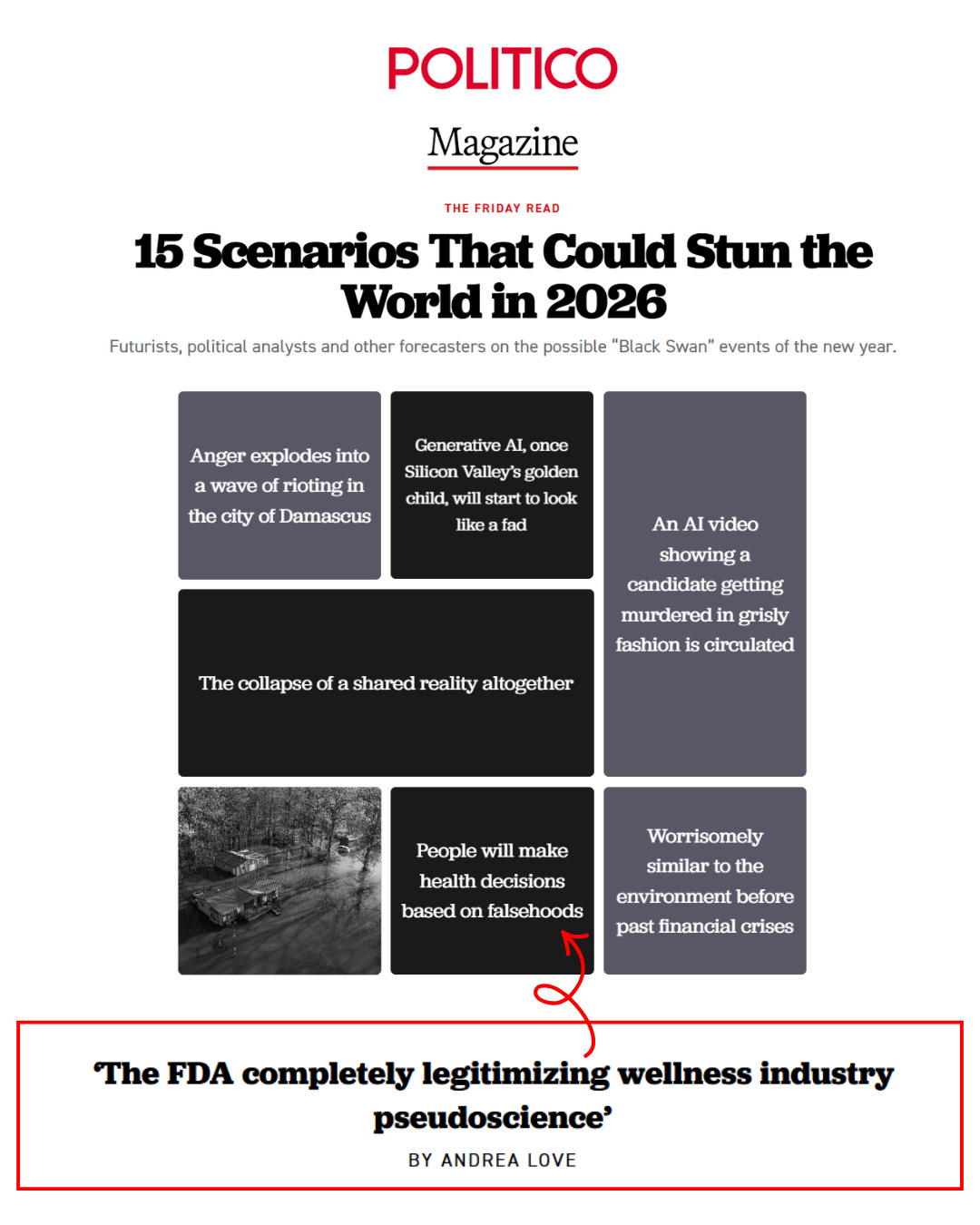
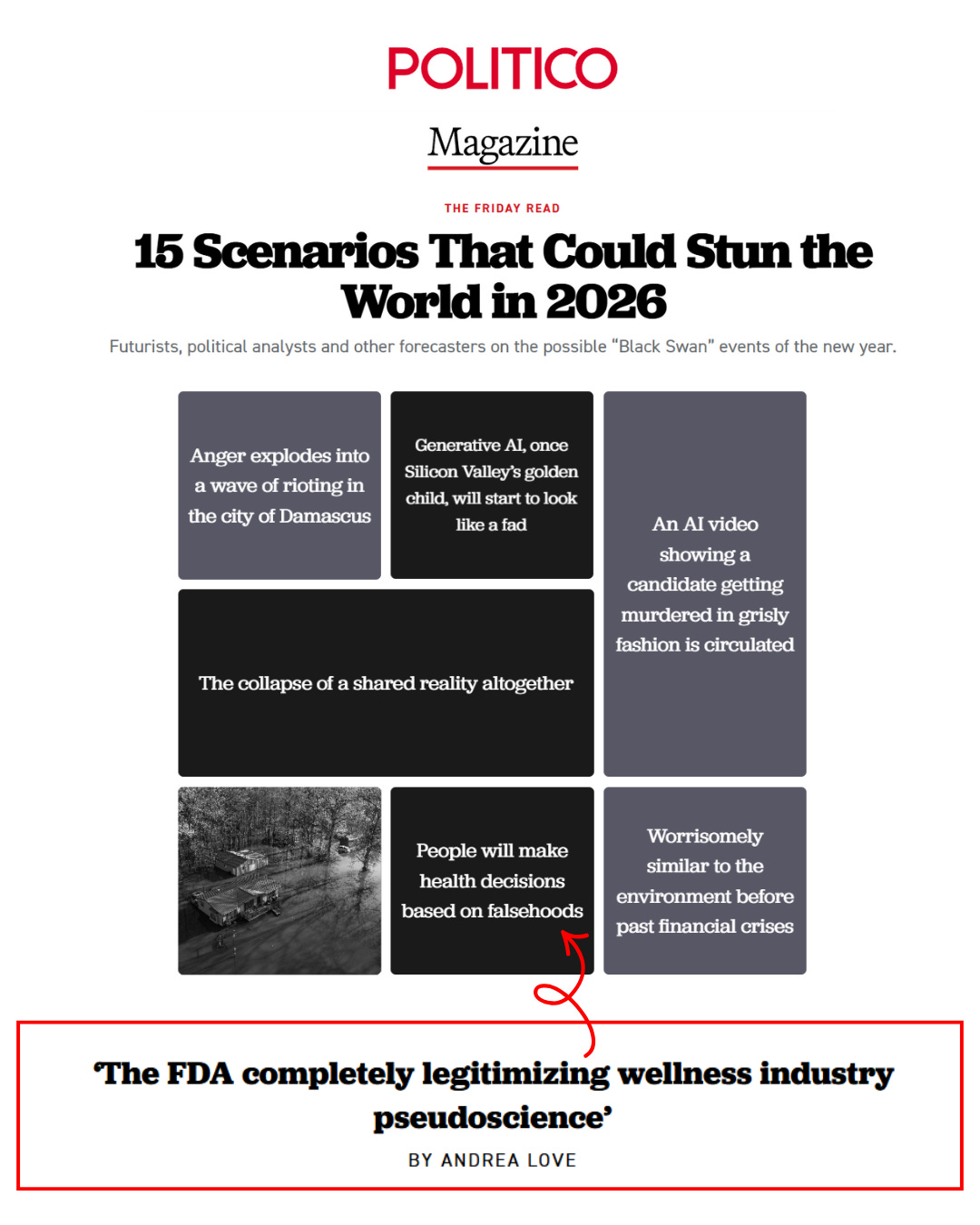
In the meantime, if you missed it, I wrote one of the 15 Black Swan predictions for 2026 for POLITICO here.

[

](https://substackcdn.com/image/fetch/$s_!JGSO!,f_auto,q_auto:good,fl_progressive:steep/https%3A%2F%2Fsubstack-post-media.s3.amazonaws.com%2Fpublic%2Fimages%2F9a6d5ecb-540b-4f8a-8fb8-7d87f273f478_1080x1350.png)

I bring this up because it was published last week, but also, because this piece, from my January column for Skeptical Inquirer magazine, talks about the 35-year wellness industry con that is the USDA Organic label. Just like dietary supplements, unproven health interventions, and unregulated wellness tests, the Organic industry is a multi-billion dollar cash cow (get it—I love a good pun) that is based on zero science and all vibes. And in nearly every metric, it’s objectively inferior than conventional alternatives—including for the reasons you’re buying it (environment, health, etc).

So let’s get into it.

And if you want to help support a scientist who is trying to help fact-check falsehoods that are harming you and the planet, consider subscribing to ImmunoLogic:


Note: this piece was written originally for my column, Inside Immunity, for the January/February 2026 issue of Skeptical Inquirer.

The organic farming and food industry is based on clean-food ideology, chemophobia, and the fantasy that “natural” is a scientific argument. It is born from the same wellness industry that sells detoxes, “clean” eating, supplements, and anti-chemical fearmongering, wrapped in conspiracy-lined distrust of scientific institutions and regulation. Organic is not a science-based food system; it’s a belief system. Just like the wellness industry, it undermines science, harms public health, deepens inequality, and drives policy that prioritizes vibes over evidence.

People believe organic is the opposite of anti-vaccine ideology. It isn’t; it’s cut from the same cloth. Anti-vaccine ideology praises “natural immunity”; organic advocates praise “natural farming.” Anti-vaccine ideology fearmongers about “toxins” in vaccines; organic activists do the same for “toxic pesticides.”

Anti-vaccine ideology demonizes “Big Pharma” while organic crusaders vilify “Big Ag.”

Same tactics, different targets.

Organic farming is [not safer](https://doi.org/10.1093/nutrit/ nuae104), not more nutritious, not better for the environment, and not pesticide-free. It is just marketed to make you feel that way.

The National Organic Program (NOP) was not created for safety, health, or sustainability; it was created in 1990 as a marketing standard. It is the agricultural counterpart to the 1994 Dietary Supplement Health and Education Act (DSHEA). DSHEA removed FDA safety oversight of dietary supplements; the NOP did the same for “natural” farming methods. Neither require proof of safety or benefit, but both fuel profitable industries; organic farming is [22–35 percent more lucrative](https://doi. org/10.1073/pnas.1423674112) than conventional.

NOP is ideology, not science. There are no standards for pesticide toxicity, nutritional impact, environmental footprint, or worker safety to get that organic label. It simply bans “synthetic” farming tools while rubber-stamping “natural” ones, even when those natural options are more dangerous. In contrast, conventional farming tools adhere to rigorous scientific safety standards and regulatory rules. Just like the supplement industry, organic farming is less regulated than its conventional counterpart yet pretends to be superior.

Share


Natural Does Not Equal Safer—Even for Chemicals Designed to Kill

The organic industry has convinced people for more than thirty-five years that organic means no pesticides. This is objectively false. Organic farming uses a lot of pesticides. A non-exhaustive list includes copper sulfate, sulfur, pyrethrins, 20% acetic acid, spinosad, copper hydroxide, copper oxide, peracetic acid, eugenol, hydrogen peroxide, boric acid, potassium silicate, and Beauveria bassiana.

The difference? They’re “naturally derived,” which in science means absolutely nothing about their effectiveness or safety. Many organic-approved pesticides are more toxic and less selective because they are prohibited from chemical alteration to improve safety or specificity.

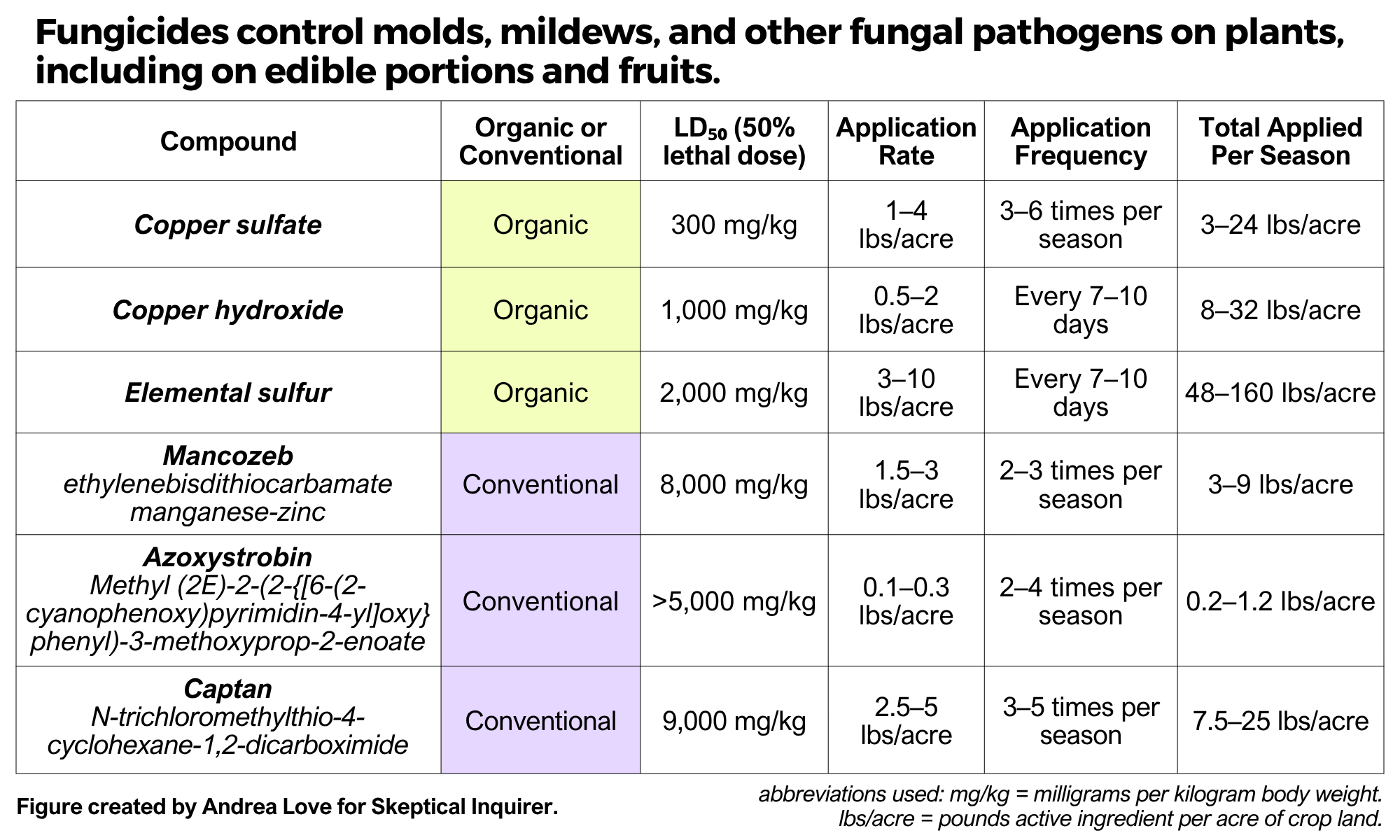
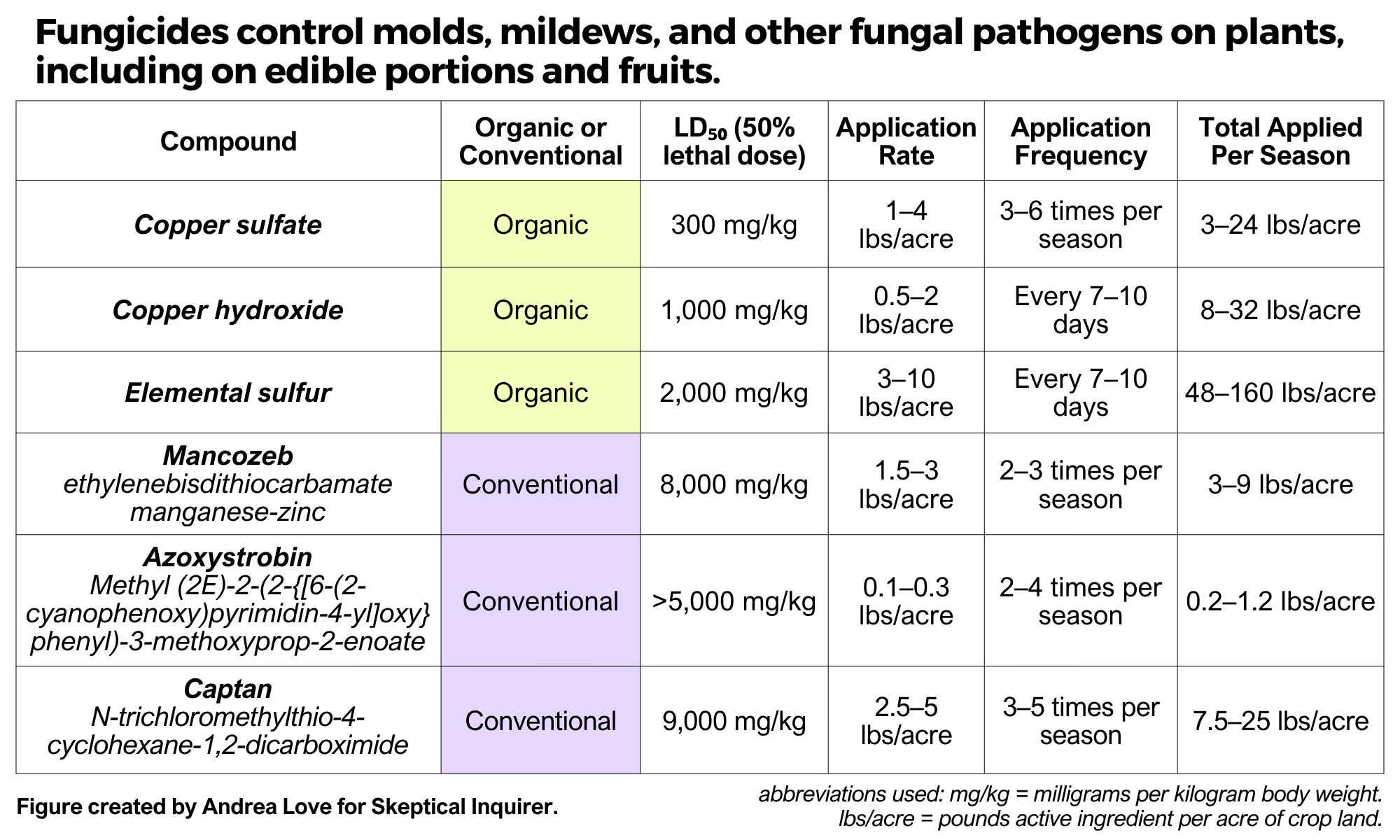
Copper sulfate, one of the most widely used fungicides in organic farming, is toxic at 300 milligrams per kilogram body weight (LD₅₀ = 300 mg/kg). It accumulates in the soil and groundwater and can be toxic to fish, aquatic life, and even humans at high enough doses. On the flip side, mancozeb, a synthetic fungicide used in conventional farming, is twenty-six times less toxic with an LD₅₀ of 8,000 mg/kg, and it rapidly degrades in the environment. Yet mancozeb is demonized solely because it’s synthetic, even though it is objectively safer and more effective.

[

](https://substackcdn.com/image/fetch/$s_!5Od9!,f_auto,q_auto:good,fl_progressive:steep/https%3A%2F%2Fsubstack-post-media.s3.amazonaws.com%2Fpublic%2Fimages%2Fd6f7a891-721d-42bf-ac84-7743a232c9cc_2000x1200.png)

Comparison of application rates and toxicity of fungicides used in conventional and organic farming.

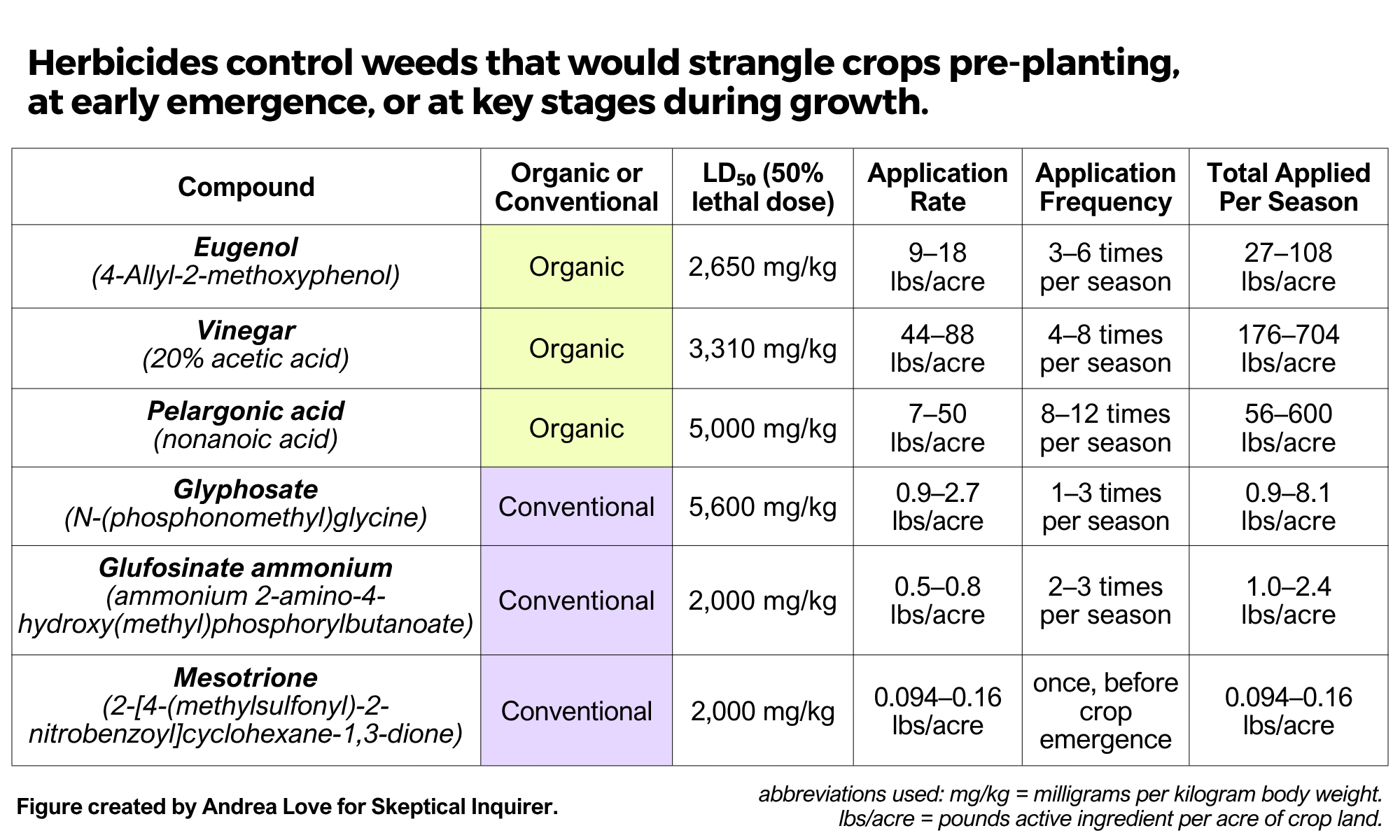
Organic pesticides are typically less potent and less targeted, which means farmers must apply more per acre and more frequently than conventional pesticides to protect crops.

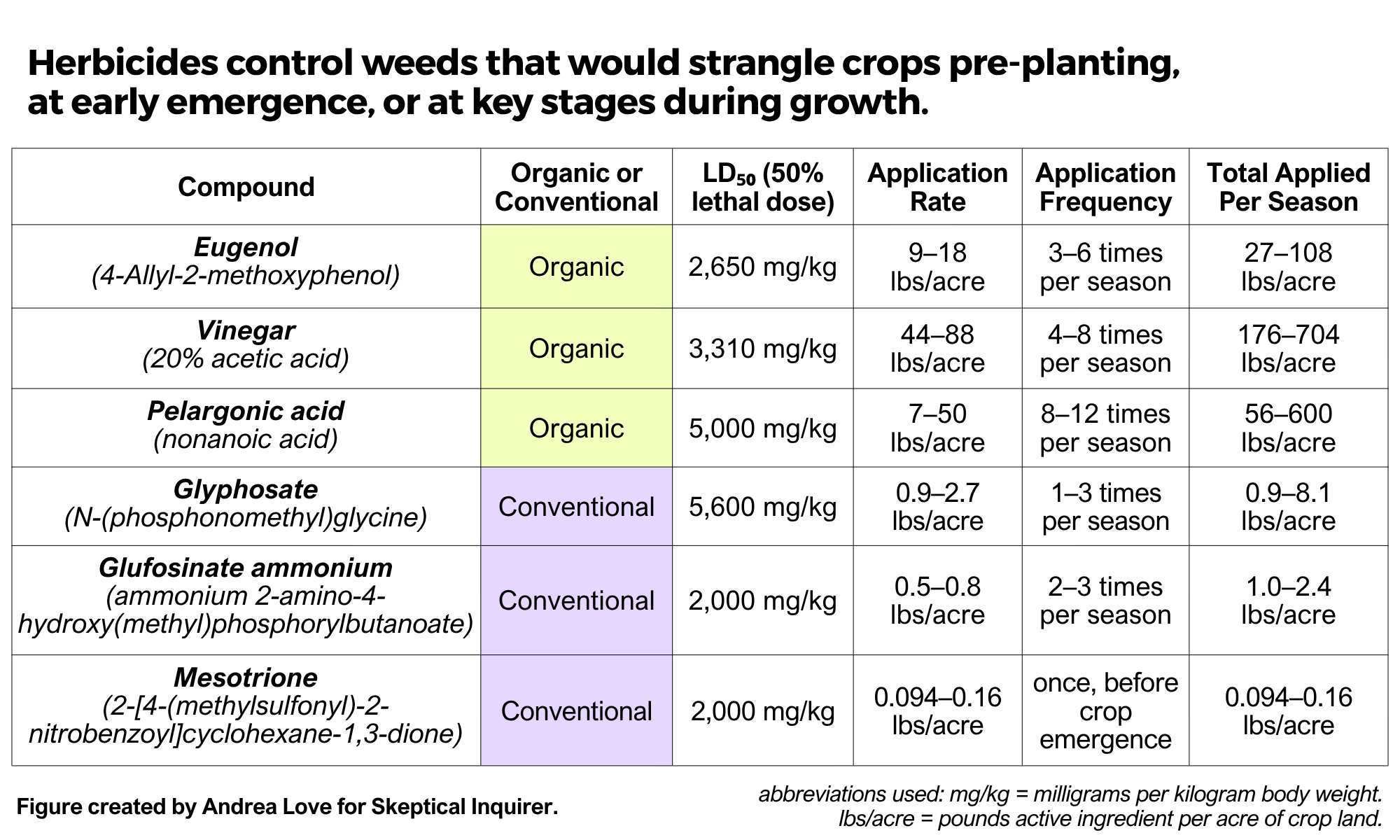
Eugenol (4-allyl-2-methoxyphenol), a clove-oil herbicide used in organic farming, is more than twice as toxic as glyphosate and requires ten times the amount per acre to control weeds. Farmers apply it up to six times per season, compared to one or two glyphosate treatments. The result is opposite to what organic marketing promises: more chemical load, more ecological disruption, more risk to farmworkers. And, ironically, because glyphosate has been targeted for nearly fifty years by anti-science activists, it is one of [the most studied and safest herbicides](https://skepticalinquirer.org/ exclusive/a-skeptical-guide-to-glyphosatetoolkit-for-ten-common-claims/) to exist.

[

](https://substackcdn.com/image/fetch/$s_!_UyL!,f_auto,q_auto:good,fl_progressive:steep/https%3A%2F%2Fsubstack-post-media.s3.amazonaws.com%2Fpublic%2Fimages%2Ff80330fc-48f1-48f9-8a9e-d92b2796bb4a_2000x1200.png)

Comparison of application rates and toxicity of herbicides used in conventional and organic farming.

A chemical isn’t safer because it “came from a plant.” Toxicity has nothing to do with where a substance originated. It is based on chemical identity, route of exposure, dose, and mechanism of action. That’s true for every substance, pesticides included.

Share


Organic Pesticides Are Unregulated

The National Organic Program (NOP) exempts “natural” products from the safety and regulatory requirements conventional pesticides must meet. It’s the same wellness loophole we see in medicine: vaccines undergo extensive clinical testing, dose–response analysis, toxicology, and post-market surveillance, while supplements make health claims without proving safety or efficacy. If you wouldn’t swap a vaccine with a “natural immune booster,” why replace evidence-based crop protection with “natural” pesticides that don’t have equal scientific standards?

Every conventional pesticide must pass toxicology and risk assessment before it is approved for use. The Environmental Protection Agency (EPA) sets enforceable residue tolerances (maximum residue levels, MRL) after all these are assessed: acute and chronic toxicity, carcinogenicity, developmental and reproductive toxicology, endocrine disruption potential, dietary and applicator exposure, environmental fate, and ecological impact. USDA’s [Pesticide Data Program](https://www.ams.usda.gov/sites/default/files/ media/2023PDPAnnualSummary.pdf) (PDP) then monitors residues on finished food products annually to confirm real-world levels remain below EPA’s safety thresholds, set 100–1,000 times lower than doses shown to cause harm.

On the converse, most pesticides approved for use in organic farming skirt all this evidence-based oversight. If a substance is “natural” or “nonsynthetic,” the NOP permits it even without EPA tolerance-setting, residue limits, dietary risk assessment, or residue monitoring. This is policy based on the appeal-to-nature fallacy.

The difference between conventional and organic farming isn’t “pesticides” versus “no pesticides.” It’s risk-based and regulated chemistry versus vibes-based and unregulated chemistry. It’s the same false dichotomy that separates FDA-approved medicine from supplements and “wellness” cures. Nature happens to make botulinum toxin, asbestos, cyanide, arsenic, ricin, and snake venom, all of which are highly poisonous.

Organic policy hides risk; it doesn’t reduce it. Less tested, less regulated, and often more toxic compounds get a pass because they’re “natural,” while safer, more targeted, more studied compounds are banned based on ideology. That isn’t protecting health or the environment. It’s legitimizing pseudoscience for profit.


Organic Foods Don’t Have ‘Fewer’ Pesticide Residues; We Just Don’t Test for Most of Them

Even well-intentioned people repeat the falsehood that organic produce has “fewer residues,” so much so that even the American Academy of Pediatrics has adopted this as an official position.

The problem? Most people don’t realize that organic pesticide residues aren’t monitored! People cite the USDA Pesticide Data Program (PDP), but the PDP monitors synthetic pesticides to ensure compliance with EPA tolerance limits. Because organic-approved pesticides are exempted from tolerance limits, the PDP does not test for them. When people claim organic food has “fewer residues,” they have identified a data gap. You can’t detect things you aren’t testing for!

“Not tested” is not the same as “not present,” yet the organic industry has been profiting off misleading people for decades. In reality, the PDP should reassure you that conventionally grown foods are very safe: over 99 percent of detected residues are well below safety limits.

'Not as Bad as Anti-Vax' is a Cop-Out: Organic Is Harmful

When I point out that organic ideology and anti-vaccine ideology share the same playbook, I’m often told, “But buying organic doesn’t hurt anyone.” Except it does. Organic ideology damages the environment, undermines food security, increases food costs, and harms public health.

Organic yields are 10–30 percent lower than conventional farming. Lower yields require more land to grow the same food—meaning more deforestation, more habitat loss, and more greenhouse gas emissions. Modeling shows that large-scale organic farming adoption would increase greenhouse gas emissions by [approximately 20 percent](https://doi.org/10.1038/ s41467-019-12622-7) from land use change alone. The [European Union’s 2020](https://www.ers.usda.gov/ webdocs/publications/99741/eb-30.pdf) Farm to Fork plan—which aims to cut (conventional) pesticide use in half and double organic acreage by 2030—is estimated to [cause 20–30 percent yield losses](https://doi. org/10.2760/98160), food price increases up to 30 percent, and greater land pressure.

We’ve seen these consequences already. In 2021, The Sri Lankan government banned all synthetic fertilizers and pesticides to force a nationwide switch to “100% organic.”

The result? Agricultural collapse, economic instability, and a food crisis. Rice yields fell by 30 percent, tea by 18 percent, food prices skyrocketed, and the economy spiraled. The outcome was so catastrophic that the government reversed course within seven months, which was already too late (International Monetary Fund 2022).

The Sri Lankan government later admitted the policy had a “worse-than-anticipated impact on agricultural production.” Translation: every scientific and economic expert warned them, and they ignored data anyway. When governments make policy based on beliefs instead of evidence, the outcome is inevitably harmful.

Organic ideology erodes public health by fixating on imaginary risks while worsening real ones. The Environmental Working Group’s “Dirty Dozen” list manipulates the PDP report to scare people about more affordable, nutritious produce that don’t actually have harmful pesticide residues on them while conveniently ignoring that organic pesticide residues aren’t monitored.

[

The Dirty Dozen undermines trust in safe and nutritious fruits and vegetables

](https://news.immunologic.org/p/the-dirty-dozen-undermines-trust)

[

The Dirty Dozen undermines trust in safe and nutritious fruits and vegetables

](https://news.immunologic.org/p/the-dirty-dozen-undermines-trust)

Dr. Andrea Love

·

June 19, 2025

[

Read full story

](https://news.immunologic.org/p/the-dirty-dozen-undermines-trust)

Trace pesticides aren’t hurting people; scaring them from eating produce is. Ninety percent of Americans don’t eat enough fruits and vegetables, and unfounded fear of pesticides exacerbates that, especially for low-income households. Telling people they are poisoning their families if they eat conventionally grown produce objectively worsens health. This tactic from the organic industry is the nutritional equivalent of anti-vaccine propaganda: create fear of a fake threat to drive people toward a real risk.

Organic ideology harms farm workers too. Rejecting conventional herbicides means increased tillage and hand-weeding, which leads to more injuries, more exploitation, more soil erosion, and more greenhouse gas emissions from farm machinery. Rejecting conventional insecticides and fungicides means less effective, more ecologically damaging, or more toxic alternatives must be handled and used. The anti-science principles of organic farming don’t improve health or sustainability; they just give wealthy consumers moral superiority.

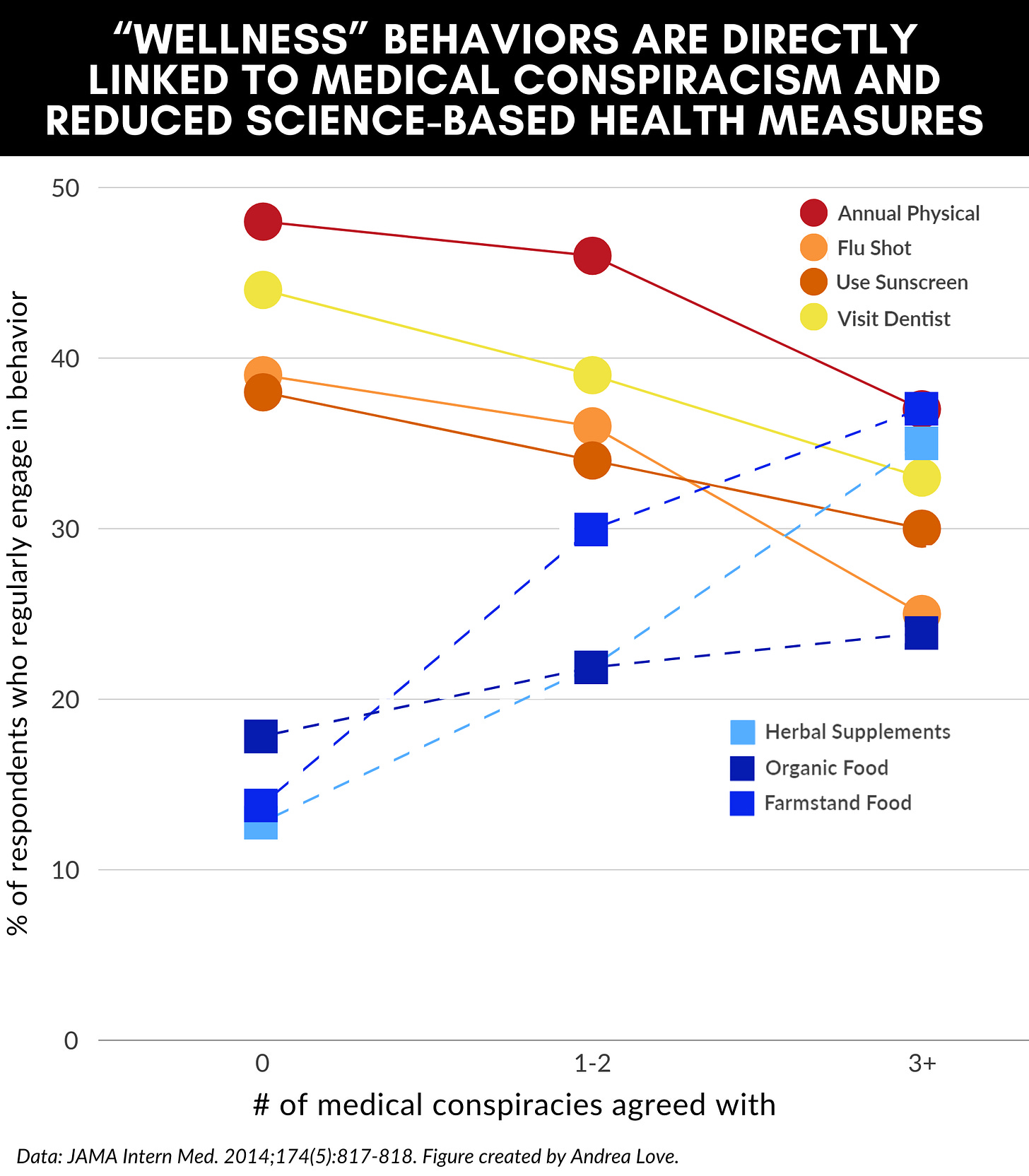
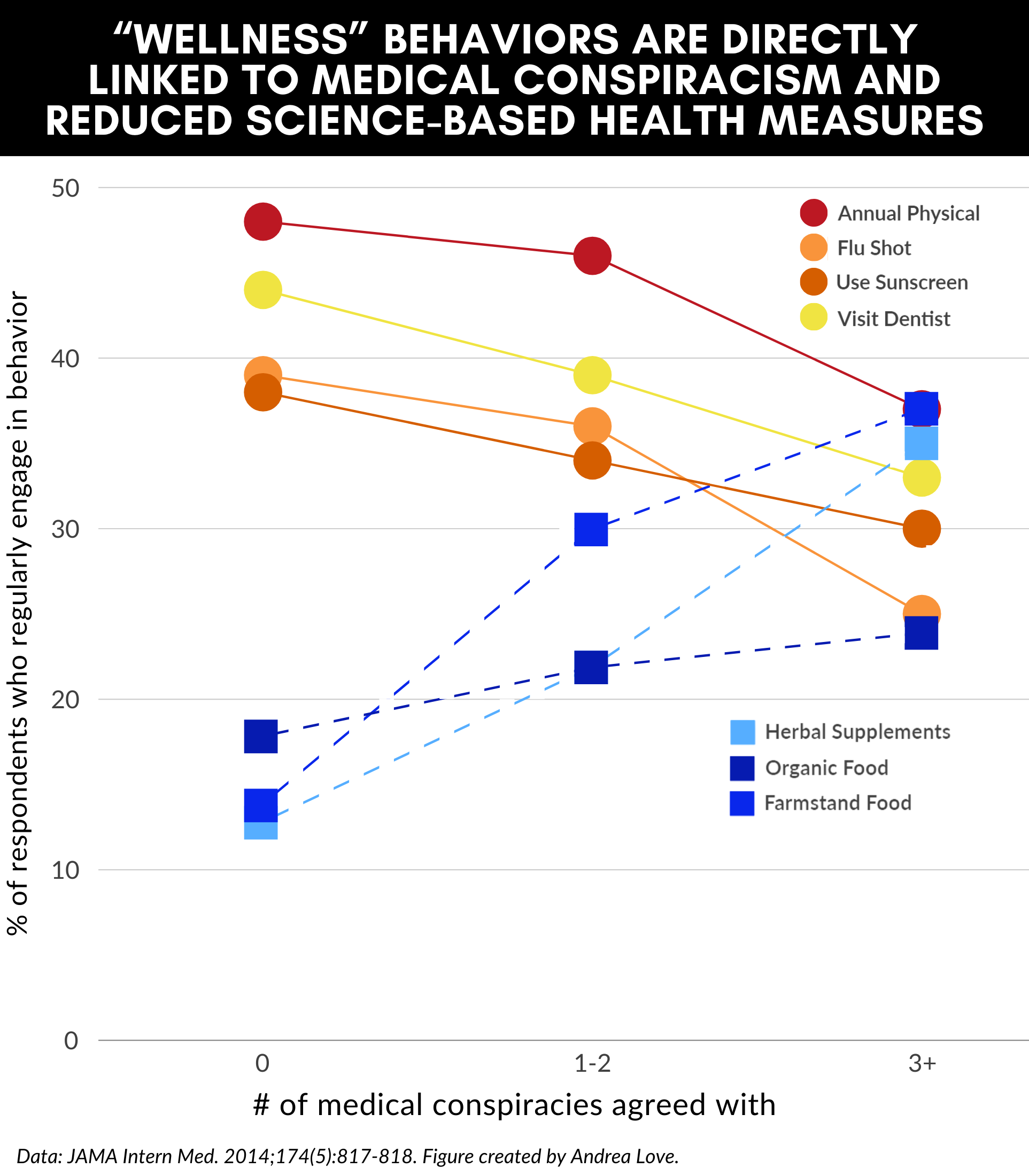
Organic ideology is directly tied to medical conspiracism along with the anti-vaccine movement and wellness pseudoscience. They originate from the same anti-science narrative: fear of “toxins,” distrust of regulators, hostility toward biotechnology, and outsized faith in the “natural” label. People who believe falsehoods about pesticides, GMOs, “chemicals,” or “toxins” also reject vaccinations, seek unproven cancer treatments, and refuse evidence-based health behaviors.

This is not a coincidence, this is by design.

[

](https://substackcdn.com/image/fetch/$s_!cnPu!,f_auto,q_auto:good,fl_progressive:steep/https%3A%2F%2Fsubstack-post-media.s3.amazonaws.com%2Fpublic%2Fimages%2F772c95e5-1e15-48ff-8d0d-18189b51d677_1925x2200.png)


You can’t be pro-science and pro-organic the same way you can’t be pro-science and anti-vaccine.

Both come from anti-science, chemophobic, anti-expertise, “nature knows best” ideology. Both replace risk assessment with moral panic. Both harm society. Organic is not the “healthy” choice; it’s the agricultural arm of the wellness-industrial-complex that undermines trust in science and profits from fear.

If you care about public health, sustainability, food security, or scientific integrity, the responsible position is to reject organic ideology outright. Not to excuse it. Not to “agree to disagree.” Reject it.

Wellness-based agriculture is no more acceptable than wellness-based oncology or wellness-based immunology. Science isn’t something you get to apply in healthcare and abandon in the grocery store.

If you support evidence-based medicine, then support evidence-based agriculture. Anything less is anti-science hypocrisy.


We all must join in the fight for science.

Thank you for supporting evidence-based science communication. With outbreaks of preventable diseases, refusal of evidence-based medical interventions, propagation of pseudoscience by prominent public “personalities”, it’s needed now more than ever.

Stay skeptical,

Andrea


“ImmunoLogic” is written by Dr. Andrea Love, PhD - immunologist and microbiologist. She works full-time in life sciences biotech and has had a lifelong passion for closing the science literacy gap and combating pseudoscience and health misinformation as far back as her childhood. This newsletter and her science communication on her social media pages are born from that passion. Follow on Instagram, Threads, Twitter, and Facebook, or support the newsletter by subscribing below:

ImmunoLogic is a reader-supported publication. To support my work, consider becoming a paid subscriber.

Read the whole story
bogorad
2 hours ago
reply
Barcelona, Catalonia, Spain
Share this story
Delete

Our AI Future Is Already Here, It’s Just Not Evenly Distributed - WSJ

1 Share
  • AI usage gap: Significant disparity remains between current AI capabilities and how most people actually apply them, promising years of diffusion and entrepreneurial opportunity.
  • Grassroots innovation: Diverse individuals—from a rural Australian goatherd to a horticulture company and a displaced copywriter—are discovering new practical uses for AI.
  • Generative accessibility: Today’s generative AI is easier to use than past technologies and can be tailored by nontechnical individuals with no single “right way” to adopt it.
  • Rising awareness: Pew Research finds 62% of Americans use AI several times weekly while awareness nears completeness among U.S. adults.
  • Tool for augmentation: AI primarily enhances existing abilities, with recent advances reducing hallucinations and enabling integration into broader software systems.
  • Capability overhang: User-discovered techniques like the “Ralph Wiggum” loop reveal previously unknown applications and unleash new productivity possibilities.
  • Composite models: Builders are combining multiple AI systems, as seen with Meta’s Manus and agronomy apps using enriched data from specialized models.
  • Adaptable workforce: Professionals, such as an Australian copywriter, now pivot to coaching and customization work as adoption pressure rises and innovation unfolds unevenly.

Christopher Mims

By

Christopher Mims


Illustration of a neighborhood showing people interacting with technology such as VR and drones.

Jason Schneider

There is a huge gap between what AI can already do today and what most people are actually doing with it.

Closing that gap will take years. Meanwhile, fortunes will be created, not just for giant tech companies, but for the everyday folks who use those companies’ AI models to build products and services of their own.

The curious among us are already leading the charge. A goatherd (and software developer) in rural Australia discovered a simple but radical new technique to optimize the performance of the leading software-writing AI. An almost 50-year-old horticulture company in Bakersfield, Calif., is rolling out an AI agent that connects its growers with decades of wisdom from professional agronomists. A copywriter who saw her business decimated by her clients’ use of AI pivoted to coaching those same clients on building their own AI tools.

Technological diffusion happens every day as people adopt innovations to suit their personal or business needs. With AI, there’s a fresh twist: Today’s generative AI is much more accessible than past technologies, and can be used even by nontechnical people. There is no “right way” to use it.

In just over three years, AI usage has gone from almost nil, to something 62% of Americans report using several times a week, according to the Pew Research Center. And while most of that usage is probably relatively basic, awareness of AI has risen to nearly 100%.

Created with Highcharts 9.0.1Increased AwarenessMore Americans are learning about the revolution in generative artificial​intelligencePercentage who say they have heard or read about AI, by groupSource: Pew Research CenterNote: Survey of U.S. adults conducted June 9–15, 2025. Respondents who​didn't give an answer aren't shown.

Created with Highcharts 9.0.1A lotA littleNothing at allU.S. adultsMenWomenAges 18–29Ages 30–49Ages 50–64Ages 65+0%20406080100

This isn’t a story of AI turning into a superhuman intelligence that replaces workers. AI remains, primarily, a tool that enhances our existing abilities. But as researchers and users grasp the real-world functionality of today’s AI, they’re seeing a huge amount of room for productivity and economic growth.

Two years ago, AI chatbots were too finicky and error-prone to be reliable and broadly useful to most people, says Ram Bala, an associate professor of AI at Santa Clara University. Today, he says, they’re ready for prime time, because of advances in reducing hallucinations, and in plugging these AI models into other software systems.

Whatever comes next in the development of AI, adoption of existing technologies will snowball well into the next decade.

AI’s untapped powers

The biggest AI innovations might come from users at work or at home, rather than tech giants and research labs.

The companies making AI models know this, and are now promoting applications their own users pioneered. For example, OpenAI this week introduced ChatGPT Health to demonstrate its ability to analyze medical records, wellness apps and provider bills in order to improve healthcare outcomes.

Users of Claude Code, Anthropic’s software-writing AI system, recently discovered a way to create finished, bug-free programs without human intervention. (One of the originators was the aforementioned Australian goatherd.) The trick: Write a small program that asks the AI, over and over again, to improve the code it has already written. Named the Ralph Wiggum technique, after the dimwitted but persistently optimistic “Simpsons” character, this simple trick is effective at forcing Claude Code to solve problems on its own.

This discovery is a great example of “capability overhang,” says Ethan Mollick, a professor of innovation and entrepreneurship at the University of Pennsylvania’s Wharton School and a leading authority on generative AI. That’s his term for the many new things existing AI can do that were unknown until users discovered them.

“This is a tool that does programming and also writes documents, and it can also do image editing, and also can read Etruscan, and a bunch of other stuff too,” says Mollick. Software projects with a narrow audience but a big potential impact might have been shelved for want of money and talent. Now, they can be built by a handful of people, or even just one, with the help of AI, he adds.

AIs play well with others

Many people building with AI are finding that fusing several AI models can yield capabilities well beyond those of a single one. Meta is pursuing Manus, which makes a software “agent” that can produce deeply researched reports and perform other actions online. While Meta has its own AI models, Manus uses a combination, including those from Anthropic and others.

Santa Clara University’s Bala, who also heads a company that builds real-world AI applications, is currently working with his team on an app for Sun World, a California developer of new varieties of fruits and vegetables. Farmers who need advice on how best to grow their crops can have natural-language conversations with AI agents preloaded with research and advice from scientific literature and a community of professional agronomists.

While the interface is powered by one of the usual top-tier chatbots, the information it is fed has been predigested and enhanced by other AIs in a process called data enrichment. 

The skills required to make this app for agronomists aren’t so different from the ones Bala has been using for years, as a data scientist and software engineer. The difference is that now, AI makes individual engineers much more effective, allowing a small team to do something that before would have been nearly impossible even with many times as many resources.

A tech team of one

Before the debut of ChatGPT in November 2022, Leanne Shelton made a comfortable living as a freelance copywriter in the suburbs of Sydney, Australia. Not long after its debut, like others in her field, she saw her business dry up. So she became an expert in customizing ChatGPT to write voicey marketing copy. She now makes more than she ever did as a copywriter, she says.

SHARE YOUR THOUGHTS

How has AI changed things in your workplace so far? Join the conversation below.

She and others are discovering the capability overhang of AI for themselves. Her story also illustrates that customizing AIs with your own data doesn’t mean you have to be a software engineer like Bala.

The intense pressure to adopt AI—from bosses, peers and, if you’re an earlier adopter like me, voices in your head—is real. So are the seemingly endless options for exploring its existing capabilities.

“I think about fields that might get suddenly affected by AI,” says Mollick. He thinks we will see sudden innovation, often in unexpected areas, even as other fields and people in some roles fall behind. “The unevenness will be hard to predict.”

Write to Christopher Mims at christopher.mims@wsj.com

Copyright ©2026 Dow Jones & Company, Inc. All Rights Reserved. 87990cbe856818d5eddac44c7b1cdeb8


What to Read Next

[

The Downside to Using AI for All Those Boring Tasks at Work

](https://www.wsj.com/lifestyle/careers/the-downside-to-using-ai-for-all-those-boring-tasks-at-work-dab9d3c8?mod=WTRN_pos1)

[

Some managers make space in the workday for repetitive, low-intensity tasks where creative sparks can fly.

](https://www.wsj.com/lifestyle/careers/the-downside-to-using-ai-for-all-those-boring-tasks-at-work-dab9d3c8?mod=WTRN_pos1)

Continue To Article


[

Bain Capital-Backed Bridge Data Centres Plans Foray Into Japan, Australia, Middle East

](https://www.wsj.com/tech/bain-capital-backed-bridge-data-centres-plans-foray-into-japan-australia-middle-east-18381bf5?mod=WTRN_pos2)

[

Data-center operators worldwide are racing to build hyperscale infrastructure for the fast-growing artificial-intelligence sector.

](https://www.wsj.com/tech/bain-capital-backed-bridge-data-centres-plans-foray-into-japan-australia-middle-east-18381bf5?mod=WTRN_pos2)

Continue To Article


[

The Stock-Market Rally Isn’t Just About Tech Anymore

](https://www.wsj.com/finance/stocks/the-stock-market-rally-isnt-just-about-tech-anymore-d42267e2?mod=WTRN_pos4)

[

Hopes for an economic reacceleration are helping to fuel a “rotation trade.”

](https://www.wsj.com/finance/stocks/the-stock-market-rally-isnt-just-about-tech-anymore-d42267e2?mod=WTRN_pos4)

Continue To Article


[

Scientists Create Robots Smaller Than a Grain of Sand

](https://www.wsj.com/science/scientists-create-robots-smaller-than-a-grain-of-sand-c3081fd0?mod=WTRN_pos5)

[

They run on light and are the world’s smallest, fully programmable, autonomous devices

](https://www.wsj.com/science/scientists-create-robots-smaller-than-a-grain-of-sand-c3081fd0?mod=WTRN_pos5)

Continue To Article


EXCLUSIVE

[

Anthropic Raising $10 Billion at $350 Billion Value

](https://www.wsj.com/tech/ai/anthropic-raising-10-billion-at-350-billion-value-62af49f4?mod=WTRN_pos6)

[

The planned deal represents nearly a doubling of the AI startup’s valuation from four months ago.

](https://www.wsj.com/tech/ai/anthropic-raising-10-billion-at-350-billion-value-62af49f4?mod=WTRN_pos6)

Continue To Article


[

Nvidia Unveils Faster AI Chips Sooner Than Expected

](https://www.wsj.com/tech/ai/nvidia-unveils-faster-ai-chips-sooner-than-expected-626154a5?mod=WTRN_pos7)

[

At the Consumer Electronics Show in Las Vegas, CEO Jensen Huang said more powerful chips will enable training of models in simulated environments.

](https://www.wsj.com/tech/ai/nvidia-unveils-faster-ai-chips-sooner-than-expected-626154a5?mod=WTRN_pos7)

Continue To Article


[

‘I’m at a crossroads’: I have $35K left on my mortgage at 3% interest. Do I dip into my $700K IRA to pay it off?

](https://www.marketwatch.com/story/im-at-a-crossroads-i-have-35k-left-on-my-mortgage-at-3-interest-do-i-dip-into-my-700k-ira-to-pay-it-off-0715335f?mod=WTRN_pos8)

[

“Over the last year, my two retirement accounts averaged a 15% gain.”

](https://www.marketwatch.com/story/im-at-a-crossroads-i-have-35k-left-on-my-mortgage-at-3-interest-do-i-dip-into-my-700k-ira-to-pay-it-off-0715335f?mod=WTRN_pos8)

Continue To Article


[

One of L.A.’s Most Expensive Homes for Sale Just Got a $40 Million Price Cut

](https://www.mansionglobal.com/articles/one-of-l-a-s-most-expensive-homes-for-sale-just-got-a-40-million-price-cut-db87de2f?mod=WTRN_pos9)

[

The megamansion was built for Tony Pritzker, heir to the Hyatt Hotel fortune and brother of Illinois Gov. JB Pritzker

](https://www.mansionglobal.com/articles/one-of-l-a-s-most-expensive-homes-for-sale-just-got-a-40-million-price-cut-db87de2f?mod=WTRN_pos9)

Continue To Article


Videos

Read the whole story
bogorad
2 hours ago
reply
Barcelona, Catalonia, Spain
Share this story
Delete

California Tech Executives Plot Against Rep. Ro Khanna Over Support of Wealth Tax - The New York Times

1 Share
  • Dual Support Strain: Representative Ro Khanna’s simultaneous backing of Silicon Valley and Sanders-style progressivism now facing new pressure.
  • Wealth Tax Backing: Khanna’s defense of a proposed California one-time billionaire wealth tax angered wealthy executives and spurred threats of departures.
  • Tech Mobilization: Silicon Valley executives have begun private discussions via WhatsApp and calls to mount a long-shot effort to unseat Khanna.
  • Khanna’s Strengths: Despite opposition, he remains well-funded with almost $15 million, enjoys South Asian district support, and won re-election easily in 2024.
  • Agarwal Consideration: Ethan Agarwal, a little-known start-up founder, is “seriously considering” challenging Khanna due to the wealth tax proposal.
  • Tax Rationale: Khanna argues the measure is needed to fund health care, seeking a balance between taxing the very wealthy and sustaining Silicon Valley vibrancy.
  • Tech Pushback: Leaders like Garry Tan and Sheel Mohnot are encouraging challengers, planning outside spending, while other prospects such as Matt Mahan and Eric Jones decline interest.
  • Political Upside: Khanna frames the conflict as billionaire-backed threats to attract small-dollar donors, and allies believe a prolonged fight could rally left-wing voters despite critics like Paul Graham warning of missteps.

Representative Ro Khanna has long managed to pull off a seemingly impossible task in his Silicon Valley district: backing the tech industry and Bernie Sanders progressivism at the same time.

But now he is starting to feel the squeeze.

Mr. Khanna, an ambitious 49-year-old Democrat seen as a possible 2028 presidential candidate, has publicly defended a proposed one-time wealth tax in California that has angered some of the state’s richest executives and prompted threats that they will flee.

Some of those wealthy Californians are now quietly mobilizing on WhatsApp chats and conference calls to try to put together a well-funded but long-shot bid to oust Mr. Khanna, according to half a dozen people close to the effort who spoke on the condition of anonymity to disclose private conversations.

The effort is unlikely to succeed: Mr. Khanna, whose profile rose as he helped lead the push for the release of the Epstein files, easily won re-election in 2024 and has loyal support from his district’s South Asian community. He sits on almost $15 million in campaign cash that even a candidate backed by wealthy tech donors would struggle to compete against.

But the anger toward him — ignited mainly by a social media post mocking billionaires who are planning to leave the state over the wealth tax proposal — reflects the tense relationship between Silicon Valley and the Democratic Party, particularly its progressive wing.

Some tech leaders believe they may have found an anti-Khanna candidate in Ethan Agarwal, a Democrat and little-known start-up founder who has been waging a bid for governor that has failed to gain traction.

Mr. Agarwal confirmed to The New York Times that he was “seriously considering challenging” Mr. Khanna, largely because of the proposed wealth tax ballot measure, which would require California residents worth more than $1 billion to pay a 5 percent tax on their assets over five years. Gov. Gavin Newsom, a Democrat, opposes the measure.

Warning that the measure “would end up destroying jobs and opportunity,” Mr. Agarwal said of Mr. Khanna, “The people of his district, Silicon Valley and California need someone working for them full time, not working to win over the Democratic Socialist vote in a future presidential primary.”

Mr. Khanna has suggested that the tax measure, which labor unions are trying to place on the ballot in November, is needed to fund health care programs in the state.

In his now-viral post from late last month, he mocked Peter Thiel and other billionaires who are angry about the tax proposal, writing, “I echo what FDR said with sarcasm of economic royalists when they threatened to leave, ‘I will miss them very much.’”

In an interview, he said the post had come off the cuff as he read a Times article during a holiday celebration at a family member’s home. “I’m surprised that one tweet did touch a nerve,” he said. (He later posted a lengthier explanation of why he supports the tax measure.)

“I’ve had constructive conversations since, with many technology leaders, explaining my view that there has to be a balance between asking people who have done extraordinarily well to pay more and making sure that the Silicon Valley ecosystem remains vibrant,” he added.

Mr. Khanna said he had not heard of Mr. Agarwal. “It’s a democracy,” he said. “It’s rare that I don’t have competition.”

Mr. Khanna’s rift with some tech leaders is striking given how he rose to Congress. A lawyer in the Bay Area for tech companies, he was the favorite of industry heavyweights, such as Sheryl Sandberg and Marc Benioff, as he made an unsuccessful bid for the House in 2014 and then ousted an incumbent Democrat in 2016.

Now, as the tech industry veers to the right, some of its leaders are publicly raging against him.

A loose constellation of Silicon Valley executives have held conversations with associates in recent days about how to best challenge him, people briefed on the talks said. Those executives include Garry Tan, the head of the influential start-up accelerator Y Combinator and the investor Sheel Mohnot.

Those efforts by Silicon Valley leaders and allied interest groups have included encouraging potential challengers to run and sketching out plans for a new outside spending effort to oppose Mr. Khanna, the people said.

Mr. Agarwal has a limited public profile and is a backup choice for some tech leaders only after failed attempts to recruit Mayor Matt Mahan of San Jose, who is a favorite of tech executives like Mr. Tan and who opposes the tax proposal. Mr. Mahan said in an interview that he had recently been approached by several “significant leaders in the tech industry,” whom he declined to name, asking him to consider challenging Mr. Khanna.

“I am not interested in doing that,” Mr. Mahan said. “I’ve been very direct with everyone. I think I have the best job in the world.”

Some tech leaders have also approached Eric Jones, a Democratic congressional candidate in a district north of San Francisco, but he is uninterested, according to a person close to him.

Other tech leaders are instead channeling their energy toward heading off the wealth tax proposal itself. In an email marked “confidential” to Silicon Valley donors and seen by The Times, the tech billionaire Ron Conway said he was helping lead a “serious effort coming together to defeat it.”

“I am confident that with Governor Newsom’s staunch opposition and a robust, well-funded campaign, we can defeat this measure when we inform voters of the true consequences for California,” wrote Mr. Conway, who has given $100,000 to the effort.

Any challenger would need to move quickly in part because of a March 6 paperwork deadline. And Mr. Khanna would not be “primaried” in the traditional sense: In California elections, the top two finishers in a first round of balloting advance to a November runoff.

There could be an upside from the conflict for Mr. Khanna. In a fund-raising email last weekend, he told his small-dollar supporters that he needed money because billionaires “are openly threatening to bankroll a primary challenger against me.”

Allies of Mr. Khanna, who served as co-chair of Senator Bernie Sanders’s 2020 presidential campaign and wrote a 2022 book titled “Progressive Capitalism: How to Make Tech Work for All of Us,” say that a prolonged fight with tech executives could endear him to left-wing voters who are suspicious of his ties to the industry.

Mr. Khanna’s critics are not having it.

“I feel sorry for him, actually,” said Paul Graham, a leading investor who co-founded Y Combinator and squabbled with Mr. Khanna about the tax over the holidays. “I don’t think he had any idea what a land mine he was stepping on.”

Read the whole story
bogorad
21 hours ago
reply
Barcelona, Catalonia, Spain
Share this story
Delete

On the Legality of the Venezuela Invasion

1 Share
  • **Subscription:** Readers invited to opt in for “Roundup” daily summaries about executive power developments.
  • **Central Question:** Author repeatedly asked whether the U.S. invasion of Venezuela is lawful and notes few effective legal constraints on presidential uses of force.
  • **Domestic Reality:** Congress has granted the president expansive global military authority with minimal oversight, courts decline to review unilateral uses of force, and no state can realistically stop U.S. action.
  • **Domestic Legal Framework:** DOJ could rely on executive-branch precedents—especially Barr’s 1989 opinion on extraterritorial arrests—to justify the Venezuela operation.
  • **Justifications:** Administration officials frame the action as arresting indicted fugitives, with kinetic force defended as unit self-defense supporting the raid.
  • **Additional Precedents:** DOJ could invoke other executive-force precedents (national interest justifications, historical interventions) though prolonged engagements might trigger congressional authorization requirements.
  • **War Powers Law:** The 1973 War Powers Resolution imposes reporting and termination deadlines that could become relevant if U.S. military presence persists in Venezuela.
  • **International Law:** The invasion contravenes the U.N. Charter and places the U.S. under occupation law obligations, including the Fourth Geneva Convention, once it “runs the country.”

Please click here to opt in to receive via email our Roundup—brief daily summaries of news developments and commentary related to executive power.

[

](https://substackcdn.com/image/fetch/$s_!delc!,f_auto,q_auto:good,fl_progressive:steep/https%3A%2F%2Fsubstack-post-media.s3.amazonaws.com%2Fpublic%2Fimages%2F304a7207-6183-42d3-9c7c-4414b678591b_980x653.jpeg)

Operation Absolute Resolve. (White House Photo.)

I’ve been bombarded today with the question: Is the U.S. invasion of Venezuela lawful?

As I have argued before, there are few if any effective legal constraints on unilateral presidential uses of force. Everyone has an opinion about what those limits should be. Academics and politicians regularly maintain that this and that presidential use of force is unlawful, even though the legal framework for analysis, especially under domestic law, is contested.

But here is the reality. Congress has given the president a gargantuan global military force with few constraints and is AWOL in overseeing what the president does with it. Courts won’t get involved in reviewing unilateral presidential uses of force. And no country plausibly could stop the U.S. action in Venezuela.

Consider becoming a free or paid subscriber

That means that in practice the only normative legal framework for presidential war powers that matters derives from executive branch precedents and legal opinions. The Justice Department, if asked, easily could have drafted an opinion based on these precedents and opinions to justify the invasion of Venezuela.

Below is my quickly written explanation for this conclusion, but of course the analysis is preliminary since there is much we do not yet know.

Domestic Law

The main precedent DOJ could cite is President George H.W. Bush’s invasion of Panama in 1989 to arrest and bring strongman General Manuel Noriega to justice in the United States, in part for drug trafficking. Some will seek to distinguish the Noriega matter from the Venezuela invasion on the grounds that Panama Defense Forces had recently killed a U.S. Marine and the Panamanian National Assembly had declared that a state of war existed between the Republic of Panama and the United States.

But the Panama precedent will nonetheless matter to the Venezuela attack due to this 1989 opinion by then-Assistant Attorney General Bill Barr, issued six months before the invasion. That opinion justified FBI arrests in foreign countries under domestic law even if doing so violated international law. It specifically concluded:

1. The FBI’s statutory arrest authority “authorize[s] extraterritorial investigations and arrests.”

2. The President could lawfully order an extraterritorial arrest pursuant to the FBI’s statutory arrest authority even if it violated customary international law in impinging “on the sovereignty of other countries.”

3. Even if those FBI authorizing statutes were limited by customary international law, the Constitution’s “take Care” Clause empowered the president to authorize federal agents to make arrests abroad that violate customary international law. (The opinion here relied on In re Neagle, the main Supreme Court precedent for the president’s “protective power” that has been invoked in recent domestic deployments.)

4. Article 2(4) of the U.N. Charter, which prohibits the “use of force against the territorial integrity” of any state, does not “prohibit the Executive as a matter of domestic law from authorizing forcible abductions” abroad. Put another way, “as a matter of domestic law, the Executive has the power to authorize actions inconsistent with Article 2(4) of the U.N. Charter.”

5. The president has authority to delegate these powers to violate international law in extraterritorial enforcement actions to the Attorney General.

6. A U.S. arrest abroad “in violation of foreign law does not violate the Fourth Amendment.”

President Trump in his press conference today did not provide a legal justification for the invasion. But Secretary of State Marco Rubio represented to Senator Mike Lee that the arrest of Venezuelan President Nicolás Maduro and his wife for violating U.S. law was the primary justification for the Venezuela action. And at today’s press conference Rubio said that “at its core, this was an arrest of two indicted fugitives of American justice, and the Department of War supported the Department of Justice in that job.” This rationale is consistent with Secretary of Defense Pete Hegseth’s claim that it was a “joint military and law enforcement raid” and General Dan Caine’s claim that it was an “apprehension mission.”

Given these explanations, the Barr opinion justifying extraterritorial law enforcement actions will likely be presented as the main domestic legal foundation for the action.

As for the boots on the ground and the kinetic uses of force, those appear to have been justified “to protect and defend those executing the arrest warrant.” This is a form of Article II self-defense argument with a long lineage. It is most akin to the “unit self-defense” that is often invoked when U.S. troops deployed abroad in violation of foreign sovereignty face “a hostile act or demonstrated hostile intent.”

Yes, it seems like bootstrapping, or worse, to say that the United States can arrest a foreign dictator on foreign soil in violation of foreign sovereignty and then invoke the self-defense of the arresting forces to bomb the country. But this is where the logic of the executive branch precedents leads. As Rebecca Ingber has explained, unit self-defense could justify “the United States using force against non-state actors who do not even have the capacity to threaten U.S. territory, in a state that has not attacked the United States, providing the groundwork for a future escalation with either that non-state actor or the state itself—and all without authorization from Congress.”

These are not the only precedents the Justice Department opinion could invoke. There is another line of precedent, summarized here, that justifies unilateral uses of presidential force in the “national interest.” Recognized national interests include the protection of U.S. persons and property, promotion of regional stability, and humanitarian concerns, all three of which could conceivably be invoked in the Venezuela context.

The DOJ opinion could also cite dozens of specific instances of past unilateral presidential uses of force stretching back at least to President Thomas Jefferson’s authorization to attack the Barbary pirates. Most on point, perhaps, are the numerous U.S. interventions in the southern hemisphere in the late nineteenth and early twentieth centuries. As one outstanding recent study concluded about multiple American interventions in (among other nations) Cuba, Panama, the Dominican Republic, Nicaragua, Honduras, Mexico, and the Danish West Indies:

Over the late nineteenth and early twentieth centuries, the United States went on a regional rampage of staggering scope and scale. There were coups and counter-coups, protectorates and annexations. Invasions were followed by occupations, and occupations by insurgencies and counterinsurgencies. Foreign capitals grew used to American marines policing their streets and American warships patrolling their waters. American policy became practically synonymous with intervention, the use or threat of force to coerce a state into exercising its sovereign functions in a particular way.

An important possible limit on the president’s unilateral power recognized in the DOJ opinions is that congressional authorization might be needed for “prolonged and substantial military engagements, typically involving exposure of U.S. military personnel to significant risk over a substantial period.” This limit could become relevant since President Trump announced today that the United States is going “to run the country until such time that we can do a safe, proper and judicious transition.” It is unclear at this point what the U.S. military role will be in Venezuela or whether the military will be involved in “prolonged and substantial military engagements” that expose U.S. military personnel “to significant risk over a substantial period.”

Also potentially relevant is the 1973 War Powers Resolution matter. That law requires the president to notify lawmakers within 48 hours of the introduction of U.S. forces into hostilities. It also requires the president (with loopholes) to “terminate any use of United States Armed Forces with respect to which such report was submitted” within 60 or (with an extension) 90 days.

This deadline might in 90 days be implicated by a continued U.S. military presence in Venezuela. Depending on what that military presence looks like, the Trump administration could invoke a variation of the Obama administration gambit in Libya to blow through the statutory time limits because the United States is not engaged in “hostilities” in Venezuela. Or it could simply disregard the WPR time limits on the ground, expressed by many administrations starting with Richard Nixon’s, that they are unconstitutional intrusions on the president’s war powers.

International Law

I noted above that DOJ has concluded that the U.N. Charter’s prohibition on the use of force does not constrain the executive branch’s domestic legal authority to invade another country to make an arrest. But the Venezuelan intervention pretty clearly violates the Charter, even if there are no domestic legal implications from that violation and even if international law here lacks any enforcement mechanism.

It will be interesting to see if the Trump administration tries to claim that it acted consistently with the Charter. Perhaps it will say, as it was said of the 1999 Kosovo intervention, that the action was “illegal but legitimate.” Or perhaps it will argue, as the United States did in the 1983 invasion of Grenada and the 1989 invasion of Panama, that the United States was defending U.S. persons there. Or perhaps it will, as it so often has in other contexts, simply blow off international law.

Since the United States plans (as President Trump said) to “run the country” for an indefinite period, it will be an occupying power and that occupation will be governed by international law—primarily the Fourth Geneva Convention. As the DOD Law of War Manual explains: “Military occupation is a temporary measure for administering territory under the control of invading forces, and involves a complicated, trilateral set of legal relations between the Occupying Power, the temporarily ousted sovereign authority, and the inhabitants of occupied territory.”

There are a lot of international law rules and restrictions that purport to govern what the United States can do as an occupying power. They are well explained in Part XI of the Law of War Manual. I don’t have space here to review them, but suffice it to say that these rules will touch on President Trump’s stated aim of “tak[ing] back the oil” and “get[ting] reimbursed.” We will see if the administration takes these rules seriously.

Conclusion

In sum, it would not be terribly hard for the Justice Department to write an opinion in support of the Venezuela invasion even if the military action violates the U.N. Charter.

To repeat, that does not mean that the action is in fact lawful—and it pretty clearly isn’t under the U.N. Charter. It only means that the long line of unilateral executive branch actions, supported by promiscuously generous executive branch legal opinions, support it. As I wrote in connection with the Soleimani strike: “our country has—through presidential aggrandizement accompanied by congressional authorization, delegation, and acquiescence—given one person, the president, a sprawling military and enormous discretion to use it in ways that can easily lead to a massive war. That is our system: One person decides.”

This is not the system the framers had in mind, and it is a dangerous system for all the reasons the framers worried about. But that is where we are—and indeed, it is where we have been for a while.

Thanks to Ema Rose Schumer and Tia Sewell for editorial assistance

Read the whole story
bogorad
23 hours ago
reply
Barcelona, Catalonia, Spain
Share this story
Delete
Next Page of Stories