Strategic Initiatives
11845 stories
·
45 followers

Trump orders creation of litigation task force to challenge state AI laws

1 Share
  • Executive order signed: President Trump issued order for nationwide AI regulatory framework overriding state laws.
  • Innovation focus: Order states US AI companies need freedom from cumbersome state regulation to compete.
  • AI Litigation Task Force: New task force to challenge state AI laws inconsistent with federal policy.
  • Task force creation: AG Pam Bondi must establish it within 30 days, coordinating with David Sacks.
  • Federal funding limits: States with onerous AI laws face restrictions on federal grants.
  • BEAD program targeted: $42.5 billion rural broadband funding at risk for non-compliant states.
  • Advocacy criticism: CDT's Alexandra Givens calls order a chill on state oversight and funding threat.
  • Prior legislative failure: Senate voted 99-1 to remove 10-year state AI regulation moratorium from bill.

On Thursday evening, President Donald Trump signed an executive order calling for a single, nationwide regulatory framework governing artificial intelligence at the expense of the ability of different states to regulate the nascent technology. “To win, United States AI companies must be free to innovate without cumbersome regulation,” the order states. “But excessive State regulation thwarts this imperative.”

As was expected after a draft of the order leaked earlier this week, the centerpiece of the document is an “AI Litigation Task Force whose sole responsibility shall be to challenge state AI laws inconsistent” with the president’s policy vision. US Attorney General Pam Bondi has 30 days to create the task force, which shall meet regularly with the White House’s AI and crypto czar, David Sacks.

As laid out in the president’s AI Action Plan from July, the administration will also limit states with “onerous” AI laws from accessing federal funding. Specifically, the secretary of commerce will target funding available under the Broadband Equity Access and Deployment (BEAD) Program, a $42.5 billion effort to expand high-speed internet access in rural communities.

Advertisement

Advertisement

Advertisement

Advocacy groups were quick to criticize the president’s order. “This executive order is designed to chill state-level action to provide oversight and accountability for the developers and deployers of AI systems, while doing nothing to address the real and documented harms these systems create,” Alexandra Givens, president and CEO of the Center for Democracy and Technology, said in a statement provided to Engadget. “States that take steps to protect their residents from such harms should not be subject to threats of legal attacks; nor should the administration punish rural Americans by threatening to withhold funding for the broadband services that could connect them to AI in the first place.”

It’s worth noting President Trump’s previous attempts to curb the ability of states to regulate AI as they see fit has proven unpopular across the political spectrum. As part of his One Big Beautiful Bill, the president attempted to impose a 10-year moratorium on state-level AI regulation. That clause was eventually removed from the legislation in a decisive 99-1 vote by the Senate.

Read the whole story
bogorad
3 hours ago
reply
Barcelona, Catalonia, Spain
Share this story
Delete

Tinker: General Availability and Vision Input - Thinking Machines Lab

1 Share
  • No waitlist: Tinker now open to all users via sign-up link.
  • Kimi K2 Thinking: Trillion-parameter model available for fine-tuning, designed for reasoning and tool use.
  • OpenAI API compatibility: New inference interface supports OpenAI API format for sampling during training.
  • Vision models: Qwen3-VL-30B-A3B-Instruct and Qwen3-VL-235B-A22B-Instruct added for image processing.
  • Image input: Uses ImageChunk with text for vision-language applications including fine-tuning.
  • Classifier recipe: Cookbook example fine-tunes VLMs as image classifiers with few examples.
  • Dataset tests: Qwen3-VL finetuned on Caltech 101, Stanford Cars, Oxford Flowers, Oxford Pets.
  • Performance comparison: Qwen3-VL outperforms DINOv2 in low-data image classification accuracy.

Today we are announcing four updates to Tinker:

  • No more waitlist
  • New reasoning model: Kimi K2 Thinking
  • New inference interface that is compatible with the OpenAI API
  • Vision input support with Qwen3-VL

General availability#

The waitlist is over! Everybody can use Tinker now; sign up here to get started. See the Tinker homepage for available models and pricing, and check out the Tinker cookbook for code examples.

More reasoning with Kimi K2 Thinking#

Users can now fine-tune Kimi K2 Thinking on Tinker. With a trillion parameters, Kimi K2 is the largest model in our lineup so far. It is built for long chains of reasoning and tool use.

OpenAI API-compatible sampling#

Tinker has a standard function for inference:

prompt = types.ModelInput.from_ints(tokenizer.encode("The capital of France is",))
params = types.SamplingParams(max_tokens=20, temperature=0.0, stop=["\n"])
future = sampling_client.sample(prompt=prompt, sampling_params=params)

With this release, we have added OpenAI API-compatible scaffolding for quickly sampling from a model by specifying a path, even while it’s still training. This also means Tinker can now plug-and-play with any OpenAI API-compatible platform. See more information in our Tinker documentation.

response = openai_client.completions.create(
    model="tinker://0034d8c9-0a88-52a9-b2b7-bce7cb1e6fef:train:0/sampler_weights/000080",
    prompt="The capital of France is",
    max_tokens=20,
    temperature=0.0,
    stop=["\n"],
)

Vision input with Qwen3-VL#

We’ve added two vision models to Tinker: Qwen3-VL-30B-A3B-Instruct and Qwen3-VL-235B-A22B-Instruct. With these, users can process pictures, screenshots, and diagrams for a variety of applications.

To input images, just interleave together an ImageChunk – consisting of your image, saved as bytes – with text chunks. For example:

model_input = tinker.ModelInput(chunks=[
  tinker.types.ImageChunk(data=image_data, format="png"),
  tinker.types.EncodedTextChunk(tokens=tokenizer.encode("What is this?")),
])

These vision inputs can be used in a variety of applications out-of-the-box, including SFT and RL finetuning.

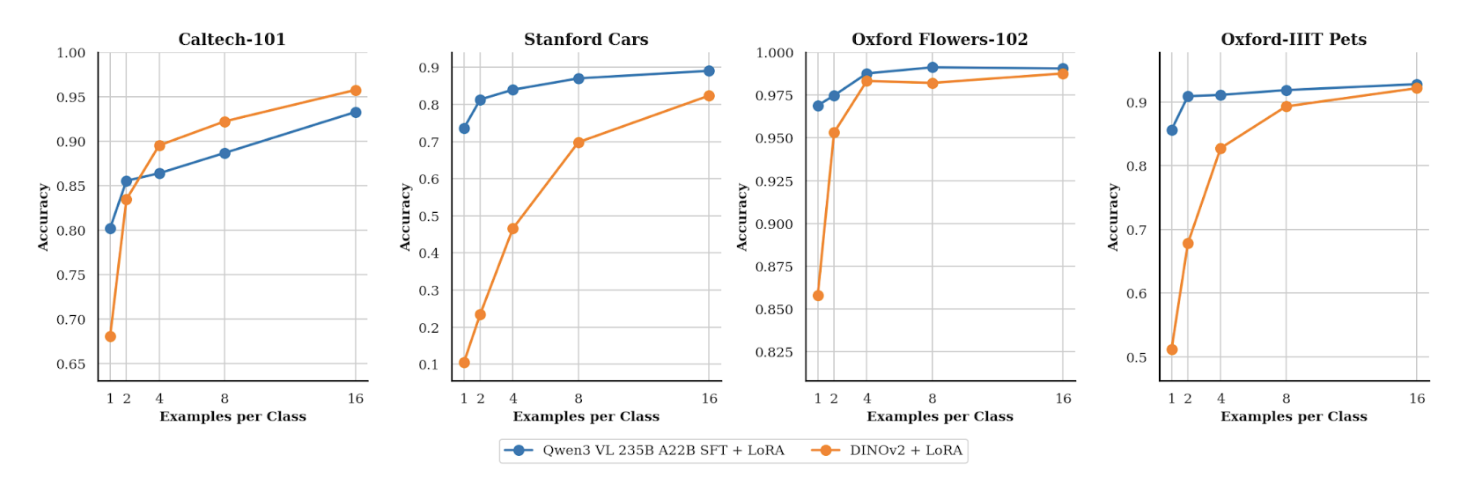
To demonstrate vision understanding in action, we are sharing a new cookbook recipe for fine-tuning VLMs as image classifiers. Qwen3-VL-235B-A22B-Instruct obtains reasonable accuracy even given just one example per class; performance improves with more labeled data.

Training image classifiers with Tinker#

To showcase Tinker’s new vision capabilities, we finetuned Qwen3-VL-235B-A22B-Instruct to classify images on four classic datasets:

Since Qwen3-VL is a language model, we frame classification as text generation: given an image, the model outputs the class name. We compare this approach against a traditional vision baseline of finetuning a vision-only model — DINOv2-base. DINOv2 is a self-supervised vision transformer that was trained to encode images, and is commonly used as a backbone for pure computer vision tasks. For DINOv2, we add a classification head that predicts a distribution over all N classes. Both models are fine-tuned with LoRA.

Labeled image data is scarce for many real-world use cases, so data efficiency is the primary measure we look at. We show the classification accuracy when sweeping across the number of labeled examples per class, starting with just a single one.

Comparison of fine-tuned Qwen3-VL-235-A22B and DINOv2 performance on simple image classification tasks.

In the limited-data regime, Qwen3-VL-235-A22B outperforms DINOv2. Not only is it a bigger model, but as a VLM, it also comes with language knowledge out-of-the-box (i.e. what a “golden retriever” or “sunflower” is). This general language-and-vision capability of Qwen3-VL makes it readily available for vision tasks beyond classification.

Happy Holidays#

Tinker exists to enable builders and researchers to train and customize state-of-the-art models. As always, we look forward to seeing what you build with Tinker. Happy holidays!

Read the whole story
bogorad
3 hours ago
reply
Barcelona, Catalonia, Spain
Share this story
Delete

DC Pipe Bomb Arrest Raises Questions About Christopher’s Wray’s FBI | RealClearInvestigations

1 Share
  • Brian Cole Jr. arrested: Charged with placing pipe bombs near DNC and RNC on Jan. 5, 2021.
  • Wray's narrative: Described as five-year FBI effort culminating in arrest.
  • Bongino's account: New team assigned two months ago reviewed existing evidence like credit cards, cell phone, vehicle data to identify suspect.
  • Investigation timeline: Massive early resources in 2021 produced 105 million data points, public tips, videos released, reward increased.
  • Discovery details: Devices found near DNC (near Harris visit) and RNC; Secret Service sweeps occurred; later deemed nonoperational.
  • Witness issues: RNC finder Karlin Younger reported inconsistencies on device timer and placement; linked to cell data provider.
  • Congressional scrutiny: Loudermilk seeks interviews, evidence on deletions; report claims resources diverted by Feb. 2021.
  • Wray's defenses: Testified to aggressive pursuit, thousands of interviews, vast data reviewed, but case unsolved at retirement.

X

Story Stream

recent articles

It’s a tale of two investigations.

In one version – based on past comments by former FBI Director Christopher Wray – the arrest last week of Brian Cole Jr. as the individual who allegedly placed pipe bombs near the Washington, D.C., headquarters of the Democratic National Committee and Republican National Committee on Jan. 5, 2021, was the culmination of a dogged, five-year effort by the bureau. 

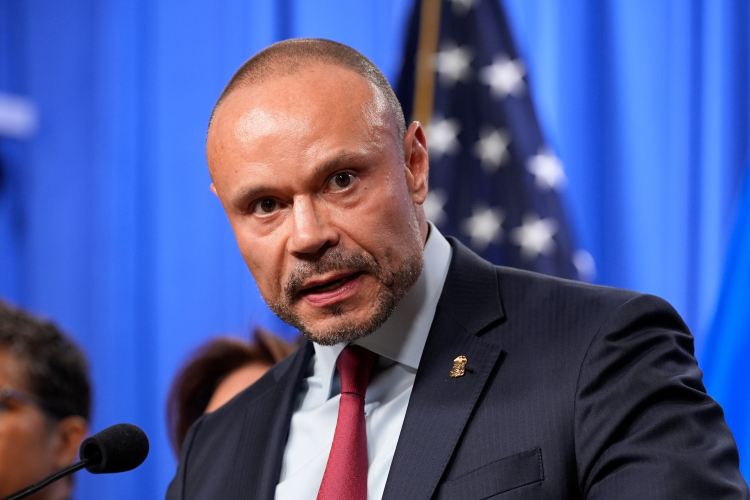
In another version, suggested by Dan Bongino, the bureau’s deputy director, FBI agents revived a long-dormant case a few months ago, quickly tracking down Cole through an existing body of evidence, not from new information. At a press conference following Cole’s arrest last week, Bongino said he assigned a fresh team of investigators out of the Washington FBI field office about two months ago that “scoured [existing evidence] over and over and over and over again.” Key pieces of evidence gathered under the previous administration – including credit card purchases of components used to construct the devices, as well as cell phone and vehicle activity from Jan. 5 – led investigators to Cole.
AP

FBI Deputy Director Dan Bongino says a new team quickly cracked the case using evidence collected years before.

AP

If Cole’s arrest proves to have solved the mystery of who planted the bombs, it presents another perhaps even more consequential question: Why did it take law enforcement so long to find him? Although there are no clear answers as of yet, Bongino’s description of the efforts that led to an arrest seems to contradict public comments and congressional testimony regarding the pipe bomb case previously provided by Wray. 

Given the case’s close connection to the highly-charged events of Jan. 6, questions are also being raised about whether Wray’s FBI essentially put the case on hold for political reasons. Such concerns stem, in part, from the bureau’s documented role in helping advance the discredited Russiagate narrative used against President Trump and its decision to remain silent as the Biden campaign dismissed Hunter Biden’s laptop as a “Russian plant” in the closing days of the 2020 campaign – despite the bureau having already verified its authenticity.

‘Every Rock’ Overturned

Although the bombs allegedly planted by Cole, who faces two federal charges relating to possession of an explosive device, never went off, law enforcement has always treated the bombs as possible instruments of mass casualties.

In the days after the Jan. 6 Capitol protest, top law enforcement officials promised to use all investigative resources necessary to track down the pipe bomb perpetrator. “Every tool, every rock is being unturned because we have to bring that person to justice,” Steven D’Antuono, head of the Washington FBI field office at the time, told reporters on Jan. 12, 2021. He also announced a $50,000 reward for anyone providing information leading to an arrest.

Acting U.S. Attorney for the District of Columbia Michael Sherwin, who joined D’Antuono during the presser, even warned that felony murder charges “related to the use of destructive devices” could await the pipe bomber despite the fact that the devices did not detonate.

Records show the FBI devoted massive resources to the investigation in early 2021. A team of at least 50 FBI agents collected security camera footage, interviews, apparel purchases, cell phone records, police transmissions, and other evidence, resulting in a trove of 105 million data points by April 2021. Tips poured in from the public; analysts quickly identified the components, including a kitchen timer and a steel pipe used to construct the devices.

The FBI doubled the reward and released video clips of the alleged suspect, who was wearing a hoodie, distinctive Nike sneakers, and a face mask while carrying a backpack around the Capitol Hill neighborhood.

D’Antuono made another urgent plea for the public’s help in March 2021. “We know it can be a difficult decision to report information about family, friends, or co-workers, but this is about protecting human life,” he said in a five-minute video posted on the FBI’s website. Authorities continued to insist the devices had been “viable” and capable of injuring or killing bystanders.

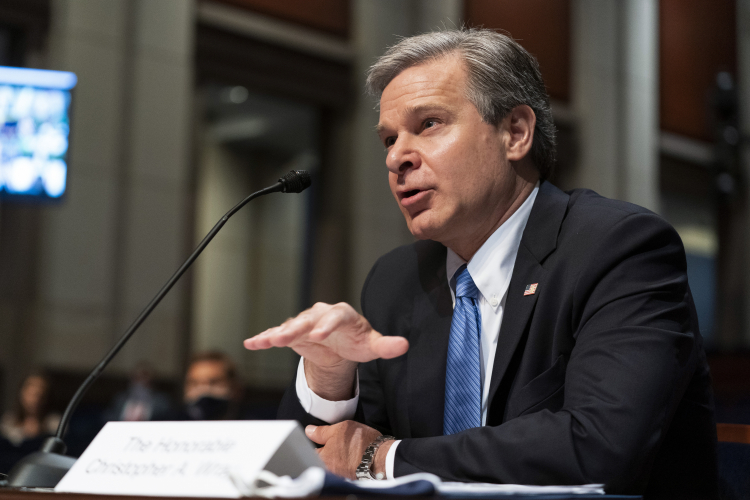
In June 2021, Wray again told Congress under oath that the FBI was “aggressively investigating” who had planted the devices.

Troubling Details
AP

While heading the FBI, Christopher Wray said the pipe bomb case was being "aggressively investigated."

AP

But even as the FBI assured the public it was conducting a vigorous investigation, journalists and Republicans in Congress were uncovering troubling details surrounding the discovery of both devices. In January 2022, Politico reported that Sen. Kamala Harris, the incoming vice president, had been inside DNC headquarters when a plain-clothes Capitol Police officer found the pipe bomb under a bush between two benches next to the driveway of the building – the same driveway Harris’ Secret Service detail had used when she arrived a few hours earlier.

That disclosure raised concerns over the Secret Service’s sweep of the premises earlier that day, as did the discovery of security camera footage showing bomb-sniffing canine units twice deployed near the spot where the device was later found. Even after the device was discovered, video shows law enforcement acting nonchalantly about the potential danger – even allowing a group of schoolchildren to walk past the area. Adding to the mystery is a Quantico report that determined the devices at both the DNC and RNC were nonoperational – a finding, if true, that is likely to be trumpeted by Cole’s lawyers.

In another odd twist, Karlin Younger, the woman who found the pipe bomb near the RNC at 12:40 p.m. on Jan. 6, worked for FirstNet - the same provider that later told the FBI the cell phone data for Jan. 5 had been corrupted and was not recoverable. According to Bongino, the cell phone data had not been corrupted and was crucial evidence that led to Cole’s arrest. 

Younger said she alerted a security guard at the RNC after she found the device sitting near a dumpster when she went to finish her laundry at 12:40 p.m. on Jan. 6. But she also told an FBI investigator the device was not near the dumpster at noon when she went to start her first load, which contradicts the official timeline that the pipe bomber planted his devices on the night of Jan. 5. An FBI report on the components of the device disproved her statement that the RNC device contained a timer set at 20 minutes – suggesting the bomb was scheduled to detonate at the exact same time Congress convened at 1:00 p.m. to certify the 2020 election.

Demand for More Answers
AP

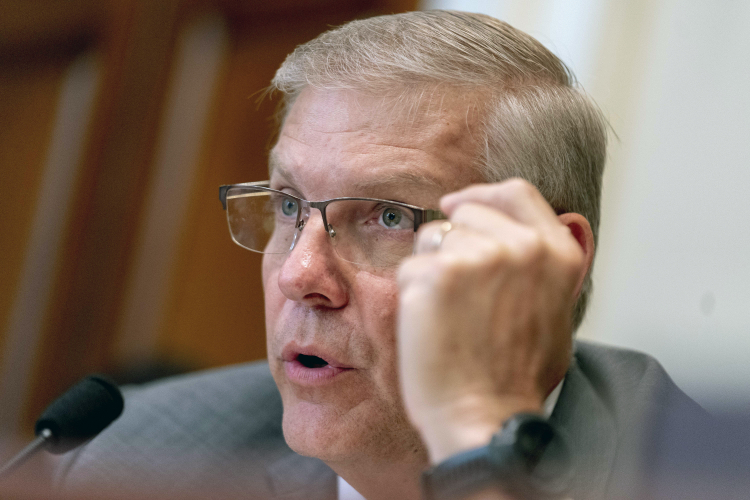
Rep. Barry Loudermilk wants more answers on the pipe bomb probe.

AP

Rep. Barry Loudermilk, chairman of a new select subcommittee on Jan. 6, wants more answers on the circumstances surrounding both discoveries. This week, he sent a letter to Younger asking her to sit for a transcribed interview before his new select subcommittee on January 6. He has previously asked the director of the Secret Service to make the agents on Harris’ security detail that day available for questioning. Loudermilk has also said he plans to explore the destruction of evidence – including the deletion of Secret Services text messages before and on January 6 and of video images from the DNC and RNC on Jan. 6. “As we go and looking for video on January 6th to see did anybody go back to these locations, that footage doesn't exist anymore,” he told podcaster Benny Johnson. “We have January 5th video, but we were told no one preserved January 6th. … This has inhibited our investigation.”

The revelation of those curious circumstances as the FBI investigation dragged on put Wray on the defensive. He refused to discuss details about the investigation with Republican Rep. Thomas Massie during a 2023 House Judiciary Committee hearing and would not confirm whether the FBI interviewed the officer who found the DNC device.

During a heated 2023 exchange with Rep. Eli Crane, an Arizona Republican, Wray said, “We [the FBI] have an entire dedicated team focused specifically on this investigation.” 

Wray also told the Arizona Republican, which had challenged him to explain the successful roundup of hundreds of J6 protesters but not the individual responsible for a potential “mass casualty” event that day, “We’ve done thousands of interviews, we’ve visited thousands of residents and businesses, viewed millions of pieces of data, there’s something like 39,000 video files, and we’ve assessed like 500 or so tips. We’ve done extensive public publicity, we’ve increased the reward money.” Wray further claimed that the FBI laboratory, weapons of mass destruction unit, technology division, and “cellular analysis team” were still hot on the pipe bomber’s trail. “I, as much as anybody, would like to see it solved.”

In a 2023 interview with Fox News’ Bret Baier, Wray said the FBI had devoted “loads” of resources to the investigation and that he had “enormous confidence” in his team assigned to the pipe bomb case.

But when Wray retired shortly before President Trump took office for the second time, a full four years after the launch of the investigation, the pipe bomb case remained unsolved. 

More Headscratchers

AP

A report overseen by Loudermilk and Rep. Thomas Massie asserted investigators had largely abandoned the case by February 2021.

AP

Others doubt Wray’s assurances that this case remained a priority on his watch. A January 2025 update on the pipe bomb matter overseen by Loudermilk and Massie asserted, based on law enforcement correspondence, that interest in the case waned as early as one month after the Capitol protest. “By the end of February 2021, the FBI began diverting resources away from the pipe bomb investigation,” the report stated, citing as a reference a Feb. 2021 email from an unidentified Capitol Police official. “One possible explanation for the reduction in resources is that the number of credible leads began to decline, no longer requiring as many special agents to cover the workload.”

Perhaps the biggest headscratcher – how the new team of investigators used cell phone data that D’Antuono claimed had been corrupted – demands answers. In sworn testimony to Congress, D’Antuono had told lawmakers that the FBI “did a complete geofence” for the night of Jan. 5 but that “some data was corrupted by one of the providers.” That assertion appears to be false.

Congress appears interested in determining how Wray’s FBI came up empty-handed. A House Judiciary Committee spokesman told RCI “everything is on the table” in terms of getting answers from the former director about the pipe bomb investigation. Efforts to reach Wray and D’Antuono for comment were unsuccessful.

But the public is entitled to know whether the investigation begun during Wray’s tenure was simply a case that took five years to bring to fruition – or whether it is another example of a federal investigation compromised by political considerations.

Support RealClear, Independent Journalism

Carl Cannon, RCP Executive Editor

“Information wants to be free!” was a rallying cry at the dawn of the Internet Age. The paradox is that information also “wants to be expensive.”

At RealClearPolitics, we provide news and information spanning the ideological spectrum—without a paywall. That’s the “free” part.

But producing quality journalism means paying reporters, editors, aggregators, tech team, and the analysts who curate RCP’s renowned polling averages. That’s the expensive part.

If you value independent news and seeing a diversity of viewpoints, please consider making a tax-deductible donation to RealClear Media Fund. Every dollar you donate is an investment in an informed public discourse and holding government and other key institutions accountable. Your support helps us put First Amendment theory into real-world practice.

Sincerely,

Carl Cannon
Executive Editor
RealClearPolitics

Read the whole story
bogorad
4 hours ago
reply
Barcelona, Catalonia, Spain
Share this story
Delete

Wikipedia accused of anti-Israel bias for locking page title referring to Israeli ‘massacre’ - JNS.org

1 Share
  • Wikipedia page title: Frozen discussion on changing "Nuseirat rescue and massacre" until August 2026.
  • Event described: Israel's June 2024 rescue of four hostages—Noa Argamani, Almog Meir Jan, Andrey Kozlov, Shlomi Ziv—from Gaza.
  • Casualty claims: Cites Palestinian officials for at least 276 killed; Israeli military reports fewer than 100, including terrorists (omitted on page).
  • Prior page history: Redirected from "2024 Nuseirat rescue operation"; earlier versions included "Nuseirat refugee camp massacre".
  • Moratorium details: Proposed July 26, implemented December 8 after change attempts.
  • Jewish leaders' views: B’nai B’rith CEO calls figures inflated, emphasizes hostage rescue; Simon Wiesenthal Center deems "massacre" non-neutral.
  • Other moratoriums: Year-long ban on Zionism article sentence; rare uses for topics like Gulf of Mexico name, Algerian boxer gender.
  • Broader actions: Wikipedia banned eight editors (six anti-Israel); U.S. House committee investigating potential antisemitic distortions.

(Dec. 11, 2025 / JNS)

Wikipedia drew criticism from Jewish leaders after the site’s editors opted to freeze discussion about the title of a page that refers to Israel committing a “massacre” in June 2024.

The decision means that no one can even discuss changing the title of the page “Nuseirat rescue and massacre” until at least August 2026. The page refers to the Jewish state’s liberation of the four hostages—Noa Argamani, Almog Meir Jan, Andrey Kozlov and Shlomi Ziv—from Gaza.

Citing “Palestinian health officials,” the Wikipedia page claims that “at least” 276 Palestinians were killed during the operation. It also says that the Israeli military recorded fewer than 100 Palestinian deaths. The Israeli media article Wikipedia cites notes that there were terrorists among the Palestinian deaths, but the encyclopedia’s page doesn’t say that.

At least as of Oct. 2, the Wikipedia page calling it a “massacre” stated that it was redirected from a page called “2024 Nuseirat rescue operation,” per an archived version of the page. Wikipedia reportedly had that page and one on “Nuseirat refugee camp massacre” as of June 18, 2024. 

After some efforts were made to change the title of the current page, Wikipedia editors proposed a moratorium on changes on July 26 and put the ban in place on Dec. 8, to last until Aug. 3.

Most Popular

U.S. Capitol Building in Washington, D.C. Credit: Wenhan Cheng/Pixabay.

House passes bill with $500 million for Israel missile defenseDec. 11, 2025

![Pennsylvania Gov. Josh Shapiro and Utah Gov. Spencer Cox talk with "Today Show" co-anchor Savannah Guthrie as part of an "NBC News" series on "finding common ground," at the Washington National Cathedral in D.C., Dec. 9, 2025. Source: Screen capture/Pennsylvania Capital-Star.](https://me.jnsi.org/uploads/2025/12/Shapiro-and-Cox-480x480.jpg "Pennsylvania Gov. Josh Shapiro and Utah Gov. Spencer Cox talk with "Today Show" co-anchor Savannah Guthrie as part of an "NBC News" series on "finding common ground," at the Washington National Cathedral in D.C., Dec. 9, 2025. Source: Screen capture/Pennsylvania Capital-Star.")

Pennsylvania, Utah governors decry political violence in joint appearance in DCDec. 11, 2025

U.S. House Speaker Mike Johnson (left) meeting with Samaria Regional Council head Yossi Dagan, December 2025. Credit: Samaria Regional Council.

Speaker Johnson ‘The Bible is clear: Judea and Samaria are the Land of Israel’Dec. 11, 2025

“Wikipedia, once again, seems to be misleading its readers,” Daniel S. Mariaschin, CEO of B’nai B’rith International, told JNS.

“The Nuseirat matter tells us two things about the war in Gaza,” he said. “We learned, early on, that any figures issued by the Hamas-led ‘Gaza Health Ministry’ were always highly inflated and not credible.” 

Mariaschin added that Israeli hostages “being held by Palestinian civilians in apartment buildings speaks clearly to Hamas’s policy of surrounding itself, or those connected to it, with human shields.”

“The real story here should be that kidnapped Israelis were being held hostage and were successfully rescued,” he told JNS.

Vlad Khaykin, executive vice president of social impact and North American partnerships at the Simon Wiesenthal Center, told JNS that Wikipedia’s use of the word “massacre” in the title is “not a neutral descriptor.”

“It is a verdict—one that draws its authority from casualty figures and claims that remain deeply contested, often circulated by those intent on recasting Israel’s efforts at self-defense as acts of villainy,” he said.

“To enshrine such a term in a headline, absent the slow work of context and verification, is not an act of impartiality,” Khaykin told JNS. “It is the quiet rewriting of the story before the facts have even settled.”

‘Moratorium on truth’

Earlier this year, Wikipedia editors placed another moratorium on discussion on a different page—a dramatic measure that it tends to take rarely. It says that such a decision “should be used with caution,” since it runs “counter to the general practice on Wikipedia that any editor may initiate a discussion on any topic related to the operations of the encyclopedia at any time.”

On Feb. 21, editors reportedly placed a year-long ban on discussions to change the line “Zionists wanted to create a Jewish state in Palestine with as much land, as many Jews and as few Palestinian Arabs as possible” in the opening paragraph of the Wikipedia article on “Zionism.”

“Since when do relied-upon sources of information online place a moratorium on the truth?” Mariaschin told JNS. “The treatment of the story of the Jews’ return to their ancient homeland is not just given short shrift. It is given a fabricated treatment of history that is both biased and dangerous.”

“One can only imagine how many people searching for the facts will walk away with an intentionally false narrative,” he said.

Khaykin told JNS that the moratorium on the Zionism page “locked in a one-sided version of history.”

In January, Wikipedia’s arbitration committee banned eight editors from editing Arab-Israeli articles indefinitely. Six of the eight are anti-Israel. They can appeal their suspensions after one year.

“This is not a simple quarrel among volunteers,” Khaykin told JNS. “It is a case study in how determined actors can quietly seize the levers of an open system, rewriting reality while the world looks away.”

A JNS review found that moratoria have only been implemented a handful of times this year, including efforts to rename the article on the Gulf of Mexico, which U.S. President Donald Trump calls the “Gulf of America,” and discussions about the gender of an Algerian boxer. (JNS sought comment from the Wikimedia Foundation.)

In February 2024, a moratorium paused discussion for three months on efforts to rename an article then titled “Israel-Hamas war.” The title of the page was changed to “Gaza war” in January. A moratorium proposal to freeze discussion on changing the title of the “Gaza genocide” page failed in August 2024.

The U.S. House Committee on Oversight and Government Reform is investigating Wikipedia over concerns of “potentially systematic efforts to advance antisemitic and anti-Israel information in Wikipedia articles related to conflicts with the State of Israel.”

Holly Huffnagle, U.S. director of antisemitism policy for the American Jewish Committee, told JNS that “coordinated and manipulated Wikipedia editing campaigns are dangerous and something that the Wikimedia Foundation must take seriously.” 

“These campaigns have the power to distort the public record, exploiting the trust people place in an open encyclopedia to push narratives crafted for hidden agendas,” she said. “Because Wikipedia is so widely cited, including by AI chatbots, even subtle, organized manipulations can change public opinion, shape news coverage and conceal the truth.”

“Procedures and policy must reflect and address these concerns,” she said.

Khaykin told JNS that Wikipedia “now serves as a foundational layer of the global information ecosystem.” 

“Its content feeds directly into Google search results and informs Alexa and Siri responses,” he said. “Increasingly, it influences AI platforms like ChatGPT. When Wikipedia’s neutrality is compromised at the source, that distortion spreads.”

“Downstream tools then shape how students, journalists, policymakers and the public understand complex issues,” Khaykin told JNS. 

Wikipedia “allows a small group to dictate what the world is permitted to know, then those who build our digital commons must ask themselves whether such a platform deserves its place of trust,” he added. “A source so easily captured should not be allowed to shape historical perspective or the truths we pass on to the next generation.”

In a world full of spin, truth matters.
Help JNS share honest reporting about Israel.

Read the whole story
bogorad
4 hours ago
reply
Barcelona, Catalonia, Spain
Share this story
Delete

Will Democrats kneel in the Rotunda for Venezuelan cartel drug traffickers? 

1 Share
  • Democrats' response to killings: Performative antics shameful amid apathy toward brutally killed women.
  • Hypothetical protest: Collective kneeling in Capitol Rotunda wearing Venezuelan drug-trafficking apparel to mourn deaths.
  • Double tap controversy: Democrats' words labeled hyperbolic hysteria over covert operations smuggling illegal drugs.
  • Sen. Chris Coons' reaction: Troubled by strike video, raised policy questions, voted against Laken Riley Act.
  • Rep. Pat Ryan's statements: Called inquiry partisanship over patriotism, killings unlawful, questioned national values, voted against Laken Riley Act.
  • Democratic politicians' pattern: Feign outrage for criminals, ignore American citizens' deaths unless politically advantageous.
  • Selective sympathy examples: Concern shown for George Floyd, Michael Brown, Trayvon Martin.
  • Critique of Democrats: Deceiving public with concern over suspected Venezuelan drug runners to undermine Trump administration.

Their performative antics were shameful, given the relative apathy they displayed when the aforementioned women were brutally killed. It was enough to wonder if they would organize a collective kneeling in the Capitol Rotunda wearing native Venezuelan drug-trafficking apparel, mourning their deaths.

The theatrical words spoken by many Democrats over the last two weeks regarding the so-called “double tap” controversy were little more than hyperbolic hysteria. It sounded as if many of them were about to cry for people involved in covert operations who smuggled illegal, dangerous drugs into the country (and around the world), often causing physical harm and death.

Consider Sen. Chris Coons (D-DE), who, after watching the video of the controversial military strike, expressed concern about what he saw. 

“I think it would be hard to watch the series of videos and not be troubled by it,” Coons said. “I have more policy questions than ever.”

“Troubled” and “policy questions,” the senator from Delaware said. Yet, we should all be “troubled” by Coons’s response because he showed more regret and empathy about the death of the suspected drug criminals than he did for Laken Riley. Furthermore, given Coons’s policy questions, it is worth noting that he voted against the Laken Riley Act. The vote against that legislation should “trouble” every American citizen.

Next, consider another “soulful” Democrat, deeply disturbed by the killing of drug traffickers, Rep. Pat Ryan (D-NY). Ryan called the Democrats’ inquiry into the controversial military operation a matter of “partisanship over patriotism.” He also categorized such killings as “unlawful” and had the sheer audacity to say that it called into question our “values as a country.”

Now, remember Ryan said that because while he lamented unlawfulness and questioned the nation’s values, he didn’t seem too concerned with either in January 2025, when, like his criminal-illegal-immigrant-loving brethren, he, too, voted against the Laken Riley Act. So much for patriotism. And as for partisanship, it seems evident Ryan was perfectly fine with Riley’s life being collateral damage so long as he could continue to support welcoming dangerous illegal immigrants into the country. 

Some “values” Ryan has.

ELISSA SLOTKIN, MARK KELLY, AND DEMOCRATIC PRIVILEGE

But Coons and Ryan represent the typical Democratic politician in Congress today. They feign outrage, concern, and sympathy for the lives of criminals but largely ignore the tragic deaths of American citizens — unless such citizens can be used to advance a political agenda, such as George Floyd, Michael Brown, or Trayvon Martin, just to name a few. They don’t care about morality or doing the right thing, and they certainly don’t care about “patriotism over partisanship.” Democrats have been grounded in ideological partisanship for decades, putting a thirst for power above morality. 

Coons, Ryan, and every other Democrat expressing concern over the deaths of suspected Venezuelan drug runners are deceiving the public. When they start expressing concern about the tragic loss of life of innocent people with the same vigor they mourn criminals, then they can be taken seriously. 

Until then, no one should believe anything they say. Their pearl-clutching over the killed alleged Venezuelan cartel members is just meant to drag down President Donald Trump and his administration.

Read the whole story
bogorad
4 hours ago
reply
Barcelona, Catalonia, Spain
Share this story
Delete

EU to impose 3 euro duty on e-commerce parcels from July 2026 | Reuters

1 Comment
  • EU Agreement: Finance ministers set 3 euro customs duty on low-value parcels from July 1, 2026.
  • Temporary Measure: Applies per item type until de minimis exemption ends, originally planned for 2028.
  • Target Imports: Focuses on cheap Chinese e-commerce goods from Shein, Temu, AliExpress, Amazon Haul.
  • Parcel Surge: Low-value imports doubled to 4.6 billion in 2024, over 90% from China.
  • Duty Application: Based on six-digit tariff codes; same type incurs single 3-euro charge, different types multiple.
  • Stated Reasons: Addresses unfair competition, consumer risks, fraud, environmental issues.
  • Political Support: MEP Barry Andrews welcomes 3-euro levy per item, suggests increase if needed.
  • Additional Plans: EU considers 2-euro handling fee per parcel, timeline unclear.

  • Summary

  • Companies

  • EU had been due to end low-value parcel customs exemption in 2028

  • Surge in parcel imports to 4.6 bln in 2024 sparks EU pressure to act faster

  • EU also looking into e-commerce parcel handling fee

BRUSSELS, Dec 12 (Reuters) - European Union finance ministers agreed on Friday to set a 3 euro ($3.52) customs duty on low-value parcels arriving in the bloc, part of efforts to crack down on cheap Chinese e-commerce imports such as from online retailers Shein and Temu.

The duty will apply per item type from July 1, 2026, and will be in place until a permanent solution is found to eliminate the "de minimis" duties exemption for online purchases below 150 euros, the EU's Council of its 27 governments said in a statement.

The bloc was due to remove the exemption in 2028 as part of an overhaul of its customs system, but pressure to act faster has grown amid concerns about Chinese goods being dumped in Europe.

"This temporary measure responds to the fact that such parcels currently enter the EU duty-free, leading to unfair competition for EU sellers, health and safety risks for consumers, high levels of fraud and environmental concerns," the Council said.

BULK OF LOW-VALUE PARCELS FROM CHINA

A Council source said the duty would apply per product type, based on six-digit tariff codes. This means 10 pairs of socks of the same type would incur a 3-euro charge, but five pairs of socks made from wool and five from cotton would count as two item types and incur a 6-euro charge.

Irish EU lawmaker Barry Andrews, who had previously sought a 5-euro levy per package, said he welcomed the 3-euro duty per item agreement and said EU countries should increase it if it did not stem the flood of cheap deliveries.

Online platforms such as Shein, Temu (PDD.O), opens new tab, AliExpress (9988.HK), opens new tab and Amazon Haul (AMZN.O), opens new tab send clothes, accessories and gadgets from Chinese factories directly to shoppers at rock-bottom prices.

Due to the customs waiver, the number of low-value e-commerce packages arriving in the bloc doubled last year to 4.6 billion, more than 90% of them from China. Imports this year are set to be even higher.

European retailers have broadly welcomed the move to impose customs duties on low-value parcels, saying it is a step towards fairer competition.

The EU is also considering a separate handling fee, which the European Commission has proposed should be set at 2 euros per parcel. It is not clear when it would be imposed.

($1 = 0.8531 euros)

Reporting by Philip Blenkinsop and Inti Landauro. Editing by Bart Meijer, Mark Potter and Alex Richardson

Our Standards: The Thomson Reuters Trust Principles., opens new tab

Purchase Licensing Rights

Read the whole story
bogorad
4 hours ago
reply
incompetent journos fail to mention the fucking VAT that is in place already! so EU will be double-dipping.
Barcelona, Catalonia, Spain
Share this story
Delete
Next Page of Stories