Strategic Initiatives
12350 stories
·
45 followers

A Power Source That Can Fit Anywhere? 3-D-Printed Battery Tech Makes It Possible - WSJ

1 Share

LLM (google/gemini-3.1-flash-lite-20260507) summary:

  • Additive Potential: three dimensional printing supposedly allows batteries to fill irregular spaces within devices to optimize volume and capacity.
  • Industry Stagnation: traditional manufacturing methods have seen negligible improvements over three decades, relying on rigid pouch or cylinder formats.
  • Chemical Agnosticism: the additive approach claims compatibility with various energy storage chemistries including lithium ion, sodium ion, and solid state variants.
  • Startup Graveyard: numerous firms attempting to disrupt established battery giants face the inevitable failures inherent in pursuing cost and scale competitiveness.
  • Military Dependence: developers are currently tethered to defense contracts as the primary funding conduit, given the disregard for economic viability in battlefield applications.
  • Operational Efficiency: some innovators aim to abandon solvent based drying ovens to trim production overheads, hoping to bypass standard industrial bottlenecks.
  • Experimental Speculation: radical concepts such as printing batteries from lunar soil remain theoretical exercises for future moon bases, illustrating the usual academic detachment from practical reality.
  • Long Term Evasion: advocates suggest that commercial mass adoption remains decades away, keeping these technologies safely confined to laboratories and niche military projects.
A soldier operating a Teledyne Flir SkyRaider drone with a military vehicle in the background.Startup Material Hybrid Manufacturing is working to 3-D-print batteries inside SkyRaider drones. Joe Ailinger

There’s a revolution in battery technology hiding in plain sight: The 3-D printing of batteries has the potential to put energy storage inside any device. This will enable lightweight and long-lasting consumer gadgets, long-range military drones and even nanoscale robots.

The way the world manufactures batteries has changed hardly at all in 30 years. Almost all the innovations we regularly hear about—from cheaper, tougher electric-vehicle batteries to “Holy Grail” solid-state batteries—are about changing the chemistry of batteries.

The promise of battery-tech 3-D printing (aka additive manufacturing) is simple: What if batteries could fill any available space, even structural elements of our gadgets, rather than always taking a rigid shape like a pouch or cylinder?

The new approach has obvious appeal. The entire airframe of a drone could be filled with energy storage for increased range. Smartglasses could have sleek battery-packed frames, so they look like everyday eyewear rather than “Revenge of the Nerds” props.

One of the biggest advantages of 3-D printing is that it works with any battery, regardless of its cell chemistry. It could advance today’s lithium-ion as well as emerging sodium-ion and solid-state tech.

Hand in blue glove holding a circular, 3D-printed battery component with a grid-like surface.A 3-D-printed battery component made from simulated moon dust and astronaut waste. ESTRELLA/The University of Texas at El Paso

In 2025, researchers published around 25,000 papers about 3-D printing of batteries and their components, yet only a handful of startups have even proposed commercializing the technology.

Attempting to beat existing battery giants has doomed many a company to the graveyard. New battery tech must compete on lifespan, durability, energy density, safety and cost—which is dependent on massive scale.

Some are trying to use 3-D printing to create efficiencies in existing battery manufacturing systems. A brave handful of startups are pursuing radical new designs and approaches. They’re starting with defense applications, where cost and scale are less of an issue.

The airspace less traveled

Gabe Elias, chief executive of Miami-based 3-D-printed battery startup Material Hybrid Manufacturing, was an engineer on the Mercedes-AMG Formula One team for six years. During that period, the team won several championships led by driver Lewis Hamilton.

Elias was tasked with figuring out how to squeeze batteries into small and unlikely places—including directly under Hamilton’s seat. He couldn’t do it with existing tech. Years later, he was introduced to Christopher Reyes, who developed a battery printing tech for his doctoral thesis at Duke University, and the two founded the company.

Material's custom-built, hybrid 3-D-printing machine for making batteries.Material's custom-built, hybrid 3-D-printing machine for making batteries. MATERIAL

Material has already 3-D-printed test battery cells in the lab, using a variety of ingredients, to prove the tech works with different chemistries. “Our approach is, instead of innovating on the chemistry side of things, let’s innovate on the way that the batteries are made,” says Elias. “Chemistry innovation is happening all across the industry.” 

Material recently announced a $7.1 million seed investment round and a $1.25 million contract with the U.S. Air Force.

By the end of August, the company plans to hit the next milestone in its Air Force contract by creating prototype batteries for Teledyne Flir’s SkyRaider drone. The drone maker could only cram in four packs of conventional lithium-ion batteries. By printing the batteries into the same space, Elias says the drone could get a 35% increase in energy storage.

A better process

At Silicon Valley-based Sakuu, the approach is more conservative than Material’s, but has the potential to show up in commercial batteries much sooner. Rather than trying to 3-D-print whole batteries, the company is working on replacing one of battery manufacturing’s biggest pain points, says Arwed Niestroj, Sakuu’s chief operating officer, who is also a nuclear physicist and former head of Mercedes-Benz Research & Development North America.

A Sakuu technician in a lab coat, hairnet, mask, and gloves operates electrode manufacturing equipment with a "Thickness Control" screen.Sakuu is developing a dry process for manufacturing electrodes intended to replace a costly industry-standard system. Sakuu

Existing battery assembly lines include football-field-long ovens for drying layers of material that have been dissolved in solvents. This requires a huge amount of energy and is a significant contributor to manufacturing costs, a big reason EV batteries aren’t cheaper.

Sakuu’s process, under development for years, uses additive manufacturing to lay down key battery components without solvents, eliminating the need for ovens, says Niestroj.

Sakuu is currently working to commercialize this tech with a major battery manufacturer—Niestroj didn’t say who, or when those cells would go on the market. Previously, Sakuu said it had a joint development partnership with Korean battery giant SK On to bring this system to market.

Radical designs

The world is full of battery designs that can make traditional lithium-ion look like the D cells in a 1980s boombox. But most are stuck at the laboratory stage.

Alexis Maurel, a researcher at the University of Texas at El Paso, has published fundamental research on this topic. In support of NASA’s push to return to the moon, he proposed a radical technique using lunar regolith—literally, moon dust—to print batteries for future moon bases.

Maurel says it typically takes about 20 years from the conception of a new battery technology to its commercialization. He’s already been at it for 10. But he’s excited by what’s to come: A number of auto manufacturers are hard at work on “structural” batteries, which means the battery pack itself helps hold the vehicle together.

Cylinders within the Wright Electrics aluminum-air batteries.Cylinders within the Wright Electric aluminum-air batteries, which achieve many times the energy storage capacity of traditional lithium-ion. Ben Hertzberg

For Malta, N.Y.-based Wright Electric, 3-D printing was key to enabling the manufacturing of an exotic battery type known as aluminum-air.

Aluminum-air batteries have off-the-charts storage capacity but can’t be recharged. They’re useful for remote military applications, where soldiers can use them to recharge an ever-growing array of electronic devices. (Used packs are either tossed or returned to base to be remanufactured.)

Wright Electric CEO Jeff Engler says his company, like Material, focuses on the military as the best customer for the expensive, still-nascent “ultra high-performance” 3-D-printed batteries.

The drone-centric wars popping up all over mean a need for more lightweight craft like those already in use in Russia, Ukraine and the Strait of Hormuz, says Engler. At the same time, militaries are also seeking ways to maximize space and minimize weight in larger aircraft, he adds.

Long before our consumer gadgets are built with fully customized energy-storing materials, 3-D-printed batteries will evolve in one of history’s most reliable tech incubators: the military.

Copyright ©2026 Dow Jones & Company, Inc. All Rights Reserved. 87990cbe856818d5eddac44c7b1cdeb8

Christopher Mims is a columnist who writes about technology for The Wall Street Journal's tech bureau in San Francisco. The subjects of his columns vary widely from one week to the next. He has written about bidets, brain implants, the cult of the founder, the history of technology, innovation, venture capital, robotics, batteries, energy, materials science, wireless communications, AI, data science, telepresence, microchips, logistics, IT, 3D printing and autonomous boats, trucks, cars, drones and flying taxis. Christopher joined the Journal from Quartz, where he also covered technology. He has won a Sabew award for commentary, and has written a book, “Arriving Today” on how supply chains work.


Up Next


Videos

Read the whole story
bogorad
3 hours ago
reply
Barcelona, Catalonia, Spain
Share this story
Delete

Mamdani’s socialist dreams for NYC are facing a wake-up call — from increasingly skittish investors // A looming cash shortage could cause financial Armageddon, On The Money has learned.

1 Comment
  • Budgetary Gimmickry: The $124.7 billion annual budget was achieved through one-time revenue measures and the deferral of municipal pension contributions.
  • Impending Liquidity Crisis: Projections from the City Comptroller indicate a substantial risk of exhausting available cash reserves as early as November.
  • Increased Borrowing Costs: Investor apprehension regarding administration policies has forced New York City to pay higher interest rates, with spreads on short-term debt widening by nearly 20% this year.
  • Risk Premiums: Long-term debt obligations have seen a 13.7% increase in the risk premium demanded by investors to finance city expenditures.
  • Fiscal Management Concerns: Reports suggest the administration is bypassing short-term debt markets to avoid negative publicity regarding high rates, resorting instead to delaying payments owed to non-profit organizations.
  • Economic Sustainability Risks: The combination of an outward migration of taxpayers and an increasing reliance on social welfare programs is placing significant long-term strain on the city’s tax base.
  • Historical Precedents: Experts specializing in municipal debt and fiscal history warn that the current trajectory echoes the unsustainable financial conditions observed during the city’s 1970s fiscal collapse.

","

Mayor Zohran Mamdani’s socialist dream for New York City is facing a wake-up call – in the form of a cash crunch and spiraling borrowing costs from investors who are increasingly alarmed over his Marxist experiments, On The Money has learned.

Mamdani – who has proclaimed that he will “replace the frigidity of rugged individualism with the warmth of collectivism” – balanced his $124.7 billion annual budget as required by New York law with a series of gimmicks, so-called one-shot revenue raisers that included delaying some pension payments. 

The result, On the Money has learned, includes a looming cash shortage that has been signaled by City Comptroller Mark Levine. As earlier reported by Melissa Russo of NBC 4, the amount of money the city has on hand is alarmingly low, and risks drying up altogether come November.

Mayor Zohran Mamdani – who has proclaimed that he will “replace the frigidity of rugged individualism with the warmth of collectivism” – balanced his $124.7 billion annual budget as required by New York law with a series of gimmicks. Gil Fontimayor / NY Post Design

Wall Street is getting nervous – increasingly so about what Mamdani is looking to accomplish and how. Accordingly, it continues to demand higher interest rates on debt. That’s the case not only with long-term debt, but also the usually super-safe, short-term variety. 

My municipal market sources confirm the squeeze. Since the beginning of the year (when Mamdani took office) the so-called “spread” or difference between triple-A short-term bonds, and those issued by NYC with a maturity of one year has jumped nearly 20%.

That skittishness is also reflected in the 13.7% spike in longer dated, 10-year debt, the so-called risk premium investors are demanding to finance all that collectivist warmth.

And it may be why the mayor’s office isn’t tapping short-term borrowing markets to make up for the looming cash deficit, Wall Street analysts tell On The Money. Instead, as Russo has reported, City Hall has played with delaying payments to nonprofits to ride out the storm and god knows what else as it scrambles for funds. 

NYC isn’t a big profitable company; its budget is growing to pay for Mamdani’s socialist dreams. Andrew Schwartz / SplashNews.com
A City Hall rep didn’t respond to On The Money’s request for comment.

True, this does happen from time to time with big, profitable companies who tap short-term borrowing markets to keep the lights on and paychecks flowing until revenues start to perk up. But NYC isn’t a big profitable company; its budget is growing to pay for Mamdani’s socialist dreams.

As I have written previously on these pages, the result is that taxpayers are fleeing. They’re being replaced by poor immigrants who tap into its extensive welfare state. Mamdani is an avowed socialist, doubling down on all of the above.

Charlie Gasparino has his finger on the pulse of where business, politics and finance meet

Sign up to receive On The Money by Charlie Gasparino in your inbox every Thursday.

Thanks for signing up!
Enter your email address

Please provide a valid email.

By clicking above you agree to the Terms of Use and Privacy Policy.

Never miss a story.

Richard Farley has a particularly firm grasp of the city’s fiscal problems and how Mamdani’s policies are making them worse and potentially unsustainable. Gotham could be heading toward financial Armageddon, he warns.

He’s a Wall Street lawyer who specializes in debt, and a historian of the city’s fiscal crisis of the 1970s. His book, “Drop Dead: How a Coterie of Corrupt Politicians, Bankers, Lawyers, Spinmeisters, and Mobsters Bankrupted New York, Got Bailed Out, Blamed the … as Usual,” should be required reading for people in government.

10

What do you think? Post a comment.

Farley tells me the logical recourse would be short-term borrowing, selling debt that expires in less than a year, known as tax or revenue anticipation notes. But “they don’t want to tap the anticipation notes markets because the high interest rates will make news,” he adds. 

“They are low on cash because they underestimated expenses to make an unbalanced budget look balanced.”

"]
Read the whole story
bogorad
5 hours ago
reply
who would have thought!
Barcelona, Catalonia, Spain
Share this story
Delete

Are DSA Mayors the Future of the Democratic Party?

1 Share

LLM (google/gemini-3.1-flash-lite-20260507) summary:

  • Electoral Surge: democratic socialists of america candidates are clinching mayoral victories in major cities, reflecting a coordinated effort to secure institutional influence within the american political landscape.
  • Strategic Alliances: mainstream democrats are delusionally courting these radicals, hoping to leverage their perceived popularity with younger demographics to salvage their own flagging relevance.
  • Governance Illusion: these socialist mayors masquerade as moderate pragmatists, but their underlying agendas consistently prioritize performative class warfare over substantive economic solutions.
  • Organizational Machinations: the socialist strategy involves establishing exclusionary power centers, actively sidelining traditional labor unions and established political machines in favor of their own activist-led apparatus.
  • Housing Hypocrisy: despite adopting the vocabulary of housing abundance, these leaders maintain crippling regulations and punitive policies that actively stifle the private investment necessary to alleviate scarcity.
  • Economic Sabotage: the ideological hostility toward capital and property owners threatens to accelerate capital flight, ultimately bankrupting the very municipalities they intend to govern.
  • Radical Alignment: the movement is inexorably tethered to a national organization increasingly obsessed with maoism, support for hostile foreign regimes, and the romanticization of political violence.
  • Historical Folly: the center-left continues its repetitive pattern of enabling extremists, ignoring the reality that such partnerships historically culminate in political catastrophe and economic decline.

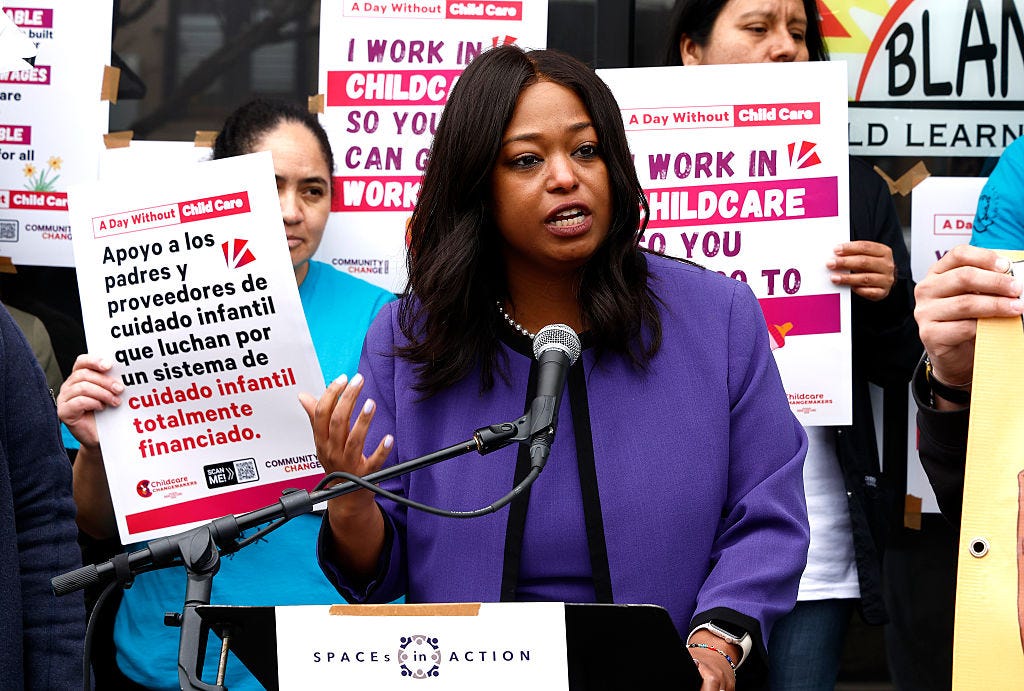
Courtesy Paul Morigi/SPACEs in Action/Getty.

Although the results are not yet fully in, it seems likely that Janeese Lewis George will be the next mayor of Washington, D.C. With 65 percent of votes counted as of this writing, Lewis George leads fellow city council member Kenyan McDuffie by 16 percentage points; she may even clear the 50 percent threshold required to avoid a run-off. That’s a decisive conclusion for a race that pitted the more moderate McDuffie against Lewis George, an endorsee and member of the Democratic Socialists of America (DSA). If the down-ballot results hold up, last night looks to have been a route for the Left in general, and the DSA in particular.

Assuming she wins, that will make Lewis George yet another DSA member running an important American city. She’ll be added to the list with not just New York City mayor Zohran Mamdani, but also Seattle mayor Katie Wilson. There are other aspirants, including most notably council member Nithya Raman, the DSA member who unexpected bested reality star and right-wing insurgent Spencer Pratt to take second place in the Los Angeles mayoral primary. (Raman is unlikely to beat incumbent mayor Karen Bass in the run-off, although the betting markets give her better odds than they gave Pratt.)

These new, openly socialist mayors have a certain allure to more traditional Democrats. With their party’s popularity in the pits, and its leaders increasingly aged, more moderate Dems see the obvious appeal to the hot new force in local politics. The DSA electeds also form their coalition from politically activated Americans under 50—a must-win group among Democrats, but also one increasingly dissatisfied with the party. The fact that some of these mayors have at least nominally leaned into pro-housing YIMBYism makes it all the easier for some on the “abundance” center-left to wonder if they’re better aligned with the socialist than they are with the establishment.

That’s all understandable. But the DSA’s electoral success should not be confused for policy success—much like the establishment Dems they replace, the DSA mayors are confusing class warfare for actual solutions to the affordability crisis. And in embracing them, mainstream Democrats also risk welcoming in an organization that has quietly grown disturbingly radical, a fact that could prove politically disastrous in the long run.

The wave of DSA mayoral candidates—and local candidates more generally—is the product of careful planning. It in part reflects Mamdani’s upset victory over former Governor Andrew Cuomo, which proved that a socialist could win a mayoralty in a city as significant as New York. But it is also the result of a concerted effort on the part of the DSA to establish itself as a separate power center in blue-city politics.

For example, as Michael Lange wrote recently, the New York City DSA has moved to muscle out the city’s unions, embodied in the Working Families Party. That looks like the current primary in New York’s seventh congressional district, which features WFP-backed Brooklyn borough president Antonio Reynoso in a fight for his political life against DSA-backed insurgent Clare Valdez. Mamdani is consciously building his “machine,” New York Magazine’s David Friedlander writes—a machine that includes his “Office of Mass Engagement,” an officially sanctioned activist wing of City Hall.

The DSA’s strategy is built on a distinct electorate. Traditional Democrats—like Bass, Cuomo, McDuffie, and Bruce Harrell, whom Wilson defeated in Seattle—tend to rely on the backing of the institutional Democratic machine to turn out votes. That machine, in turn, often relies on working-class voters activated by unions and by the party’s infrastructure.

The DSA generally has no access to the latter, and is not necessarily influential in the former, though some unions are increasingly divided between traditional and socialist factions. What it has instead is a cohort of thousands of ideologically committed young(ish) adults, willing to knock on doors to get out the vote for its candidates.

DSA candidates’ priorities are often shaped by the concerns of these constituents. Mamdani’s affordability messaging, as Manhattan Institute president Reihan Salam has argued, was tailored to the concerns of credentialed but downwardly mobile Millennials—people who feel the city is too expensive to afford them the kind of life they expected. Wilson, Lewis George, and Raman have similarly emphasized housing affordability. At the same time, many of these candidates tell a consistent story about why costs are too high: greed on the part of their cities’ ultra-wealthy, who are unwilling to pay their fair share, and of whom punitive taxation is therefore appropriate.

In spite of this, the DSA’s willingness to seize on the affordability narrative—especially on housing—has made them appealing to the pro-housing “abundance” wing of the Democratic Party. That’s helped by DSA electeds’ and candidates’ willingness to endorse moderate reforms to permitting and other minor barriers to housing—as, for example, in Raman’s platform or Mamdani’s SPEED reforms. Against the sclerosis of the Democratic establishment, an apparent bias for action may make the DSA appealing to more moderate Democrats eager for change.

To be sure, concessions on permitting reform are welcome, no matter whom they come from. But the high cost of living in America’s major metros are not simply the result of minor procedural hurdles, but of a more comprehensive opposition to allowing the market to supply what is demanded. And the DSA’s open hostility toward the people who do the supplying is incompatible with actually existing abundance.

This hostility manifests itself in policy. Mamdani’s administration has worked to seize property from landlords while pushing the city’s business community out. Lewis George has promised to strengthen D.C.’s Tenant Opportunity to Purchase Act, which gives tenants the right of first refusal to purchase—and which has helped cripple the city’s housing market. Wilson has dismissed millionaires fleeing Seattle—even as they are taking with them the tax base needed to sustain her promised expansion of government—and “abundant” construction using union-built social housing. Raman has taken meaningful steps toward reform, like pushing to fix Measure ULA, but she also emphasizes the need for new housing to be built by “well-paid union labor”—a dogwhistle for preserving prevailing wage standards.

This ideological posturing can have real economic consequences. Permitting reform can only get you so far if investment dries up and no one wants to build for fear that their property will be seized in a questionably constitutional taking. Cities are subject to exit-based vetoes—scaring off talent and capital risks killing the golden goose.

Even if they weren’t so explicitly appropriative, these mayors would still be hemmed in by their unwillingness to target ideologically inconvenient cost drivers. As my colleague Eric Kober has written, Mamdani’s housing aspirations are limited by his unwillingness to attack destructive policies like Mandatory Inclusionary Housing, the requirement that “a sizable percentage of units in new buildings in rezoned areas be offered at below-market rents.” Raman and Wilson’s nods to union-built housing similarly indicate that they still feel beholden to organized labor—a major driver of housing costs.

At its best, DSA YIMBYism gives with one hand while taking with the other. That’s a political strategy that’s palatable to their voters, but it’s not one that gets at the root causes of our affordability crisis, which is government’s comprehensive chokehold on the private sector.

Share

But the biggest question about the rise of the DSA mayors is not so much their approach to policy as it is the organization with which they are aligned. In 2020, many moderate Democrats found themselves in rooms with true radicals—people who had for years pushed police and prison abolition, and who took the opportunity to advance their goals when the time came. Making bedfellows with the DSA today runs the risk of the same dynamic emerging in the Democratic party tomorrow.

To be sure, Mamdani has tried to present a more moderate image in office. But other DSA electeds are not so circumspect. As my colleague Stu Smith has reported, DSA members in other local positions have been quite open in their willingness to use public office to advance their political interests, including rerouting public funds to activist-led “mutual aid” efforts and picking fights with Democrats to their right.

Meanwhile, the national DSA—the group with which all these mayors are ultimately affiliated—has veered further and further into extremism. As Smith has reported, the DSA just passed a platform that calls for abolishing the Department of War and “abolishing the carceral forces of the capitalist state” among other policy initiatives. It has also begun building a “self-defense” wing in part charged with preparing for a “national uprising,” and put a pro-political violence self-identified Maoist on the committee in charge of that effort. And it’s increasingly found common cause with groups likely funded by the Chinese Communist Party, and worked to advance the interests of the regime in Cuba.

Not every member of the DSA endorses these priorities, of course. But that supporters of political violence and sympathists for hostile foreign powers hold sway in the DSA’s institutional infrastructure is a reason to ask: are these really the sort of people to get in bed with?

One of the worst habits of the respectable liberal is to see in the far-left ideologue something admirable, however disagreeable. The center-left’s flirtation with DSA politics is not new; it is a repetition of an age-old pattern in American political life. Historically, Democrats embrace of radical Leftism has ended not in bold change, but electoral tears. But maybe this time will be different.

Read the whole story
bogorad
1 day ago
reply
Barcelona, Catalonia, Spain
Share this story
Delete

It's time for transparent pricing in medicine

1 Share

LLM (google/gemini-3.1-flash-lite-20260507) summary:

  • Price Transparency Requirement: mandatory disclosure of medical costs for procedures and drugs functions as the touted solution to industry opacity.
  • Market Distortion Claims: current financial structures mask true service value causing patients to irrationally overconsume medical treatments.
  • Profit Motive Reality: administrative and hospital decisions prioritize institutional gain over clinical necessity regardless of external narratives.
  • Consumer Agency Restoration: shifting toward direct cash payments for routine care is presented as a method to empower users against industry giants.
  • Cartel Behavior Accusations: the lack of competitive pricing is framed as a deliberate tactic to shield providers from market forces.
  • Chronic Systemic Complexity: institutional survival depends on an incomprehensible web of regulations that marginalizes independent medical practitioners.
  • Regulatory Capture Fears: large corporate entities thrive on the instability and complexity that smaller participants are unable to navigate.
  • Theoretical Reform Viability: simple policy changes are proposed as a fragile potential wedge against an otherwise monolithic and entrenched healthcare bureaucracy.

No surprise, Sunday’s article about 10 possible fixes for American healthcare sparked lots of reader suggestions, from minor to radical. I may run a second list with your ideas (or host a chat to discuss the issue).

But I was struck by how many of you pushed one seemingly simple change: requiring open pricing for medical procedures, services, and drugs whenever possible. This suggestion came up more than any other, even restricting drug advertising.

I agree. Open pricing may seem like a small change, but in fact it would have major philosophical and practical benefits.

(I’m committed to transparent pricing for Unreported Truths! Click to see!)

Our $5 trillion system encourages consumers, aka patients, to think of care as free — while setting up a maze of hidden financial incentives and honeypots that providers and administrators spend huge amounts of time navigating and fighting over.

Pretending medicine isn’t about money hasn’t made medicine less about money. It has just distorted the system in deeply destructive ways.

Even if doctors do not let financial incentives drive treatment decisions for individual patients (and some clearly do), profit drives every structural decision in American medicine, from where hospitals open satellite clinics to the drugs pharmacy benefits managers push to how quickly patients are discharged.

The list is endless.

Yet at the most crucial point of contact, we simply hide the price of treatments. Among other distortions, this fiction encourages patients to overconsume medical services. We implicitly assume we do not need to discourage people from seeking out healthcare. We imagine most healthy people will not go to doctors if they do not have to, so we do not have to regulate access to care.

But in the United States in 2026, that assumption no longer seems to hold.

We have an ever-increasing number of chronic conditions, often driven by unhealthy lifestyle choices, as well "sort-of" diseases with a strong psychosocial component. Drug company advertising fuels patient demand for the costliest possible treatments for all these conditions. (To a lesser extent, so does hospital and physician group advertising.) Under the circumstances, even completely healthy people may feel almost compelled to use the system, if only because they pay so much into it and get nothing back.

Meanwhile, the lack of open pricing discourages competition on price (obviously). This cartel-like behavior is particularly harmful because many procedures, particularly imaging and blood testing, have very low marginal costs. And routine imaging doesn’t always require expensive new equipment. Cheaper, older machines can deliver more than adequate results.1

In other words, independent providers may have more flexibility on price than patients (or even they) realize, especially for cash payors where insurance overhead isn’t a major cost.

As one reader wrote:

An absolutely crucial fact--that almost no one with conventional insurance even realizes--is that most day-to-day, routine medical tests, procedures, and drugs are very inexpensive. That's especially so in markets like Las Vegas, where I live, where there are many cash-pay customers. A chest X-ray is $23; a standard MRI is about $125; I had a CT scan 2 weeks ago that cost $103…

Of course, there are any number of conditions, medical emergencies, and specialized drugs that are astronomically expensive--that's why we all need some form of catastrophic insurance. But for the day-to-day, routine stuff, the less any 3rd party (insurance company, employer's benefits manager, government, hospital corporation) is involved, the better off everyone is.

Try a one-time donation!

It’ll save you money in the long run once we fix medicine!

And so we should require transparent pricing for a broad array of routine services — in doctors’ offices, in outpatient and urgent care facilities, in testing labs, even in hospitals where possible. Doing so will encourage price competition. It may also convince some people to start paying for routine services themselves and switch to higher-deductible insurance plans.

Most importantly, it will encourage people to think of routine medical care as simply another service — and help restore their agency over not just health, but the healthcare they consume.

Another reader put the problem — and the solution — in a larger context:

The core problem in American healthcare is not simply cost. It is complexity, and more importantly, the velocity of complexity.

Rules, reimbursement structures, compliance requirements, coding systems, network rules, and incentive structures change so rapidly that only very large institutions can realistically keep up. Hospitals, insurers, private equity groups, pharmaceutical companies, and large regulatory/compliance infrastructures adapt because they have armies of administrators and lawyers. Independent physicians and patients cannot.

That instability itself becomes a mechanism of control.

Direct physician-patient relationships, transparent pricing, and simple market feedback become harder and harder to sustain because the system is constantly shifting underneath everyone. The result is opacity. And opacity is where fraud, waste, abuse, and rent-seeking thrive.

The public can understand simple ideas:

* transparent pricing,

* aligned incentives,

* direct accountability,

* same rules for everyone,

* and reducing unnecessary intermediaries.

Implementing four out of those five suggestions would require massive structural changes that are essentially politically impossible in the current system.

But transparent pricing? That’s hard to argue against. That’s at least theoretically possible.

And maybe moving towards it will eventually help drive the rest.

1

As one reader wrote: I broke my foot and my insurance was billed almost $6K for the no contrast CT scan. I think the surgery with everything - anesthesia, doctor, titanium screws, etc. - was about $8K total and used techniques not available 10-15 years ago. CTs have been around since 1971 - over half a century. Utter BS.

Read the whole story
bogorad
2 days ago
reply
Barcelona, Catalonia, Spain
Share this story
Delete

Spencer ‘Pratt Pack’ uncovers disturbing new mystery on Skid Row // A Spencer Pratt volunteer team made a startling discovery in Skid Row on Sunday: Ballots were everywhere, but almost nobody claimed they actually voted.

1 Share
  • Voter Registration Concerns: Volunteers in Los Angeles found a significant disparity between the number of mail-in ballots sent to individuals on Skid Row and the actual number of residents who recall casting those ballots.
  • Investigation Scope: Public records analysis identifies over 7,600 voter registrations linked to non-residential locations, including shelters, supportive housing, and addiction treatment centers.
  • Illegal Activities Alleged: Reports from local residents indicate that individuals have been offered cash or other incentives by third-party petition circulators in exchange for registering to vote.
  • Documented Criminal Charges: Federal prosecutors have charged a Marina del Rey woman with paying individuals, including homeless persons, to register to vote in connection with past petition collection activities.
  • Resident Testimony: Multiple residents contacted during outreach efforts stated they completed registration forms facilitated by canvassers but lacked any recollection of participating in an actual election.
  • Election Integrity Questions: The findings have raised questions regarding the chain of custody for mail-in ballots and the validity of large-scale registration drives conducted within transient populations.

","

A Spencer Pratt volunteer team has claimed they found lots of ballots were sent out on Skid Row – but few there actually voted in the Los Angeles mayoral race.

The California Post joined four members of the “Pratt Pack” on Sunday as they spent hours touring the run-down neighborhood.

Former California State Senate candidate Susan Collins interviews a resident on Skid Row. Rafael Fontoura for CA PostMichael Barnett being interviewed while waiting in line for food and clothes on Skid Row. Rafael Fontoura for CA Post

They asked dozens of locals about voter registration, mail-in ballots and the petition gatherers who have worked the district for years trying to get them to vote.

It comes just a week after Pratt was dumped out of the race for mayor after Karen Bass won and Nithya Raman received a huge pile of mail-in ballots that saw her dramatically overtake him.

Susan Collins, a former California State Senate candidate who was part of the “Pratt Pack” on Sunday, told The Post: “What we’re finding is a lot of people being registered to vote, a lot of ballots being sent out, and nobody actually voted.”

Volunteers with Spencer Pratt’s election team spent several hours speaking with homeless residents throughout Skid Row about their experiences with voter registration drives. Rafael Fontoura for CA PostAn election worker processes mail-in ballots for the California state primary election at the Los Angeles County Ballot Processing Center in City of Industry. Getty Images

The California Post’s own investigation uncovered thousands of voter registrations.

A review of public records identified more than 7,600 registered voters linked to shelters, supportive housing projects, addiction treatment centers and social service agencies, including 1,160 registrations connected to the Midnight Mission in Skid Row.

One longtime local told volunteers on Sunday he personally knew the Marina del Rey woman recently charged by federal prosecutors with paying homeless people to register to vote.

Brenda Lee Brown Armstrong, known as “Anika,” was charged in May with paying another person to register to vote.

Skid Row is home to one of the largest concentrations of homeless residents in the United States. Rafael Fontoura for CA PostHomeless residents gather outside a service provider in Skid Row, where thousands of people rely on shelters, meal programs and outreach services each year. Rafael Fontoura for CA Post

According to federal prosecutors, Armstrong worked for years as a paid petition circulator collecting signatures for California ballot measures and has agreed to plead guilty.

“She was right at this corner. This was her area,” Thadeus Brown told volunteers. Brown claimed people were routinely offered money or cigarettes to sign forms.

Sign up for the California Morning Report newsletter

California's top news, sports and entertainment delivered to your inbox every day.

Thanks for signing up!
Enter your email address

Please provide a valid email.

By clicking above you agree to the Terms of Use and Privacy Policy.

Never miss a story

“She’d give them $3 to $5. Some of the cheap people give them $2 and a cigarette,” he alleged. But Brown’s account echoed a theme volunteers said surfaced again and again throughout the day: residents remembered registering to vote.

They remembered petition gatherers. What many didn’t remember was actually casting a ballot.

Homeless residents gather in Skid Row, an area that has become the focus of questions surrounding voter registration drives and ballot distribution. Rafael Fontoura for CA Post

The volunteers moved through tents, shelters, service centers and sidewalk encampments, interviewing people residents about their experiences with the drives.

“A lot of people never voted,” Brown said. “They did register, but they just wanted the names.”

Questions continue surrounding voter registrations linked to shelters, service providers and homeless communities. Rafael Fontoura for CA Post

For Collins, who has spent years raising concerns about ballot collection practices, the most striking part of Sunday’s visit was hearing the same story repeated block after block.

“So what I’ve been hearing from a lot of people is that they registered to vote,” Collins said. “I have not found anybody that has actually voted.”

Members of the Pratt Pack fan out across Skid Row, interviewing residents about ballots, voter registrations and election-related outreach. Rafael Fontoura for CA Post

“The big question now is what happened to all those ballots,” Collins said. “People remember getting them. They don’t remember voting. So where did the ballots go?”

Ann Juliano, who was visiting Skid Row for the first time, described the experience as eye-opening and said it strengthened her determination to stay involved rather than watch from afar.

“It was really intense,” Juliano said. “We saw a guy chasing another guy with a shovel and attacking him.”

A Skid Row resident shares his experiences during a Sunday outreach effort. Rafael Fontoura for CA Post

Juliano said she came to Skid Row looking for answers, convinced there was more to the election story than voters were being told.

“I guess being here is part of trying to figure out what happened. The numbers just don’t make sense. That’s why I’m digging deeper instead of sitting on the sidelines.”

What do you think? Post a comment.

“One thing I would like to say is that I think this election has forever changed Los Angeles,” she said. “At least that’s my hope, that people will feel empowered to keep talking about the truth and keep looking for the truth.”

","
Former California State Senate candidate Susan Collins interviews a resident on Skid Row.Rafael Fontoura for CA Post
Michael Barnett being interviewed while waiting in line for food and clothes on Skid Row.Rafael Fontoura for CA Post
Volunteers with Spencer Pratt's election team spent several hours speaking with homeless residents throughout Skid Row about their experiences with voter registration drives.Rafael Fontoura for CA Post
An election worker processes mail-in ballots for the California state primary election at the Los Angeles County Ballot Processing Center in City of Industry.Getty Images
Skid Row is home to one of the largest concentrations of homeless residents in the United States. Rafael Fontoura for CA Post
Homeless residents gather outside a service provider in Skid Row, where thousands of people rely on shelters, meal programs and outreach services each year.Rafael Fontoura for CA Post
Homeless residents gather in Skid Row, an area that has become the focus of questions surrounding voter registration drives and ballot distribution.Rafael Fontoura for CA Post
Questions continue surrounding voter registrations linked to shelters, service providers and homeless communities.Rafael Fontoura for CA Post
Members of the Pratt Pack fan out across Skid Row, interviewing residents about ballots, voter registrations and election-related outreach.Rafael Fontoura for CA Post
A Skid Row resident shares his experiences during a Sunday outreach effort.Rafael Fontoura for CA Post
You are viewing1 of 10imagesPrevious ImageNext Image
"]
Read the whole story
bogorad
4 days ago
reply
Barcelona, Catalonia, Spain
Share this story
Delete

10 ways to save American healthcare! - by Alex Berenson

2 Shares

LLM (google/gemini-3.1-flash-lite-20260507) summary:

  • Monopoly Regulation: dismantle regional and academic hospital systems by enforcing strict limits on local market concentration
  • Executive Compensation: impose windfall salary taxes on executives at nonprofit hospital systems to align incentives with charitable missions
  • Vaccination Reform: transition to the danish vaccine schedule while ending universal hepatitis b shots at birth
  • Pharmaceutical Accountability: eliminate corporate profit incentives for drugs lacking proof of clinical benefit and require rigorous data reporting
  • Surgical Validation: allocate funding for placebo controlled clinical trials to verify the necessity of common minor surgeries
  • Research Restrictions: establish an international agreement to criminalize gain of function research involving dangerous pathogens
  • Insurance Limitations: restrict coverage for mental health and drug rehabilitation services unless supported by randomized controlled trial evidence
  • Catastrophic Coverage: authorize the market entry of inexpensive high deductible insurance policies to emphasize major medical risk protection

First things first: One week to Father’s Day. I’ll have more to say about THE FATHERHOOD MANIFESTO soon. Your emails have been very supportive, and the great reviews keep pouring in on Amazon.

So don’t wait. Get your copy now, in time for Father’s Day!

American medicine is a $5 trillion mess that eats anyone who tries to fix it (the knives are now out for Robert F. Kennedy Jr.).

But our healthcare doesn’t have to be this bad. I woke up thinking of 10 ways to improve it. (Yes, this is actually what I woke up this Sunday morning thinking about. I know, I need more hobbies.)

The first two are probably the most popular politically — and the least likely ever to go anywhere. But even the simplest of these would face huge political and economic obstacles. Still, that doesn’t mean we shouldn’t try for them.

(Unreported Truths doesn’t take weekends off. Please support it!)

So, without further ado, here are 10 changes I’d make to the healthcare leviathan if I were in charge:

1: Break up local health care monopolies and oligopolies, particularly the “nonprofit” regional and academic hospital systems that have grown spiderwebs around nearly every metro area. Set strict limits on local concentration, recognizing that nearly all health care is delivered locally.

2: Set windfall salary taxes on executives at those systems. These hospitals pay no taxes. They are supposed to serve the public interest, not their executives. If they want to receive the benefits of ordinary charities, they should run like charities.

3: Move to the Danish vaccine schedule for children. Most importantly, end the recommendation for universal Hepatitis B shots at birth. Vaccinations are not public health theater and shouldn’t be treated that way. If a child isn’t at reasonable risk for contracting an illness she shouldn’t have to be vaccinated against it because other children are.

4: Prevent pharmaceutical companies from profiting from any medicine sold under the Food and Drug Administration’s “accelerated approval” program — that is, without proof of clinical benefit. In general, I think accelerated approval is a mistake. “Surrogate endpoints” like changes in the amount of protein a cell produces may or may not actually help a patient feel better or live longer, the changes that actually matter.

But if we are going to allow accelerated approvals, we have to force drug companies to follow through by producing real data proving those benefits. And pharma companies have shown they will drag their feet as long as they are making money from a drug sold under the accelerated program.

5: Begin a long-term program of funding placebo-controlled clinical trials to determine if common minor surgeries are helpful compared to rehabilitation, rest, and waiting. It’s more than surgery for meniscal tears — many surgeries have much weaker clinical evidence than people realize.

6: End all gain-of-function research designed to increase viral or bacteria transmissibility or dangerousness. Propose an international agreement making all such research a crime against humanity. Covid proved the risks of such research.

Beyond that, Covid revealed the fatal flaws in the theory (propounded by virologists, of course) that virologists need to run such research to determine the dangers of newly emerging viruses. After all, they didn’t predict Covid, or any of the evolutionary pathways it took. We cannot predict how pathogens will evolve in the wild, only respond to them when they do.

Setting a bright line on this issue is particularly important at a time when artificial intelligence tools may give private and non-state researchers a greater ability to pursue gain-of-function research.

If such research must be conducted at all, it should be run in a handful of government-run labs worldwide — no more than one in any country — that are internationally supervised.

Like these ideas? Consider a one-time donation to Unreported Truths! Don’t like them? Donate anyway!

7: End insurance parity between mental health and physical health conditions (except for psychiatric drug treatments that have randomized controlled trial evidence supporting them). I know this one will be very controversial with many of you.

But we have next to no evidence that mental health care works, and the nebulousness of these conditions allows the creation of expensive honeypots like autism behavioral therapy.

8: At a minimum, sharply cut back on drug addiction rehab coverage, which is incredibly expensive, fails to reduce addiction or relapse when it is tested, and actually encourages unscrupulous operators and companies to recycle addicts through programs to survive. Insurance companies should be required to provide one 30- to 60-day rehab every five years; after that the addict or his family is responsible for covering the cost.

9: Allow insurance companies to create and sell inexpensive, high-deductible health insurance products — true catastrophic insurance. This would return health insurance to its roots and make it more like other insurance products; your home insurance covers serious damage to your house, not fixing a faucet.

10: End medical aid in dying programs. When a patient has days or weeks left with a terminal illness, the difference between pain control and hastening life’s end can be impossible to distinguish. (Even then, physicians should be cautious.) Outside of that boundary, doctors should not be in the euthanasia business. The experience of Canada, Belgium, and other countries shows these programs inevitably metastasize.

If people are too afraid to kill themselves to do so without a doctor’s help to make the process effortless and painless, they probably shouldn’t be killing themselves. And doctors — who are in the business of healing —- should not be helping them.

(Whew! That was 10! Reward yourself for getting to the end with a subscription.)

So. At least for today, Those are my Top 10 American Healthcare Fixes (TM).

Looking forward to hearing what you think of them — and your own suggestions.

Read the whole story
cherjr
4 days ago
reply
48.840867,2.324885
bogorad
4 days ago
reply
Barcelona, Catalonia, Spain
Share this story
Delete
Next Page of Stories