Strategic Initiatives
12126 stories
·
45 followers

How Long Can Anthropic Play Defense? | WSJ AI & Business for March 3 - WSJ

1 Share
  • Governmental Conflict: Anthropic faces a ban on federal business following a dispute between CEO Dario Amodei and Defense Secretary Pete Hegseth regarding supply-chain security.
  • Commercial Presence: The company maintains widespread adoption of its Claude AI tools among private sector organizations for automation and coding tasks.
  • Market Valuation: Anthropic intends to pursue an initial public offering later this year with an anticipated valuation exceeding $380 billion.
  • Financial Status: Current business operations involve a reported annual cash burn of approximately $3 billion, complicating the path to profitability without federal contracts.
  • Consumer Reception: The Claude mobile application reached the top position in the Apple App Store, surpassing OpenAI’s ChatGPT following the public dispute.
  • Industry Impact: Technological advancements by Anthropic are identified as a primary catalyst for the recent selloff in broader software sector valuations.
  • Hardware Developments: Nvidia is planning to launch a specialized AI chip designed for inferencing, aiming to address a specific niche in their compute-heavy product portfolio.
  • Market Trends: OpenAI recently secured $110 billion in new funding commitments, establishing a valuation of $730 billion ahead of its planned public listing.

Dan Gallagher

By

Dan Gallagher

March 3, 2026 1:14 pm ET

7


BPC > Only use to renew if text is incomplete or updated: | archive.li

BPC > Full article text fetched from (no need to report issue for external site): | archive.today | archive.md

Anthropic Co-founder and CEO Dario Amodei

Anthropic Co-founder and CEO Dario Amodei Chance Yeh/HubSpot/Getty Images

Many tech companies survive without contracts with the federal government. None are planning to go public later this year at a valuation hopefully well north of $380 billion—while still burning loads of cash.

Anthropic’s standoff with the Pentagon has snowballed into the AI company being effectively banned from doing business with any federal agency, at least according to a missive fired off by President Trump on Friday. That followed an apparently tense face-to-face meeting between Anthropic CEO Dario Amodei and Defense Secretary Pete Hegseth, who later designated Anthropic as a supply-chain risk. 

That designation could impair Anthropic’s ability to work with any company that does business with the federal government. Anthropic says it will challenge that designation in court.

But even if successful on that legal front, Anthropic will likely have to go forward without the U.S. government as a customer. Guggenheim analyst John DiFucci estimates the U.S. federal government accounts for about 8%-9% of worldwide spending on software, which makes it difficult for any software vendor to ignore it as a customer.

But Anthropic isn’t your typical software vendor. The company’s Claude AI tools are widely used across large and small businesses for tasks like coding automation. That success has made it into one of the most important names in AI—Anthropic’s software was being used by the U.S. government as part of the Iran attacks just hours after the ban was announced, the WSJ reported.

The company’s announcements of new services and capabilities have been the major spark behind the “SaaSpocalypse.” That has been a brutal selloff of software stocks that has cost companies like Salesforce, Workday and ServiceNow more than one-quarter of their market capitalizations so far this year. 

Anthropic, in other words, already has its hooks deep into corporate America. And the company’s resistance to the Pentagon’s demands also seems to have rallied strong support among consumers, with the Claude app hitting number one in Apple’s App Store. It also surpassed OpenAI’s ChatGPT in that ranking for the first time. 

Tech companies have taken seemingly costly stands before and stuck by them. Google famously exited the Chinese internet search market in 2010 after deciding it wasn’t comfortable censoring results to abide by the government’s censorship rules. But Google was already public at that point, very profitable and generated about $8.5 billion in annual free cash flow. 

Anthropic, by contrast, is reportedly burning through about $3 billion a year in cash. Losing federal-government contract dollars, and possibly more from government contractors, could dent the company’s efforts to cast itself as a stronger business than arch-rival OpenAI. The Wall Street Journal reported late last year that the company was aiming to turn a profit ahead of the ChatGPT maker, which doesn’t expect to get to that level until 2030.

Pulling that off without Uncle Sam’s support will be much tougher. It’s IPO might be as well. 

This is an edition of the WSJ AI & Business newsletter, a weekly digest to help you make sense of AI’s impact on business with news, insights and data from our global team of technology journalists. If you’re not subscribed, sign up here.


Nvidia Goes After New AI Chip Market

Jensen Huang, CEO of Nvidia

Jensen Huang, CEO of Nvidia REUTERS/ANN WANG

Nvidia will use its widely followed GTC conference later this month to unveil a new type of AI chip, one that may fill what is seen as a notable gap in the company’s portfolio. Nvidia, by far, rules the market for compute-heavy systems that handle the training of AI models. Now it is designing a new system for AI “inferencing,” which refers to AI models generating output, according to The Wall Street Journal.


The Number

$110 Billion

The amount of secured commitments for new funding that OpenAI has received in a deal valuing the company at $730 billion ahead of an expected initial public offering later this year.


What the Humans Are Saying

“Frontier AI systems are simply not reliable enough to power fully autonomous weapons.”

— Anthropic chief Dario Amodei speaking last week before the Trump administration banned the government from working with the company.


AI in Charts

Nvidia now makes more revenue in a single quarter than most other chip companies generate in an entire year. In a turbulent market awash in a new class of AI fears, that’s no longer enough. In fact, the company’s runaway success could be seen as a sign of the industrywide destabilization to come, given the massive amounts of capital spending that are filling its coffers while financially weakening the world’s largest companies—and employers.


AI in the Wild

PHD Student Kayley Waltz reflected in a wafer. Johns Hopkins Whiting School of Engineering, Baltimore, Maryland.

PhD Student Kayley Waltz reflected in a wafer. Justin T. Gellerson for WSJ

Sometime in the next 15 years, the same technology that produced the world’s first photograph will allow us to make the most powerful, densely packed silicon microchips allowed by physics. It will be a triumph of engineering—and the final step in the march of chip-industry progress known as Moore’s Law. Getting there is the multitrillion-dollar challenge the entire semiconductor industry now faces.


Other Highlights From the Week in AI


About Us

WSJ AI & Business is a weekly look at AI’s transformation of the business world. This newsletter was curated and edited by Dan Gallagher. Reach him at dan.gallagher@wsj.com (if you’re reading this in your inbox, you can just hit reply). Got a tip for us? Here’s how to submit.

Copyright ©2026 Dow Jones & Company, Inc. All Rights Reserved. 87990cbe856818d5eddac44c7b1cdeb8

Already a subscriber? Sign In


Videos

Read the whole story
bogorad
29 minutes ago
reply
Barcelona, Catalonia, Spain
Share this story
Delete

OpenAI, Pentagon add more surveillance protections to AI deal

1 Share
  • Enhanced Protection Measures: OpenAI and the Pentagon have updated their agreement to include reinforced surveillance protections for their collaborative AI initiatives.
  • Restrictive Data Usage: The revised terms explicitly prohibit the use of OpenAI technology for personalized surveillance or the targeting of specific individuals.
  • Human Rights Compliance: OpenAI asserts that these additional guardrails are designed to align with international human rights standards and prevent technological misuse.
  • Security Sector Partnership: Discussions regarding these safeguards occurred as the Department of Defense explores the integration of generative AI into administrative and cybersecurity operations.
  • Policy Shift Context: These developments follow OpenAI’s recent decision to remove a blanket prohibition on "military and warfare" applications from its terms of service.
  • Surveillance Definitions: The agreement identifies "high-risk" activities, such as facial recognition for law enforcement, as areas requiring stringent ethical boundaries and oversight.
  • Strategic Collaboration Goals: The partnership seeks to leverage AI for non-combat tasks, including data analysis and streamlining bureaucratic processes within the military.
  • Corporate Governance Role: OpenAI’s leadership maintains that active engagement with the Pentagon allows the company to influence the ethical deployment of AI in national security.

Updated 9 hours ago - Technology

Scoop: OpenAI, Pentagon add more surveillance protections to AI deal

Add Axios on Google

Add Axios as your preferred source to

see more of our stories on Google.

Add Axios on Google

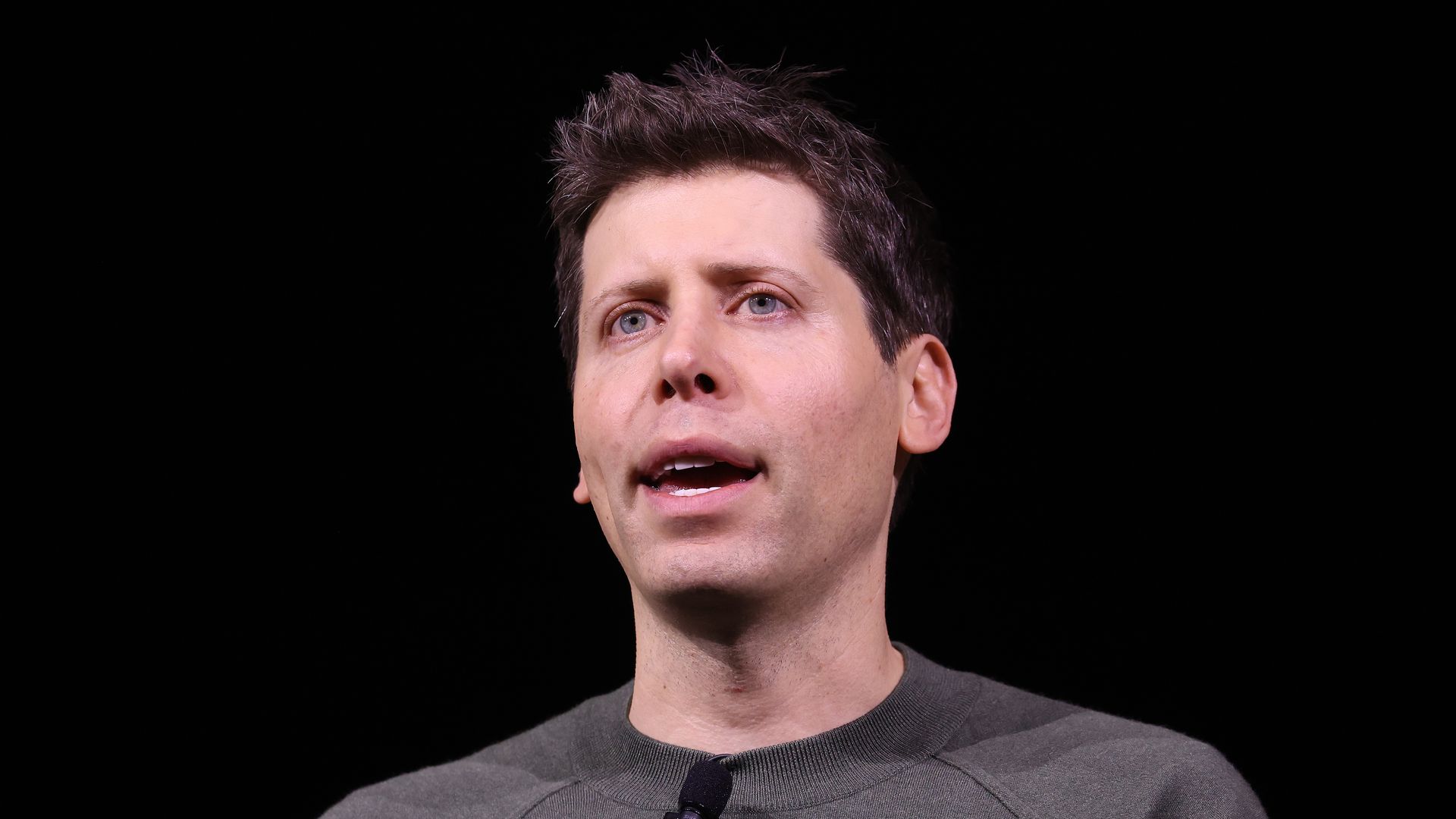
OpenAI CEO Sam Altman, speaking against a black backdrop.

OpenAI CEO Sam Altman. Photo: Justin Sullivan/Getty Images

Add Axios on Google

What to read next
Read the whole story
bogorad
1 day ago
reply
Barcelona, Catalonia, Spain
Share this story
Delete

Inside the plan to kill Ali Khamenei // Israel spent years hacking Tehran’s traffic cameras and monitoring bodyguards ahead of the assassination of Iran’s supreme leader

1 Share
  • Hacked Cameras and "Pattern of Life": Israeli intelligence reportedly exploited years of hacked traffic cameras in Tehran to build detailed profiles, known as "pattern of life" data, on Iranian officials' security details, tracking their movements and routines.
  • Mobile Phone Disruption: For the assassination operation, Israel allegedly disrupted mobile phone towers near the target location, making phones appear busy and potentially preventing warnings from reaching Khamenei's protection detail.
  • Deep Intelligence Picture: Israel's intelligence campaign, utilizing Unit 8200, Mossad assets, and military intelligence analysis, created an extensive "intelligence picture" of Tehran, allowing them to identify anomalies and plan operations.
  • Social Network Analysis for Targeting: Sophisticated mathematical methods like social network analysis were employed to sift through vast amounts of data, identifying key decision-makers and potential targets within Iran.
  • Strategic Gains Debated: While Israel has a history of assassinating foreign targets, the extent to which its technological and intelligence-driven operations have translated into significant strategic gains remains a subject of debate.
  • Targeting Khamenei During Wartime: The decision to assassinate Khamenei was political, not solely technological, and was timed to coincide with a planned meeting of senior Iranian officials, deemed a more opportune moment than during declared war.
  • Combined U.S. and Israeli Intelligence: The operation involved a combination of Israeli intelligence, including technical surveillance from hacked cameras and phone networks, and a crucial human source reportedly provided by the CIA.
  • Long-Term Focus on Iran: A directive from 2001 established Iran as a top priority for Israeli intelligence, leading to decades of efforts to disrupt its nuclear program, assassinate scientists, and degrade its military capabilities.

When the highly trained, loyal bodyguards and drivers of senior Iranian officials came to work near Pasteur Street in Tehran — where Ayatollah Ali Khamenei was killed in an Israeli air strike on Saturday — the Israelis were watching.

Nearly all the traffic cameras in Tehran had been hacked for years, their images encrypted and transmitted to servers in Tel Aviv and southern Israel, according to two people familiar with the matter.

One camera had an angle that proved particularly useful, according to one of the people, allowing them to determine where the men liked to park their personal cars and providing a window into the workings of a mundane part of the closely guarded compound.

Complex algorithms added details to dossiers on members of these security guards that included their addresses, hours of duty, routes they took to work and, most importantly, who they were usually assigned to protect and transport — building what intelligence officers call a “pattern of life”.

Show video info
LOADING
Show video description
Video description

Shot from a balcony, two large plumes of smoke rise over the rooftops of Tehran

Large plumes of smoke are visible in the direction of Ali Khamenei’s compound in Tehran on February 28 © X

The capabilities were part of a years-long intelligence campaign that helped pave the way for the ayatollah’s assassination. This source of real-time data — one of hundreds of different streams of intelligence — was not the only way Israel and the CIA were able to determine exactly what time 86-year-old Khamenei would be in his offices this fateful Saturday morning and who would be joining him.

Nor was the fact that Israel was also able to disrupt single components of roughly a dozen or so mobile phone towers near Pasteur Street, making the phones seem as if they were busy when called and stopping Khamenei’s protection detail from receiving possible warnings.

Long before the bombs fell, “we knew Tehran like we know Jerusalem”, said one current Israeli intelligence official. “And when you know [a place] as well as you know the street you grew up on, you notice a single thing that’s out of place.”

The dense, so-called “intelligence picture” of the arch-enemy’s capital was the result of laborious data collection, made possible by Israel’s sophisticated signals intelligence Unit 8200, the human assets recruited by its foreign intelligence agency the Mossad and the mountains of data digested by military intelligence into daily briefs.

Israel used a mathematical method known as social network analysis to parse through billions of data points to unearth unlikely centres of decision-making gravity and identify fresh targets to surveil and kill, said a person familiar with its use. All this fed an assembly line with a single product: targets.

“In Israeli intelligence culture, targeting intelligence is the most essential tactical issue — it is designed to enable a strategy,” said Itai Shapira, a brigadier general in the Israeli military reserves and 25-year veteran of its intelligence directorate. “If the decision maker decides that someone has to be assassinated, in Israel the culture is: ‘We will provide the targeting intelligence.’”

Drone bases, aircraft shelters and radar sites were destroyed by US and Israeli strikes © Vantor 2026

Israel has assassinated hundreds of people overseas, including militant leaders, nuclear scientists, chemical engineers — and many innocent bystanders. But even with the killing of as prominent a political and religious leader as Khamenei, how much this aggressive, decades-long use of its technological and technical prowess has paved the way for major strategic gains is fiercely debated both within and outside Israel.

The country’s intelligence superiority was on full display in the 12-day war last June, when more than a dozen Iranian nuclear scientists and high-ranking military officials were assassinated within minutes in an opening salvo.

That had been accompanied by an unprecedented disabling of Iran’s aerial defences through a combination of cyber attacks, low-range drones and precise munitions fired from outside Iran’s borders, destroying the radars of the Russian-built missile launchers.

“We took their eyes first,” said one current intelligence official. Both in the June war and now, Israeli pilots have used a specific kind of missile called the Sparrow, variants of which are able to hit a target as small as a dining table from more than 1,000km away — far from Iran and the reach of any of its aerial defence systems.

Not all of the details of the latest operation are known. Some may never be made public, in order to protect sources and methods still being used to track down other targets.

But killing Khamenei was a political decision, not simply a technological achievement, said more than half a dozen current and former Israeli intelligence officials interviewed for this story.

When the CIA and Israel determined that Khamenei would be holding a meeting on Saturday morning at his offices near Pasteur Street, the chance to kill him alongside so much of Iran’s senior leadership was especially opportune.

They assessed that hunting them down after a war had properly begun would have been much harder, since the Iranians would quickly embark on pre-arranged evasive practices, including heading underground to bunkers immune to Israeli bombs.

Khamenei, unlike his ally Hizbollah leader Hassan Nasrallah, did not live in hiding. Nasrallah had spent years of his life in underground bunkers, dodging several Israeli assassination attempts until September 2024, when Israeli fighter jets dropped as many as 80 bombs over his hide-out in Beirut, killing him.

Instead, Khamenei had mused in public about the possibility of being killed, dismissing his own life as inconsequential to the fate of the Islamic republic — in fact, some Iran experts have said he expected to be martyred.

But during wartime, one of the people interviewed said, he did take some precautions. “It was unusual for him to not be in his bunker — he had two bunkers — and if he had been, Israel wouldn’t have been able to reach him with the bombs that they have,” the person said.

Large smoke plumes from the direction of Khamenei’s compound were seen across Tehran © X

Even in June 2025, in the throes of a full-blown war, Israel made no known attempts to bomb Khamenei. It had instead targeted mostly the leadership of the Iranian Revolutionary Guards Corps, missile launchers and stockpiles and Iran’s nuclear facilities and scientists.

While Donald Trump had repeatedly threatened to attack Iran in recent weeks, building up an “armada” off its shores, negotiations between the US and Iran over the Islamic republic’s nuclear programme were meant to continue this week.

The mediator Oman said Iran was willing to make concessions that might help stave off a war, and described the most recent meeting last Thursday as fruitful.

In public, the US president grumbled that things were moving too slowly. But a person familiar with the matter said that, in private, Trump was “dissatisfied with the Iranian responses”, paving the way for war.

A person briefed on the operation said the attack on Iran had been planned for months, but officials adjusted their operation after the US and Israeli intelligence confirmed that Khamenei and his senior officials would be meeting in his compound in Tehran on Saturday morning.

Donald Trump discusses the conflict on Saturday with secretary of state Marco Rubio and White House chief of staff Susie Wiles © Daniel Torok/The White House/AP

Tracking individual targets used to be laborious work, requiring visual confirmations and parsing false confirmations, but Israel’s vast algorithm-driven data collection had automated that task in recent years.

But for a target as high value as Khamenei, failure was not an option. Israeli military doctrine requires that two separate senior officers, working independently from each other, confirm with high certainty that a target is in the location that is to be attacked and who he is accompanied by.

In this instance, according to two people familiar with the matter, Israeli intelligence had information from signals intelligence, such as the hacked traffic cameras and deeply penetrated mobile phone networks. One of the people said it showed that the meeting with Khamenei was on schedule, with senior officials heading to the location.

But the Americans had something even more concrete — a human source, both people familiar with the situation said. The CIA declined to comment.

That allowed Israeli jets, which had been flying for hours in order to arrive on time at the right location, to fire off as many as 30 precision munitions, the former senior Israeli intelligence official said.

The Israeli military added that striking in daylight provided an advantage. “The decision to strike in the morning rather than at night allowed Israel to achieve tactical surprise for the second time, despite heavy Iranian preparedness,” it said.

Show video info
LOADING
Show video description
Video description

Drone footage shows two large buildings erupting in smoke after a strike

Footage posted by the Israel Defense Forces on Mar 1 shows a strike on the Islamic Revolutionary Guard Corps' Sarallah headquarters in north Tehran © IDF/X

The tactical success was the culmination of two separate events, more than 20 years apart, said Sima Shine, a former official at the Mossad who had a focus on Iran.

The first was a directive given in 2001 from former Prime Minister Ariel Sharon to Meir Dagan, the then-head of the Mossad — preoccupied with Syria, Palestinian militants, Hizbollah in Lebanon and others — to make Iran a priority.

“‘All the things the Mossad is doing is well and fine,’” Sharon told Dagan, according to Shine. “‘What I need is Iran. That’s your target.’”

“And since then, that is the target,” she said. Israel had sabotaged Iran’s nuclear programme, killed its scientists, fought back its proxies and even destroyed the military infrastructure of its crucial ally Syria in the days after dictator Bashar al-Assad was ousted.

But Iranian intelligence agencies were formidable adversaries.

In 2022, a group tied to Iranian security services released data purportedly siphoned from a phone belonging to the Mossad chief’s wife. Iran also hacked CCTV cameras in Jerusalem during the 2025 war to get real-time damage assessments that the Israelis had censored from broadcast; it bought photographs of missile defences; and even mapped the jogging route of a major politician by bribing Israeli citizens, according to Israeli prosecutors.

The second event, Shine added, was the October 7, 2023 cross-border attack from Hamas, which Israel claims was backed by Iran and changed a longstanding calculus in Israel: that despite having penetrated the circles of several enemy heads of state, from Egypt’s Gamal Abdel Nasser to Syria’s Hafez al-Assad, their killings were off-limits even at times of war.

Killing foreign leaders is not just taboo but operationally fraught. Failure only adds to their stature, as it did following the CIA’s many botched attempts to kill Cuba’s Fidel Castro, while success can set into motion unpredictable chaos.

But, said Shine, Israel’s string of intelligence coups — including the 2024 assassination of Hamas leader Ismail Haniyeh in Tehran, and a $300mn multiyear clandestine project to booby trap thousands of Hizbollah pagers and radios — has its own seductive powers.

“In Hebrew, we say, ‘With the food comes the appetite’,” she said. “In other words, the more you have, the more you want.”

Graphics by Chris Campbell, Aditi Bhandari and Ian Bott

Read the whole story
bogorad
2 days ago
reply
Barcelona, Catalonia, Spain
Share this story
Delete

What’s Really at Stake in the Fight Between Anthropic and the Pentagon - WSJ

1 Share
  • Defense Conflict: The US Department Of Defense Has Clashed With Anthropic Over Imposed Limits On Military Technology Use
  • Guardrail Dispute: Anthropic Refused To Remove Internal Rules Prohibiting Its AI From Being Used For Autonomous Weapons And Mass Surveillance
  • Security Designation: Defense Secretary Pete Hegseth Labeled Anthropic A Supply Chain Risk Following Their Refusal To Meet Pentagon Demands
  • Executive Action: President Trump Responded By Ending All Federal Government Use Of Anthropics AI Models And Technology
  • Market Competition: Competitors Like OpenAI And xAI Have Moved To Secure Pentagon Deals For Classified Settings Following Anthropics Exit
  • Sovereign Authority: Pentagon Officials Asserted That Elected Officials And Congress Rather Than Private Corporations Determine The Rules Of Engagement
  • National Security: The Military Desires AI Capabilities To Combat High Speed Threats Such As Drone Swarms And Hypersonic Missiles
  • Economic Impact: Real World Applications For Military AI Currently Include Logistics Optimization Cybersecurity And Mission Summarization Tasks

Tim Higgins

By

Tim Higgins


Illustration of Pete Hegseth, military equipment, and Dario Amodei.

Defense Secretary Pete Hegseth and Anthropic CEO Dario Amodei Jeremy Leung/WSJ, AP, Bloomberg

It would be so much easier to understand the fight between the Pentagon and AI star Anthropic if we were talking about traditional weapons.

If Anthropic were selling bullets, for example, then obviously Defense Secretary Pete Hegseth wouldn’t want limits imposed by an ammunition maker on whom he could shoot at or when. But AI is way more, a nascent technology featuring the promise of possible superintelligence. Its potential uses and capabilities are still being developed.

So the real fight is over the dream of what AI could be.

It is the same disagreement that is taking place across Wall Street and corporate America. What exactly does artificial intelligence mean for our future? 

It is a question that sent the stock market into a tizzy this past week on a report by Citrini Research that painted a doomsday scenario for the economy if AI wipes out the white-collar workforce. “What if our AI bullishness continues to be right…and what if that’s actually bearish?” the firm asked.

It’s at the heart of some Silicon Valley workers’ fears that the American dream is on the verge of vanishing as AI further divides the haves from the have-nots in a world where humans are replaced by robots in factories and cubicles.

For Anthropic Chief Executive Officer Dario Amodei, there is concern over Pentagon demands to remove its self-imposed rules that prevent the company’s AI from being used for mass domestic surveillance and autonomous weapons. “Frontier AI systems are simply not reliable enough to power fully autonomous weapons,” Amodei said Thursday. “We will not knowingly provide a product that puts America’s warfighters and civilians at risk.”

His statement came ahead of a Friday deadline for the company to get on board with the Pentagon’s demands or else face some pretty dire consequences. With Anthropic’s recalcitrance, President Trump responded by announcing the entire federal government would stop working with Anthropic.


Newsletter Sign-up

Technology

A weekly digest of tech columns, big stories and personal tech advice, plus a news ticker and a touch of dark humor.

Subscribe


Hegseth declared Anthropic a supply-chain risk, imperiling its ability to work with other companies that do business with the U.S. government. That cleared the way for rivals to swoop in, such as OpenAI, which on Friday said it had agreed to a deal with the Pentagon for its AI to be used in classified settings that satisfies its own safety concerns.  

For the Pentagon, the Anthropic fight has been about concerns that a private company—especially one the Trump administration has labeled as “woke”—wanted to control how the military uses technology. 

Emil Michael, undersecretary at the Pentagon for research and engineering, spent the past week stressing that Anthropic’s AI would be used for lawful purposes—adding that there are laws against mass domestic surveillance and rules that govern autonomous weapons. Anthropic doesn’t “make the rules,” the former Uber executive told Bloomberg TV on Friday. “Congress makes the rules, the president signed them, we execute them,” he said.

At the heart of that debate is a bigger question: Is AI a tool—a silver bullet to answer hard questions or find new efficiencies? For the Pentagon, that might look like a way to combat swarming AI drones launched by an enemy, for example. For businesses, that might look like a way to free up workers from busy work so the company can do more.

Or is AI something more? For many in Silicon Valley, that might mean AI will develop a consciousness of its own, become a godlike power—and replace human labor altogether. 

To be clear, it was still early days for the Defense Department’s use of Anthropic’s AI. 

Amodei has said his technology has been used for cybersecurity and to support combat operations by the military and intelligence community. Its AI was used—through a partnership with the data company Palantir Technologies—in the U.S. military’s operation to capture Venezuelan leader Nicolás Maduro, my colleagues have reported.

“No one on the ground has actually, to our knowledge, run into the limits” imposed by Anthropic, Amodei told CBS News on Friday. “I can’t say what their plans are—we don’t know—but we have no evidence that these use cases have actually…run into trouble.”

When the Pentagon’s Michael describes how Anthropic’s AI is being used, it sounds familiar to anyone using Claude or OpenAI’s ChatGPT—except running on classified information—as the large organization looks to be more efficient. 

“In the military context, there’s a lot of logistics that happen in the military,” he told CBS News. “How do I get something from one place to another? How much stuff do I have in either place? What do I need to move efficiently forward? What supplies might I need for a certain mission? How do I take all these different papers that have been written about what I’m going to do and make it in a consistent, summarized document?”

In other words, boring stuff. 

Yet, the Pentagon sees the potential for autonomous weapons—with a human in the loop, as officials stress—as important to national security, given the advances seen in drone technology in places such as Ukraine. 

“From a defense standpoint, whether it’s a drone swarm that’s coming at a military base, whether it’s a hypersonic missile coming at the United States…you want to be able to take them down potentially faster than a human could alone,” Michael told Bloomberg News.

What apparently increased tensions between the Pentagon and Anthropic was a hypothetical question poised to the startup about whether it would prohibit the government from using the company’s models to stop an imminent missile attack against the U.S. because of its autonomous-weapons prohibition. 

And, just like that, it was as if the 1983 sci-fi movie “WarGames” was feeling real.

SHARE YOUR THOUGHTS

What do you think AI means for the future? Is it a tool, or something more? Join the conversation below.

The debate is a natural byproduct of the hype around AI that has ushered in an era of magical thinking. What was once the stuff of sci-fi now feels possible—even if the actual AI technology is still far from being able to do what’s being imagined. 

Still, advances in the AI labs and noticeable improvements in the chatbots fuel more ideas of what could come. It has suddenly become mainstream to think wildly. So much so that it can feel like we’re living in a time when the limits of what might be possible are merely constrained by one’s imagination. 

It isn’t surprising, then, that there will be fights today to decide whose dream of AI wins tomorrow.

Write to Tim Higgins at tim.higgins@wsj.com

The Global AI Race

Coverage of advancements in artificial intelligence, selected by the editors

Get WSJ's AI Newsletter

Government Agencies Raise Alarms About Use of Elon Musk’s Grok Chatbot Government Agencies Raise Alarms About Use of Elon Musk’s Grok Chatbot

Amazon Tries Its Low-Cost Approach to Winning the AI Race Amazon Tries Its Low-Cost Approach to Winning the AI Race

Meta and AMD Agree to AI Chips Deal Worth More Than $100 Billion Meta and AMD Agree to AI Chips Deal Worth More Than $100 Billion

Anthropic Accuses Chinese Companies of Siphoning Data From Claude Anthropic Accuses Chinese Companies of Siphoning Data From Claude

Copyright ©2026 Dow Jones & Company, Inc. All Rights Reserved. 87990cbe856818d5eddac44c7b1cdeb8


What to Read Next

[

Trump Administration Shuns Anthropic, Embraces OpenAI in Clash Over Guardrails

](https://www.wsj.com/tech/ai/trump-will-end-government-use-of-anthropics-ai-models-ff3550d9?mod=WTRN_pos1)

[

The OpenAI chief says the deal for the Pentagon to use its tools in classified settings includes the same prohibitions that Anthropic had wanted.

](https://www.wsj.com/tech/ai/trump-will-end-government-use-of-anthropics-ai-models-ff3550d9?mod=WTRN_pos1)

Continue To Article


EXCLUSIVE

[

Altman Says OpenAI Is Working on Pentagon Deal Amid Anthropic Standoff

](https://www.wsj.com/tech/ai/openais-sam-altman-calls-for-de-escalation-in-anthropic-showdown-with-hegseth-03ecbac8?mod=WTRN_pos2)

[

Altman waded into the standoff between Anthropic and the Pentagon over the use of AI on the battlefield, telling his staff that the company was working on a deal that might help solve the impasse.

](https://www.wsj.com/tech/ai/openais-sam-altman-calls-for-de-escalation-in-anthropic-showdown-with-hegseth-03ecbac8?mod=WTRN_pos2)

Continue To Article


[

Anthropic Refuses Pentagon’s Proposal to Loosen AI Guardrails

](https://www.wsj.com/politics/national-security/anthropic-claude-defense-department-update-b17544d9?mod=WTRN_pos4)

[

The decision comes ahead of a Friday deadline to reach an agreement or face tough government measures.

](https://www.wsj.com/politics/national-security/anthropic-claude-defense-department-update-b17544d9?mod=WTRN_pos4)

Continue To Article


EXCLUSIVE

[

Government Agencies Raise Alarm About Use of Elon Musk’s Grok Chatbot

](https://www.wsj.com/politics/national-security/elon-musk-xai-grok-security-safety-government-73ab4f6e?mod=WTRN_pos5)

[

Warnings about xAI’s safety and reliability preceded the Pentagon’s decision to approve Grok for use in classified settings.

](https://www.wsj.com/politics/national-security/elon-musk-xai-grok-security-safety-government-73ab4f6e?mod=WTRN_pos5)

Continue To Article


[

Pentagon Gives Anthropic Ultimatum and Deadline in AI Use Standoff

](https://www.wsj.com/tech/ai/pentagon-gives-anthropic-ultimatum-and-deadline-in-ai-use-standoff-40915a8a?mod=WTRN_pos6)

[

Defense Secretary Pete Hegseth threatened to use the government’s leverage in a meeting with CEO Dario Amodei at the Pentagon.

](https://www.wsj.com/tech/ai/pentagon-gives-anthropic-ultimatum-and-deadline-in-ai-use-standoff-40915a8a?mod=WTRN_pos6)

Continue To Article


[

Tech, Media & Telecom Roundup: Market Talk

](https://www.wsj.com/business/tech-media-telecom-roundup-market-talk-ebe1c085?mod=WTRN_pos7)

[

Find insight on Warner Bros. Discovery, Alphabet, Palantir and more in the latest Market Talks covering Technology, Media and Telecom.

](https://www.wsj.com/business/tech-media-telecom-roundup-market-talk-ebe1c085?mod=WTRN_pos7)

Continue To Article


[

Trump blacklists Anthropic — and OpenAI swoops in

](https://www.marketwatch.com/story/trump-blacklists-anthropic-opening-the-door-to-elon-musk-and-xai-03011fda?mod=WTRN_pos8)

[

Claude developer Anthropic refused to let its products be deployed for autonomous weapons or mass surveillance.

](https://www.marketwatch.com/story/trump-blacklists-anthropic-opening-the-door-to-elon-musk-and-xai-03011fda?mod=WTRN_pos8)

Continue To Article


[

In Madrid, Recoletos Is the Neighborhood With That ‘Old Money Feel’

](https://www.mansionglobal.com/articles/in-madrid-recoletos-is-the-neighborhood-with-that-old-money-feel-0d689d67?mod=WTRN_pos9)

[

The sophisticated, high-priced enclave is removed enough from bustling Centro yet lies within minutes of shopping and restaurants

](https://www.mansionglobal.com/articles/in-madrid-recoletos-is-the-neighborhood-with-that-old-money-feel-0d689d67?mod=WTRN_pos9)

Continue To Article


Videos

Read the whole story
bogorad
3 days ago
reply
Barcelona, Catalonia, Spain
Share this story
Delete

This Is the End - by Hussein Aboubakr Mansour

1 Share
  • Confirmed Death: White House And Israeli Officials Verified That Ayatollah Khamenei Was Killed By A Joint Military Strike That Destroyed His Tehran Compound
  • Leadership Tenure: Khamenei Ruled The Islamic Republic For Thirty Six Years Following His Appointment In Nineteen Eighty Nine After The Death Of Khomeini
  • Revolutionary Background: He Served As President During The Nineteen Eighties And Was A Primary Figure Linked To The Original Nineteen Seventy Nine Revolutionary Generation
  • Security Control: His Power Was Maintained Through The Methodical Expansion Of The Revolutionary Guard Into A Dominant Economic And Military Praetorian Class
  • Terrorism Sponsorship: The Deceased Leader Built An Extensive Regional Proxy Network Including Groups Such As Hezbollah Hamas And The Houthi Militants
  • Nuclear Ambitions: Under His Rule Iran Advanced Its Nuclear Program Infrastructure While Utilizing Diplomatic Agreements To Secure Temporary Sanctions Relief
  • Domestic Suppression: Khamenei Systematically Crushed Internal Social Protests And Reformist Movements Scaling Up Violently To Masacres Of Thousands In Recent Years
  • Historical Resonance: The Elimination Of The Supreme Leader Occurred On The Eve Of Purim A Festival Celebrating The Deliverance Of Jews From A Persian Oppressor

[

Where Is Iran's Supreme Leader, Ayatollah Ali Khamenei? - The New York Times

](https://substackcdn.com/image/fetch/$s_!-okw!,f_auto,q_auto:good,fl_progressive:steep/https%3A%2F%2Fsubstack-post-media.s3.amazonaws.com%2Fpublic%2Fimages%2Fcb0ae517-7c20-4883-b6ec-b1da26e34871_1800x1800.jpeg)

Share

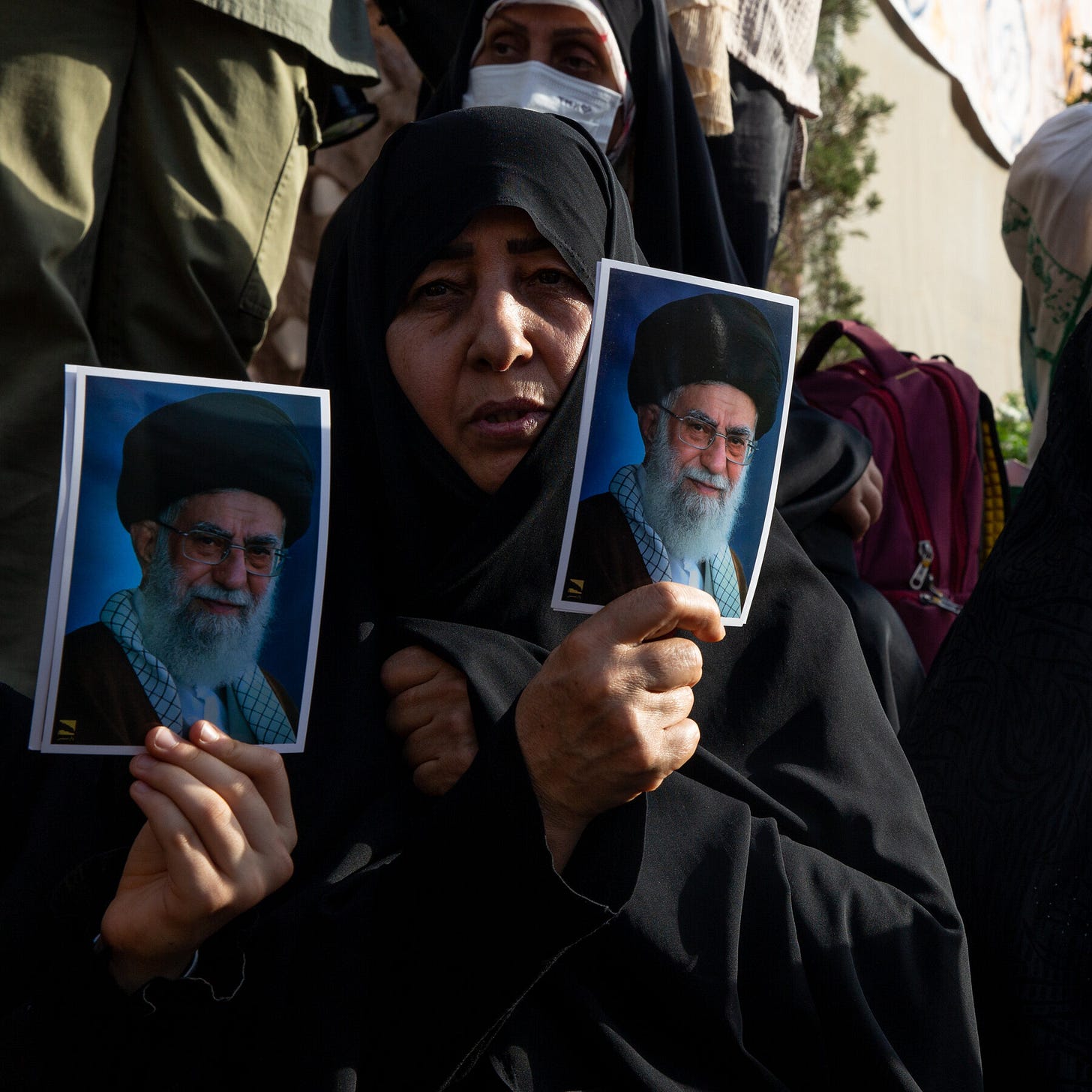
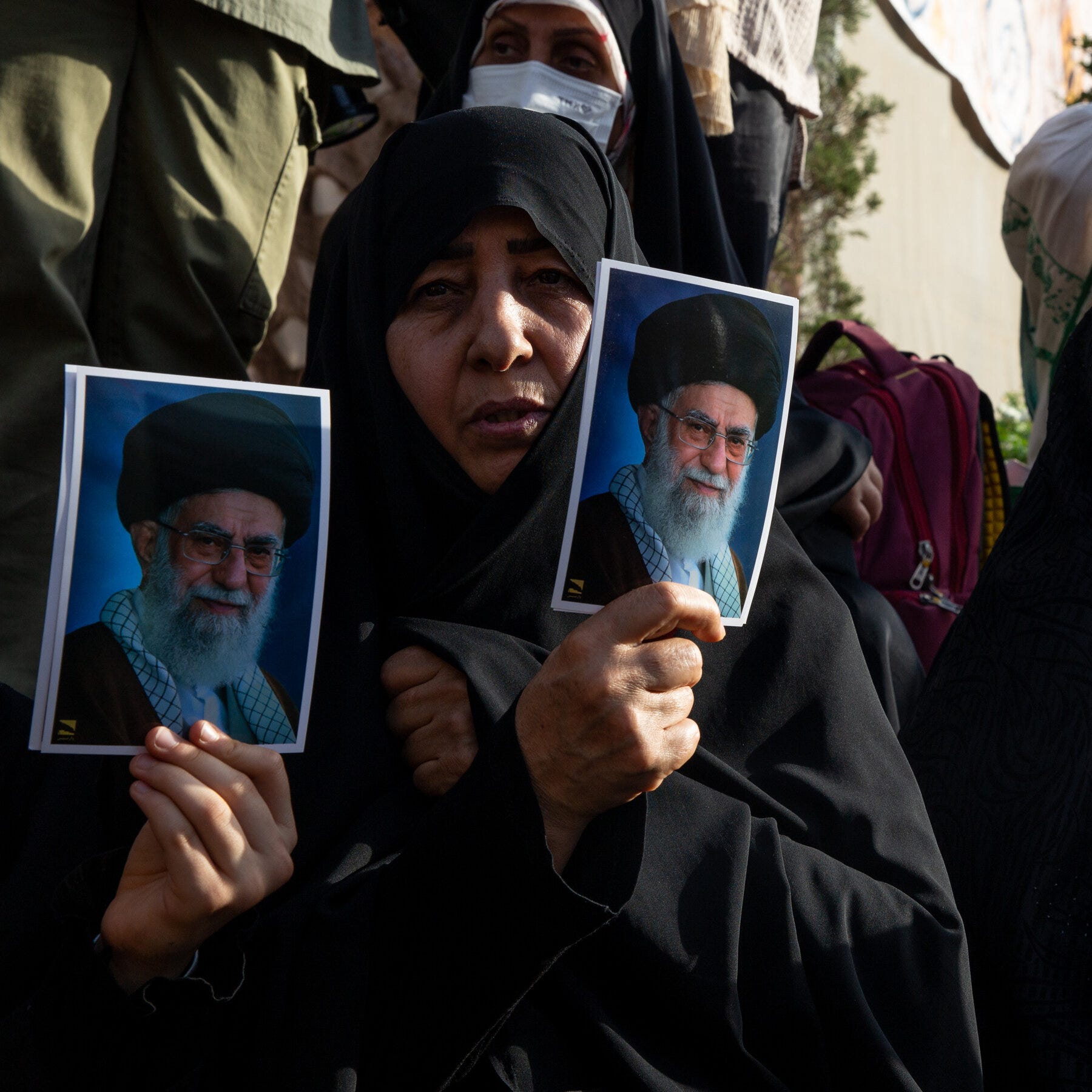
Khamenei is dead. The White House and Israeli officials confirmed it, and satellite imagery shows the compound in the heart of Tehran reduced to rubble. The man who ruled the Islamic Republic for thirty-six years, outlasted six American presidents, built and sustained the most consequential state sponsor of terrorism in the modern Middle East, and who oversaw the weekly chants of “Death to America” and “Death to Israel” — that man is gone, killed on a Saturday morning by the joint force of the two nations he swore to destroy.

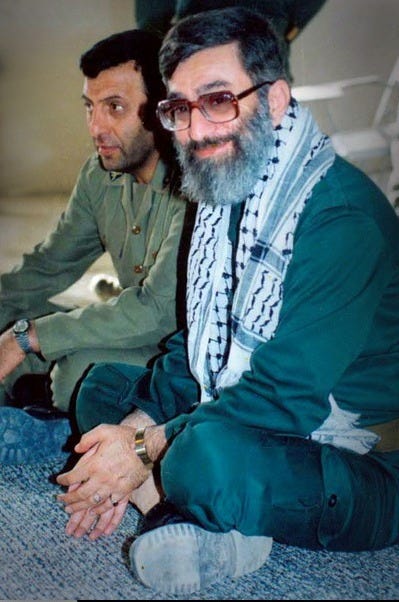
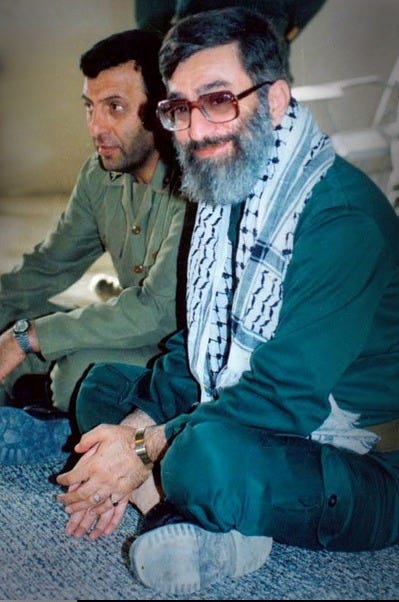
He was eighty-six years old. He had been the supreme leader since June 4, 1989, elected by the Assembly of Experts within hours of Khomeini’s death to a position for which he was, by the theological standards of Shi’a jurisprudence, never fully qualified. Khamenei was a hojatoleslam, a mid-ranking title of respect for Shiite Muslim clerics, translating to “Proof of Islam” or “Authority on Islam,” not a grand ayatollah. His authority, thus, was political, not scholarly. He compensated for this deficit with ruthlessness, patience, and an unbroken commitment to the revolutionary project that consumed his entire adult life. He was nineteen when he first began studying under Khomeini. He was a revolutionary before he was anything else, imprisoned under the Shah, wounded by an assassination attempt in 1981 that cost him the use of his right arm, and installed as president at forty-two in the chaotic aftermath of the republic’s founding. He served two terms, was elevated to supreme leader, and proceeded to outlast every rival, every reformist, every protest movement, and every American attempt at negotiation, containment, and coercion — until today.

[

File:Ayatollah Khamenei in Military Uniform in 1988 by Khamenei.ir 11  (c).jpg - Wikimedia Commons

](https://substackcdn.com/image/fetch/$s_!8Ckc!,f_auto,q_auto:good,fl_progressive:steep/https%3A%2F%2Fsubstack-post-media.s3.amazonaws.com%2Fpublic%2Fimages%2Fd64c93d8-db75-4729-85e0-802558a79a36_399x602.jpeg)

Middle-aged Ayatollah Khamenei in Military Uniform in 1988

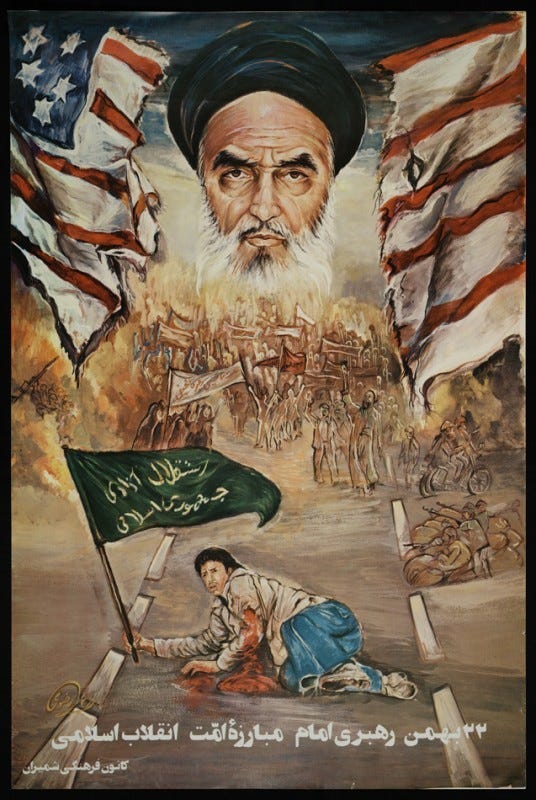
His career was the Islamic Republic. There is no separating the two. When the revolution’s founder, Khomeini, died in 1989, the system he left behind was volatile, factional, and untested. It was Khamenei who stabilized it — not through charisma, which he lacked, nor through theological authority, which he never fully possessed, but through the methodical cultivation of the Revolutionary Guard as a parallel state, an economic empire, and a praetorian class whose fortunes were indistinguishable from his own. He turned the IRGC from a revolutionary militia into the largest conglomerate in Iran, controlling perhaps a third of the national economy. He built the proxy network all over the region — Hezbollah, Hamas, Islamic Jihad, the Houthis, the Iraqi militias — into the most effective non-state military architecture in the world. He advanced the nuclear program through every diplomatic arrangement designed to restrain it, extracting sanctions relief from the JCPOA while preserving the knowledge base and centrifuge infrastructure that made breakout capacity a permanent condition rather than a future possibility. He crushed the Green Movement in 2009, the protests of 2019, the Mahsa Amini uprising of 2022, and — with a cruelty that hastened the end — the December 2025 protests, in which his security forces massacred thousands. He was, in the full sense of the word, the last man standing of the 1979 generation — the final link between the Islamic Republic and its founding revolutionary act.

[

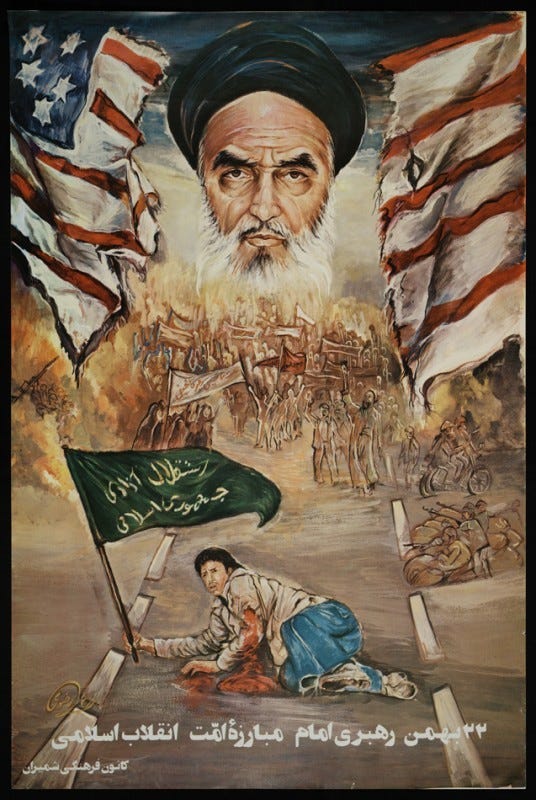
History In Posters — Iranian Anti-American poster with Khomeini...

](https://substackcdn.com/image/fetch/$s_!tM4h!,f_auto,q_auto:good,fl_progressive:steep/https%3A%2F%2Fsubstack-post-media.s3.amazonaws.com%2Fpublic%2Fimages%2F2ee5fbc2-8fd1-4fc1-a4fb-9f238e03a61b_536x800.jpeg)

And now he is dead, and the republic he held together through force, terror, and the sheer weight of fear faces the question it has spent forty-six years deferring: whether it can survive without a supreme leader, and whether anyone can command the loyalty that accrued not to the office but to the man.

The Islamic Republic of Iran was not merely another ideological state. It was, and I think many of our Ivy League leftist professors would agree, the most ambitious political-theological experiment of the twentieth century — the only successful revolutionary project to fuse modern state power and modern German ideology with premodern clerical authority and sustain it across nearly five decades. It outlived the Soviet Union, which fell twelve years after the revolution. It outlived Ba’athist Iraq, which Saddam took to war against it for eight years and which the Americans dismantled in 2003. It outlived Qaddafi’s Libya, Mubarak’s Egypt, and Assad’s Syria — the last of which fell in 2024, taking with it Iran’s most important Arab client state and the land corridor that connected Tehran to Hezbollah. It survived invasions, wars, sanctions, cyberwarfare, targeted assassinations, internal uprisings, and a twelve-day combined Israeli-American air campaign just eight months ago. It survived because Khamenei understood that revolutionary legitimacy is sustained only by the credible monopoly on organized terror and the systematic, violent elimination of alternatives. It was also the last successor state in the ideological lineage that descended from Nazi Germany through Arab Nationalism — the final regime to make the global propagation of antisemitism and the annihilation of Jews a matter of state doctrine.

And then there is the date.

Purim begins Monday evening. The festival that commemorates the deliverance of the Jewish people from Haman’s plot to annihilate them — a story set, as it happens, in Persia. In Shushan, in the land that became Iran. The Book of Esther is the only book of the Hebrew Bible in which God’s name does not appear, and the rabbinical tradition has always understood this as the point: that divine action in history is sometimes most present precisely where it is most hidden, working through the decisions of men and women who do not fully understand what they are enacting. Khamenei, who fashioned himself the heir to an Islamic revolution against the enemies of God, was killed by the Jewish state on the eve of the Jewish festival that celebrates the destruction of a Persian enemy who sought to destroy the Jews. He would have appreciated the irony, perhaps. I certainly do.

Whether one reads this through providence or coincidence is a matter of faith. But no one can deny the resonance, and the symbolism will likely do political work that no policy can. For the Iranian diaspora celebrating in the streets tonight, for the protesters who survived January’s massacres, for the Israelis sheltering from Iranian missiles that can no longer be replenished by the man who ordered their construction, for the world Jews — this is not an amusing accident. It is a story to be told.

This is the end. Not the end of the war, but it is the end of the Islamic Republic, at least, as it has existed since 1979, if not at all. And whatever emerges from the rubble of Khamenei’s compound and the wreckage of his nuclear program and the ruins of his proxy empire will not be the same thing. It cannot be. The Ayatollah is gone. The last guardian is dead, and the guardianship dies with him.

Seventy-two hours will tell us a great deal about what follows. But what happened today is already momentous. The longest-serving autocrat in the modern Middle East, the architect of the region’s most destabilizing project or terrorism, the first enemy of America and of Jews, was killed by those two nations acting in concert on the eve of the festival that commemorates exactly such a deliverance. History is not ironic. But it rhymes — sometimes in bangs, sometimes in a whimper, today in both.

Khamenei is dead. The Islamic Republic is over. The Prussian utopian vision of political Islam is largely no more. The rest is politics.

Baruch atah, Adonai Eloheinu, Melech haolam, shehecheyanu, v'kiy'manu, v'higiyanu laz'man hazeh!

The Abrahamic Metacritique is a reader-supported publication. To receive new posts and support my work, consider becoming a free or paid subscriber.

Read the whole story
bogorad
3 days ago
reply
Barcelona, Catalonia, Spain
Share this story
Delete

Why Tehran’s Two-Tiered Internet Is So Dangerous - Schneier on Security

1 Share
  • Total Communications Shutdown: The January 2026 blackout went beyond standard web filtering by disabling mobile networks, landlines, and domestic infrastructure to prevent all forms of citizen coordination.
  • Strategic Infrastructure Interference: Authorities dismantled both physical and logical layers of connectivity, including the removal of social features like comment sections and chat boxes from otherwise functional domestic services.
  • Institutionalized Tiered Access: The Supreme Council of Cyberspace has established a legal framework where global internet connectivity is a privilege granted based on loyalty rather than a default right.
  • Privileged Connectivity Classes: The implementation of "white SIM cards" allows government officials and security forces unrestricted access to global platforms like Instagram and WhatsApp while the general public remains restricted.
  • Digital Apartheid Tactics: Whitelisting at the data center level ensures that the state and its loyalists remain online during crises, making the economic and political costs of a general shutdown manageable for the regime.
  • Atomization Through Isolation: The network architecture is designed to break the psychological momentum of social movements by preventing the "swarm" dynamics associated with real-time digital coordination.
  • Exportable Repression Model: Iran's method of retrofitting standard global infrastructure with restrictive overlays provides a template for other regimes seeking high levels of control without building independent ecosystems.
  • Technological Redundancy Requirement: Countering these shutdowns necessitates the deployment of direct-to-cell satellite technology and mesh networks that bypass state-controlled internet service provider choke points.

Why Tehran’s Two-Tiered Internet Is So Dangerous

Iran is slowly emerging from the most severe communications blackout in its history and one of the longest in the world. Triggered as part of January’s government crackdown against citizen protests nationwide, the regime implemented an internet shutdown that transcends the standard definition of internet censorship. This was not merely blocking social media or foreign websites; it was a total communications shutdown.

Unlike previous Iranian internet shutdowns where Iran’s domestic intranet—the National Information Network (NIN)—remained functional to keep the banking and administrative sectors running, the 2026 blackout disrupted local infrastructure as well. Mobile networks, text messaging services, and landlines were disabled—even Starlink was blocked. And when a few domestic services became available, the state surgically removed social features, such as comment sections on news sites and chat boxes in online marketplaces. The objective seems clear. The Iranian government aimed to atomize the population, preventing not just the flow of information out of the country but the coordination of any activity within it.

This escalation marks a strategic shift from the shutdown observed during the “12-Day War” with Israel in mid-2025. Then, the government primarily blocked particular types of traffic while leaving the underlying internet remaining available. The regime’s actions this year entailed a more brute-force approach to internet censorship, where both the physical and logical layers of connectivity were dismantled.

The ability to disconnect a population is a feature of modern authoritarian network design. When a government treats connectivity as a faucet it can turn off at will, it asserts that the right to speak, assemble, and access information is revocable. The human right to the internet is not just about bandwidth; it is about the right to exist within the modern public square. Iran’s actions deny its citizens this existence, reducing them to subjects who can be silenced—and authoritarian governments elsewhere are taking note.

The current blackout is not an isolated panic reaction but a stress test for a long-term strategy, say advocacy groups—a two-tiered or “class-based” internet known as Internet-e-Tabaqati. Iran’s Supreme Council of Cyberspace, the country’s highest internet policy body, has been laying the legal and technical groundwork for this since 2009.

In July 2025, the council passed a regulation formally institutionalizing a two-tiered hierarchy. Under this system, access to the global internet is no longer a default for citizens, but instead a privilege granted based on loyalty and professional necessity. The implementation includes such things as “white SIM cards“: special mobile lines issued to government officials, security forces, and approved journalists that bypass the state’s filtering apparatus entirely.

While ordinary Iranians are forced to navigate a maze of unstable VPNs and blocked ports, holders of white SIMs enjoy unrestricted access to Instagram, Telegram, and WhatsApp. This tiered access is further enforced through whitelisting at the data center level, creating a digital apartheid where connectivity is a reward for compliance. The regime’s goal is to make the cost of a general shutdown manageable by ensuring that the state and its loyalists remain connected while plunging the public into darkness. (In the latest shutdown, for instance, white SIM holders regained connectivity earlier than the general population.)

The technical architecture of Iran’s shutdown reveals its primary purpose: social control through isolation. Over the years, the regime has learned that simple censorship—blocking specific URLs—is insufficient against a tech-savvy population armed with circumvention tools. The answer instead has been to build a “sovereign” network structure that allows for granular control.

By disabling local communication channels, the state prevents the “swarm” dynamics of modern unrest, where small protests coalesce into large movements through real-time coordination. In this way, the shutdown breaks the psychological momentum of the protests. The blocking of chat functions in nonpolitical apps (like ridesharing or shopping platforms) illustrates the regime’s paranoia: Any channel that allows two people to exchange text is seen as a threat.

The United Nations and various international bodies have increasingly recognized internet access as an enabler of other fundamental human rights. In the context of Iran, the internet is the only independent witness to history. By severing it, the regime creates a zone of impunity where atrocities can be committed without immediate consequence.

Iran’s digital repression model is distinct from, and in some ways more dangerous than, China’s “Great Firewall.” China built its digital ecosystem from the ground up with sovereignty in mind, creating domestic alternatives like WeChat and Weibo that it fully controls. Iran, by contrast, is building its controls on top of the standard global internet infrastructure.

Unlike China’s censorship regime, Iran’s overlay model is highly exportable. It demonstrates to other authoritarian regimes that they can still achieve high levels of control by retrofitting their existing networks. We are already seeing signs of “authoritarian learning,” where techniques tested in Tehran are being studied by regimes in unstable democracies and dictatorships alike. The most recent shutdown in Afghanistan, for example, was more sophisticated than previous ones. If Iran succeeds in normalizing tiered access to the internet, we can expect to see similar white SIM policies and tiered access models proliferate globally.

The international community must move beyond condemnation and treat connectivity as a humanitarian imperative. A coalition of civil society organizations has already launched a campaign calling fordirect-to-cell” (D2C) satellite connectivity. Unlike traditional satellite internet, which requires conspicuous and expensive dishes such as Starlink terminals, D2C technology connects directly to standard smartphones and is much more resilient to infrastructure shutdowns. The technology works; all it requires is implementation.

This is a technological measure, but it has a strong policy component as well. Regulators should require satellite providers to include humanitarian access protocols in their licensing, ensuring that services can be activated for civilians in designated crisis zones. Governments, particularly the United States, should ensure that technology sanctions do not inadvertently block the hardware and software needed to circumvent censorship. General licenses should be expanded to cover satellite connectivity explicitly. And funding should be directed toward technologies that are harder to whitelist or block, such as mesh networks and D2C solutions that bypass the choke points of state-controlled ISPs.

Deliberate internet shutdowns are commonplace throughout the world. The 2026 shutdown in Iran is a glimpse into a fractured internet. If we are to end countries’ ability to limit access to the rest of the world for their populations, we need to build resolute architectures. They don’t solve the problem, but they do give people in repressive countries a fighting chance.

This essay originally appeared in Foreign Policy.

Tags: censorship, Internet

Posted on February 27, 2026 at 7:05 AM9 Comments

Read the whole story
bogorad
4 days ago
reply
Barcelona, Catalonia, Spain
Share this story
Delete
Next Page of Stories