Strategic Initiatives
12142 stories
·
45 followers

New York City Mandates Pushy Tipping Prompts for Delivery Apps // The new rules are likely to increase food-delivery costs and frustrate consumers.

1 Share
  • Legislative Mandates: New York City laws now require delivery platforms to display tipping prompts before checkout and feature a 10 percent default tip suggestion.
  • Administrative Enforcement: The Mamdani administration, through the Department of Consumer and Worker Protection (DCWP), has committed to aggressive compliance monitoring and legal action against delivery companies.
  • Legal Standing: Federal judges rejected lawsuits filed by gig companies like Uber and DoorDash, allowing the new tipping regulations to take effect as of January 26.
  • Regulatory Justification: The DCWP asserts that previous attempts by companies to move tip prompts to after-order screens resulted in substantial reductions in worker gratuities.
  • Economic Impact: Government-mandated tipping prompts are expected to contribute to "tip creep," potentially increasing consumer costs and reducing the overall volume of delivery orders.
  • Market Consequences: Similar interventions, such as mandated delivery-driver minimum wages, have previously been linked to higher prices for consumers and decreased demand for services.
  • Consumer Perception: Aggressive, state-enforced tipping prompts are increasingly viewed by the public as manipulative business tactics that shift labor costs directly onto the user.

Last year, the New York City Council passed several laws requiring delivery apps like DoorDash and Instacart to prompt users for a tip, and to make the prompts extra visible by making them appear before the completion of the order. Under new Mayor Zohran Mamdani, the city’s Department of Consumer and Worker Protection (DCWP) is pledging to enforce these laws aggressively.

The tipping-prompt mandates are a well-intentioned effort to help gig workers. But they build on prior misguided policies pushed by New York politicians. These latest rules will increase consumers’ tipping fatigue and likely raise food-delivery costs.

Finally, a reason to check your email.

Sign up for our free newsletter today.

First Name*
Last Name*
Email*
Sign Up
This site is protected by hCaptcha and its Privacy Policy and Terms of Service apply.
Thank you for signing up!

In 2023, the city council created a minimum wage for app-based restaurant delivery drivers. Unsurprisingly, that decision raised the cost of food delivery in New York City. Many companies responded by moving tipping prompts so that they appeared after a delivery order was completed, rather than before. That change was meant to reduce the price shock customers experienced when placing an order.

The city council responded to this shift with new ordinances. These required that app-based delivery companies display a suggested tip amount of 10 percent by default and position the tipping prompt before or at the time the order is placed, rather than afterward. Both measures are meant to increase tips.

Gig companies—including DoorDash, Uber, and Instacart—filed numerous lawsuits to block enforcement of these laws. In January, two federal judges rejected their bids, and the laws went into effect on January 26.

The Mamdani administration has signaled its intent to enforce the laws aggressively. DCWP is led by Samuel Levine, the former director of the Federal Trade Commission’s Bureau of Consumer Protection in the Biden administration. In January, Levine warned gig companies that his agency would “vigorously enforce” the new tipping laws and hold “companies that try to skirt the rules accountable.” DCWP also recently announced legal action against the restaurant-delivery company Motoclick for, among other things, allegedly stealing tips from its drivers.

Around the same time, DCWP released a report accusing gig companies of employing “design tricks,” such as moving tipping prompts within their apps, to reduce worker tips by more than $550 million. According to DCWP, apps with a post-order tip prompt yielded an average tip of 76 cents. The average tip on platforms that did not move their prompts was $2.17.

DCWP’s results are unsurprising. Evidence has long suggested that tipping prompts—especially those with default suggestions—encourage customers to tip more. Including a higher default option creates an “anchoring effect,” which pressures a customer to choose that amount.

These tactics come at a cost, both literally and figuratively. Americans are increasingly frustrated with the phenomenon of “tip creep,” the term used to describe the Covid-triggered proliferation of tipping requests and expectations across all sectors of the economy. Practices like pre-entered tip suggestions draw particular scorn. Research suggests that aggressive tipping prompts may cause some customers to avoid a business altogether.

Thanks to the near ubiquity of tipping prompts, customers are increasingly understanding suggested tip amounts as part of the overall cost of a purchase. That causes them to feel that food delivery has become more expensive, potentially leading to a reduction in orders. When New York City and Seattle raised their minimum wages for app-based delivery drivers, food-delivery costs spiked and orders plummeted. Higher tips will likely have a similar effect.

Customers have traditionally associated pushy tipping prompts with underhanded business tactics designed to “nudge” their behavior or shift labor costs onto consumers. That the government is mandating the practice doesn’t make it any less off-putting—or any less harmful to consumers.

Jarrett Dieterle is a legal policy fellow at the Manhattan Institute.

Photo by Michael M. Santiago/Getty Images

Read the whole story
bogorad
5 hours ago
reply
Barcelona, Catalonia, Spain
Share this story
Delete

Harness engineering: leveraging Codex in an agent-first world | OpenAI

1 Share
  • Systematic Development: A Software Product Was Built Utilizing Only Artificial Intelligence Agents With No Manually Written Code Across Five Months
  • Increased Velocity: The Development Speed Was Estimated To Be Ten Times Faster Than Traditional Manual Coding Methods
  • Human Oversight: Engineers Function Primarily As System Architects Who Define Design Constraints And Specify Intent Rather Than Writing Code
  • Comprehensive Automation: Agents Independently Manage Infrastructure Configurations Documentation Observability Tooling And Internal Developer Utilities
  • Context Management: Maintaining A Knowledge Base Within A Structured Repository Map Replaces Monolithic Manuals To Ensure Agency Clarity
  • Mechanical Enforcement: Custom Linters And Structural Tests Are Employed To Mandate Architectural Boundaries And Maintain Consistent Code Quality
  • Continuous Integration: Agents Perform Complex Tasks Including Debugging Validating Features And Merging Pull Requests Without Requiring Constant Human Review
  • Technical Maintenance: Automated Processes Function As Garbage Collection To Regularly Audit The Codebase And Resolve Compounding Technical Debt

Over the past five months, our team has been running an experiment: building and shipping an internal beta of a software product with 0 lines of manually-written code.

The product has internal daily users and external alpha testers. It ships, deploys, breaks, and gets fixed. What’s different is that every line of code—application logic, tests, CI configuration, documentation, observability, and internal tooling—has been written by Codex. We estimate that we built this in about 1/10th the time it would have taken to write the code by hand.

Humans steer. Agents execute.

We intentionally chose this constraint so we would build what was necessary to increase engineering velocity by orders of magnitude. We had weeks to ship what ended up being a million lines of code. To do that, we needed to understand what changes when a software engineering team’s primary job is no longer to write code, but to design environments, specify intent, and build feedback loops that allow Codex agents to do reliable work.

This post is about what we learned by building a brand new product with a team of agents—what broke, what compounded, and how to maximize our one truly scarce resource: human time and attention.

We started with an empty git repository

The first commit to an empty repository landed in late August 2025.

The initial scaffold—repository structure, CI configuration, formatting rules, package manager setup, and application framework—was generated by Codex CLI using GPT‑5, guided by a small set of existing templates. Even the initial AGENTS.md file that directs agents how to work in the repository was itself written by Codex.

There was no pre-existing human-written code to anchor the system. From the beginning, the repository was shaped by the agent.

Five months later, the repository contains on the order of a million lines of code across application logic, infrastructure, tooling, documentation, and internal developer utilities. Over that period, roughly 1,500 pull requests have been opened and merged with a small team of just three engineers driving Codex. This translates to an average throughput of 3.5 PRs per engineer per day, and surprisingly the throughput has increased as the team has grown to now seven engineers. Importantly, this wasn’t output for output’s sake: the product has been used by hundreds of users internally, including daily internal power users.

Throughout the development process, humans never directly contributed any code. This became a core philosophy for the team: no manually-written code.

Redefining the role of the engineer

The lack of hands-on human coding introduced a different kind of engineering work, focused on systems, scaffolding, and leverage.

Early progress was slower than we expected, not because Codex was incapable, but because the environment was underspecified. The agent lacked the tools, abstractions, and internal structure required to make progress toward high-level goals. The primary job of our engineering team became enabling the agents to do useful work.

In practice, this meant working depth-first: breaking down larger goals into smaller building blocks (design, code, review, test, etc), prompting the agent to construct those blocks, and using them to unlock more complex tasks. When something failed, the fix was almost never “try harder.” Because the only way to make progress was to get Codex to do the work, human engineers always stepped into the task and asked: “what capability is missing, and how do we make it both legible and enforceable for the agent?”

Humans interact with the system almost entirely through prompts: an engineer describes a task, runs the agent, and allows it to open a pull request. To drive a PR to completion, we instruct Codex to review its own changes locally, request additional specific agent reviews both locally and in the cloud, respond to any human or agent given feedback, and iterate in a loop until all agent reviewers are satisfied (effectively this is a Ralph Wiggum Loop⁠(opens in a new window)). Codex uses our standard development tools directly (gh, local scripts, and repository-embedded skills) to gather context without humans copying and pasting into the CLI.

Humans may review pull requests, but aren’t required to. Over time, we’ve pushed almost all review effort towards being handled agent-to-agent.

Increasing application legibility

As code throughput increased, our bottleneck became human QA capacity. Because the fixed constraint has been human time and attention, we’ve worked to add more capabilities to the agent by making things like the application UI, logs, and app metrics themselves directly legible to Codex.

For example, we made the app bootable per git worktree, so Codex could launch and drive one instance per change. We also wired the Chrome DevTools Protocol into the agent runtime and created skills for working with DOM snapshots, screenshots, and navigation. This enabled Codex to reproduce bugs, validate fixes, and reason about UI behavior directly.
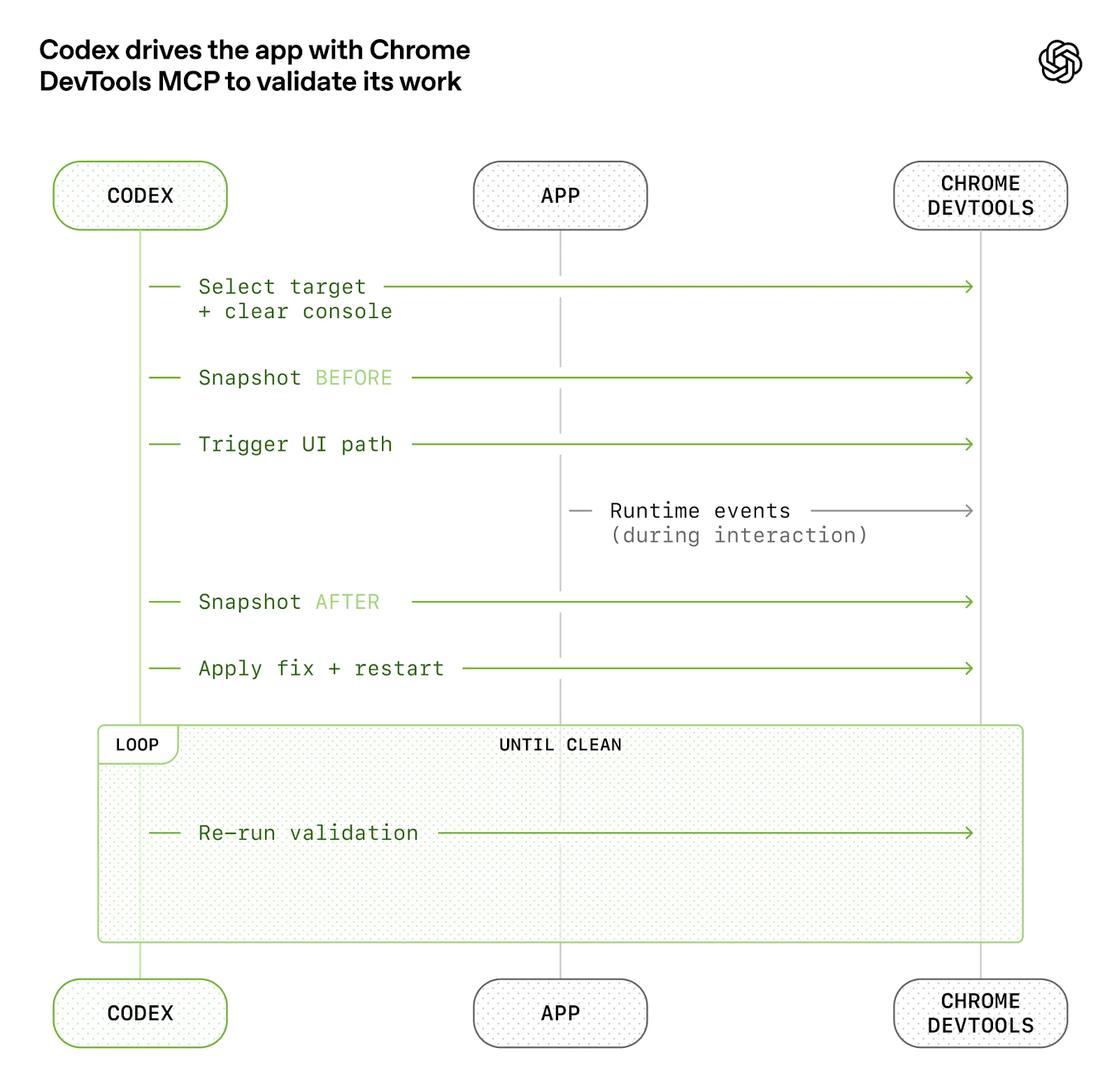
Diagram titled “Codex drives the app with Chrome DevTools MCP to validate its work.” Codex selects a target, snapshots the state before and after triggering a UI path, observes runtime events via Chrome DevTools, applies fixes, restarts, and loops re-running validation until the app is clean.

We did the same for observability tooling. Logs, metrics, and traces are exposed to Codex via a local observability stack that’s ephemeral for any given worktree. Codex works on a fully isolated version of that app—including its logs and metrics, which get torn down once that task is complete. Agents can query logs with LogQL and metrics with PromQL. With this context available, prompts like “ensure service startup completes in under 800ms” or “no span in these four critical user journeys exceeds two seconds” become tractable.
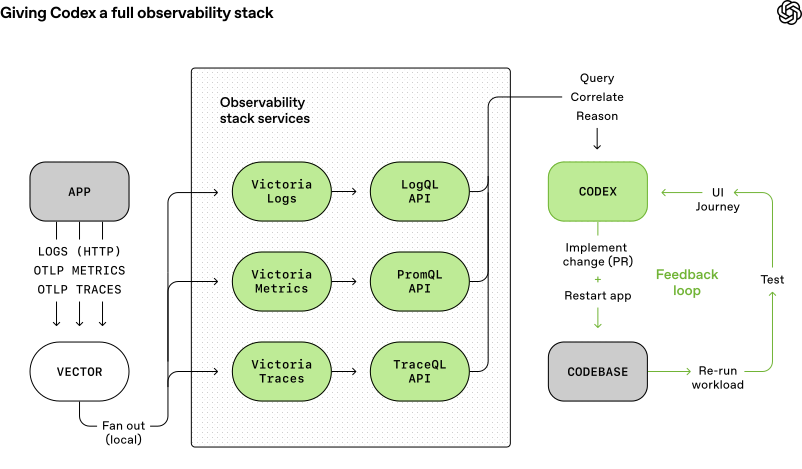
Diagram titled “Giving Codex a full observability stack in local dev.” An app sends logs, metrics, and traces to Vector, which fans out data to an observability stack containing Victoria Logs, Metrics, and Traces, each queried via LogQL, PromQL, or TraceQL APIs. Codex uses these signals to query, correlate, and reason, then implements fixes in the codebase, restarts the app, re-runs workloads, tests UI journeys, and repeats in a feedback loop.

We regularly see single Codex runs work on a single task for upwards of six hours (often while the humans are sleeping).

We made repository knowledge the system of record

Context management is one of the biggest challenges in making agents effective at large and complex tasks. One of the earliest lessons we learned was simple: give Codex a map, not a 1,000-page instruction manual.

We tried the “one big AGENTS.md⁠(opens in a new window)” approach. It failed in predictable ways:

  • Context is a scarce resource. A giant instruction file crowds out the task, the code, and the relevant docs—so the agent either misses key constraints or starts optimizing for the wrong ones.
  • Too much guidance becomes non-guidance****. When everything is “important,” nothing is. Agents end up pattern-matching locally instead of navigating intentionally.
  • It rots instantly. A monolithic manual turns into a graveyard of stale rules. Agents can’t tell what’s still true, humans stop maintaining it, and the file quietly becomes an attractive nuisance.
  • It’s hard to verify. A single blob doesn’t lend itself to mechanical checks (coverage, freshness, ownership, cross-links), so drift is inevitable.

So instead of treating AGENTS.md as the encyclopedia, we treat it as the table of contents.

The repository’s knowledge base lives in a structured docs/ directory treated as the system of record. A short AGENTS.md (roughly 100 lines) is injected into context and serves primarily as a map, with pointers to deeper sources of truth elsewhere.

Plain Text

1 AGENTS.md 2 ARCHITECTURE.md 3 docs/ 4 ├── design-docs/ 5 │ ├── index.md 6 │ ├── core-beliefs.md 7 │ └── ... 8 ├── exec-plans/ 9 │ ├── active/ 10 │ ├── completed/ 11 │ └── tech-debt-tracker.md 12 ├── generated/ 13 │ └── db-schema.md 14 ├── product-specs/ 15 │ ├── index.md 16 │ ├── new-user-onboarding.md 17 │ └── ... 18 ├── references/ 19 │ ├── design-system-reference-llms.txt 20 │ ├── nixpacks-llms.txt 21 │ ├── uv-llms.txt 22 │ └── ... 23 ├── DESIGN.md 24 ├── FRONTEND.md 25 ├── PLANS.md 26 ├── PRODUCT_SENSE.md 27 ├── QUALITY_SCORE.md 28 ├── RELIABILITY.md 29 └── SECURITY.md

In-repository knowledge store layout.

Design documentation is catalogued and indexed, including verification status and a set of core beliefs that define agent-first operating principles. Architecture documentation⁠(opens in a new window) provides a top-level map of domains and package layering. A quality document grades each product domain and architectural layer, tracking gaps over time.

Plans are treated as first-class artifacts. Ephemeral lightweight plans are used for small changes, while complex work is captured in execution plans⁠(opens in a new window) with progress and decision logs that are checked into the repository. Active plans, completed plans, and known technical debt are all versioned and co-located, allowing agents to operate without relying on external context.

This enables progressive disclosure: agents start with a small, stable entry point and are taught where to look next, rather than being overwhelmed up front.

We enforce this mechanically. Dedicated linters and CI jobs validate that the knowledge base is up to date, cross-linked, and structured correctly. A recurring “doc-gardening” agent scans for stale or obsolete documentation that does not reflect the real code behavior and opens fix-up pull requests.

Agent legibility is the goal

As the codebase evolved, Codex’s framework for design decisions needed to evolve, too.

Because the repository is entirely agent-generated, it’s optimized first for Codex’s legibility. In the same way teams aim to improve navigability of their code for new engineering hires, our human engineers’ goal was making it possible for an agent to reason about the full business domain directly from the repository itself.

From the agent’s point of view, anything it can’t access in-context while running effectively doesn’t exist. Knowledge that lives in Google Docs, chat threads, or people’s heads are not accessible to the system. Repository-local, versioned artifacts (e.g., code, markdown, schemas, executable plans) are all it can see.
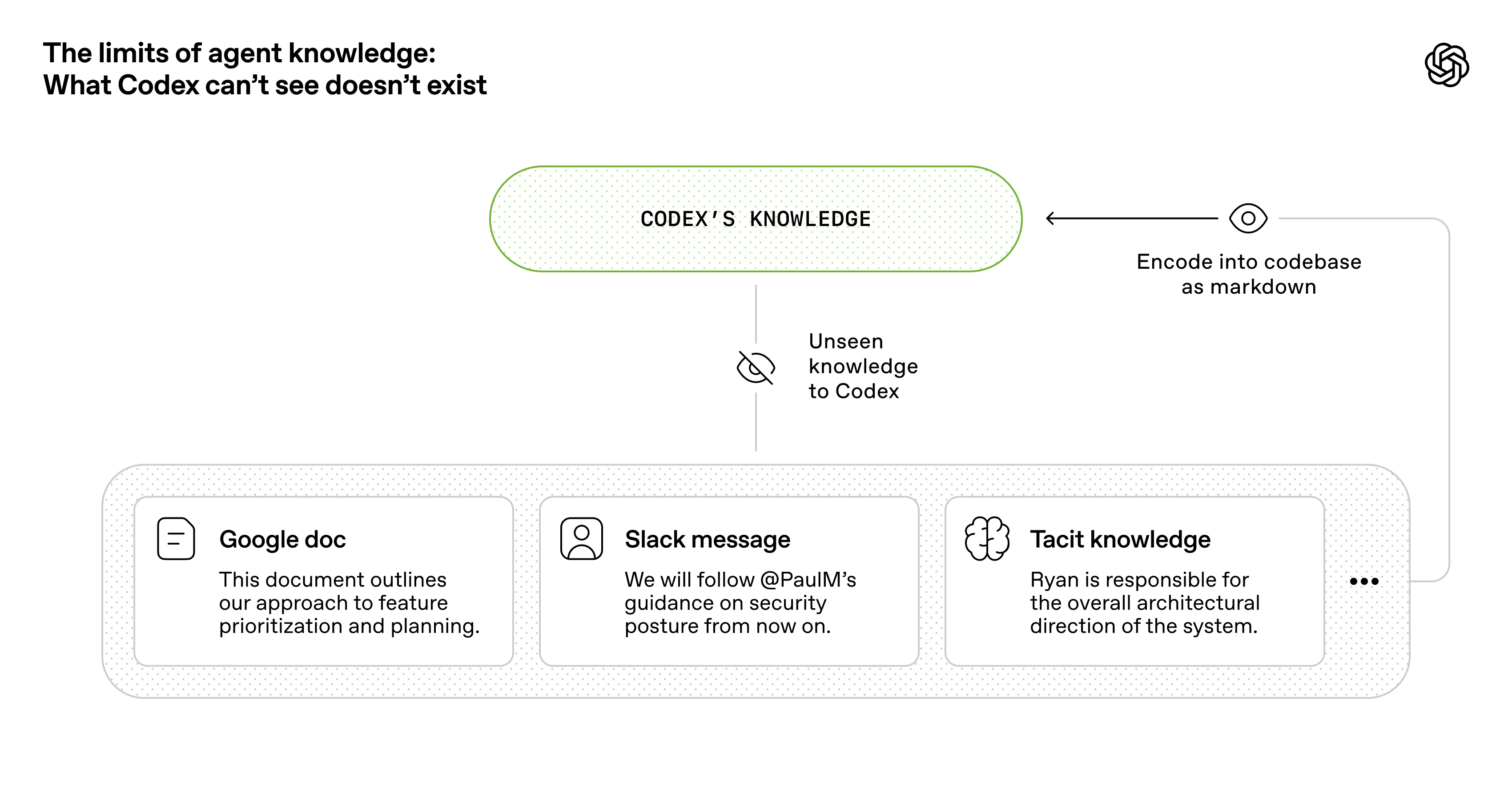
Diagram titled “The limits of agent knowledge: What Codex can’t see doesn’t exist.” Codex’s knowledge is shown as a bounded bubble. Below it are examples of unseen knowledge—Google Docs, Slack messages, and tacit human knowledge. Arrows indicate that to make this information visible to Codex, it must be encoded into the codebase as markdown.

We learned that we needed to push more and more context into the repo over time. That Slack discussion that aligned the team on an architectural pattern? If it isn’t discoverable to the agent, it’s illegible in the same way it would be unknown to a new hire joining three months later.

Giving Codex more context means organizing and exposing the right information so the agent can reason over it, rather than overwhelming it with ad-hoc instructions. In the same way you would onboard a new teammate on product principles, engineering norms, and team culture (emoji preferences included), giving the agent this information leads to better-aligned output.

This framing clarified many tradeoffs. We favored dependencies and abstractions that could be fully internalized and reasoned about in-repo. Technologies often described as “boring” tend to be easier for agents to model due to composability, api stability, and representation in the training set. In some cases, it was cheaper to have the agent reimplement subsets of functionality than to work around opaque upstream behavior from public libraries. For example, rather than pulling in a generic p-limit-style package, we implemented our own map-with-concurrency helper: it’s tightly integrated with our OpenTelemetry instrumentation, has 100% test coverage, and behaves exactly the way our runtime expects.

Pulling more of the system into a form the agent can inspect, validate, and modify directly increases leverage—not just for Codex, but for other agents (e.g. Aardvark) that are working on the codebase as well.

Enforcing architecture and taste

Documentation alone doesn’t keep a fully agent-generated codebase coherent. By enforcing invariants, not micromanaging implementations, we let agents ship fast without undermining the foundation. For example, we require Codex to parse data shapes at the boundary⁠(opens in a new window), but are not prescriptive on how that happens (the model seems to like Zod, but we didn’t specify that specific library).

Agents are most effective in environments with strict boundaries and predictable structure⁠(opens in a new window), so we built the application around a rigid architectural model. Each business domain is divided into a fixed set of layers, with strictly validated dependency directions and a limited set of permissible edges. These constraints are enforced mechanically via custom linters (Codex-generated, of course!) and structural tests.

The diagram below shows the rule: within each business domain (e.g. App Settings), code can only depend “forward” through a fixed set of layers (Types → Config → Repo → Service → Runtime → UI). Cross-cutting concerns (auth, connectors, telemetry, feature flags) enter through a single explicit interface: Providers. Anything else is disallowed and enforced mechanically.
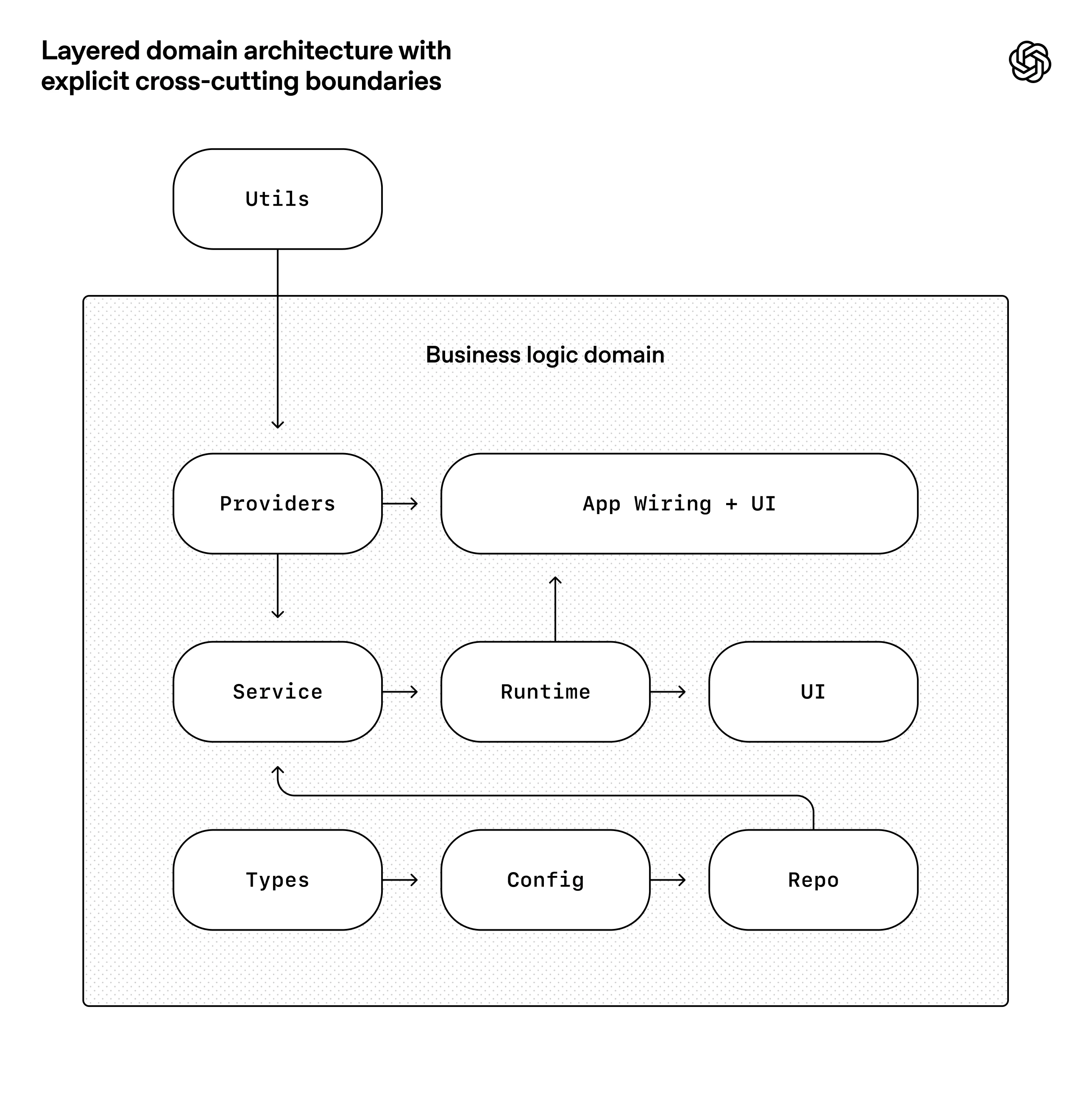
Diagram titled “Layered domain architecture with explicit cross-cutting boundaries.” Inside the business logic domain are modules: Types → Config → Repo, and Providers → Service → Runtime → UI, with App Wiring + UI at the bottom. A Utils module sits outside the boundary and feeds into Providers.

This is the kind of architecture you usually postpone until you have hundreds of engineers. With coding agents, it’s an early prerequisite: the constraints are what allows speed without decay or architectural drift.

In practice, we enforce these rules with custom linters and structural tests, plus a small set of “taste invariants.” For example, we statically enforce structured logging, naming conventions for schemas and types, file size limits, and platform-specific reliability requirements with custom lints. Because the lints are custom, we write the error messages to inject remediation instructions into agent context.

In a human-first workflow, these rules might feel pedantic or constraining. With agents, they become multipliers: once encoded, they apply everywhere at once.

At the same time, we’re explicit about where constraints matter and where they do not. This resembles leading a large engineering platform organization: enforce boundaries centrally, allow autonomy locally. You care deeply about boundaries, correctness, and reproducibility. Within those boundaries, you allow teams—or agents—significant freedom in how solutions are expressed.

The resulting code does not always match human stylistic preferences, and that’s okay. As long as the output is correct, maintainable, and legible to future agent runs, it meets the bar.

Human taste is fed back into the system continuously. Review comments, refactoring pull requests, and user-facing bugs are captured as documentation updates or encoded directly into tooling. When documentation falls short, we promote the rule into code

Throughput changes the merge philosophy

As Codex’s throughput increased, many conventional engineering norms became counterproductive.

The repository operates with minimal blocking merge gates. Pull requests are short-lived. Test flakes are often addressed with follow-up runs rather than blocking progress indefinitely. In a system where agent throughput far exceeds human attention, corrections are cheap, and waiting is expensive.

This would be irresponsible in a low-throughput environment. Here, it’s often the right tradeoff.

What “agent-generated” actually means

When we say the codebase is generated by Codex agents, we mean everything in the codebase.

Agents produce:

  • Product code and tests
  • CI configuration and release tooling
  • Internal developer tools
  • Documentation and design history
  • Evaluation harnesses
  • Review comments and responses
  • Scripts that manage the repository itself
  • Production dashboard definition files

Humans always remain in the loop, but work at a different layer of abstraction than we used to. We prioritize work, translate user feedback into acceptance criteria, and validate outcomes. When the agent struggles, we treat it as a signal: identify what is missing—tools, guardrails, documentation—and feed it back into the repository, always by having Codex itself write the fix.

Agents use our standard development tools directly. They pull review feedback, respond inline, push updates, and often squash and merge their own pull requests.

Increasing levels of autonomy

As more of the development loop was encoded directly into the system—testing, validation, review, feedback handling, and recovery—the repository recently crossed a meaningful threshold where Codex can end-to-end drive a new feature.

Given a single prompt, the agent can now:

  • Validate the current state of the codebase
  • Reproduce a reported bug
  • Record a video demonstrating the failure
  • Implement a fix
  • Validate the fix by driving the application
  • Record a second video demonstrating the resolution
  • Open a pull request
  • Respond to agent and human feedback
  • Detect and remediate build failures
  • Escalate to a human only when judgment is required
  • Merge the change

This behavior depends heavily on the specific structure and tooling of this repository and should not be assumed to generalize without similar investment—at least, not yet.

Entropy and garbage collection

Full agent autonomy also introduces novel problems. Codex replicates patterns that already exist in the repository—even uneven or suboptimal ones. Over time, this inevitably leads to drift.

Initially, humans addressed this manually. Our team used to spend every Friday (20% of the week) cleaning up “AI slop.” Unsurprisingly, that didn’t scale.

Instead, we started encoding what we call “golden principles” directly into the repository and built a recurring cleanup process. These principles are opinionated, mechanical rules that keep the codebase legible and consistent for future agent runs. For example: (1) we prefer shared utility packages over hand-rolled helpers to keep invariants centralized, and (2) we don’t probe data “YOLO-style”—we validate boundaries or rely on typed SDKs so the agent can’t accidentally build on guessed shapes. On a regular cadence, we have a set of background Codex tasks that scan for deviations, update quality grades, and open targeted refactoring pull requests. Most of these can be reviewed in under a minute and automerged.

This functions like garbage collection. Technical debt is like a high-interest loan: it’s almost always better to pay it down continuously in small increments than to let it compound and tackle it in painful bursts. Human taste is captured once, then enforced continuously on every line of code. This also lets us catch and resolve bad patterns on a daily basis, rather than letting them spread in the code base for days or weeks.

What we’re still learning

This strategy has so far worked well up through internal launch and adoption at OpenAI. Building a real product for real users helped anchor our investments in reality and guide us towards long-term maintainability.

What we don’t yet know is how architectural coherence evolves over years in a fully agent-generated system. We’re still learning where human judgment adds the most leverage and how to encode that judgment so it compounds. We also don’t know how this system will evolve as models continue to become more capable over time.

What’s become clear: building software still demands discipline, but the discipline shows up more in the scaffolding rather than the code. The tooling, abstractions, and feedback loops that keep the codebase coherent are increasingly important.

Our most difficult challenges now center on designing environments, feedback loops, and control systems that help agents accomplish our goal: build and maintain complex, reliable software at scale.

As agents like Codex take on larger portions of the software lifecycle, these questions will matter even more. We hope that sharing some early lessons helps you reason about where to invest your effort so you can just build things.

Read the whole story
bogorad
11 hours ago
reply
Barcelona, Catalonia, Spain
Share this story
Delete

Elon Musk pushes out more xAI founders as AI coding effort falters

1 Share
  • Management Turnover: Several co-founders departed xAI amid ongoing structural reorganization and leadership changes directed by Elon Musk.
  • Operational Audit: Managers from Tesla and SpaceX were deployed to evaluate internal workflows and personnel performance at the start-up.
  • Product Performance: The company's coding tool and Grok chatbot have faced difficulties in achieving market adoption compared to competing platforms.
  • Strategic Realignment: Development efforts are being refocused on improving data training quality and integrating expertise from broader corporate entities.
  • Employee Retention: High resignation rates among researchers persist due to workplace demands and competition for technical talent.
  • Internal Rebuilding: Development projects are undergoing foundational overhauls to rectify perceived issues in initial product execution.
  • Recruitment Efforts: The firm is actively soliciting previously rejected candidates and hiring new engineering talent for specific software development roles.
  • Corporate Integration: The merger with X and operational resource sharing continue as part of a broader strategy centered on long-term data center and AI goals.

current progress 27%

Stephen Morris and Cristina Criddle in San Francisco

Published2 hours ago

42

Unlock the Editor’s Digest for free

Roula Khalaf, Editor of the FT, selects her favourite stories in this weekly newsletter.

Elon Musk has ordered another round of job cuts at xAI after growing frustrated with the poor performance of its coding product, forcing out several more co-founders and parachuting in “fixers” from SpaceX and Tesla to audit the start-up.
The latest overhaul of the two-year-old start-up follows the success of Anthropic and OpenAI, whose AI coding tools have shaken up the software industry, multiple people familiar with the decisions said.

Musk has dialled up the pressure after merging SpaceX with xAI in a $1.25bn deal, as he attempts to meet a June deadline for what could be the biggest stock market listing in history. The world’s richest man has said his goals are to launch AI data centres into space, build factories on the Moon and colonise Mars.

Musk has relentlessly pushed the heavily lossmaking AI start-up to catch up with rivals, but so far its Grok chatbot and coding product have failed to gain traction with paying individual users or businesses.

“xAI was not built right first time around, so is being rebuilt from the foundations up,” Musk posted on X on Thursday. “Same thing happened with Tesla.”

SpaceX and Musk did not immediately reply to requests for comment.

Managers from SpaceX and Tesla have been seconded to review xAI employees’ work and have fired some after deeming their efforts inadequate, said two people with direct knowledge of the matters.

One area of focus has been the quality of the data used to train the models, a key reason its coding product lagged behind Anthropic’s Claude Code or OpenAI’s Codex.

The review has pushed out two more co-founders. Zihang Dai, one of the most senior members of the technical staff, who had publicly acknowledged that xAI was behind on coding, departed this week.

Guodong Zhang, who had run pre-training of Grok models, told colleagues that he was leaving after being blamed for the issues with the coding product and relieved of his primary duties by Musk, two people familiar with the decision said. He confirmed that Thursday was his last day in a post on X.

After the departures, only Manuel Kroiss — known as “Makro” — and Ross Nordeen will remain of the 11 co-founders who helped Musk set up xAI in San Francisco in March 2023.

Last month, Musk criticised the coding team for falling behind in a town hall meeting that was posted online. He detailed a reorganisation after several other co-founders had been removed, including Greg Yang, Tony Wu and Jimmy Ba.

Toby Pohlen, a former DeepMind researcher, was put in charge of the “Macrohard” project to build digital agents that Musk said could replicate entire software companies. Musk said it was the “most important” drive at the company. The name is a “funny” reference to Microsoft, the billionaire added. Pohlen left 16 days later.

Musk has redeployed Ashok Elluswamy, head of AI software at Tesla, to reboot the Macrohard effort and review the work done previously. Musk said that Tesla and xAI would work together to develop a “digital Optimus” that would combine the car and robot maker’s real-world AI expertise and Grok’s large language models.

Staff complain that the constant upheaval is destroying morale and preventing xAI from achieving its potential.

Musk has built a vast data centre in Memphis with more than 200,000 specialised AI chips, which he plans to expand to 1mn GPUs over time. It also benefits from the data fed in by his social media network X, which was merged with xAI last year and now promotes the Grok chatbot.

Employees were sent a memo denying that there would be mass lay-offs on Wednesday, the people said. However, researchers continue to quit because of burnout because of Musk’s “extremely hardcore” work demands or after receiving better offers from rivals, multiple people familiar with the departures said.

The lay-offs and departures have left xAI with many roles to fill. Recruiters have been contacting unsuccessful candidates from previous interviews and assessments to offer them jobs, often on better financial terms, the people said.

“Many talented people over the past few years were declined an offer or even an interview at xAI. My apologies,” Musk posted on Friday morning. He said he would be “going through the company interview history and reaching back out to promising candidates”.

Musk still has the ability to recruit top Silicon Valley talent. This week, xAI poached two staff from popular AI coding app Cursor — Andrew Milich and Jason Ginsberg — to help improve the “Grok Code Fast” product.

Musk welcomed them in a post on Thursday, adding: “Orbital space centres and mass drivers on the Moon will be incredible.”

Reuse this content (opens in new window) CommentsJump to comments section

Latest on xAI

Follow the topics in this article

Comments

Read the whole story
bogorad
1 day ago
reply
Barcelona, Catalonia, Spain
Share this story
Delete

Trump’s international strategy is becoming clearer | Lowy Institute

1 Share
  • Strategic Goal: Restoration Of Absolute American Superiority Over China And Russia
  • Economic Pressure: Sustained Sanctions Designed To Weaken Rival Economies Long Term
  • Regional Stabilization: Support For New Governments In Syria And The Middle East To Diminish Adversary Influence
  • Resource Control: Removal Of Venezuelan Oil Shipments To Authoritarian States Following Regime Change
  • Alliance Strengthening: Increased Defence Spending From Nato And Asian Allies Through Aggressive Diplomacy
  • Regime Instability: Potential Collapse Of Authoritarian Governments In Cuba And Iran Due To External Pressure
  • Disruption Of Supply: Risk Of Severe Oil Import Shortages For China During Future Taiwan Crisis Scenarios
  • Operational Tactics: Application Of Precision Force And Strategic Unpredictability Based On Established Military Theory

Donald Trump’s behaviour during this presidential term reveals a surprisingly deep strategic logic.

The core goal remains to restore absolute American superiority over China and Russia. But Trump wants to avoid confronting these major rivals directly. He is rather working to isolate Beijing and Moscow from their international partners and deprive them of any major means of external support.

At the same time, Trump is building a program of sustained economic, technology and other sanctions to markedly weaken the Chinese and Russian economies over the longer term.

The evidence for this strategic approach is fairly clear from the patterns of the administration’s behaviour.

Following the collapse of the Bashar al-Assad regime in Syria, Trump and some European leaders moved quickly to help the new administration of Ahmed al-Sharaa stabilise the country and embark on a peaceful, pro-Western future. Chinese and Russian influence is greatly reduced.

In Gaza, the US has brokered a peace deal and in southern Lebanon it has supported an extended ceasefire. However, Hamas and Hezbollah are working to reinforce their local political control and will probably only partially disarm. The result may be a weak peace on both fronts with modest Chinese and Russian influence.

The surprise arrest of Venezuelan President Nicolas Maduro to face charges in a New York court of conspiring to traffic cocaine to the United States has markedly changed the security environment in Central and South America. The restructured Venezuelan government, along with those of Colombia, Panama and Mexico, are now coordinating their security more closely with relevant US agencies.

The arrest of Maduro has also halted cut-price and “gifted” oil being supplied to China, Russia and other authoritarian states. And, as US Secretary of State Rubio recently emphasised, the US operation has removed the risk of China or Russia gaining control of the Venezuela’s oil reserves – the world’s largest.

Trump has also taken extraordinary steps to end the defence and security foot-dragging of the NATO and Asian allies.

An immediate consequence is that with Venezuelan oil shipments to Cuba now stopped, the long-running economic crisis in Havana is coming to a head with transport, electricity, some foods and even water being rationed. The Communist regime may soon collapse.

Iran is another weakened authoritarian state that is vulnerable to precision intervention by the United States and its allies. If, as seems likely, the US strikes Iranian nuclear and leadership targets in coming weeks, the regime will probably fall to a renewed public revolt. That, in turn, would likely end Iranian support for the Houthi rebels, Hezbollah, Hamas and other radical terrorist groups.

A pro-Western Iran would probably abandon “special deal” oil exports to China, Russia and other authoritarian states. When combined with Venezuela’s redirected oil trade, about half of China’s oil imports would no longer be supplied by close partners and, in the event of a Taiwan crisis, deliveries from most of its suppliers may cease.

Meanwhile, Trump has gone out of his way to maintain positive lines of communication with Russia’s Vladimir Putin and China’s Xi Jinping. Trump senses that there may be scope for deals to buy time to strengthen American and allied military capabilities, rebuild the alliance’s industrial base and allow tightening economic and technology sanctions to further weaken Russia’s and China’s strategic power.

Trump has also taken extraordinary steps to end the defence and security foot-dragging of the NATO and Asian allies, including by threatening the territorial integrity of Denmark and Canada. Steep rises in the defence budgets of most allies have now been announced. The Europeans have also agreed to carry the primary burden for their own security and for reinforcing the defence of Ukraine. Trump’s unpredictable wielding of US power has certainly gained the attention of the NATO allies. Xi and Putin have also learnt that Trump is not to be trifled with.

America’s strategic operations during the last year draw on key themes from Trump’s own book The Art of the Deal and Sun Tzu’s The Art of War. Notable features include indirect approaches to priority strategic goals, frequent assertions of superior capabilities, exaggerated ambit claims, intentional unpredictability to induce rival caution, operational deception, tactical surprise, precise use of military force for short periods, and economic and technology sanctions to drive opponents into long-term strategic decline.

Trump’s application of these measures has often been messy and imperfect but, overall, it has been effective in seizing the momentum in international security affairs.

At the core of Trump’s recently published National Defence Strategy is a “strong denial defence” of the First Island Chain stretching from Japan, through Taiwan and the Philippines to Indonesia. US operations during the last year reveal a deeper level of denial strategy – that of removing all major sources of external support from Beijing and Moscow. This deep denial strategy is shifting the balance of power back to the US and its allies.

There is plenty of scope for things to go wrong in the Taiwan Strait and elsewhere during the remainder of Trump’s term. But the regimes in Beijing and Moscow are both struggling with economic and political challenges and are now in the process of losing their major international partners. Their future prospects are deteriorating and the cold winds of isolation are growing stronger.

Read the whole story
bogorad
1 day ago
reply
Barcelona, Catalonia, Spain
Share this story
Delete

YouTube Now Worlds Largest Media Company, Topping Disney

1 Share
  • Market Position: YouTube Established Status As The Worlds Largest Media Company In 2025
  • Financial Record: Platform Generated Over 60 Billion Dollars In Total Revenue During 2025
  • Competitive Analysis: Estimated Earnings Surpass The Walt Disney Companys Media Business Results
  • Corporate Valuation: Market Value Estimated Between 500 Billion And 560 Billion Dollars
  • Revenue Streams: Income Sources Include Advertising Subscriptions Plus Virtual Multichannel Video Services
  • Creator Economy: Milestone Payment Of Over 100 Billion Dollars Distributed To Partners And Content Creators
  • Future Growth: Expansion Driven By Artificial Intelligence Tools And Strategic Industry Positioning
  • Service Scaling: YouTube TV Reaches 10 Million Subscribers With Projections To Overtake Traditional Cable Competitors

YouTube‘s cultural influence is already hard to ignore, but 2025 could nonetheless be a turning point for the Google-owned video platform: It’s the year it became the world’s largest media company.

YouTube had more than $60 billion in revenue in 2025, parent company Alphabet reported last month. Now, the influential financial research firm MoffettNathanson runs the numbers and comes to the conclusion that YouTube’s estimated $62 billion in 2025 will have allowed it to pass The Walt Disney Co.’s media business, which generated $60.9 billion last year (excluding Disney’s lucrative experiences division).

Related Stories

[

YouTube

](https://www.hollywoodreporter.com/business/digital/youtube-politicians-journalists-ai-deepfake-detection-tool-1236525427/)

Business

YouTube Gives Political Figures and Journalists Access to AI Deepfake Detection Tool

[

Phil Rosenthal in episode 701 of Somebody Feed Phil.

](https://www.hollywoodreporter.com/tv/tv-news/somebody-feed-phil-moving-to-youtube-1236525778/)

TV

'Somebody Feed Phil' Moving to YouTube From Netflix in 2027

The firm, which declared YouTube the “new king of all media” last year, is now valued at between $500 billion-$560 billion, far above any traditional media competitors. The closest would be Netflix, which has a market cap of about $409 billion as of writing.

YouTube’s ad revenue hit $11.4 billion in Q4, totaling over $40 billion for the year. But it also has an enormous subscription business, encompassing YouTube Premium, YouTube Music, NFL Sunday Ticket, and the YouTube TV virtual multichannel video service.

YouTube TV now has around 10 million subscribers, and is likely to overtake pay-TV leaders Charter and Comcast in the coming years.

YouTube has now paid out more than $100 billion to creators, music companies and media partners, reflecting its starring role in the entertainment ecosystem.

“There are two really fundamental things that we do for creators,” YouTube CEO Neal Mohan told The Hollywood Reporter last year, just a few hours after announcing the milestone. “One is help them build an audience and connect with their fans, regardless of where those fans are in the world; and the second thing we do is we help them build businesses. That’s what that $100 billion represents for me.”

MoffettNathanson argues that the scale as a distributor, both of pay-TV and of creator-led content, will help it continue its explosive growth. So will its heavy investment into AI tools, which will allow creators to produce more content at a faster cadence.

“Over the next few years, unlike almost any other asset we cover, we strongly believe that YouTube will be a major beneficiary of both the structural tailwinds and headwinds facing technology and media companies,” Michael Nathanson writes.

Indeed, there may not be another company that sits so squarely at the intersection of media and technology.

“I am a technologist, but I also love media and storytelling. I’ve been that way since I can remember, I’m a fan myself, fundamentally,” Mohan said. “Leading YouTube is a privilege where I can actually bring both those pieces together, that human storytelling and creativity and the best of technology, that’s what motivates me every morning.”

One top YouTube creator says that they are already aggressively experimenting with the tools, mostly to help with things like set design, costumes, makeup and visual effects that would otherwise be prohibitively expensive or time-consuming.

And a time when essentially every other media company is stuck in neutral, if not going in reverse, YouTube and Netflix appear to be the only players still able to put their foot and the pedal and accelerate. YouTube’s 2024 revenue topped $50 billion, and last year it topped $60 billion, with plans to roll out skinnier bundles for YouTube TV, and a creator-driven economy that shows no signs of slowing, how high can it go?

Read the whole story
bogorad
1 day ago
reply
Barcelona, Catalonia, Spain
Share this story
Delete

The Former Uber Executive at the Pentagon Who’s Become Anthropic’s Nemesis - WSJ

1 Share
  • Defense Department Leadership: Emil Michael Serves As The Under Secretary For Research And Engineering Reporting Directly To Secretary Pete Hegseth
  • Public Conflict Resolution: Michael Engaged In High Profile Disputes With Anthropic Chief Executive Dario Amodei Regarding Contractual Terms And Usage Guardrails
  • Negotiation Strategy: Professional Colleagues Characterize Michael As A Tenacious Tactician Who Utilizes Empathetic Yet Assertive Methods To Gain Maximum Advantages
  • Military Integration Goals: The Current Administration Prioritizes Accelerating The Adoption Of Advanced Artificial Intelligence Technologies Within Defense Infrastructure Networks
  • Departure From Anthropic: Negotiations Terminated After Public Statements From Anthropic Effectively Ended Prospects For A Future Partnership With The Department Of Defense
  • Alternative Strategic Alliances: Following The Failed Anthropic Agreement The Defense Department Secured New Artificial Intelligence Contracts With OpenAI And XAI
  • Corporate Background Context: Michael Previously Played A Central Role In The Rapid Growth And Resource Acquisition Strategies During His Tenure At Uber
  • Professional Career History: The Under Secretary Possesses Extensive Experience In Government Service Private Equity And Law Including Backgrounds At Goldman Sachs And Harvard University

“Even if you’re a master dealmaker, at some point you realize the other side doesn’t want to make a deal,” Michael said Thursday in an interview with The Wall Street Journal. 

As the department’s under secretary for research and engineering reporting to Defense Secretary Pete Hegseth, Michael has been the public face of the Pentagon in a saga that has consumed attention spans in Washington and Silicon Valley. In posts on X, sometimes in all-caps, Michael has blasted Anthropic Chief Executive Dario Amodei, accusing him of lying and having a God complex. Amodei has called some of Michael’s public statements lies and said he has mischaracterized the company’s position, which is that it only sought assurances about guardrails for its technology.

But Michael insists that his behind-the-scenes discussions with Amodei were always polite and cordial. “He and I never yelled at each other, never screamed,” Michael said.

Of his “edgy” posts on X, he said, “It was in response to their public denigration of this administration, our work and our mission. I was matching fire with fire,” Michael said.

Dario Amodei, co-founder and CEO of Anthropic, speaking at the company's Builder Summit.

Dario Amodei, co-founder and CEO of Anthropic. Samyukta Lakshmi/Bloomberg News

A little edginess is nothing new for Michael. In his time at Uber, where he spent four years as chief business officer and the closest confidant to then-Chief Executive Travis Kalanick, the company was in almost continuous conflict with local governments, regulators and labor organizations. Michael was personally involved in some of the controversial episodes that led to Kalanick’s ouster, and his own.

Friends, associates and former colleagues and bosses describe Michael as a sharp-elbowed negotiator and a tactician who can turn a mess into a lucrative payday. They describe his negotiating style as patient, respectful and empathetic, even as he presses for maximum advantage.

“He is one of the best deal guys in the world. And he wants to play on the biggest field,” said Joe Fernandez, who founded the startup Klout in 2008 and spent eight months recruiting Michael to work for him as chief operating officer.

The Pentagon’s decision to punish a tech company for refusing to comply with contract demands underscores the Trump administration’s eagerness to integrate an evolving and powerful technology into the world’s most powerful military, on its own terms. 

Those who know Michael, who is also a Stanford-trained lawyer, chalk up his public bellicosity toward Anthropic to a fierce professional loyalty.

“Emil’s job when he worked for Travis was to zealously represent Travis. And his job when he works for the Department of Defense is to zealously represent the Department of Defense,” said Joe Sullivan, the former chief security officer for Uber.

U.S. Secretary of Defense Pete Hegseth and Under Secretary of Defense Emil Michael speak before an XQ-58A Valkyrie UAS at the Pentagon.

Defense Secretary Pete Hegseth and Emil Michael at a Pentagon event last summer. Win McNamee/Getty Images

In its lawsuit, Anthropic has warned that the administration’s moves could cost it billions of dollars in revenue this year and hurt its future fundraising. Even as the company has accused the Defense Department of pressuring private-sector customers to turn their backs on Anthropic—a claim Michael called absolutely untrue—it has continued to insist it is eager to play a role in national defense.

Michael said the window for that has closed.

“There is no chance. There’s no partnership that can be had.”

Uber’s A-team

Michael, 53 years old, was born in Cairo and grew up in New Rochelle, N.Y., where he attended public school. He went on to study government at Harvard University, where he got involved in Republican politics and joined a fraternity.

Michael left a job at Goldman Sachs for Silicon Valley during the dot-com boom and was an early employee at Tellme Networks, which made phone-based voice-recognition software. The company survived the bust and was sold to Microsoft for $800 million in 2007. Michael’s job included convincing big, bureaucratic companies such as FedEx and AT&T to partner with a startup, said David Weiden, a founding partner at Khosla Ventures who attended Harvard with Michael and remains a friend.

He joined the Obama administration as a White House fellow and assistant to Defense Secretary Robert Gates. He has been a registered Republican since adulthood, but his financial contributions have split party lines, public records show. His largest was a $1 million donation in 2024 to MAGA, President Trump’s super PAC.

He returned to Silicon Valley and eventually joined the so-called A-team at Uber, the inner circle that led the company to become one of the fastest-growing and most richly funded startups at the time. There, he leveraged his Goldman connections. He courted investors at San Francisco parties, bringing in large Middle East funds and eventually raising $20 billion. His preferred fundraising style was “less based on relationships, much more based on math and giving everyone a chance to participate,” versus the clubby tactic of playing investors against each other, Michael said.

Emil Michael, Senior Vice President of Business for Uber Technologies Inc., speaks during a Bloomberg Television interview.

Michael speaking during a 2014 TV interview as a senior Uber executive. David Paul Morris/Bloomberg

Emil Michael, Senior Vice President of Business for Uber Technologies Inc., speaks during a Bloomberg Television interview.

Michael speaking during a 2014 TV interview as a senior Uber executive. David Paul Morris/Bloomberg

He secured $3.5 billion from the Saudi sovereign-wealth fund to give Uber the leverage to strike a deal with its largest competitor in China, Didi Chuxing. Michael told Didi executives that Uber would spend the entire sum to compete with Didi in China if they didn’t agree to buy Uber’s operation there, which was burning $100 million a month. Michael completed the sale, which he called the most satisfying deal of his career, in two months. Uber took home around $7 billion.

In 2014, Michael and other Uber executives visited an escort karaoke bar during a work trip to South Korea, prompting an employee to file a complaint about the incident. Michael in 2014 publicly apologized after he suggested digging up dirt on the personal lives of journalists critical of Uber. One of his direct reports obtained and shared the private medical records of an Uber passenger who was raped in India. The incident prompted an investigation into alleged bribery by Uber executives and a lawsuit from the victim, although neither led to civil or criminal penalties.

In 2017, independent investigators determined that Uber tolerated a culture of sexual harassment and bullying, setting the stage for Kalanick’s ouster. Around the same time, Michael left after the board pushed for his removal.

“Emil is one of the most inspiring and effective leaders I know. Our country is stronger, safer, and better because of his service,” Kalanick told the Journal.

Deal collapses

After Uber, Michael led a lower-profile life, marrying and having two children. He founded a blank-check company with venture capitalist Shervin Pishevar, an Uber investor who was forced out of his own venture firm amid sexual harassment claims. Pishevar didn’t respond to a request for comment.

SHARE YOUR THOUGHTS

Should an AI company be allowed to tell the military how its tools can be used? Join the conversation below.

Michael’s name was in the mix for Transportation Secretary before Trump nominated him for the Defense Department role in late 2024, people familiar with the matter said. In a reorganization that began last year, six key organizations, including the military’s AI office, were all put under Michael’s purview.

“Coming to the department from the private sector, he is helping spur a new era of innovation,” said chief Pentagon spokesman Sean Parnell.

Michael said his top priority is to accelerate the Defense Department’s adoption of AI. “Moving fast to do that is very important when you have a four-year term.”

After assuming his role, Michael reviewed the Pentagon’s contract with Anthropic and found it relied on the AI company giving the department exceptions for using its tools in certain military scenarios, a clunky process. He began negotiating a new deal.

The Pentagon gave Amodei a Feb. 27 deadline for agreeing to new terms. After both sides went back and forth with proposals, Amodei on Feb. 26 said publicly that the company was declining the Defense Department’s latest offer and couldn’t accede to its requests. The pre-emptive, public move by Amodei escalated the spat to Hegseth, after which there was a near-zero chance of reconciliation, an administration official said.

“It got out of my hands. I report to the secretary of war, who reports to the president,” Michael said.

Michael said he spent the following weekend, after the deadline passed, trying to save the deal, without success. But ever the dealmaker, he was working other options. As Anthropic was bowing out, the department signed deals with two of its biggest rivals, OpenAI and xAI.

Corrections & Amplifications
Joe Fernandez founded the startup Klout. An earlier version of this article misspelled his name as Fernanzez. (Corrected on March 13.)

Read the whole story
bogorad
1 day ago
reply
Barcelona, Catalonia, Spain
Share this story
Delete
Next Page of Stories