Strategic Initiatives
11948 stories
·
45 followers

Morgan Stanley: Most Gen Zers and millennials in the US listen to about three hours of AI music a week - Sherwood News

1 Share
  • Survey inclusion: Morgan Stanley’s annual audio habits study introduced AI music questions for the first time.
  • Listening volume: Americans aged 18-44 report 2.5-3 hours of AI-generated music per week, matching the runtime of “Avatar.”
  • Prevalence: Roughly 50-60% of listeners in that demographic engage with AI music weekly.
  • Distribution channels: YouTube and TikTok are identified as the primary platforms for AI music consumption.
  • Spotify outlook: Analysts view AI as a tailwind for Spotify’s global distribution scale and personalization efforts.
  • Personalization strategy: AI is expected to underpin Spotify’s “personalization 2.0” initiatives moving forward.
  • Warner Music Group view: AI music is expected to enhance the value of scarce catalog assets despite competition for frontline content.
  • Suno partnership: WMG’s collaboration with Suno is highlighted as a critical step toward monetizing AI music while AI risks appear priced into current shares.

Video may have killed the radio star, but AI is starting to dance on its grave.

Morgan Stanley’s annual survey of audio habits revealed that younger Americans are listening to an amount of AI-generated music each week that’s roughly on par with the run time of “Avatar.”

“This is the first year we included any AI music questions in our survey,” wrote a team led by analyst Benjamin Swinburne. “What we found surprised us, with 50-60% of listeners 18- 44 reporting 2.5-3 hours per week of AI music listening.”

[

Morgan Stanley AI listening

](https://sherwoodnews.imgix.net/Screenshot%202026-01-08%20at%2011.22.42%E2%80%AFAM.png)

The most common sources from which AI music is being ingested are YouTube and TikTok, per Morgan Stanley’s survey. Even so, their analysts remain bullish on SpotifySPOT $539.20 (-2.56%) and Warner Music GroupWMG $31.01 (4.27%), writing:

“As a distribution platform with leading global scale, a history of product innovation, and leveraging machine learning, we see AI as a tailwind to Spotify in 2026 and beyond. Specifically, we expect AI to prove foundational to Spotify’s ‘personalization 2.0’ efforts. For OW WMG, we expect the rise of AI music to increase the value of scarce catalog assets while potentially creating new competition for front line content. However, we see WMG’s recently announced Suno partnership as an important step toward AI music monetization. We believe the multiple compression absorbed by WMG shares in 2025 suggests a lot of AI risk is already priced in.”

Read the whole story
bogorad
2 hours ago
reply
Barcelona, Catalonia, Spain
Share this story
Delete

A stable Venezuela could offer visitors more than just oil // Coral beaches, Andean peaks and the world’s tallest waterfall give the country huge potential as a tourist destination

1 Share
  • Tourism Potential: Venezuela’s natural assets contrast with its tiny tourism GDP share of 0.5%, inviting comparisons to neighbors that depend heavily on tourist dollars.
  • Regional Benchmarks: Costa Rica and Panama respectively rely on tourism for about 6% and 7% of GDP, while Venezuela trails amid informal economy and weaker rule of law.
  • Infrastructure Gaps: Airports, roads, and security would need major upgrades before mass tourism can arrive, posing significant upfront costs.
  • Investment Risk: Major franchises such as Marriott still operate there but would demand powerful incentives to shoulder the political and security risks.
  • Economic Upside: Attracting 7mn tourists spending $1,500 each could yield $11bn directly, with up to $3.50 of peripheral value per dollar spent, boosting a GDP around $98bn.
  • Historical Caution: Past episodes like Hugo Chávez’s seizure of a Blackstone-owned hotel underscore why US investors have been wary despite the potential.

For obvious reasons, financial discussions around Venezuela’s future mostly revolve around its enormous oil reserves. But Donald Trump’s talk of turning Gaza into a “Riviera of the Middle East” last year suggests it is worth considering another kind of trade that — one day — could help bring prosperity to the tottering Latin American country: tourism.

Holidaymakers are economically significant for many of Venezuela’s near neighbours. Foreign tourist spending makes up about 6 per cent of Costa Rica’s GDP, and about 7 per cent of Panama’s. In Venezuela, the equivalent sum is about 0.5 per cent, based on estimates from the World Travel & Tourism Council.

That’s not a surprise: much of the economy is informal, while infrastructure and rule of law are weak, even by regional standards. Costa Rica ranks 54th in the Global Peace Index, a proxy for general safety and stability; Venezuela is 139th.

Seen from space, it should be otherwise. Coral beaches, Andean peaks and the world’s tallest uninterrupted waterfall are precious assets. A steady stream of well-heeled consumers would undoubtedly help a country that Deutsche Bank flags as the world’s poorest on a per capita basis, by some measures.

Costa Rica, a tiny country that has pointedly targeted US travellers, welcomed about 2.9mn tourists in 2024, and they spent a total of $5.5bn, according to UN Tourism. A stable Venezuela, which is roughly the same flight time from the US and with twice the coastline, ought to be able to beat that with ease. For Trump, a serial resort builder who has repeatedly failed to crack Latin America, this potential is unlikely to go unnoticed.

Today, potential is all it is. Even absent political unrest, tourist essentials such as airports would need to be built or restored; roads upgraded; rampant crime kept under control. For giant companies such as Marriott, which retains four franchised properties in Venezuela where rivals mostly left, it would take powerful incentives to add risk that investors won’t reward anyway.

Nonetheless, whoever runs Venezuela once the current turmoil has resolved has good reason to try. Imagine the country was able to attract 7mn tourists a year, on a par with Colombia, and that each spent $1,500, somewhat less than Costa Rica. That’s almost $11bn of direct spending. Then think that each $1 a tourist spends can create up to $3.50 of value, according to World Economic Forum estimates. For a country with perhaps $98bn of GDP this year, on Citigroup estimates, that’s a big windfall.

Some US investors will flinch at the memory of past bad bets on Venezuelan tourism. Blackstone fell foul of strongman politics in 2009 when Hugo Chávez breezily expropriated one of its beachfront Hilton hotels in a fit of pique over the way the resort was run. Then again, if the troubled country can find stability — at this stage still an “if” — even sceptical financiers may again start to take notice.

john.foley@ft.com

Read the whole story
bogorad
2 hours ago
reply
Barcelona, Catalonia, Spain
Share this story
Delete

How special forces became modern warfare’s go-to solution // Pearl-clutching about the Venezuela operation ignores the history of US military strategy

1 Share
  • Operation Description: The narrative recounts the secretive, military-style abduction of Venezuelan President Nicolás Maduro, likening it to past high-profile special forces missions such as the raid that killed Osama bin Laden and the overthrow of Muammer Gaddafi.
  • Means over Motives: The writer urges focusing on the operational method—special forces deployment—rather than speculating on geopolitical motives like oil or ideological doctrines.
  • Special Forces Heritage: Delta Force’s roots trace back to Vietnam-era irregular warfare and Britain’s SAS, reflecting a long history of Western powers learning from guerrilla tactics.
  • Strategic Appeal: Western democracies rely on special forces to answer fundamental wartime questions—who to target, who should execute missions, and how to shield citizens from prolonged combat.
  • Irregular Warfare Trade-offs: Such operations deliver cost savings and deniability but raise concerns about accountability, oversight, and hidden financing, with historical references to covert alliances with narcotics networks.
  • Cultural Visibility: Despite their secrecy, special forces are increasingly prominent in media, entertainment, and domestic security agencies like ICE, reinforcing their relevance.
  • Legal Context: The piece asserts that liberal democracies have long intertwined international law with coercive tools such as sanctions, blockades, and targeted special operations.
  • Conclusion on Perception: The author argues that the Maduro raid, while striking, follows a well-established playbook and should not be viewed as unthinkable within the current American military framework.

The writer is an FT contributing editor and writes the Chartbook newsletter

Blacked-out helicopters fly low across a darkened city. Explosions and gunfire erupt. Masked men surge towards their objective — a kill, a capture, a body, a blindfolded and handcuffed VIP. All of it filmed live through night vision optics, fed back to a command centre where a group huddles, eyes fixed on the screens. The whole event, long trailed in advance and yet a complete surprise. Held secret, for security reasons of course, until unleashed on the world as a sensational PR coup.

Since the abduction of President Nicolás Maduro of Venezuela by US special forces last weekend, the world has been puzzling over motive and strategy. Was it oil? The “Donroe Doctrine”? Cuba? Who is next?

But if you focus not on the ends but on the means, then the selfsame scene evokes very different associations. Whatever its ultimate motive, this is no throwback to gunboat diplomacy or a rupture with familiar norms. We have seen this before. The template for the Maduro operation was the Obama administration’s killing of Osama bin Laden. Bin Laden, of course, was not a head of state. In that regard the closer parallel is to the toppling of Libyan leader Muammer Gaddafi in 2011. Compared to those operations, the capture of Maduro was smoothly executed and almost quaintly legalistic.

Though Maduro was a high-status target, operations to hunt down those designated as enemies of the United States are anything but exceptional. The special forces establishment, currently numbering in the order of 70,000 “operators”, is in action continuously.

Delta Force, the core of America’s modern military special forces, was formed in 1977 from veterans of dirty wars in Vietnam and Laos. It drew inspiration from Britain’s SAS, a freewheeling unit set up during the second world war that attracted American attention for its success in fighting communist guerrillas in Malaya.

In the latter half of the 20th century, special forces units proliferated. For western democracies their attraction is the answer that they offer to the basic questions of modern warfare. Who to kill? Who should do the killing? And how to minimise the burden on your citizens?

One set of answers, much favoured by liberal democracies, emphasises bombardment or blockade by long-range air and sea power. These play to economic and technological strengths and minimise the risk to troops. But they are also blunt instruments, and expensive.

Assassination, subversion, hit and run sabotage, psyops and paramilitary proxies orchestrated by special forces make huge demands on a handpicked group of specialists, but cut costs and offer the added benefit of deniability. Self-consciously mirroring their opponents in leftwing guerrilla movements, cold war special forces learned to put irregular warfare at the service of the state. Subsequently, the so-called war on drugs and the global war on terror expanded their operations on a huge scale.

Rumours suggesting that Maduro’s overthrow was an inside job are par for the course. Pitting “gangs” against “counter-gangs” was the model developed by the British in Malaya and perfected in Northern Ireland. The US played the same game in Iraq.

Special forces are both part of the state and deliberately unbound from many of its rules. This ambiguity is useful but at scale it poses nagging questions of accountability and resources. How to pay for regular, standing armies was, after all, the question that historically gave rise to parliaments. Who, then, oversees and pays for an irregular war fought off the books? Not for nothing, first the French and then the CIA learned to make the drug lords of the Golden Triangle into the paymasters of their paramilitaries. As the Iran-Contra affair of the 1980s and the opium economy of Afghanistan reveal, America’s secret state knows a thing or two about narcoterrorism.

The current special forces establishment grew out of an effort to bring military discipline and some degree of Congressional oversight to this murky world. Eagerly supported by a bipartisan consensus, the special forces are today more lethal than ever and, though covert, also the most visible and culturally “relevant” branch of the US military. Images of muscle-bound Navy Seals and Delta Force make endless fodder for Hollywood, social media and computer games. The paramilitary antics of Immigration and Customs Enforcement (ICE) bear their cultural imprint. 

Of course, the fact that the US maintains a special forces establishment the size of the British Army does not by itself explain any given operation. But what it should rule out is pearl-clutching. Far from being unthinkable, what the Trump administration did in Venezuela has been imagined over and over again. And, as for the legality, international law has always been entwined with the chosen tools of liberal warfare — sanctions, blockade and punitive special operations. If gun-toting special operators appear as a modern Frankenstein, this is our monster.  

Read the whole story
bogorad
2 hours ago
reply
Barcelona, Catalonia, Spain
Share this story
Delete

Military briefing: the return of the war chopper // US operations to capture Nicolás Maduro and seize a Russian tanker were a reminder of the enduring power of helicopters

1 Share
  • Helicopter resurgence: The 160th Special Operations Aviation Regiment flew Chinook, Black Hawk, and MH-6 Little Bird helicopters into Caracas and the mid-Atlantic for rapid strikes once thought beyond rotary-wing reach.
  • Mission assets: Success depended on skilled night flying, advanced terrain-following radar, heavy suppressive firepower, and infrared “dark flares” to mitigate air-defence threats.
  • Extended reach: Little Birds operating some 200 miles offshore relied on auxiliary fuel tanks and endurance planning to stage missions from nearby naval vessels.
  • Elite pedigree: The unit, dubbed the “Night Stalkers,” was created after the failed 1980 Iran rescue, retains rigorous training, and treats that mission’s lessons as foundational.
  • Strategic debate: Helicopters remain relevant despite past heavy losses and program delays in countries like Britain, as new technology reinforces their traditional strengths.
  • Persistent risk: Caracas mission saw one helicopter hit by gunfire, highlighting dangers similar to historical raids such as Son Tay and the bin Laden operation’s radar-mapping tactics.

For the past decade, the future of aerial warfare appeared to belong to cutting-edge unmanned drones and long-range precision weapons.

But two operations carried out last week by the US Army’s elite aviation unit were a reminder of the enduring power of another crucial piece of technology: helicopters, which swooped deep into a hostile capital and far out to sea for operations once assumed to be beyond their reach.

On Saturday, Chinook and Black Hawk helicopters flown by the 160th Special Operations Aviation Regiment travelled into Caracas to seize Venezuelan president Nicolás Maduro and his wife.

While much of Venezuela’s air defences were pulverised or jammed by US strikes, the success of the operation relied on skilled night flying and high-tech helicopters.

Days later, the regiment was operating over the mid-Atlantic, ferrying US commandos and law enforcement personnel to seize the Russian oil tanker Marinera in MH-6 Little Bird helicopters.

These small, lightly armed aircraft, usually associated with short-range urban missions, are rarely seen far from land, and their appearance some 200 miles offshore surprised seasoned experts.

US military helicopters flying above Caracas last week. © via Reuters

While details of the mission remain limited, experts believe the Little Birds would have relied on auxiliary fuel tanks and careful endurance planning to ferry operators far out to sea in order to stage the operation from nearby naval vessels.

The use of helicopters outfitted with new technology allows missions into environments once presumed too risky, just as the US appears to be entering a new phase of special operations less constrained by traditional ideas of diplomacy and legality.

“The era of the helicopter is back,” said Andrew Turner, a former Royal Air Force Air Marshal who once flew with 7th Squadron, the British counterpart to the 160th. “Not that they ever left, but drones and debates about AI have recently obscured the role of helicopters on the battlefield.”

Helicopters were first widely used in combat during the Vietnam war. But heavy losses suffered by Russian helicopter assault units in Ukraine, primarily from shoulder-fired missiles, have fuelled a debate about their future.

In Britain, the New Medium Helicopter programme — aimed at replacing ageing Puma helicopters — has faced delays amid budgetary pressure and critics questioning the strategic need for them.

US soldiers disembark helicopters in Vietnam in 1965 © Horst Faas/AP

However, technology has addressed some of those vulnerabilities — while amplifying helicopters’ traditional strengths.

This includes the latest terrain-following navigation radar — which allows very low altitude night flying — machine guns that can fire 4,000 rounds a minute to suppress ground fire, and infrared “dark flares” that can divert heat-seeking missiles.

Turner said the “relentless” training and new technology gives the 160th the “ability to go practically anywhere and do anything”.

The unit was created in the aftermath of the failed US attempt to rescue hostages held in Iran in 1980, in which four helicopters were lost to mechanical failures and a collision before reaching Tehran.

Based at Fort Campbell, Kentucky, the unit was designed to provide dedicated, highly specialised helicopter support to US special forces.

Known as the “Night Stalkers”, its pilots and crews undergo some of the most demanding training in the US military and operate a fleet of upgraded MH-47 Chinooks, MH-60 Black Hawks and MH-6 Little Birds.

One person who has worked closely with the 160th called them “relentless learners”.

Remains of crashed US helicopters following the failed hostage rescue mission in Iran in 1980 © Bettmann via Getty Images

Pilots who join the unit read the after-action report of the failed 1980 Iran rescue operation.

“They’ve not just read it, they have internalised it and the lessons. It’s still with them, it’s the reason they exist,” said Kalev Sepp, a US special forces veteran and a former deputy assistant defence secretary for special operations and counterterrorism.

An emeritus lecturer in special operations at the Naval Postgraduate School in Monterey, Sepp said one would have to go back decades to find a parallel to the Caracas operation.

He cited a 1970 US raid into North Vietnam to extract prisoners from the Son Tay prison near Hanoi, which entailed helicopters flying into what was then the densest concentration of air defences in the world.

No helicopters were lost, though one was intentionally crashed as part of the assault on the compound. But the Son Tay raid was unsuccessful because of faulty intelligence — the prisoners had been moved.

The riskiness of such missions remains high, despite the new technology and tactics. In the Caracas raid, one helicopter was hit by gunfire as it approached Maduro’s compound, injuring a pilot, but it was able to fly back.

Sepp said during two decades of conflict in Afghanistan and Iraq, US special forces aviation had become a “machine that Special Operations Command developed to be able to find people and hunt them down to either capture or kill them”.

This evolution culminated in the 2011 mission to kill Osama bin Laden in Pakistan, in which Black Hawk helicopters, modified for stealth, flew deep into Pakistani airspace — though one of them had to be destroyed after a hard landing in bin Laden’s compound.

That operation, Sepp said, required electronically “mapping” Pakistani radar to evade detection, a technique almost certainly used in the operation to capture Maduro.

However, he added: “It’s one thing to go into a compound with some bodyguards in a country that is not overtly hostile. It’s another thing to go after the head of state of a hostile country.”

Read the whole story
bogorad
4 hours ago
reply
Barcelona, Catalonia, Spain
Share this story
Delete

From Design doc to code: the Groundhog AI coding assistant (and new Cursor vibecoding meta)

1 Share
  • Groundhog Project: The author introduces an open-source agentic coding tool named “groundhog” designed to teach how Cursor and similar coding assistants function.
  • Cursor Techniques: Combining the /specs method with stdlib rules and compiler-rich languages enables rapid, hands-free development by directing LLMs through detailed specifications.
  • Specification Domains: The workflow segments the codebase into domains like src/core, src/ai/mcp_tools, and src/ui, letting multiple Cursor sessions work in parallel without overlap.
  • Stdlib Automation: Cursor rules automate processes such as rule generation, git commits, and enforcing coding conventions for languages like Rust.
  • Loopback Workflow: A core prompt loop instructs Cursor to study specifications and rules, implement missing functionality, add tests, and run builds and linting until completion.
  • Multi-Boxing Strategy: Independent Cursor instances with separate git worktrees enable concurrent progress across different parts of the project.
  • Recommendation of Languages and Tests: Rust or Haskell are preferred thanks to strong compiler guarantees and clear errors, paired with property-based tests or static analysis for quality feedback.
  • Future Vision: The goal is to bootstrap Groundhog to self-build, with future posts covering MCP tools and links to the project repository plus social sharing options.

Ello everyone, in the "Yes, Claude Code can decompile itself. Here's the source code" blog post, I teased about a new meta when using Cursor. This post is a follow-up to the post below.

[

You are using Cursor AI incorrectly...

I’m hesitant to give this advice away for free, but I’m gonna push past it and share it anyway. You’re using Cursor incorrectly. Over the last few weeks I’ve been doing /zooms with software engineers - from entry level, to staff level and all the way up to principal level.

Geoffrey HuntleyGeoffrey Huntley

](https://ghuntley.com/stdlib/)

When you use "/specs" (this post) method with the "stdlib" (above) method in conjunction with a programming language that provides compiler soundness (driven by good types) and compiler errors, the results are incredible. You can drive hands-free output of N factor (entire weeks' worth) of co-workers in hours.

Today, alongside with teaching you the technique I'm announcing the start of a new open-source (yes, I'm doing this as pure OSS and not my usual proprietary licensing) AI headless agentic coding agent called "groundhog".

Groundhog's primary purpose is to teach people how Cursor and all these other coding agents work under the hood. If you understand how these coding assistants work from first principles, then you can drive these tools harder (or perhaps make your own!).

We'll be building it together, increment by increment, as a series of blog posts, so don't rush to GitHub and raise GitHub issues that XYZ does not work as I'm yet to decide on the community model around the project and doing customer support for free is not high up on my list.

[

GitHub - ghuntley/groundhog: Groundhog’s primary purpose is to teach people how Cursor and all these other coding agents work under the hood. If you understand how these coding assistants work from first principles, then you can drive these tools harder (or perhaps make your own!).

Groundhog's primary purpose is to teach people how Cursor and all these other coding agents work under the hood. If you understand how these coding assistants work from first principles, then y…

GitHubghuntley

](https://github.com/ghuntley/groundhog?ref=ghuntley.com)

Groundhog is a teaching tool first. If you want a full-blown thing right now, go check out "Goose", "Roo/Cline", "Aider" or "AllHands".

All the code you are about to see was generated using these two techniques in conjunction with multiple concurrent sessions of the Cursor IDE open working on their own separate specification domain.

what the heck is a specification domain?

Consider a standard application layout on a filesystem:

  • src/core - this is where your core application lives.
  • src/ai/mcp_tools - here is where your MCP tools live.
  • src/ui - here is where your UI lives.

By driving the LLM to implement the core basics in a single implementation session before src/ai/mcp_tools and src/src/ui to build the "heart of the application", you can then fan out and launch multiple copies of Cursor to work on parts of the application that do not overlap.

[

Multi Boxing LLMs

Been doing heaps of thinking about how software is made after https://ghuntley.com/oh-fuck and the current design/UX approach by vendors of software assistants. IDEs since 1983 have been designed around an experience of a single plane of glass. Restricted by what an engineer can see on their

Geoffrey HuntleyGeoffrey Huntley

](https://ghuntley.com/multi-boxing)

Using https://git-scm.com/docs/git-worktree is a key ingredient to get it to work if you use a single machine, as you want each Cursor ("agent") to have its own working directory.

Start by authoring a "stdlib" rule to automatically do git commits as increments of the specification as it is also key. If you want to Rolls-Royce it, you can create a rule to auto-create a pull request when the agent is complete.

Now, you might be wondering about how to handle merge conflicts. Well, you can author a "stdlib" rule that drives Cursor to automatically reconcile the branches.

okay, what is a specification?

Specifications are the heart of your application; the internal implementation of an application matters less now. As long as your tests pass and the LLM implements the technical steering lessons defined in your "stdlib", then that's all that matters.

I'll be the first one to admit it's a little unsettling to see the API internals of your application wildly evolve at a rapid rate. Software engineers have been taught to control the computer; letting go and building trust in the process will take some time.
how I build applications now

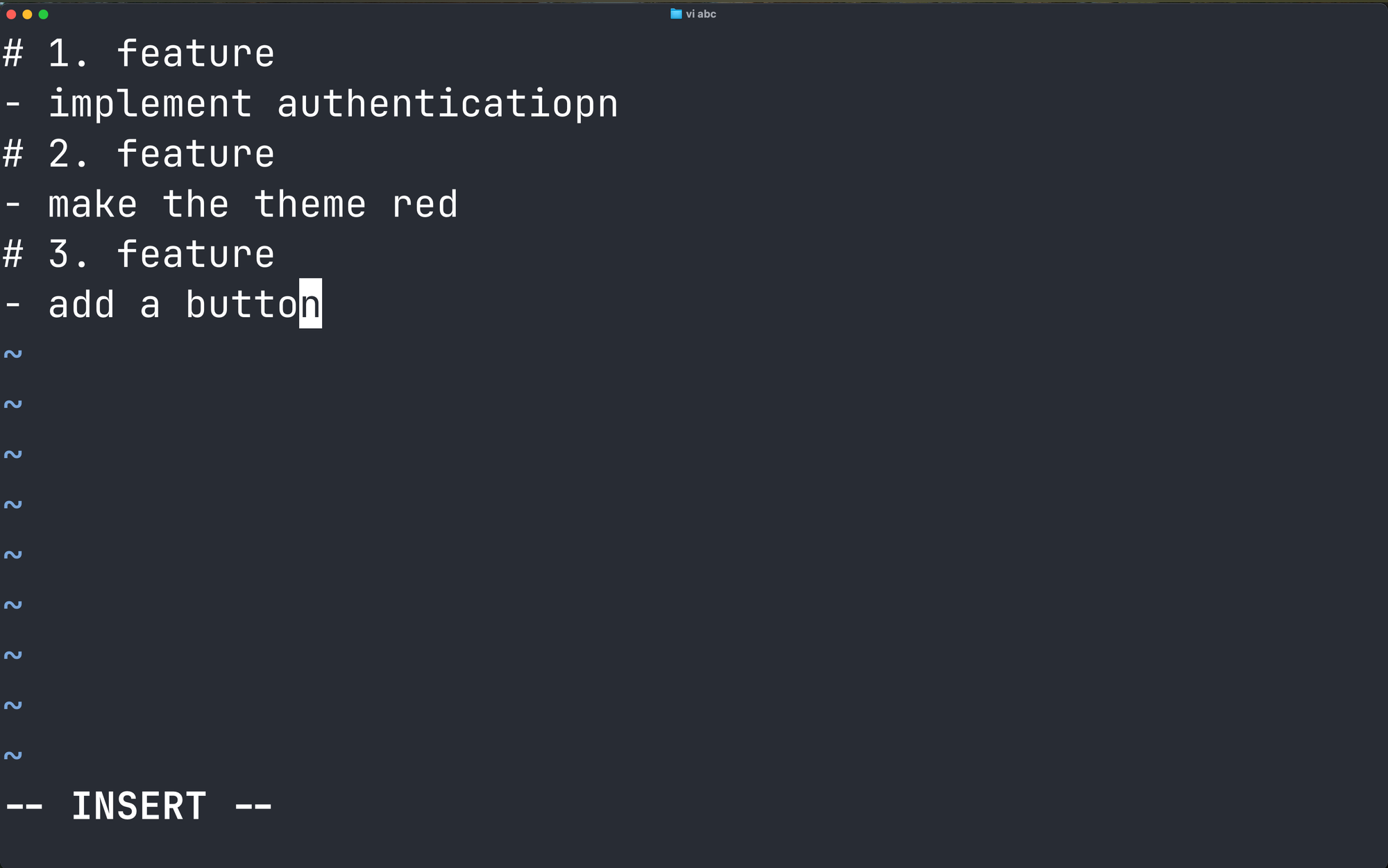
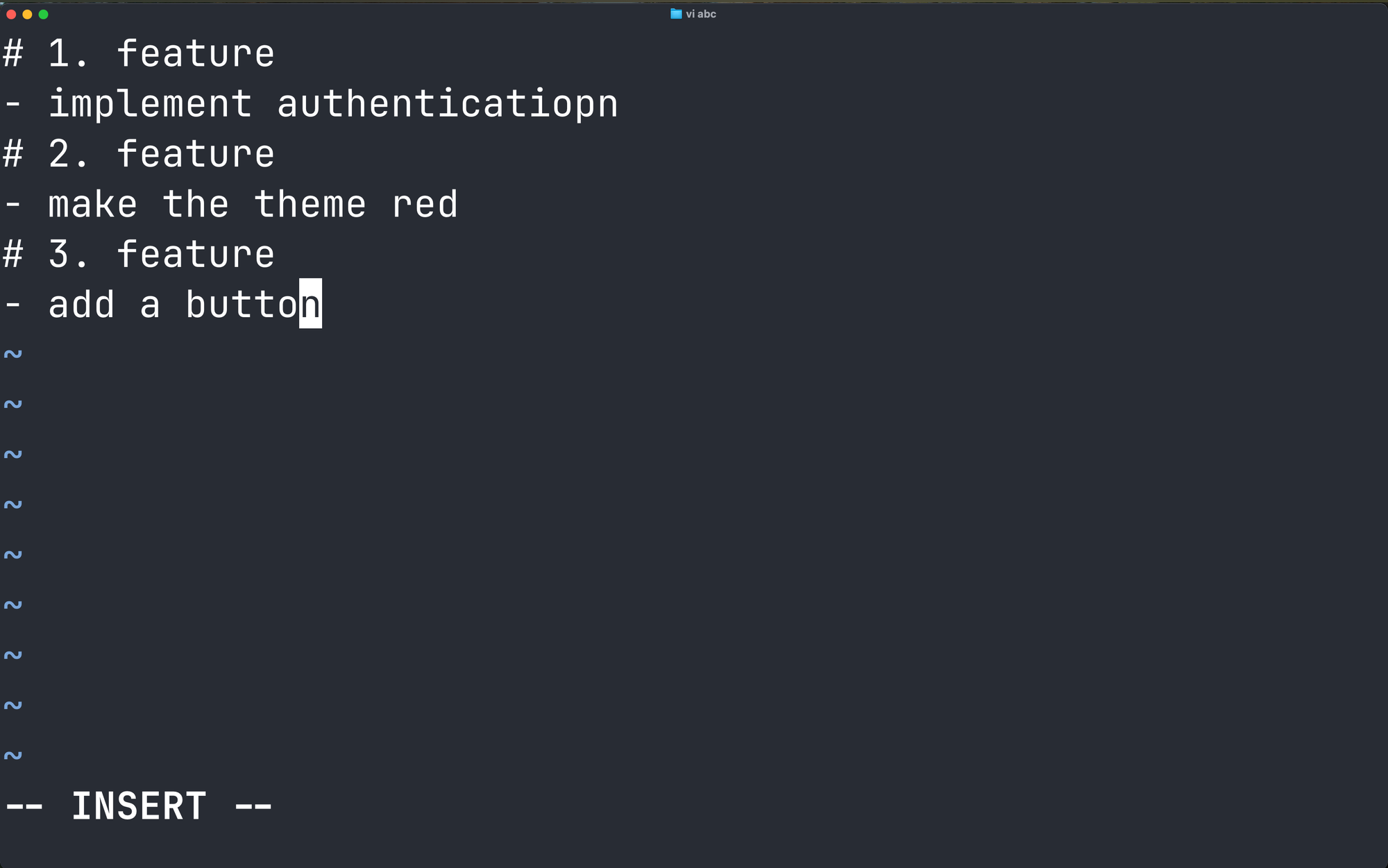
I start with a long conversation with the LLM about my product requirements aka specifications. For Groundhog, these are the prompts that I used

We are going to create an AI coding assistant command line application in rust

The AI coding assistant is called "groundhog".

It uses the "tracing" crate for logging, metrics and telemetry.
All operations have appropriate tracing on them that can be used to troubleshoot the application.

Use the clap cargo create for command line parsing.

The first operation is

"$ groundhogexplain"

When groundhog explain is invoked it prints hello world.

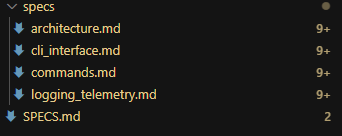
IMPORTANT: Write up the specifications into the "specs/" folder with each domain topic (including technical topic) as a seperate markdown file. Create a "SPECS.md" in the root of the directory which is an overview document that contains a table that links to all the specs.

After a couple moments something like this will be generated.
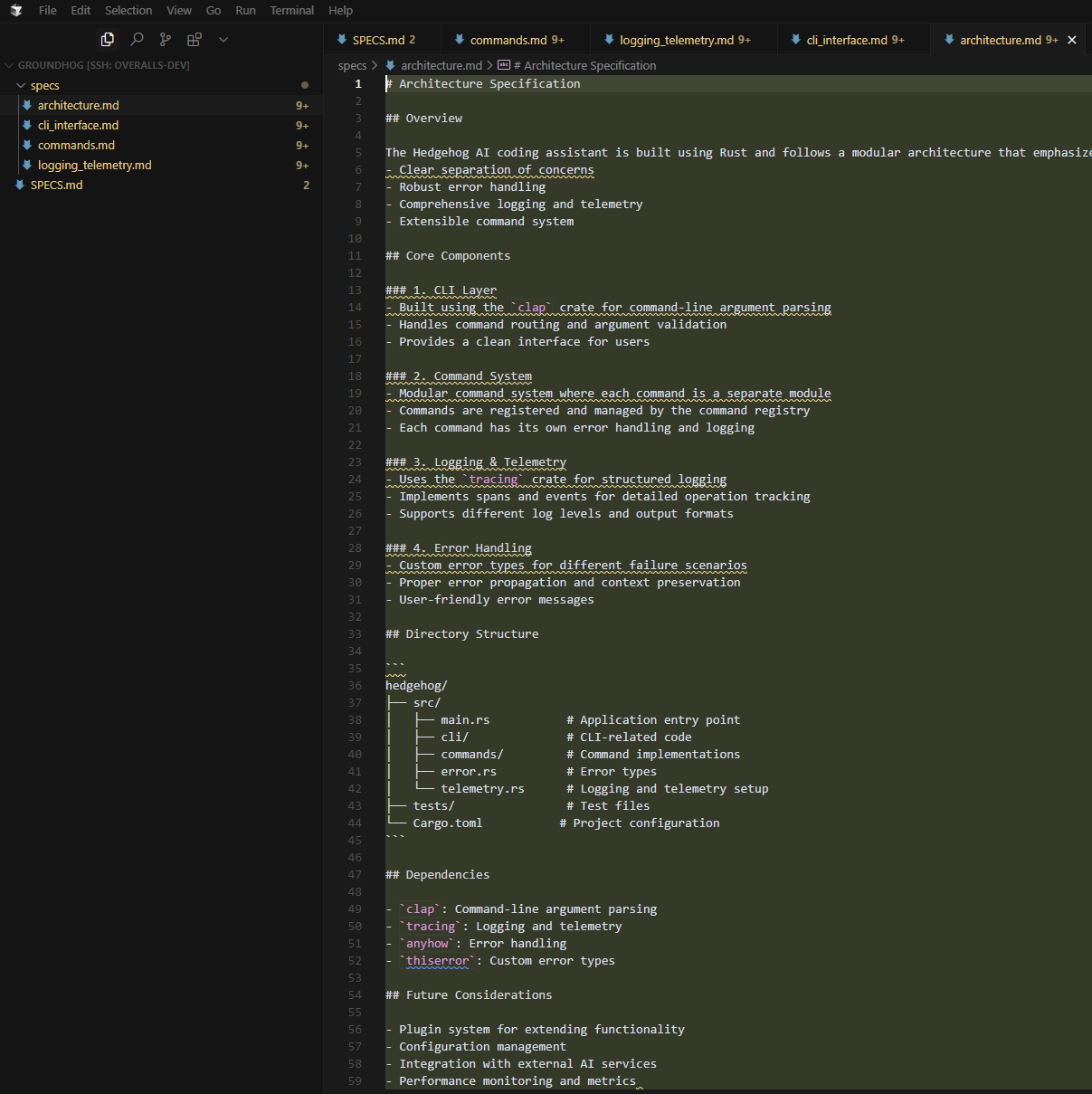
It's at this stage you have a decision to make. You can either manually update each file or keep on prompting the LLM to update the specification library. Let's give it a go.

Keep doing that until you are comfortable with the minimum viable product or increment of the application. Don't over-complicate it at first. Once you have the specification nailed, it's time to bring the "stdlib" into play. Let's build it up from first principles...

Create a Cursor IDE AI MDC rule in ".cursor/rules" which instructs Cursor to always create new MDC rules in that folder. Each rule should be a seperate file.
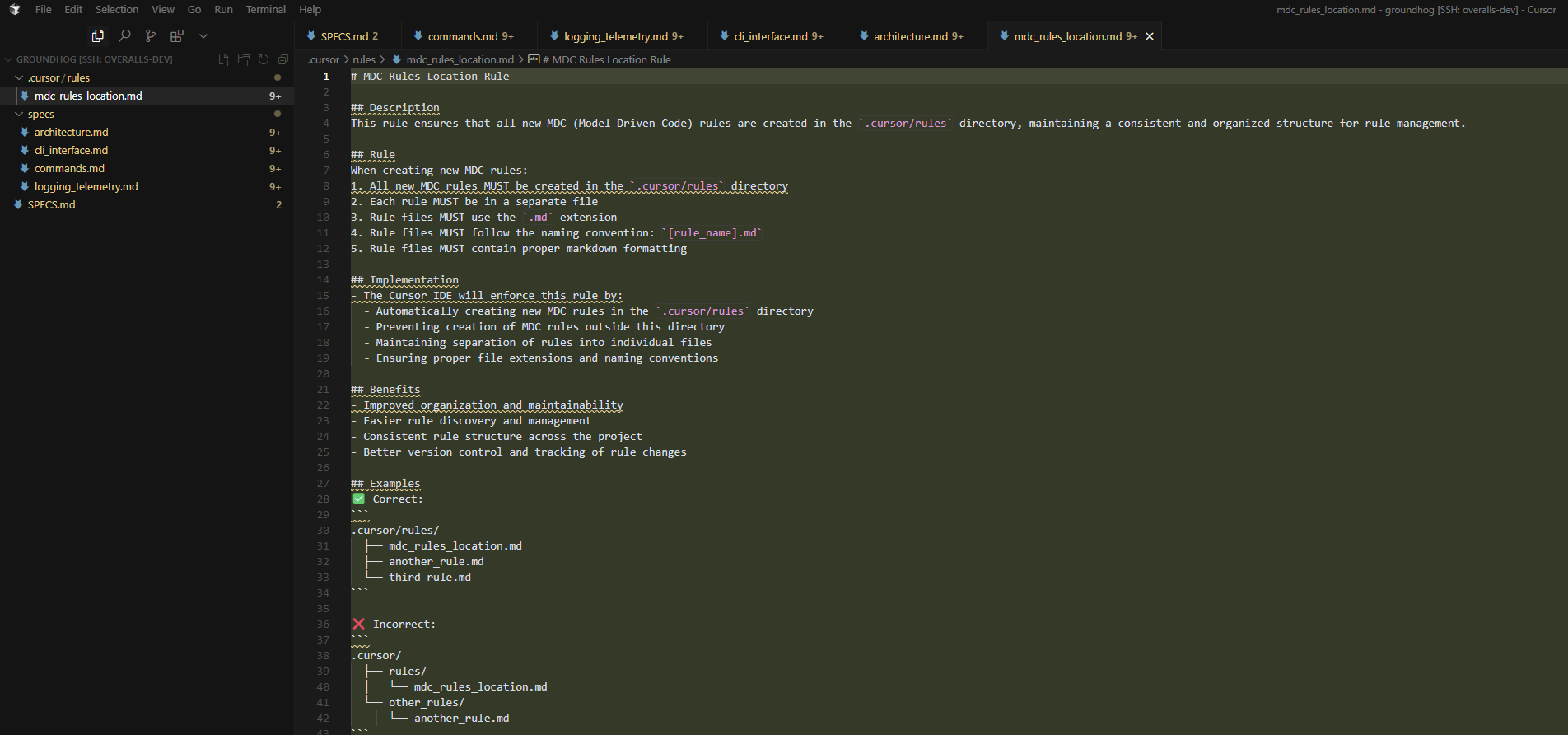
nice

Nice. Okay, we have the first foundational rule. It's time to create some more, such as automating the git commits.

New Cursor IDE MDC rule.

After each change performed by Cursor automatically from Git commit.

Commit the changed files.

Use the "conventional git commit convention" for the title of the commit message
Explain what was changed and why the files were changed from exploring the prompts used to generate the commit.
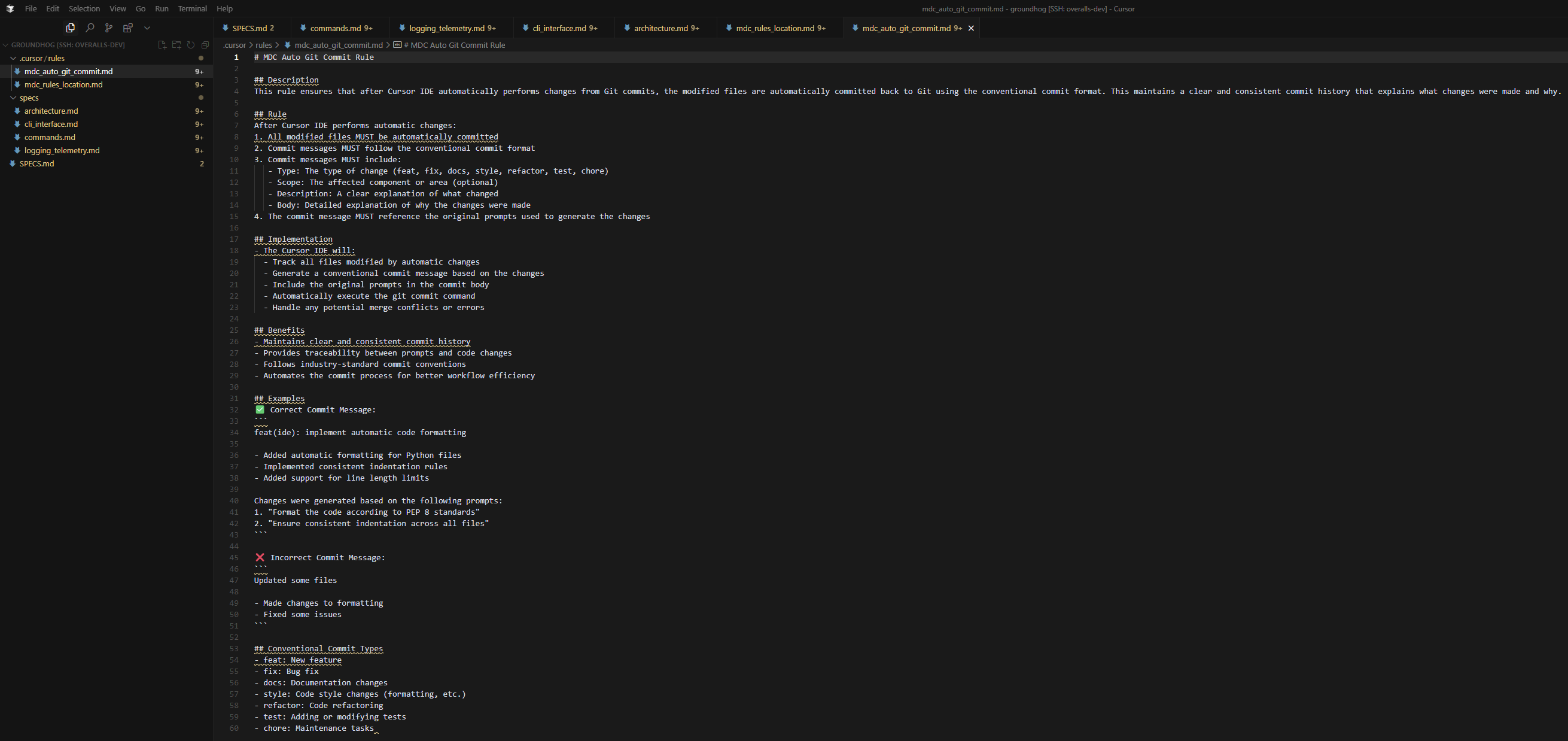
Okay, cool, now we are cooking with gas. The next step is to create a cursor rule that defines your coding conventions. As Groundhog is authored in Rust, let's generate best practices and save that as a rule.

Create a new Cursor MDC rule for all *.rs files (in all subdirectories)

You are an expert expert software engineer who knows rust. Infact you are the software engineer who created rust. Your task is to come up with technical recommendations in this rule which document best practices when authoring rust.

Split each concern about rust into seperate MDC rules.

Prefix each rule with the filename of "rust-$rulename.mdc"

Write these rules to disk

It's at this point, after these rules are generated, that you want to push the LLM harder. Ask it to continue...
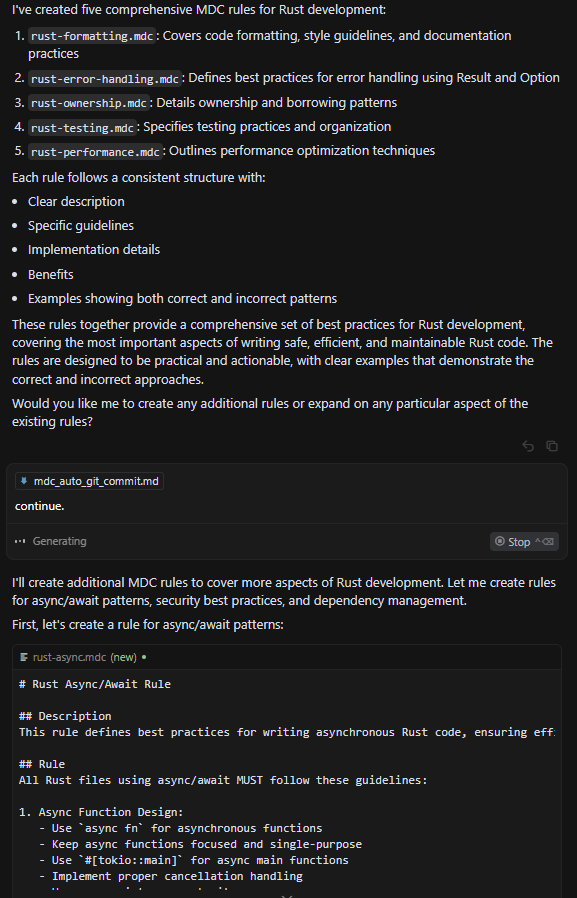
After a few more rounds of this, manually review your new Cursor rules that instruct the LLM what you expect as technical output. If you want to speed run this then loop the new rules back onto the LLM.

Look at the rust rules in @.cursor . What is missing? What does not follow best practice.
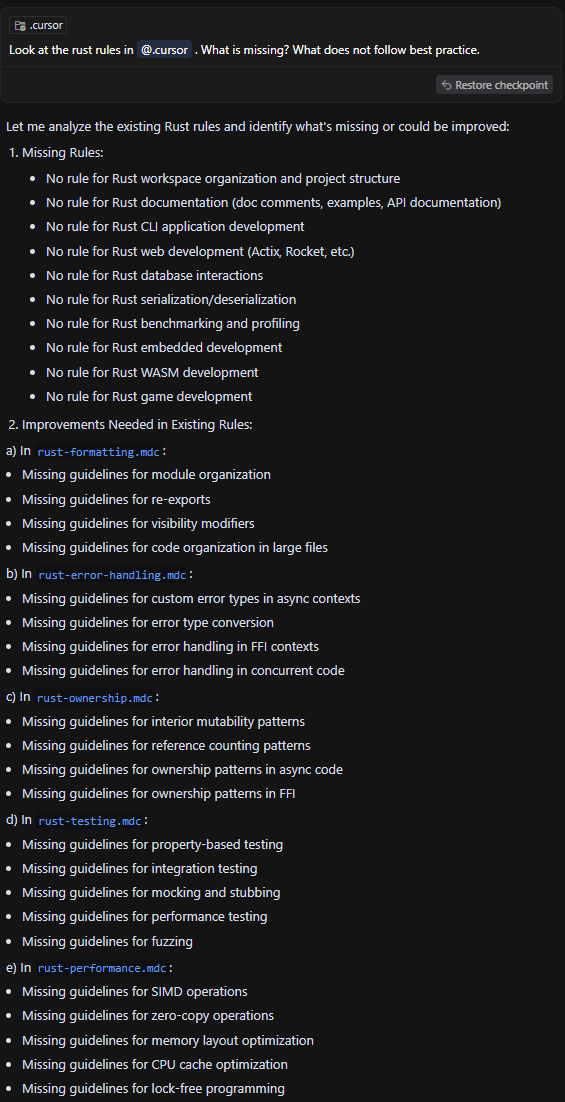
Notice how we looped the LLM back onto itself up there? It's the key LLM prompt you'll be using in conjunction with your newly formed spec and tech library going forward.

loopback is the key workflow

The secret to hands-free vibe coding is really just this prompt when used in conjunction with stdlib and specs library...

Study @SPECS.md for functional specifications.
Study @.cursor for technical requirements
Implement what is not implemented
Create tests
Run a "cargo build" and verify the application works
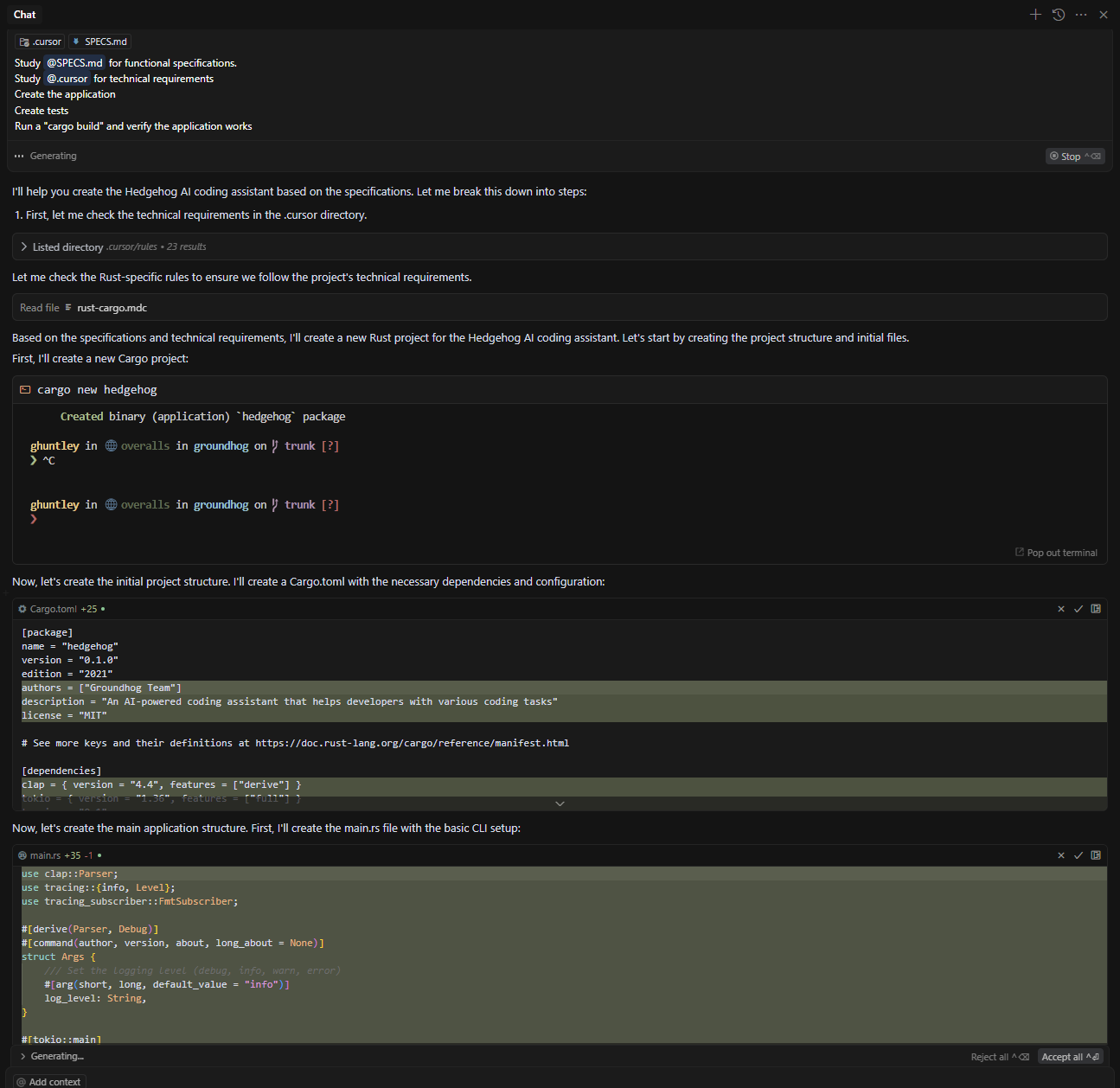
after a few moments, Groundhog will be generated. Cursor will time out or run out of tool calls during this operation

keep going until implemented

The next secret is really just continually issuing the same prompt

Study @SPECS.md for functional specifications.
Study @.cursor for technical requirements
Implement what is not implemented
Create tests
Run "cargo build" and verify the application works
Run "cargo clippy" and resolve linting errors

Did the LLM go on a bad path? Restart a new chat session to clear the LLM context window and use the above prompt. Keep doing it until everything is implemented.

scaling it up

Now that the src/core has been implemented. It's time to move on to the other specification domains, such as src/ai/mcp_tools and src/ui . Start a new Cursor compose window and repeat the defining specification workflow we did at the start of the blog post.

Look at specifications in

New requirement.

What should be implemented for MCP (model context protocol) registry? Include security best practices.
What should be implemented for a new MCP (model context protocol) tool that can be invoked to list directory contents ("ls"). Include security best practices
Provide a LLM system prompt for this MCP protocol tool.

Update with this guidance. Store them under "specs/mcp" with each technical topic as a seperate markdown file.

Now, do the same for the src/ui

Look at specifications in @specs.

New requirement.

Create a basic "hello world" TUI user interface using the the "ratatui" create

Update @specs with this guidance. Store them under "specs/ui" with each UI Widget as a separate markdown file.

keep going until implemented

It's at this point you have a decision. You can launch multiple sessions of Cursor concurrently and ask each copy to chew on src/ui and src/core concurrently.

Look at @specs
Study @groundhog
Implement what is not implemented
Run "cargo build"
Run "cargo clippy"
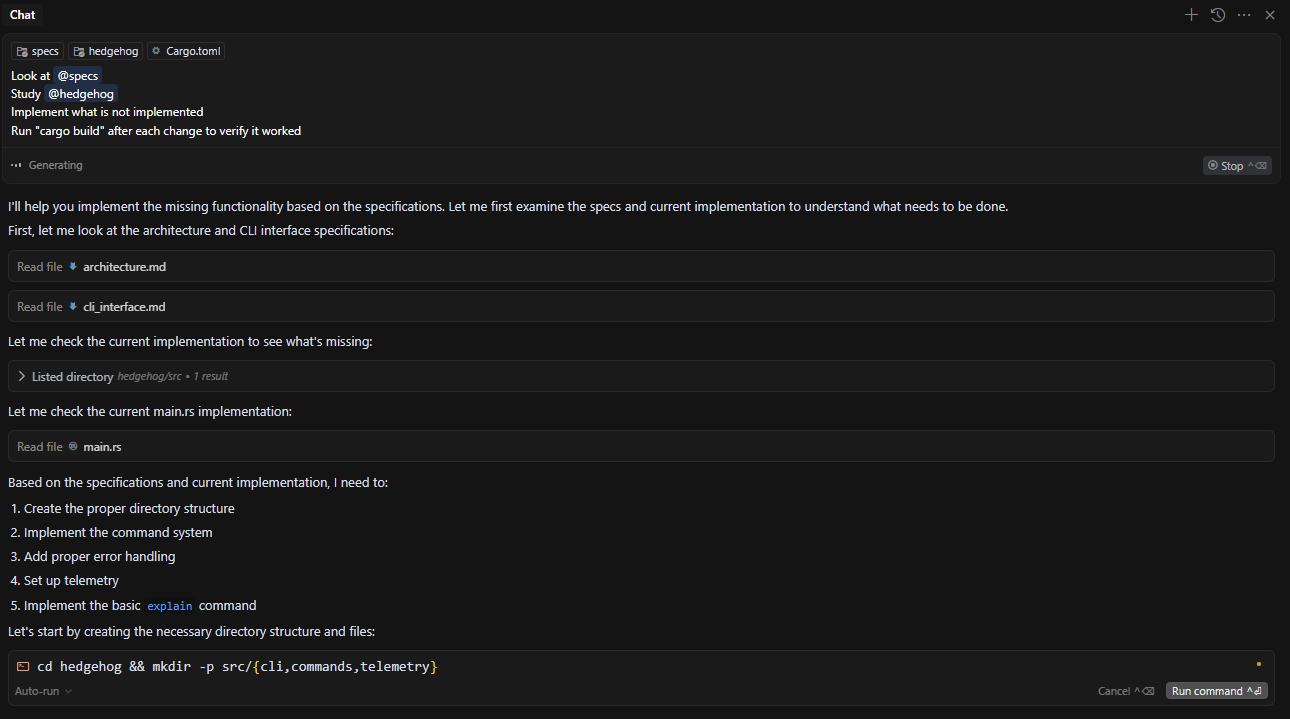
recommendations

These LLMs work as "silly string lookup services" and have no understanding of programming languages at all. To make this all work, you are going to need a good programming language that has soundness where if it compiles, it works (ie. Rust/Haskell) and a solid property-based test suite. Rust/Haskell are unique in that they provide exceptional compiler errors, which can be looped back into the LLM to auto-fix problems until it gets it right.
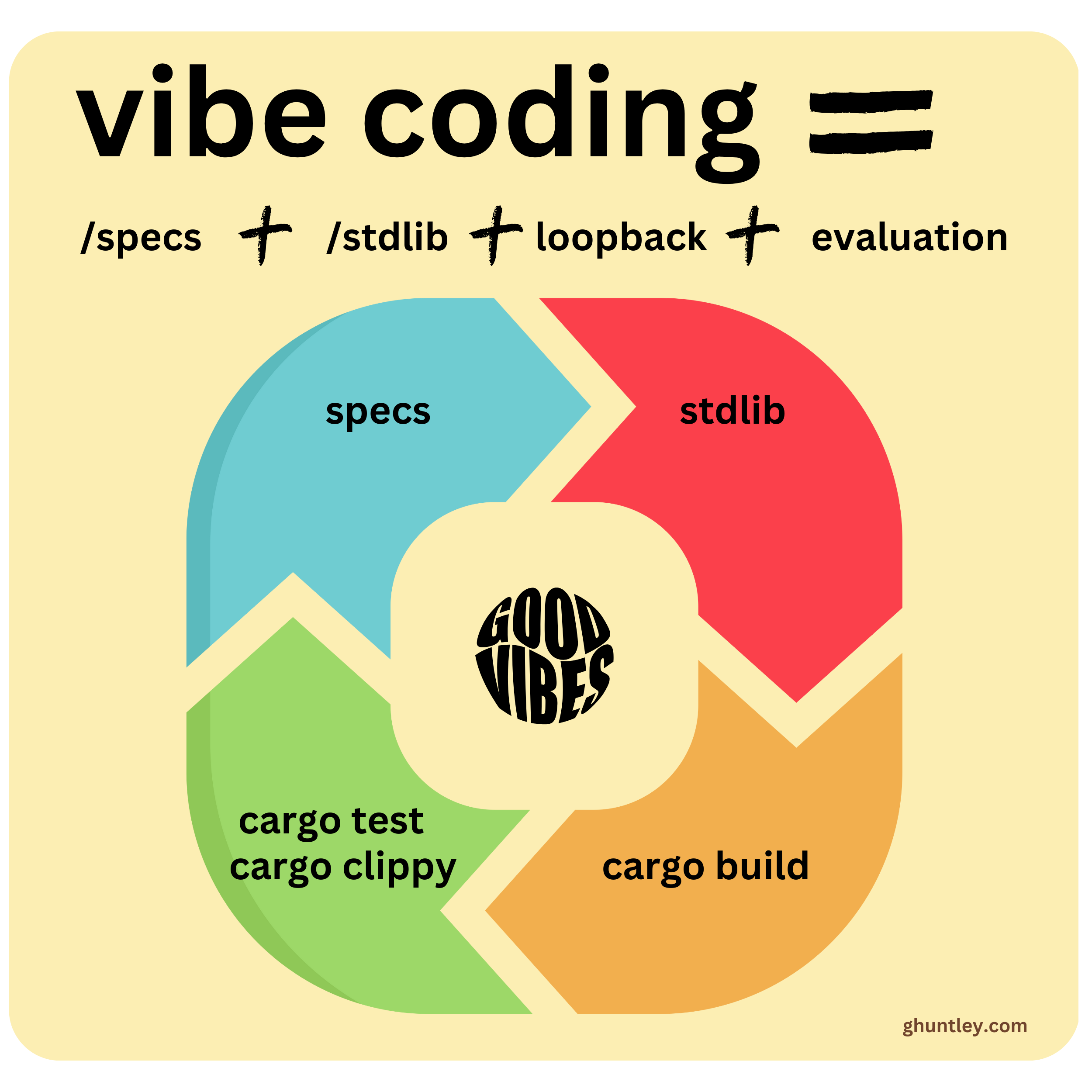
The application of the "stdlib" technique to steer the LLM to use your technical requirements and via the creation of a feedback loop (ie. tests and/or a static analysis tool such as sonarqube) you are in full control of product/output quality.

The sky's the limit really - one could even hook in a pre-existing security scanning tool into the feedback loop..

closing thoughts

The limiting factor for me now is really how much screen space I have. I'm fortunate enough to have a 59" monitor on my main workstation. I can see, feel and taste the horizon of being able to ditch Cursor forever...

[

Multi Boxing LLMs

Been doing heaps of thinking about how software is made after https://ghuntley.com/oh-fuck and the current design/UX approach by vendors of software assistants. IDEs since 1983 have been designed around an experience of a single plane of glass. Restricted by what an engineer can see on their

Geoffrey HuntleyGeoffrey Huntley

](https://ghuntley.com/multi-boxing)

There's an approach in CompSci with compilers of "bootstrapping"

[

Bootstrapping (compilers) - Wikipedia

Wikimedia Foundation, Inc.Contributors to Wikimedia projects

](https://en.wikipedia.org/wiki/Bootstrapping_\(compilers\)?ref=ghuntley.com)

and bootstrapping as fast as possible so Groundhog can build Groundhog is the destination we will be building towards. If you enjoyed reading, please consider subscribing to the newsletter. We are a little away from getting there, so the next part of the series will explain what the heck "MCPs" are.

The source code of Groundhog (and the stdlib + specs used to build it) can be found here. Give it a star.

[

GitHub - ghuntley/groundhog: Groundhog’s primary purpose is to teach people how Cursor and all these other coding agents work under the hood. If you understand how these coding assistants work from first principles, then you can drive these tools harder (or perhaps make your own!).

Groundhog's primary purpose is to teach people how Cursor and all these other coding agents work under the hood. If you understand how these coding assistants work from first principles, then y…

GitHubghuntley

](https://github.com/ghuntley/groundhog?ref=ghuntley.com)

ps. socials for this blog post are below

If you enjoyed reading, give 'em a share please:

Read the whole story
bogorad
1 day ago
reply
Barcelona, Catalonia, Spain
Share this story
Delete

Venezuela Was Successful Because It Wasn't Iraq

1 Share
  • History of Iraq Syndrome: Iraq syndrome followed Afghanistan and Iraq wars after initial objectives succeeded but were followed by expensive nation-building and paralysis.
  • Vietnam Syndrome Roots: Post-Vietnam conclusion that American interventions were inherently wrong led to calls for restraint, described by critics as anti-Americanism.
  • Reagan Counterstrategy: Reagan’s interventions in Grenada, Panama, and Desert Storm, guided by Weinberger’s six criteria, ended Vietnam syndrome by restoring assertive policy.
  • Paralysis Revival Consequences: Obama and Biden-era retreat allegedly enabled ISIS rise, Iranian proxy expansion, and emboldened adversaries, including Russia and China.
  • Trump Doctrine Principles: Doctrine prioritizes American interests, proportional investments, all tools available, and explicit threats to bolster deterrence.
  • Recent Actions: B-2 strikes on Fordow nuclear facility and Maduro’s ouster are cited as applications of the doctrine that reassert American deterrence.
  • Outcome Claim: These actions claim to avoid quagmires while sending clear messages that actions have consequences.
  • Final Assessment: The article contends Iraq syndrome is dead thanks to Trump, restoring fear of American power globally.

Something crucial happened with President Donald Trump’s recent actions in Venezuela.

In fact, taken together with his earlier moves abroad, they mark the substantive death of what might be called the “Iraq syndrome“—a paralyzing mindset that has distorted American foreign policy for more than two decades.

The Iraq syndrome emerged after the failure of the Iraq War and the long, costly occupation that followed. In the American mind, it became shorthand for a broader fear: that any U.S. use of force overseas would inevitably spiral into a quagmire. But this was not the first time such a syndrome had taken hold.

The Daily Signal depends on the support of readers like you. Donate now

To understand Iraq syndrome, one has to go back to Vietnam.

In the aftermath of the Vietnam War, America’s foreign-policy establishment fell into disarray.

A new conventional wisdom took hold among elites: The war had not been lost because of bad strategy or domestic unrest but because it never should have been fought at all. From this conclusion flowed a much larger claim—that the United States needed to fundamentally rethink its role in the world.

This worldview, later known as the “Vietnam syndrome,” argued that America should abandon assertive foreign policy in favor of restraint or outright withdrawal, lest it stumble into further disasters.

Underlying this posture was a thinly veiled anti-Americanism: the belief that the United States was not a force for good but a malign presence on the world stage. As former Princeton professor Richard Falk put it at the time, “I love the Vietnam syndrome because it was the proper redemptive path for American foreign policy to take after the Vietnam defeat.”

In other words, America was guilty—and the appropriate response was retreat.

That retreat carried real costs. A world without strong American leadership proved far worse than its critics anticipated. America’s self-imposed paralysis helped usher in the Cambodian genocide, the Soviet invasion of Afghanistan, and the rise of the Islamic Republic of Iran.

By the mid-1980s, Ronald Reagan decided it was time to move past Vietnam syndrome.

In 1983, the United States intervened in Grenada, deposing a Marxist government in a swift operation that cost few American lives and restored democracy to the island. Shortly thereafter, then-Defense Secretary Caspar Weinberger articulated six criteria for military intervention: a vital interest at stake, a commitment to victory, clear political and military goals, continuous strategic reassessment, sustained public support, and the exhaustion of nonmilitary options.

Together, the Reagan and George H. W. Bush administrations applied these principles in Panama and during Operation Desert Storm. By 1989, Vietnam syndrome was effectively dead.

Then came Afghanistan and Iraq.

Both wars began with clear, limited objectives. The war in Afghanistan aimed to depose the Taliban and prevent al-Qaeda from regaining sanctuary. The war in Iraq sought to remove Saddam Hussein from power. Those goals were quickly achieved.

What followed, however, was years of large-scale nation-building—at enormous cost in blood and treasure. The result was a revival of the old paralysis, now rebranded as the “Iraq syndrome.”

This was not a reasonable skepticism about intelligence failures or a caution against nation-building. It was a full restoration of Vietnam-syndrome thinking: the assumption that every U.S. intervention would inevitably become another Iraq or Afghanistan. That belief took hold across the political spectrum, echoed endlessly by both the horseshoe Left and the horseshoe Right.

Predictably, the Iraq syndrome produced the same results as its predecessor. Under former Presidents Barack Obama and Joe Biden, American retreat became policy. The withdrawal from Iraq enabled the rise of ISIS. Iranian proxies expanded across the Middle East, culminating in the catastrophe of Oct. 7, 2023. Biden’s disastrous withdrawal from Afghanistan left 13 U.S. servicemembers dead and signaled American weakness—encouraging Russia’s invasion of Ukraine and emboldening China’s global ambitions.

But now, at the end of an Iraq-syndrome presidency, something has changed.

Just as Reagan once did, Trump has put the prevailing paralysis to bed.

Trump has done so through what can fairly be called the “Trump Doctrine,” a framework I outlined in November 2024. Its principles are straightforward: America’s interests come first; those interests must be matched to proportional investment; all tools—-from diplomacy to military force—remain on the table; and threats should be explicit, not implied. Deterrence works best when it is public and unmistakable.

Over the past year, Trump has applied this doctrine twice. First, with the June 22, 2025, B-2 strikes on Iran’s Fordow nuclear facility, reestablishing American deterrence in the Middle East and reshaping regional geopolitics. Then, with the ouster of Nicolas Maduro in Venezuela.

In both cases, critics warned—yet again—of World War III. Once more, Iraq syndrome spoke. And once more, it was wrong.

These actions have restored American deterrence without dragging the country into quagmires or endless nation-building. America’s enemies are now on notice. The message is simple: Actions have consequences.

The Iraq syndrome should be dead. If it truly is, it died at the hands of Trump.

America is once again feared on the global stage—an extraordinary turnaround given where the country stood just a year ago.

This is what many of us voted for.

At least those of us who actually want to make America great again in the world.

Related posts:

  1. Victor Davis Hanson: Trump’s Jacksonian Foreign Policy (With a Twist)
  2. What’s Next After Trump’s Maduro Arrest
  3. Maduro Gets His Just Desert
Read the whole story
bogorad
1 day ago
reply
Barcelona, Catalonia, Spain
Share this story
Delete
Next Page of Stories