Log in


 China
China

 2040
2040

 2050
2050

 2060
2060














Elon Musk’s Department of Government Efficiency (DOGE) went from an inside joke about a Musk-favored cryptocurrency, Dogecoin, to the biggest story in Washington to a near-nonentity—all in under a year. During DOGE’s whirlwind tour in power, the press highlighted its improbable promises of trillions of dollars in savings, its exaggerations of the savings it did achieve, and its occasional naivete about the politics and policy of Washington.
Yet the media spent so much time disputing DOGE’s claims that they largely ignored how it did change spending. In the end, while DOGE made only modest reductions in government contracting and a handful of cuts to government grants, it had a massive impact on the federal civil service. Before Trump took office, the civil service hit a modern peak of more than 2.3 million employees. Since then, it has shrunk by more than 270,000 people, a 12 percent drop—the fastest decline in federal employment since the end of World War II.
DOGE foes succumbed to their own hyperbole about the workforce downsizing, with many predicting a collapse of basic government functions. “How many people can the federal government lose before it crashes?” the Brookings Institution fretted late last year. Such dire predictions have since gone conspicuously quiet. By most indications, the federal government is running much as it did before. Some critics may have to admit: the DOGE workforce cuts worked.
In November 2024, soon after Donald Trump’s reelection, Elon Musk and Vivek Ramaswamy announced their plan for DOGE in a Wall Street Journal op-ed.They described the initiative as a “lean team of small-government crusaders,” working to “cut the federal government down to size.” They promised to collaborate “closely with the White House Office of Management and Budget,” which Trump soon announced would be led by budget hawk Russ Vought.
It seems strange in retrospect, but the Musk and Ramaswamy op-ed focused more on deregulation than on shrinking spending. Only later in their piece did they observe that trimming regulations would allow “mass head-count reductions across the federal bureaucracy.” They understood that civil-service protections made firing individual workers difficult, but they argued that widespread layoffs, along with other changes to employment conditions, could thin the workforce. “Requiring federal employees to come to the office five days a week would result in a wave of voluntary terminations that we welcome.”
At the time, one could be forgiven for thinking that little would happen. Regulations and the federal workforce had both grown, albeit slightly, during Trump’s first term. Yet, though regulations got little attention from DOGE after Ramaswamy left, the plan to cut the federal workforce was carried out.
Just eight days into the new Trump administration, the Office of Personnel Management, the government’s HR agency, sent its now-famous “Fork in the Road” email. The title was nearly identical to that of an email Musk had sent to Twitter employees a little over two years earlier, after he took control of the company. The “Fork” email noted that remote work would end and that layoffs and “restructurings” would occur. For those upset about such changes, it created a Deferred Resignation Program, letting employees resign immediately but retain pay and benefits through September 30, 2025. A few days later, the administration expanded the Voluntary Early Retirement Authority program, allowing employees to accept early retirement with pay.
Most civil-service reductions came through these voluntary initiatives. Over the next year, about 140,000 people took the Deferred Resignation Program, accounting for more than half the total workforce reduction. Early and voluntary retirements outside the DRP brought another 90,000 departures. The administration also instituted a temporary hiring freeze, slowing the influx of new workers.
Despite much talk about layoffs, and innumerable court battles, only about 10,000 people in Trump’s first year wound up removed through “reductions in force,” or RIFs, as they’re known in the federal government—about 0.5 percent of the old workforce. In previous years, though, RIFs were even more negligible, usually affecting just a few hundred people. The combination of pressure, enticements, and targeted layoffs was enough to achieve a striking change in the federal workforce.
The media often portrayed DOGE as a way for Donald Trump to get back at agencies he disfavored and social programs he disliked. It would surprise many to learn that the biggest workforce reductions came at the former Department of Defense, now the Department of War. The department has over 85,000 fewer employees than it did at Trump’s inauguration, down more than 10 percent. The Trump administration and the Republican Congress have showered the department with largesse and expanded military purchases, but that hasn’t stopped DOGE and Trump from trimming its civilian headcount.
Though liberal-leaning agencies like Health and Human Services saw larger proportional shrinkage, every agency across the federal government took cuts. The Department of Veterans Affairs, another agency favored by Trump and Republicans, has 27,000 fewer employees today than it did pre-inauguration.
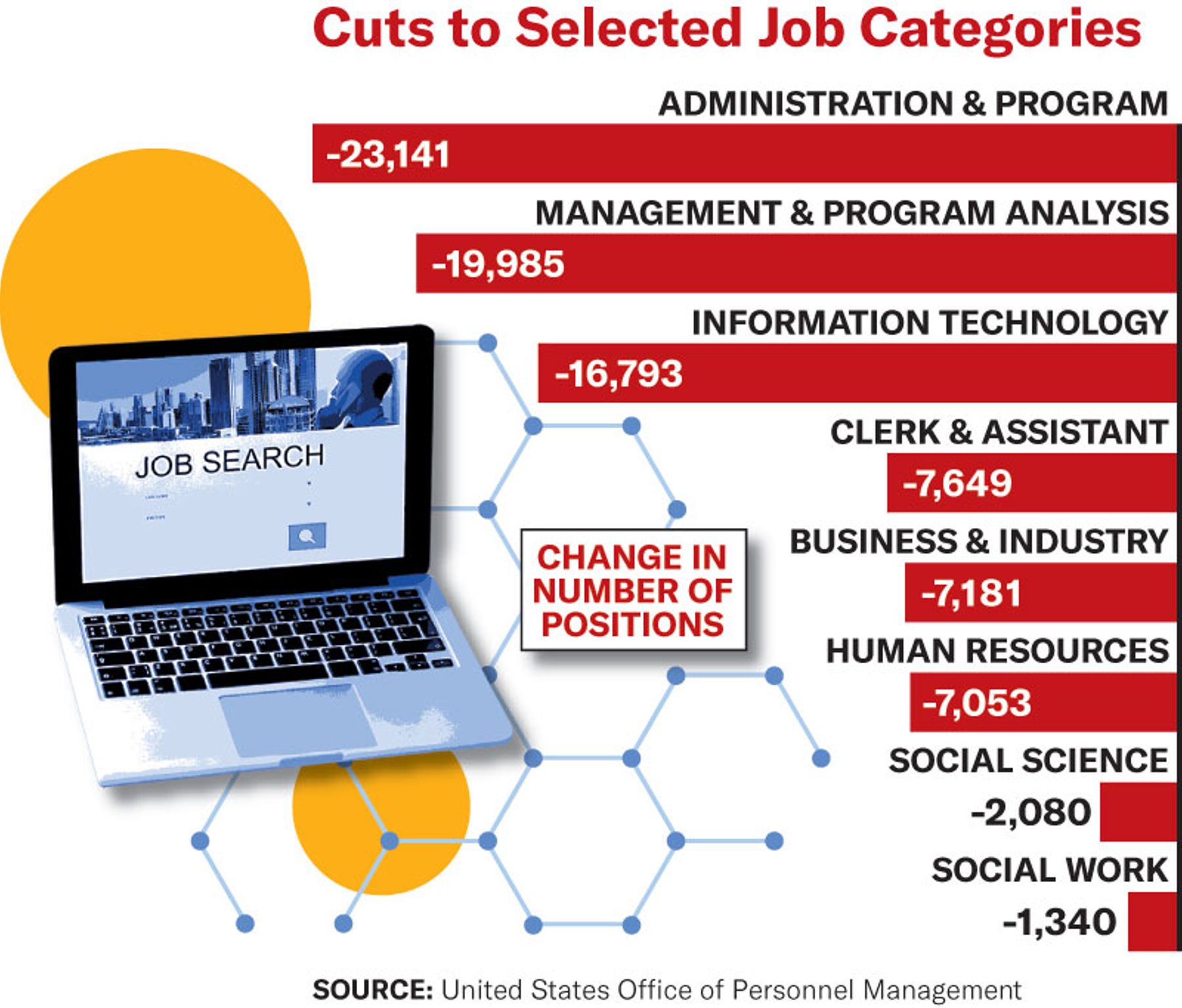
Looking beyond departments to the types of jobs eliminated, the biggest group by far, at over 43,000, consisted of general administration, management, and “program analysis” positions—the sorts of middle-management jobs that previous government-slimming efforts have targeted. Other positions that saw large cutbacks included general attorneys, HR officials, clerks, and general business managers, each losing roughly 7,000 workers. If you wanted to trim fat, these are the positions you’d start with.
DOGE also made smaller cutbacks across hundreds of types of federal positions, adding up to significant numbers. The government has eliminated 1,000 or more positions among public-affairs specialists, logistics managers, financial administrators, accountants, budget analysts, social-science analysts, and grants managers. It also lost about 100 interior designers and creative-arts therapists.
Two surprising areas of shrinkage were information technology (17,000 fewer positions) and contracting (slightly fewer than 7,000). The administration has emphasized reforming these areas, so some of these reductions may prove temporary, aimed more at replacing personnel than at permanently slimming the workforce.
The DOGE civil-service cuts were substantial, but they fell heavily on administrative and managerial jobs across a wide range of agencies. Those who decry them need to explain why, for instance, the roughly 160,000 administration, management, and program-analysis positions that remain are insufficient—and how having tens of thousands more such government workers would improve the lives of Americans.
In previous periods of workforce reform, the government has sometimes replaced civil servants with contractors doing similar work. That does not appear to have happened with DOGE.
The government’s massive procurement complex uses so-called Product and Service Codes to classify its yearly purchases. Focusing on Professional, Administrative, and Management Support services (the closest contractual equivalent to much of the work performed by civil servants), the Trump administration spent $100 billion on such contracts over the year ending in June—a not-insubstantial drop from the $112 billion shelled out during the Biden administration’s last year. Broaden the categories to include IT services, training, analysis, and operation of government facilities—other work that approximates civil-service functions—and one sees a similar, though smaller, decline, from about $226 billion to $218 billion.
By any reasonable measure, then, the eliminated civil-service positions were not simply replaced by contractors. In fact, government-service contracting declined, too.
DOGE claimed that it cut tens of billions in contracts across all aspects of federal operations. At DOGE’s “Wall of Receipts,” which documents supposed savings, contract cancellations are the biggest part by far. Looking at all government contracts, including those unrelated to typical civil-service work, total spending did rise during the most recent year under Trump, relative to the final year of the Biden administration. But most of that increase came from the buildup in homeland-security and defense contracting, including purchases such as surveillance aircraft and tanks, rather than substitutes for government workers. DOGE achieved real contract savings, but these were more than offset by higher spending elsewhere, reflecting a shift in priorities rather than an overall reduction in contracting.
One of DOGE’s other major emphases was slashing grants, which, it noted, often went to left-leaning nonprofits and universities with little accountability. In the year ending in June, the government spent $226 billion on project grants and cooperative agreements, the types of grants over which the administration has the most discretion. Comparing that figure with the final months of the Biden administration would exaggerate the decline because of an unprecedented effort to push grant money out the door after the election but before Trump took office. One Biden official said that it was as though “we’re on the Titanic and we’re throwing gold bars off the edge.” In the last full year of the Biden administration before the election, the government spent $237 billion on such grants. Grants, then, saw a modest but noticeable decline.
In sum, Trump and DOGE made some cutbacks to contracts and grants while redirecting spending toward new priorities. But the savings here are likely to prove temporary: total spending in these areas is not materially different from what it was under the Biden administration. The workforce reforms are likelier to endure—and to remain DOGE’s most important legacy.
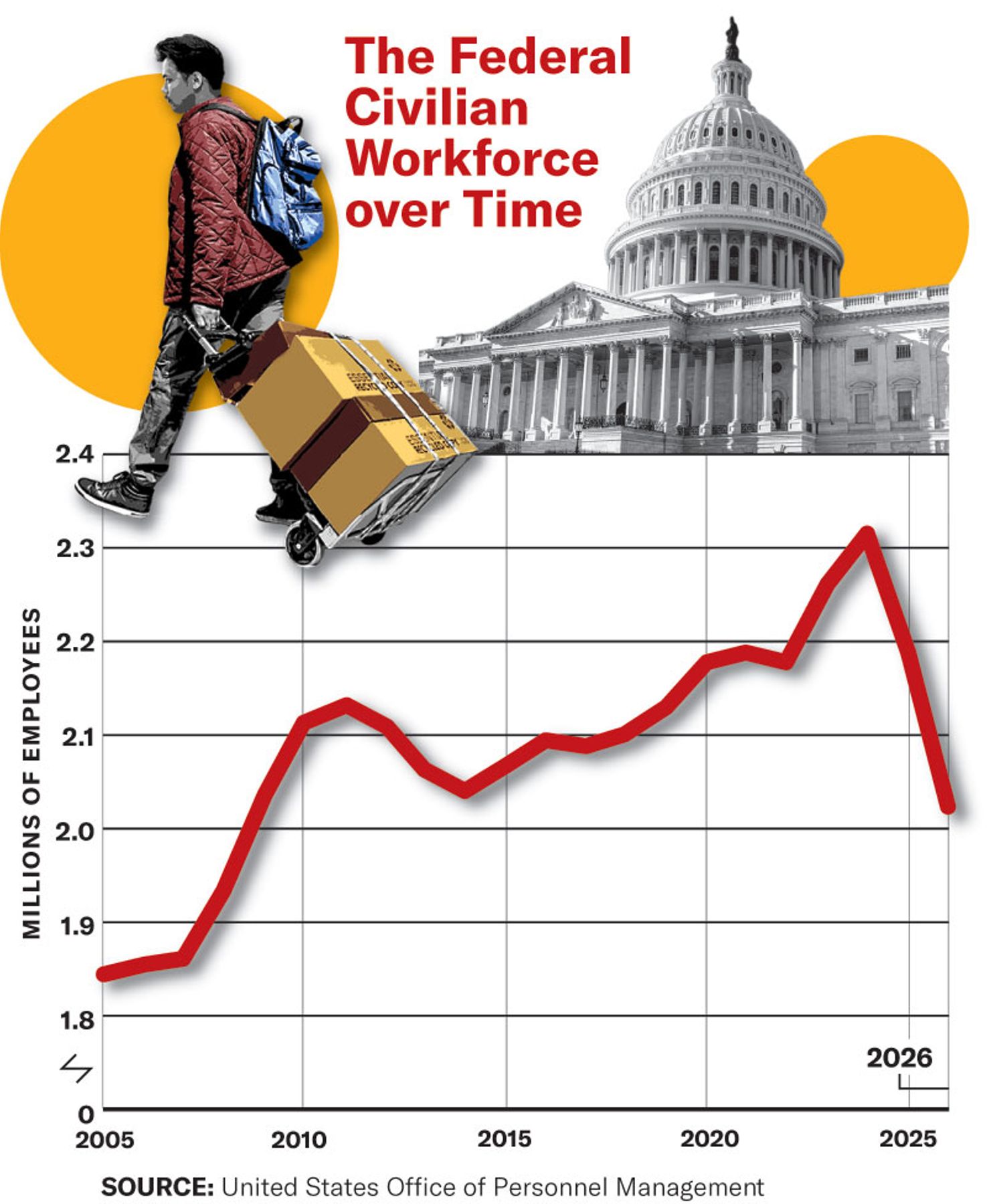
Only twice in the last century has the federal workforce shrunk on a comparable scale. The first came after World War II, when the federal government let go more than 1 million employees in two years. Yet since the workforce had swelled by more than 2 million during the war, this hardly represented an austerity program.
A closer analogy to Trump’s reforms is the retrenchment of the 1990s, an effort backed by both parties. Less than a month after taking office, President Bill Clinton issued an executive order calling for the elimination of 100,000 government jobs. Though some of the cuts reflected the post–Cold War “peace dividend,” Clinton directed every agency with more than 100 employees to “eliminate not less than 4 percent of its civilian personnel positions” over the next three fiscal years. The Federal Workforce Restructuring Act of 1994 accelerated the effort by authorizing buyouts for federal employees.
Clinton was able to push these changes through, despite typical Democratic support for the civil service, because he was willing to get rid of middle-management positions that had little outside support. One of Clinton’s reformers, John Kamensky, said that the unions acquiesced because they supported reducing the ranks and power of middle managers. The retrenchment took place over five years, but by its end, the federal workforce was 400,000 employees smaller. There was little indication that government became less efficient as a result.
Under both Clinton and Trump, most of the reductions came through resignations or retirements. Under Trump, however, workers faced far more pressure to leave. Some of DOGE’s efforts were ham-handed and seemed designed to make life harder for those who remained. One Brookings Institution analysis found that there were more than 25,000 instances where someone was fired, but was then hired back. The fight against telework was so extensive that the federal government ended up with a lower work-from-home rate than the private sector—an unusual disparity, given its disproportionately white-collar workforce, and one that could eventually make recruitment and retention harder.
One reason for the often roundabout efforts to downsize the workforce is the stultified nature of America’s civil service, which makes targeted reductions difficult, as the original Musk and Ramaswamy op-ed observed. But that some changes were reversed, or will be reversed, does not mean that the broader project was misguided. Musk admitted after he slashed the Twitter workforce by 80 percent that some people would have to be rehired. Likewise, the reversal of some federal cuts suggests that the administration was willing to recognize where civil servants performed important work and adjust accordingly. The best measure of whether the reductions worked is how they affected—or didn’t affect—ordinary Americans.
Since the advent of DOGE, opponents have predicted dire consequences from the loss of federal employees. Everett Kelley, president of the American Federation of Government Employees, warned that the reductions would “have vast, unintended consequences that will cause chaos” for Americans.
The media have hunted for such catastrophic consequences ever since. When flash floods killed more than 100 people in Texas over the July 4 weekend in 2025, some claimed that cuts to the National Weather Service had led to delayed warnings. Yet even former NWS staffers noted that the agency had issued an urgent warning hours before the flooding and had performed as expected. The NWS pointed out that five staffers were on duty in the region, typical for an overnight shift when severe weather was expected. Any connection between the deaths and the slimmed workforce was tenuous, at best.
The Internal Revenue Service saw the largest rollback of any government “subagency,” losing about 27,000 employees, or more than a fourth of its headcount. Many predicted that this could lead to billions of dollars in lost tax revenue. Yet the reductions largely reversed the staffing increases from the Biden administration, returning the agency to roughly the employment levels of Trump’s first term. The total additional tax recommended from audits did decline in fiscal year 2025, down $2 billion to $27 billion. But that figure was also broadly in line with levels at the beginning of the Biden administration, while the total tax take rose substantially. Reduced IRS staffing may ultimately hamper the agency’s ability to collect taxes, but so far, little evidence supports the massive revenue losses that critics predicted.
The Social Security Administration endured the next-largest workforce reduction of any agency. Martin O’Malley, who headed the SSA during the Biden administration, predicted disaster. “You’re going to see the system collapse and an interruption of benefits. I believe you will see that within the next 30 to 90 days.” He told seniors to “start saving” in preparation. When O’Malley issued his warning, the administration planned to eliminate 7,000 positions; it has now gotten rid of 8,000.
The subsequent debate over the SSA’s performance has not been about any interruption in benefits, which never occurred, but about whether call wait times went up or down slightly. Frank Bisignano, a former fintech CEO who now heads both the IRS and the SSA, claimed that wait times had declined. Senator Elizabeth Warren claimed that the agency was concealing an increase. An audit that Warren requested from SSA Inspector General Michelle Anderson, a longtime civil servant, found that the agency saw a 65 percent increase in calls over the previous year, while average wait times fell. The audit concluded that the agency had “improved performance because it used a new telecommunications platform and staff realignments.” In any case, a debate over wait-time minutes was a far cry from predictions of hungry seniors. (By contrast, the IRS wait time for its main help line did increase in this period, from about four to seven minutes, one study found.)
The federal government publishes a vast array of statistics on everything from the economy to personal health. At the outset of the second Trump administration, some data librarians panicked about DOGE or other cuts to statistical agencies and created a “Data Rescue Project” to preserve information that the Trump administration might ax.
Today, the dataindex.us website finds 38 datasets or groups of datasets that have stopped publication since Trump’s inauguration. While some discontinued reports—on wages in particular industries, say—may have broad uses, the value of others is less obvious. The government no longer publishes an annual count of mink pelts produced or an interactive map projecting (guessing, actually) how much climate change might cost each U.S. county. And gone, too, is a consumer complaint database about financial companies. Perhaps the administration concluded that American consumers already have plenty of outlets for complaining online.
Dataindex.us also notes 338 instances of “data elements removed” from other datasets, which sounds worrisome until one sees that the overwhelming majority involved ending the collection of information about “gender identity.” Given the roughly 550,000 government datasets, these changes seem minor.
When lettuce contamination led to a cyclospora outbreak that hospitalized hundreds this year, the New York Times wanted to tell its readers that Trump’s data-gathering reductions hampered the search for the source. But the paper could say only, in painfully roundabout language, that “funding cuts haven’t made the job easier.” It also acknowledged that most experts considered the investigation “par for the course” and that, while the CDC had scaled back a specific foodborne-illness tracker, “states still test for and report the infections to the CDC through other routes.”
No DOGE intervention garnered as much attention as the dismantling of the U.S. Agency for International Development. USAID saw the largest proportional workforce reduction of any agency: more than 90 percent. Atul Gawande, a former USAID official in the Biden administration, repeated charges that, even before the first year of the Trump administration was over, USAID cuts had already caused 600,000 deaths, most of them children. The Lancet claimed that, with continuing cuts, 14 million additional deaths could happen by 2030.
Yet those dire estimates are difficult to square with the government’s own spending figures. The United States provided almost $9 billion in health aid in fiscal year 2025. That was down from $13 billion in the last full year of the Biden administration, but not far below the $10 billion provided in 2023 and roughly equal to the nearly $9 billion provided in 2019, during Trump’s first term. And in the national security and State Department appropriations act for fiscal year 2026, signed by President Trump earlier this year, Congress provided $9.4 billion for global health.
A broader view of foreign aid, including health, humanitarian assistance, and other program support, shows a more substantial drop from the Biden administration’s final totals—almost by half, to $18 billion. But that figure is, again, not far below the $22 billion given in 2019. Even after accounting for inflation, the government spent billions more on such aid last year than in 2006, during the George W. Bush administration.
Many people confused two kinds of cuts: those to USAID’s workforce and those to foreign aid itself. The former were far more severe than the latter. With fewer USAID workers, the Trump administration has changed how foreign-aid funds are distributed. It spent billions to quadruple the budget of a UN humanitarian-affairs fund and provided billions more through bilateral agreements with foreign governments, rather than relying on traditional distribution channels such as nonprofits. Disbursals have slowed, even from newly appropriated funds, but the administration has focused the money it has distributed on paying health workers and buying medications. By contrast, it has slashed funding for programs such as workforce training. It’s far too soon to know the effects of the new system.
One can make a good argument that health aid has brought enormous gains in well-being to some of the world’s most desperate people, and that more is needed. But charges about deaths resulting from USAID cuts were often based on confusion about what actually happened. Much of the aid still went out the door. Claims of mass deaths also overlook that, by the same logic, one could accuse previous presidents of causing millions of deaths by declining to spend even more.
Cuts to the IRS and foreign aid have less to do with efficiency, DOGE’s putative focus, than with competing policy priorities. Republicans have long worried about excessive IRS intrusiveness, even if greater enforcement raises more revenue, and have argued that American taxpayers should not be overly burdened with supporting people abroad. Unlike many other DOGE reductions, those at the IRS and USAID can’t be evaluated by a simple measure of efficiency. Whether they “worked” depends largely on what one believes the goals of government should be.
Most of the workforce reductions, however, came in traditional government agencies, from the Department of War to the Department of Transportation to the SSA. Despite the fervent fears (or hopes) of critics, there is little evidence that the reforms kneecapped the agencies’ operations.
The DOGE cuts were never going to restore the federal government to fiscal solvency. Federal spending overwhelmingly goes to mandatory programs, especially entitlements, that DOGE could not touch.
Yet many in the media, while claiming that DOGE had devastated the government and even killed millions, also argued that its cuts saved zero money. They pointed to charts showing federal spending rising in 2025 relative to 2024. Such comparisons ignored the continued growth of entitlement spending and interest on the debt, both largely outside DOGE’s reach, as well as the fact that many savings from workforce cutbacks and contract cancellations would take time to materialize.
Some argued against the civil-service cuts by pointing out that the federal workforce accounts for only a small share of federal spending. Spending on federal employees constitutes less than $400 billion, or about 5.5 percent of federal expenditures.
Yet the federal government is so big that cuts to almost anything can be dismissed as minor. Outside Washington, $400 billion still counts as a lot of money, and saving even a fraction of that amount year after year can make a material difference. The Economic Policy Innovation Center estimated that shrinking the federal workforce by 10 percent would save about $600 billion in salaries and health benefits over about a decade. More savings would eventually come from reduced pension liabilities. The Trump administration’s workforce reductions could produce even greater savings.
DOGE’s argument, shared by Office of Management and Budget director Russ Vought, was that there was plenty of fat in government, even at agencies that Republicans favored. After all, about 1.3 million of the government’s roughly 2 million workers are employed by the Departments of War, Veterans Affairs, and Homeland Security. DOGE and Vought argued that most agencies could do more with less. The evidence so far suggests that they were right.
Many of DOGE’s claims were exaggerated, in part because of Musk’s typical exuberance. Trump famously described him as “50 percent genius, 50 percent boy.” But if one stops comparing DOGE with its promises and considers its actual effects, its record looks quite different. In about a year and a half, the federal workforce shrank by more than a tenth, while targeted grants and contracts declined as well. The government kept functioning much as before. One might call that a success.